Dual key properties are attracting fresh attention from Australian investors in 2026, but the structure comes with genuine trade-offs that rarely make the headline. This guide unpacks the mechanics, the appeal, the risks, and the practical steps to assess one properly before signing a contract.
What dual key properties are and how they work
A dual key property is a single dwelling on one legal title that contains two self-contained living spaces, each with its own entrance, kitchen, bathroom, and living area. From the street, it looks like a standard house. Inside, a shared wall or an internal door separates a full-sized dwelling from a smaller attached unit, studio, or one-bedroom apartment.
The name comes from those two keys: each tenant enters independently. Unlike a duplex, which sits on two separate titles (and can be sold individually), a dual key property is purchased and financed as a single asset. Unlike a granny flat, the secondary space is typically built as part of the original structure rather than added to an existing property.
Most dual key stock in Australia has been developed in Queensland and, to a lesser extent, outer-ring suburbs of other capital cities. They have historically been marketed to yield-focused investors, often as off-the-plan products. That marketing context is worth keeping in mind as you evaluate any deal.
For investors exploring dual income property structures more broadly, it helps to understand where dual key fits relative to granny flats, duplexes, and dual occupancy arrangements, each of which operates under different planning, financing, and resale rules.

The main appeal for Australian investors
The core attraction is straightforward: two rental income streams from a single purchase price and a single mortgage. For investors trying to build a property portfolio without doubling their transaction costs or stamp duty exposure, that structure has obvious appeal.
Rental market conditions in 2026 strengthen the income argument. Cotality (formerly CoreLogic) data shows that every capital city recorded a vacancy rate below 2.0% in the March 2026 quarter, with the national rate sitting at 1.6%. Sydney's median rent reached $824 per week in March 2026, up 5.9% year-on-year. In that environment, the prospect of filling two tenancies within one asset carries real weight.
Other reasons investors consider the structure:
- Cash flow buffer. If one tenancy becomes vacant, the second continues generating income. For investors managing serviceability tightly, this partial offset matters.
- Tax deductions. Two kitchens, two bathrooms, and two sets of fixtures mean a quantity surveyor can identify depreciation across a wider range of assets than a standard single dwelling.
- Lower entry than two properties. Buying one dual key property typically costs less than acquiring two separate investment properties in the same suburb, even accounting for the yield premium built into the asking price.
- Multi-generational appeal. In markets where extended families want proximity but not shared living, a dual key can suit both the investor and the eventual occupant market.
None of these benefits are guaranteed, and they need to be stress-tested against location, building quality, and comparable rents rather than the developer's projections.
The risks and trade-offs to watch in 2026
This is where an honest conversation gets important. Dual key properties carry a specific set of risks that are easy to underestimate when the headline yield looks attractive.
Finance and valuation risk
Lenders have historically been cautious with dual key properties. Because the asset trades primarily in an investor-only pool, banks may apply a more conservative loan-to-value ratio (LVR) or value the property below the contract price at settlement. A pre-settlement shortfall can leave you scrambling for additional cash or renegotiating the deal.
From 1 February 2026, APRA has capped high debt-to-income lending at 20% of new loans from authorised deposit-taking institutions. Investors already carrying debt who add a dual key purchase may find their DTI ratio pushes them into restricted territory with major banks, requiring a specialist lender or restructured approach.
Council rules and zoning
Planning approval for dual key and dual occupancy configurations varies significantly by state and local government area. In NSW, 2024 reforms made dual occupancy permissible across more R2 Low Density zones than before, but specific LGAs, heritage overlays, and lot size minimums still apply. Victoria sets minimum land sizes between 500 and 600 square metres in most Melbourne councils, with overlay controls adding further complexity. Queensland rules also differ across LGAs.
For off-the-plan or newly built dual key stock, the approvals are already in place. But if you are considering a property that could be converted or developed into a dual key configuration, checking the relevant local environmental plan or planning scheme is non-negotiable before you spend on due diligence.
Liquidity and resale demand
This is perhaps the most underappreciated risk. Because dual key properties sit on a single title, owner-occupiers have little reason to buy them at resale. The resale pool is almost entirely other investors. That narrows your exit options and can suppress capital growth relative to comparable standard dwellings in the same suburb.
Owner-occupiers represent around two-thirds of the Australian property market. Removing that buyer group at resale is a meaningful structural limitation, one that some analysts describe as the primary capital growth constraint for the asset class.
Maintenance and tenant mix
Two tenancies mean two sets of maintenance requests, two lease cycles, and the added complexity of managing relationships between tenants sharing close proximity. If both units target similar tenant profiles in a tight rental market, the arrangement can work smoothly. If tenant compatibility becomes an issue, the resolution options for a landlord are limited.
| Risk factor |
Standard investment property |
Dual key property |
| Lender appetite |
Mainstream |
More conservative, may need specialist |
| Resale buyer pool |
Owner-occupiers + investors |
Investors primarily |
| Capital growth profile |
Location-driven |
Can lag comparables |
| Cash flow buffer |
Single income stream |
Partial offset from second tenancy |
| Maintenance complexity |
Standard |
Higher (two full tenancies) |
| Planning / approval risk |
Low for existing dwellings |
Variable by LGA and state |
For a deeper look at common property investment mistakes investors make when chasing yield over fundamentals, that context is worth reviewing before committing to any high-yield structure.
Who dual key properties may suit best
Dual key is not a fit for every investor. The structure tends to work best in specific circumstances.
Investors it may suit:
- Cash flow-focused investors who need rental income to offset holding costs while they wait on longer-term equity growth elsewhere in their portfolio.
- Investors in the early portfolio-building phase who want income security and cannot yet absorb a full vacancy on a standard investment property.
- Those buying in high-rental-demand corridors where both tenancies are genuinely likely to stay occupied, particularly near universities, hospitals, or transport infrastructure.
- Investors with a clear exit plan that targets the investor resale pool rather than relying on owner-occupier demand at sale.
Where it is likely not a fit:
- Investors prioritising capital growth above cash flow. Most dual key stock, especially off-the-plan, does not perform at the same growth rate as well-located standard dwellings.
- First-time investors who are drawn primarily by the headline yield figure without stress-testing the valuation, financing, and resale fundamentals.
- Investors who want flexibility to sell to the widest possible buyer pool at any point in their holding period.
A considered property investment strategy always starts with your personal goals, timeframe, and risk profile before it starts with the property type. Dual key is a tool, not a default.
How to assess a dual key property before you buy
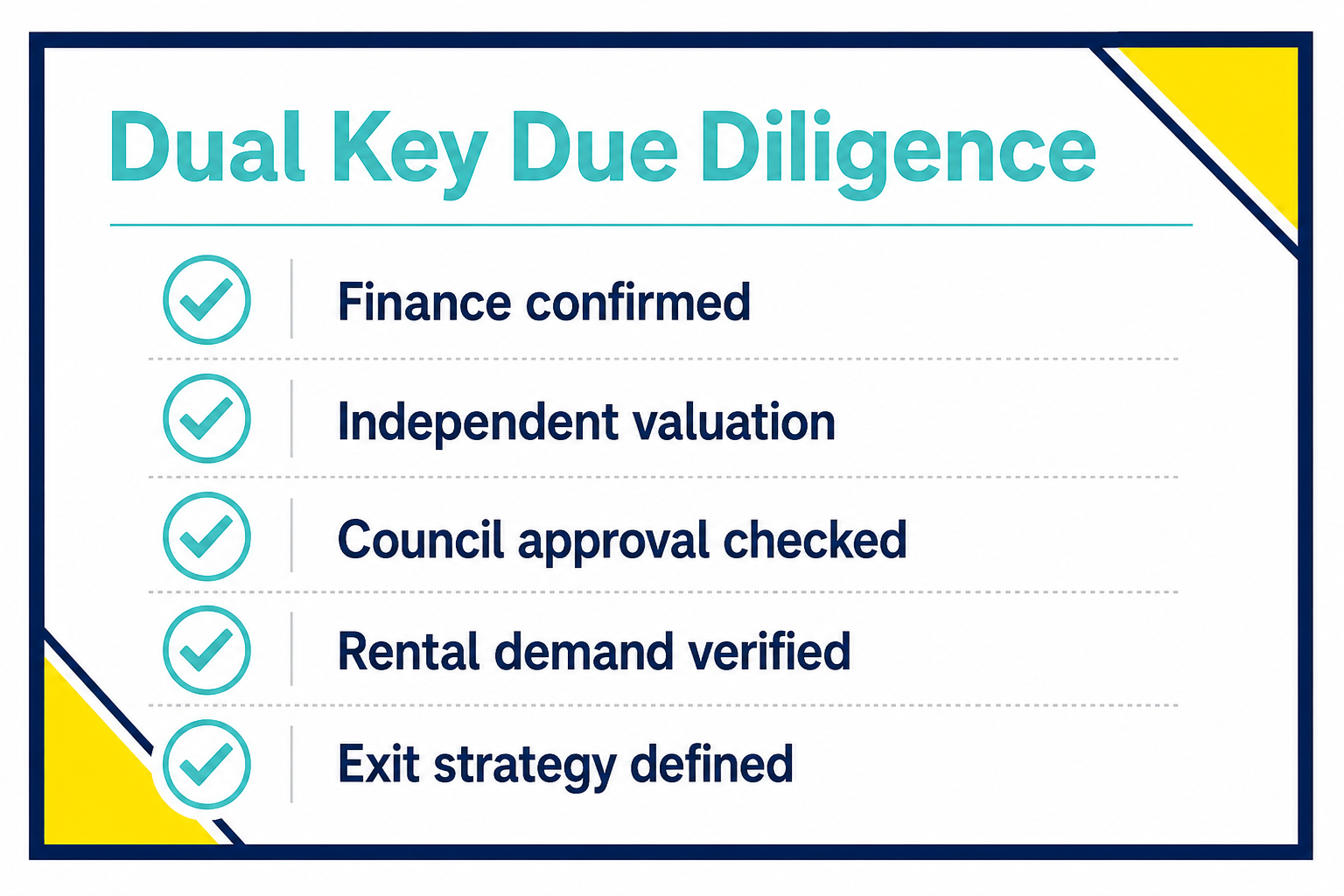
If you are seriously evaluating a dual key property, a structured due diligence process matters more here than with a standard single-tenancy purchase. The following checklist covers the ground that experienced buyers agents work through before recommending or proceeding.
Pre-purchase due diligence checklist
Finance and structure
- Confirm LVR and serviceability with a lender before you are in contract, not after.
- Ask whether the bank will accept the second rental income in serviceability calculations and at what percentage (many lenders shade rental income to 80%).
- Check whether your existing DTI exposure puts you above APRA's 6x income cap threshold.
Valuation and pricing
- Obtain an independent valuation. Off-the-plan dual key properties are frequently sold with a developer margin built in, meaning the day-one valuation may come in below purchase price.
- Compare the asking price with recent sales of comparable standard dwellings in the same suburb. A dual key premium should be justified by the yield, not just the marketing.
Location and rental demand
- Check vacancy rates and days on market for rentals in the suburb. A tight rental market helps; a suburb with rising vacancy does not.
- Look at who the likely tenants are. Is the suburb genuinely attractive to two separate tenant profiles, or are you relying on one type of renter?
- Review current investment hotspots and market conditions across Brisbane, Adelaide, and other outperforming markets before settling on a location.
Council and planning
- Confirm the dual key configuration is council-approved and compliant, not an informal conversion.
- Check whether the property is in a zone where dual occupancy is permitted and whether any overlays apply.
Building quality and maintenance
- Arrange a thorough building and pest inspection that specifically assesses shared walls, plumbing separation, and any areas of deferred maintenance on both dwellings.
- Understand which services (water, electricity, gas) are separately metered and which are shared.
For a comprehensive framework, the property investment due diligence checklist from Buyers Agency Australia provides a step-by-step structure you can apply to any property type.
Questions to ask a buyer's agent before proceeding
Engaging an experienced buyers agent before you commit to a dual key property can surface issues that are not visible in the marketing brochure. Here are the questions worth pressing on.
On strategy fit:
- Does this property type align with my stated investment goals, or am I attracted primarily by the yield number?
- How does this compare to a standard investment property at a similar price point in the same location?
On the numbers:
- What does an independent valuation suggest, and how does that compare to the asking price?
- What comparable dual key sales exist in this suburb, and how have they performed relative to similar standard dwellings over five and ten years?
- What gross yield assumptions are baked into the projections, and are those achievable based on current comparable rents?
On tenant demand:
- Is rental demand in this suburb genuinely strong enough to support two tenancies consistently, including during softer periods?
- What is the likely tenant profile for each unit, and is there any meaningful risk of tenant conflict in close-proximity living?
On the exit:
- If I need to sell in three to five years, who is the likely buyer, and at what discount to market might I need to sell?
- Is there any conversion value if I wanted to return the property to a single dwelling or pursue subdivision at a later point?
On hidden costs:
- What are the ongoing property management fees for two tenancies, and how does that affect net yield?
- Are there any body corporate or shared facility costs that apply to this specific configuration?
Dragan Dimovski, with over 20 years of property investment experience, works through exactly this kind of structured evaluation before recommending any property type to a client. The goal is to match the asset structure to the strategy, not the other way around.
If you want a straight read on whether a buyers agent is worth the cost for this kind of decision, that breakdown covers it clearly.

Final takeaway: strategy first, property second
Dual key properties occupy a legitimate but specific space in the Australian investment market. In the right location, with the right financing structure and a clear-eyed view of the resale profile, they can deliver meaningful cash flow and income stability within a broader portfolio. In the wrong location, or bought primarily on the strength of a developer's yield projection, they can underperform standard dwellings on both income and growth over time.
The structure itself is not the problem or the solution. What matters is whether it fits your specific investment plan, your borrowing position, your holding timeline, and your eventual exit goals. Australia's two-speed property market in 2026 means that location selection within any property strategy carries more weight than ever.
If you are weighing up whether dual key makes sense for your next acquisition, the most useful step is a clear-eyed conversation about your numbers before you fall in love with a property. Book a free strategy session with the Buyers Agency Australia team to map out whether this structure fits your property investment goals, or whether a different approach will do more work for your portfolio.
Ready to move forward? Contact the team at Buyers Agency Australia to get started with a structured, strategy-led acquisition process.
Frequently asked questions about dual key properties in Australia
What is the difference between a dual key property and a duplex?
A duplex sits on two separate titles and can be sold individually. A dual key property is one dwelling on a single title with two self-contained spaces accessed by separate entrances.
Can I get a standard home loan for a dual key property?
Yes, but lenders vary in how they assess them. Some apply a lower LVR or shade rental income, so confirm your financing structure with a lender before exchange, not after.
Do dual key properties have good capital growth?
Generally, dual key properties can lag comparable standard dwellings because the resale pool is limited almost entirely to investors, removing the owner-occupier demand that typically drives prices higher.
Are dual key properties legal in all states of Australia?
Approval depends on local council zoning and state planning rules. Most are built in Queensland, and NSW has recently expanded permissibility in R2 zones. Always verify compliance with your specific LGA before purchasing.
How does a buyer's agent help when assessing a dual key property?
A buyers agent conducts independent valuation checks, comparable sales analysis, rental demand research, and due diligence on council compliance, giving you an objective view before you commit.
 General
A clear, expert guide to dual key properties in Australia, covering how they work, who they suit, the...
The established-versus-new-build debate has never carried more weight for Australian investors. With significant tax reforms taking effect from July 2027, a capacity-constrained construction sector, and tightening borrowing conditions reshaping how every purchase decision stacks up, the case for established stock is stronger and more nuanced than it has ever been.
Why established properties are gaining the edge in 2026
The property market entering mid-2026 is operating under pressure from multiple directions. The May 2026 Federal Budget introduced the most significant property tax changes in nearly three decades, restricting negative gearing on established properties purchased after 12 May 2026 to apply only from 1 July 2027. Westpac's housing forecast update projected a 34% fall in new investor activity near-term, with dwelling price growth expected to stall broadly across the major capital cities for 2026.
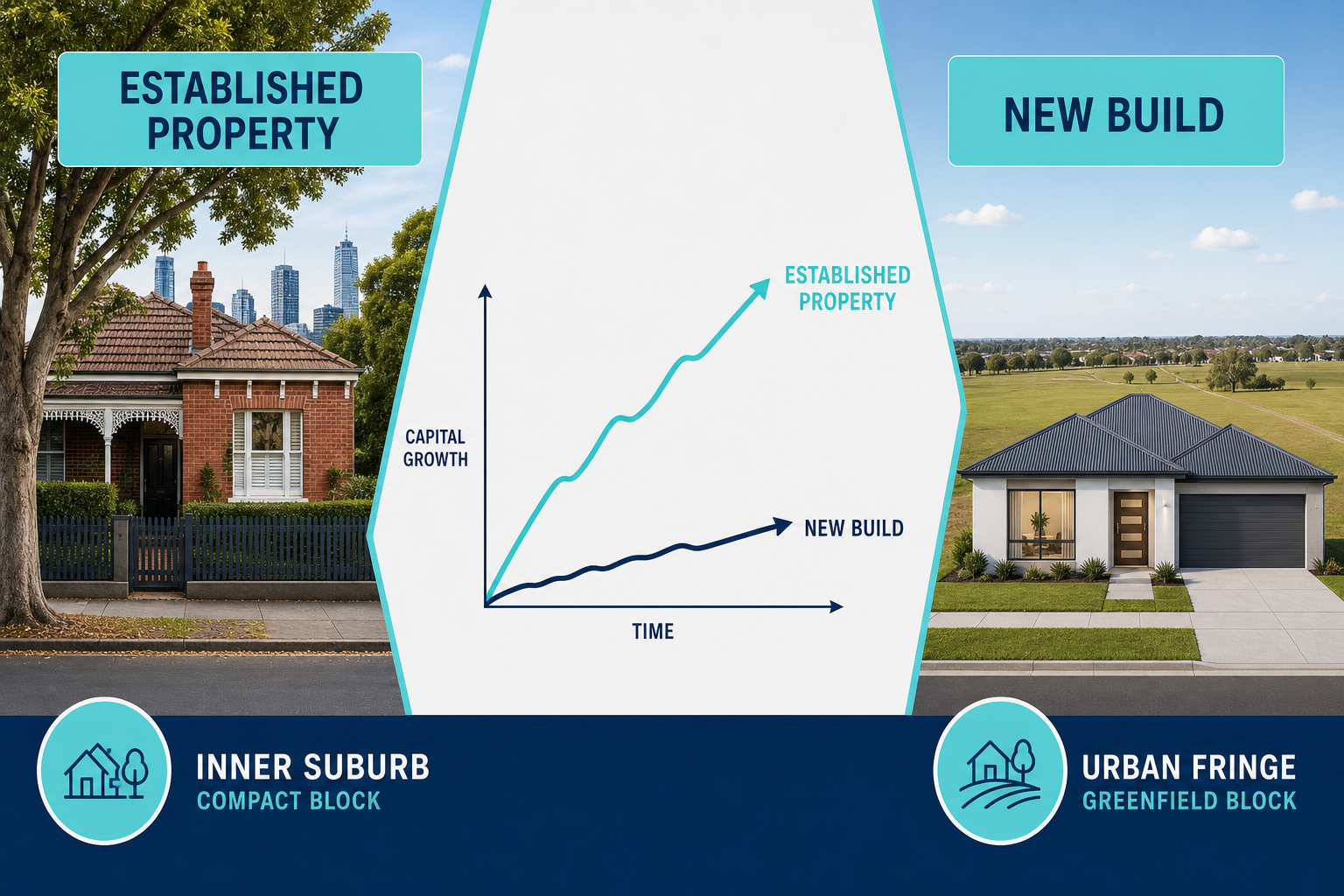
For investors who understand how property investment strategy builds long-term wealth, none of this changes the core thesis. Established properties in well-located suburbs carry a structural advantage that no policy change removes: a high land-to-asset ratio where the appreciating component dominates the balance sheet. Buildings depreciate over time; well-located land does not.
The short-term noise around tax incentives is real, but experienced investors at Buyers Agency Australia know that good property investment decisions are built on long-term fundamentals, not a single budget cycle.
Established vs new builds: the factors that matter most
The comparison between established stock and new builds ultimately comes down to what drives value over a 7 to 15 year hold. The table below summarises the key differences investors should assess before committing.
| Factor |
Established Property |
New Build |
| Land-to-asset ratio |
Typically higher in inner/middle rings |
Lower; building value dominates initially |
| Location depth |
Proven suburbs, infrastructure in place |
Often outer-ring or greenfield |
| Settlement risk |
Low; property exists and is priced by market |
Moderate to high; construction delays, builder insolvency |
| Depreciation |
Limited plant and equipment post-2017 changes |
Higher first-year depreciation claims |
| Renovation flexibility |
Strong; value-add potential at your discretion |
Nil for several years; warranty constraints apply |
| Resale buyer pool |
Broad owner-occupier and investor demand |
Narrower; loses "new" premium on first resale |
| Build-quality certainty |
Assessed pre-purchase via inspection |
Unknown until practical completion |
Land is the appreciating component of any property asset. In established suburbs, land scarcity is structural, driven by heritage overlays, planning constraints, and the simple fact that no new land is being created inside the 10 to 20-kilometre ring. This scarcity compounds over time and drives the long-term capital growth that genuine portfolio builders rely on.
New builds in greenfield estates often carry significant building value relative to land. When a buyer pays a premium for a completed new home, part of that price reflects developer margin, construction cost, and marketing. The Altus Group noted that only 174,030 homes were completed in the first year of the National Housing Accord, 27.5% below the 240,000 annual rate required, a signal that supply-side ambitions are not translating into delivered stock. That construction cost pressure flows directly into new-build pricing.
Settlement risk is a material consideration that many investors underestimate. Australia's construction sector entered 2026 with rising insolvencies, labour shortages, and persistent cost escalation. Very few projects finish on schedule due to weather events, regulatory approvals, and subcontractor failures. An investor buying off-the-plan may be waiting 18 to 36 months with capital tied up, interest accruing, and no rental income flowing.
For a comprehensive view of what can go wrong on the other side, read more: The Hidden Risks Of Buying Brand-New Investment Properties.
Where new builds can still make sense
A balanced view requires acknowledging that new builds suit specific investor profiles and strategies. Under the proposed 2026 Budget framework, eligible new builds retain full negative gearing deductibility from 1 July 2027 and investors can choose between the existing 50% CGT discount or the new indexation treatment when they sell. For a high-income earner in the 45% marginal tax bracket with a strong cash-flow focus and a short-to-medium hold horizon, the after-tax position on an eligible new build may be favourable.
Turnkey convenience also has genuine appeal for interstate or time-poor investors who cannot manage a renovation or want predictable holding costs from day one. New builds often attract better rental yields initially relative to purchase price, particularly in areas with tight rental markets and low vacancy.
Some SMSF strategies may also find new builds appropriate because the fund's tax environment differs from individual investors, and depreciation benefits are meaningful at lower tax rates. Investors in regulated superannuation funds are excluded from the negative gearing restrictions entirely.
The honest answer is: if your strategy is purely income-driven, your tax position is high, and you are buying a genuinely supply-adding new build in a suburb with strong rental fundamentals, it can work. However, tax benefits support a good investment decision; they do not replace one.
Common mistakes investors make when choosing new over established
The most damaging investor decisions tend to follow a predictable pattern. Understanding these mistakes is part of sound property investment advice for anyone evaluating their next purchase.
Chasing developer incentives. Fixed-rate finance, cashback offers, and rental guarantees are marketing tools, not investment fundamentals. Rental guarantees in particular are often priced into the purchase cost and expire after 12 to 24 months, leaving the investor exposed to the actual market rental rate.
Overvaluing display-home appeal. A display home is designed to sell. The fixtures, finishes, and landscaping shown are often upgrades not included in the standard package. Investors who buy on emotion rather than suburb fundamentals frequently find themselves holding a property that looks great but sits in a location with limited comparable sales depth and weak buyer competition at resale.
Ignoring future buyer demand. When an investor eventually sells, the property becomes an established property. At that point, a buyer will compare it against all other established stock in that suburb. If the suburb has weak owner-occupier demand, limited amenity, or a glut of similar new builds, the resale pool shrinks materially.
Underestimating holding costs and build-quality risk. Off-the-plan purchases lock in a price today for a product that is delivered in the future. If construction costs rise sharply (as they have through 2024 to 2026), the builder's margin is squeezed, and so is build quality. Warranty claims, defects, and strata disputes in new apartment complexes are consistently among the most common post-settlement complaints from investors.
| Mistake |
Why It Hurts the Portfolio |
| Chasing incentives |
Real cost is embedded in the purchase price |
| Display-home emotion |
Misses suburb fundamentals and resale depth |
| Ignoring owner-occupier demand |
Limits buyer pool at exit |
| Underestimating holding costs |
Cash flow shortfalls undermine long-term hold |
| Skipping due diligence |
Build defects and strata issues erode equity |
How a strategy-led buyers agent assesses the right purchase type
Buyers Agency Australia approaches every purchase brief from a portfolio-first position. That means understanding what the client is actually trying to achieve before any property type is considered.
Dragan Dimovski, with more than 20 years of property investment experience, builds the assessment around four core questions: What is the investor's growth objective versus income objective? What is their realistic hold period? What does their borrowing capacity and cash-flow buffer look like under stress-tested conditions? And what does exit strategy look like in five, ten, and fifteen years?
From there, the process involves a suburb-level comparison that goes beyond median prices. It accounts for infrastructure spending commitments, off-market property access, rental vacancy trends, comparable sales depth, and the ratio of owner-occupiers to investors in the target suburb. A suburb with high owner-occupier demand is a stronger signal of long-term capital growth than one driven primarily by investor buying.
For established properties, due diligence includes a building and pest inspection, strata records review (where applicable), council zoning confirmation, and a comparable sales analysis that tests both the buy-in price and the likely resale price in five to ten years. For clients considering new builds, the same rigour applies to the developer's track record, the contract terms, the feasibility of the pricing relative to comparable established stock, and the rental market in that specific suburb.
If you are weighing up the right approach for your situation, book a free strategy session to work through the numbers with the team.
What investors should review before buying in 2026
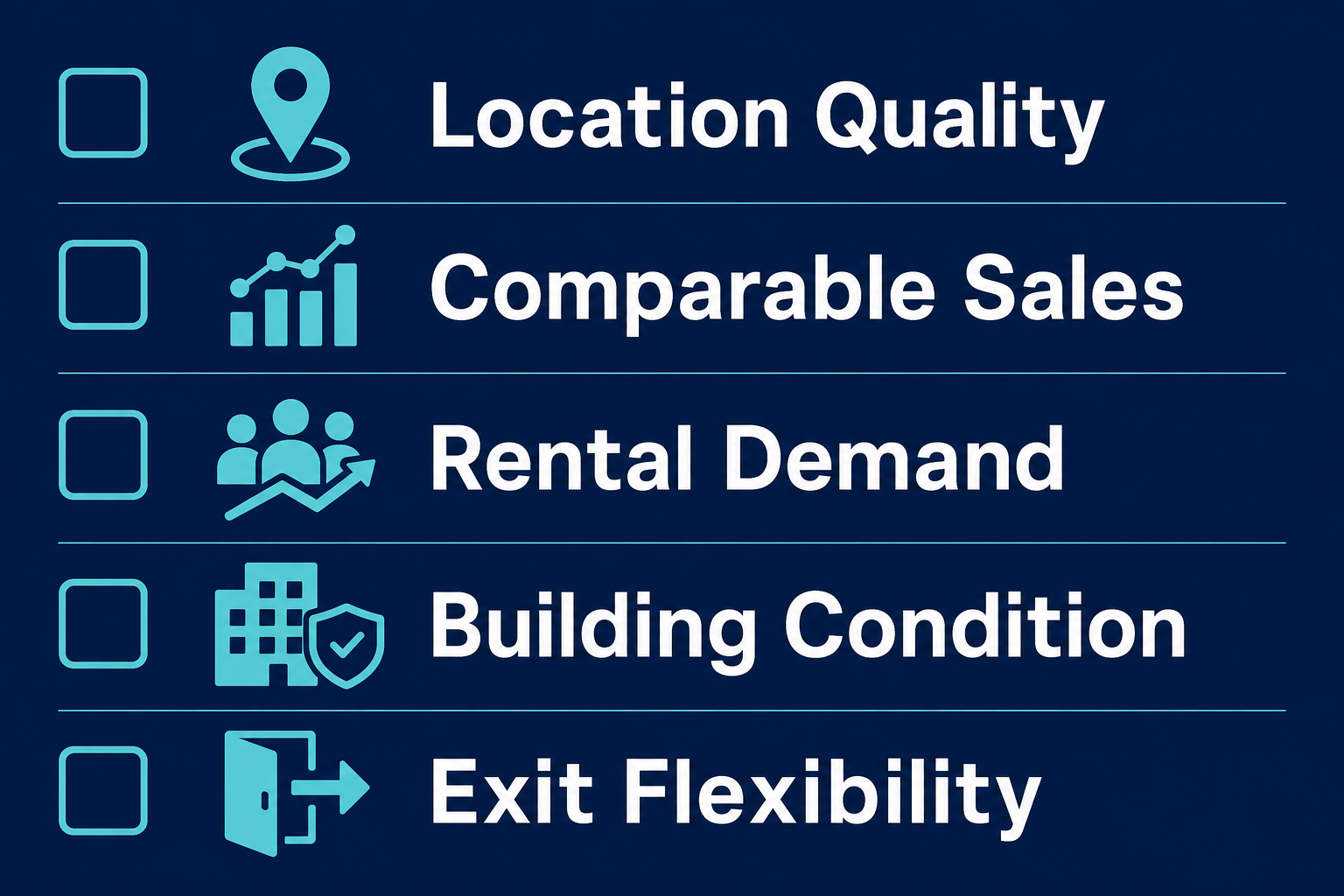
Regardless of purchase type, the following checklist covers the due diligence items that matter most in the current environment. For a more detailed breakdown, the property investment due diligence checklist covers these points in full.
Location quality
- Is there genuine infrastructure in place: employment nodes, public transport, schools, retail?
- What is the owner-occupier percentage in the suburb?
- Is the suburb in the inner or middle ring, or fringe/greenfield?
Comparable sales
- What have similar properties sold for in the last 12 months?
- Is there a sufficient volume of comparable sales to validate the asking price?
- What is the spread between buy-in price and likely resale price?
Rental demand
- What is the current vacancy rate in the suburb?
- Is rental demand driven by long-term tenants or seasonal/transient population?
- Does the gross yield support your cash flow under current interest rate conditions?
Building condition (established properties)
- Is a full building and pest inspection commissioned from an independent inspector?
- Are there any structural issues, drainage problems, or undisclosed defects?
- What is the strata maintenance fund balance and what are the capital works levy exposure?
Exit flexibility
- Who will buy this property in 10 years, and why?
- Is the suburb likely to attract a broader buyer pool over time?
- Does the property have development potential, or is it a hold-and-grow asset?
This checklist is not exhaustive, but it covers the core decision points that separate a portfolio-grade purchase from a product sale. Investors who are working through these questions for the first time will benefit from reading about top property investment hotspots and strategies for 2026 to identify where the stronger fundamentals currently sit.
Final takeaway: choose the asset that best supports long-term portfolio outcomes
The 2026 market environment is complex. The Federal Budget has introduced real tax incentives for new builds, construction costs remain elevated, and the broader market is navigating a period of slower price growth. For most investors focused on building genuine long-term wealth, established properties in well-located suburbs remain the more reliable foundation.
The land-to-asset ratio, resale depth, renovation flexibility, and proven buyer demand that characterise quality established stock are structural advantages that outlast any budget cycle. Tax benefits are one variable in the investment equation; they should support a sound purchase decision, not drive it.
If you are unsure whether established or new-build is the right fit for your strategy, the team at Buyers Agency Australia can help you work through the analysis. Map out your next property move with a free strategy session, or contact the team directly to discuss your circumstances.
Frequently asked questions
Do established properties always outperform new builds on capital growth?
Historically yes, particularly in inner and middle-ring suburbs where land scarcity drives appreciation. Location and land content matter more than the age of the building.
Will the 2026 Federal Budget changes make new builds a better investment?
New builds retain negative gearing and CGT flexibility from July 2027, which improves their tax position. However, tax benefits alone do not make a property a sound investment; location fundamentals still apply.
What is the main risk of buying off-the-plan in 2026?
Settlement risk is significant: construction delays, builder insolvency, rising costs, and the possibility that the completed property is worth less than the contract price at settlement.
Can established properties still be negatively geared after May 2026?
Properties purchased before 7:30pm AEST on 12 May 2026 are fully grandfathered. Established properties purchased after that date will have restricted negative gearing from 1 July 2027 under the proposed changes.
How does a buyers agent help investors choose between established and new build?
A buyers agent assesses your goals, cash flow, hold period, and exit strategy before recommending a property type, then applies independent due diligence to validate the purchase on fundamentals, not marketing.
 General
A strategic look at why established properties hold the edge over new builds for Australian investors in 2026,...
When the Reserve Bank of Australia raises the cash rate, most buyers freeze. Auction rooms thin out, open homes get quieter, and headlines predict a market correction that rarely arrives as forecast. But for investors who have a clear property investment strategy and the discipline to stay the course, this hesitation from others creates genuine, measurable advantage.
The RBA raised the cash rate three times in early 2026, taking it back to 4.35% and fully reversing the easing cycle of 2025. For nervous buyers, that number feels like a stop sign. For prepared investors working with Buyers Agency Australia, it can be the starting gun.
Why Interest Rate Hikes Create Hesitation in the Market
The psychology of rising rates is well-documented. When borrowing becomes more expensive, a predictable chain of events unfolds. Borrowing capacity falls, serviceability calculations tighten, and buyers who were already stretched begin to exit the market entirely.
For owner-occupiers, higher repayments can genuinely change affordability. The concern is real and proportionate. But many investors conflate the experience of their own mortgage stress with a broader collapse in property fundamentals – and that confusion is where poor decisions get made.
| Common Fear During Rate Hikes |
What the Data Often Shows |
| Property prices must fall significantly |
Prices fell modestly in Sydney (-0.4%) and Melbourne (-0.9%) from late 2025 highs, while Perth rose 7.3% in Q1 2026 |
| Rental demand will weaken |
National vacancy rate remained at just 1.2% in April 2026, well below a balanced market's 3-4% |
| Now is a bad time to invest |
Investor loan volumes hit record highs in late 2024 before the new rate cycle began |
| Borrowing capacity makes deals impossible |
Conservative structuring and strategic location selection still produce viable opportunities |
The gap between perceived risk and actual fundamentals is exactly where opportunity lives. Understanding why property prices can keep rising even in a high-rate environment is the first piece of investor education worth internalising.

Why Panic Can Create Opportunity for Prepared Investors
When fear enters the market, several dynamics shift in favour of the patient and prepared.
First, competition drops. Auctions with 12 registered bidders become auctions with four. Properties that would have sold above reserve now sit on market for three or four weeks – long enough for a thorough assessment and a considered negotiation. For investors who do the work, this is a significant shift in buying conditions.
Second, vendor expectations reset. Sellers who listed during a stronger cycle are confronted with current sentiment and often become far more negotiable on price, settlement terms, and conditions. This is not exploitation – it is the natural function of a market finding its level.
Third, off-market properties become more accessible. Agents who once moved properties privately at peak price now see value in bringing trusted buyer representatives into the conversation earlier. The networks that support off-market access strengthen precisely when public competition weakens.
None of this means every property in a high-rate environment is a sound purchase. It means the conditions for disciplined selection and strong negotiation are considerably better than they were twelve months earlier.
The Investor Mindset That Matters Most in a Rising-Rate Environment
The investors who perform best during rate cycles are not the boldest. They are the most systematic.
They enter the market with a written plan: target yield, minimum land content, acceptable vacancy rate profile, and a clear understanding of their own serviceability ceiling. They do not revise that plan based on the morning news cycle. And they build conservative assumptions into every projection – not the best case, not the median case, but a scenario where rates stay elevated for longer than expected and vacancy sits slightly above the historical average.
Smart property investment strategy means owning the numbers before you own the asset. That means modelling the holding cost at the current rate plus a buffer, not at the rate you hope to see in eighteen months.
It also means resisting the urge to time the market. Australia's long-run property data consistently shows that time in the market outperforms attempts to time entry. Why property investment strategy matters more than suburb selection is a principle that becomes even more relevant when emotions run high.
For Dragan Dimovski, founder of Buyers Agency Australia and a property investor with 20+ years of experience, the rising-rate environment does not change the fundamentals of good acquisition. It filters out the noise and forces investors to buy for the right reasons: genuine rental demand, quality location, and a price that reflects value rather than sentiment.
What to Assess Before Buying During Interest Rate Hikes
Due diligence is always important. In a rising-rate environment, it becomes non-negotiable. The following areas warrant particular attention:
Cash flow resilience. Model the property's holding cost at the current rate, then add 0.5% as a buffer. If the property cannot service that scenario on rental income alone – or with a manageable shortfall given your income position – it is too tight. Positive cash flow or near-neutral gearing in this environment is achievable with the right location and property type selection.
Rental demand quality. National rental vacancy rates remain structurally tight. Sydney held a vacancy rate of 0.8% in March 2026, while Brisbane sat at 0.6%. These are not temporary anomalies – they reflect a structural undersupply of rental housing that is expected to persist through 2030, according to CBRE research showing Australia needs approximately 75,000 new apartments per year but is building only around 60,000.
Location fundamentals. Not all markets respond to rate rises equally. Perth, for example, recorded 7.3% home value growth in Q1 2026 despite three consecutive RBA hikes, according to Cotality data. The right suburb in the right city with genuine supply constraints and employment diversity performs differently to speculative markets.
Serviceability buffer. APRA's standard buffer applies, but smart investors also build a personal buffer. If your current lender's assessment limits your maximum loan to a specific figure, work with that ceiling and select a property that fits comfortably within it – not one that stretches to the edge.
A complete property investment due diligence checklist is worth working through systematically before any purchase in the current climate.

How a Buyers Agent Can Help Investors Stay Strategic
One of the less obvious costs of a high-rate environment is the emotional cost. Investors who go it alone are exposed to every data point, every conflicting headline, and every anxious comment from people with no skin in the game. That noise is expensive. It leads to hesitation, over-analysis, and missed windows.
A buyers agent provides structural discipline. Not by making decisions for you, but by ensuring you are making decisions based on verified data, current market access, and a clear brief – rather than emotion.
At Buyers Agency Australia, the team brings three practical advantages to the current environment: access to off-market stock that bypasses public competition entirely, negotiation capability built on direct agent relationships and current comparable data, and market selection research that moves beyond headline data to suburb-level supply-demand analysis.
For investors in Brisbane, where strategic property acquisition is particularly active, having buyer-side representation can be the difference between a sound acquisition at a fair price and an overpriced purchase driven by fear of missing out.
The value of professional representation compounds when conditions are complex. A good buyers agent pays for themselves not just in the purchase price negotiated, but in the properties you do not buy – the ones that look attractive under pressure but would underperform over a ten-year hold.
If you are navigating the current rate environment and want a structured approach to your next acquisition, book a free strategy session with the team to map out what is actually possible for your situation.
Common Mistakes to Avoid When Others Are Panicking
High-rate environments do not just create opportunities – they concentrate the consequences of poor decisions. These are the errors that consistently show up:
Chasing contrarian positioning without a plan. "Buy when others are fearful" is sound in principle but dangerous without a specific property brief, location thesis, and cash flow model. Buying any property simply because sentiment is low is not a strategy.
Overpaying for urgency. Reduced competition does not mean absent competition. Strong properties in tightly held suburbs still attract genuine interest. Running a proper valuation assessment before every offer remains essential – as first-time investors who have avoided costly mistakes consistently attest.
Ignoring portfolio sequencing. Buying a second or third property without assessing how it affects your total borrowing capacity and serviceability is a common error. Each acquisition affects the next. A clear property portfolio plan that sequences acquisitions around equity growth and serviceability windows is far more reliable than opportunistic buying.
Relying on rate-cut timing. Buying a property whose viability depends on rates falling by a specific date is speculative, not strategic. The RBA's own guidance as of mid-2026 indicates underlying inflation is expected to stay above target until late 2027, which means investors who plan around imminent cuts may be disappointed.
Neglecting the biggest investment mistakes. From over-leveraging to buying in weak rental markets, the most common property investment mistakes Australians are making tend to cluster during moments of market uncertainty.
| Mistake |
Why It Happens |
How to Avoid It |
| Buying on emotion (fear or greed) |
Headline-driven decisions |
Use a written brief and stick to it |
| No cash flow modelling |
Optimism about rate cuts |
Model at current rate plus 0.5% buffer |
| Wrong location |
Chasing cheap prices |
Assess rental demand, supply, and employment |
| No portfolio plan |
Single-property thinking |
Plan three acquisitions ahead, not one |
Frequently Asked Questions
Do property prices fall when interest rates rise in Australia?
Not always. Some markets softened slightly in 2026, but others like Perth rose 7.3% in one quarter. Location and supply fundamentals matter more than the rate level alone.
Is now a good time to buy an investment property in Australia?
With reduced competition, more realistic vendor expectations, and vacancy rates below 1.5% nationally, conditions favour disciplined investors with solid cash flow models and a clear strategy.
How do I know if an investment property is cash flow viable at current rates?
Model the holding cost at the current rate plus a 0.5% buffer. If rental income covers or comes close to that scenario, the property has genuine cash flow resilience.
What does a buyers agent do during a high-rate environment?
A buyers agent provides off-market access, verified comparable data, and negotiation support – helping investors make disciplined decisions rather than emotional ones when market sentiment is volatile.
How many properties should I aim for in my portfolio?
This depends on your income, equity, and serviceability position. A structured portfolio plan, reviewed with a buyers agent, sequences each acquisition to protect borrowing capacity for the next one.
Conclusion: Buy With Strategy, Not Fear
Interest rate hikes are not a verdict on property. They are a filter – one that removes speculative buyers from the market and rewards investors who have done the work, built a sound brief, and structured their acquisition sensibly.
The structural conditions underpinning Australian residential property – a chronic housing undersupply, sustained population growth, and rental vacancy rates that remain well below a balanced market – do not disappear when the RBA raises the cash rate. They persist. And in many cases, the softening in public competition that follows a rate hike makes it easier, not harder, to access the right property at the right price.
A disciplined property investment strategy is not about ignoring risk. It is about understanding which risks are real, which are just sentiment, and building a plan that can withstand both. That is precisely what Buyers Agency Australia exists to deliver – from initial strategy through to settlement.
If you are ready to move forward with clarity rather than hesitation, book a free strategy session with the team today. To speak directly, contact the team and take the first step toward a portfolio plan built for the market as it actually is.
 General
Rising interest rates cause most buyers to retreat - but disciplined investors see opportunity. Learn the property investment...
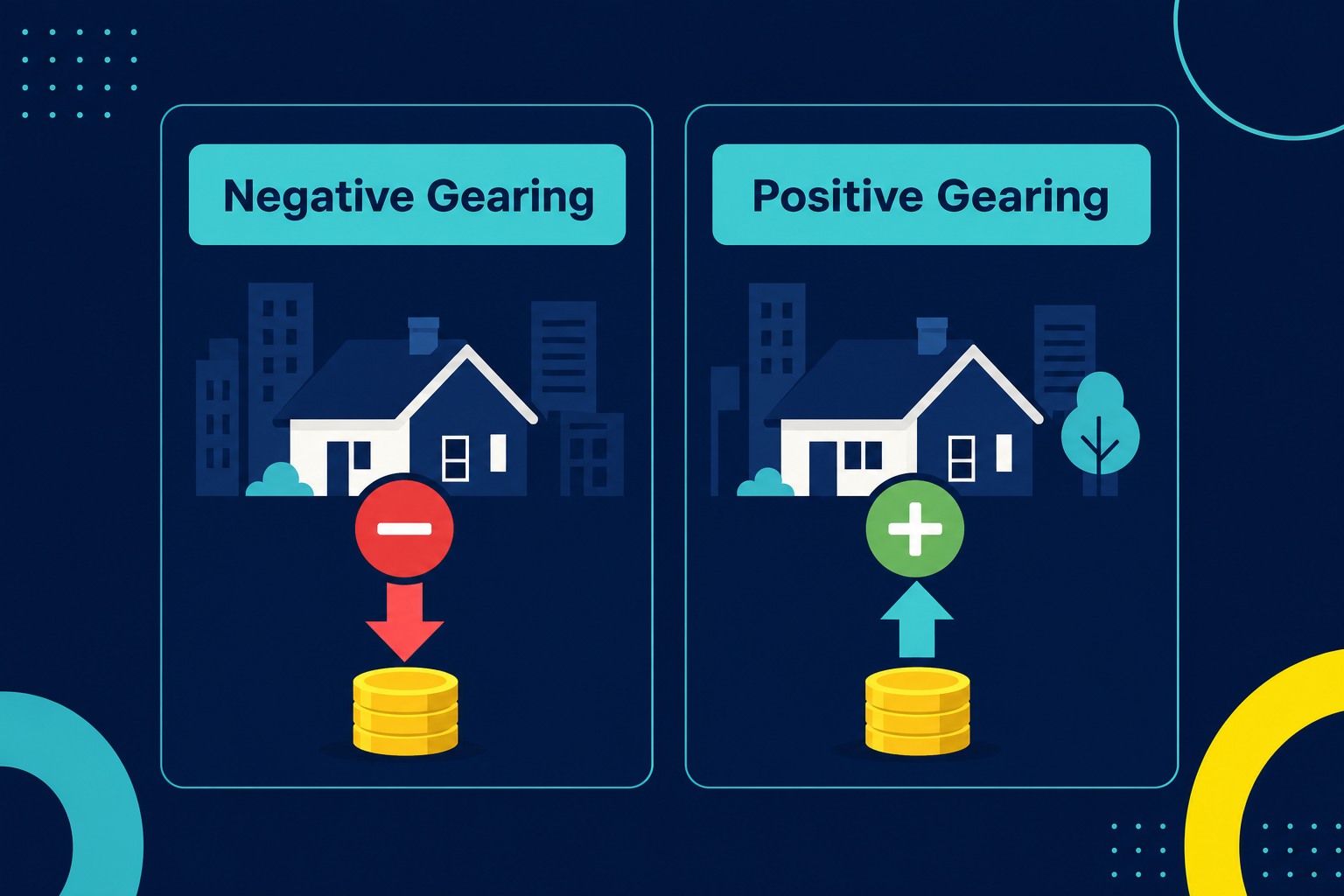
The 2026 Federal Budget rewrote key rules for property investors. With negative gearing on established residential properties now quarantined for new purchases made after 12 May 2026, income-generating assets are no longer just attractive – they have become strategically essential for many investors. Understanding what makes a positive-geared established property genuinely worth holding is now one of the most important investor skills in Australia.
Why positive-geared established properties are back in focus
For much of the past decade, Australian investors accepted that cash flow would run negative for years, banking on future capital growth and a tax offset to bridge the gap. That model demanded patience, strong income, and confidence that rates would stay manageable. All three conditions have shifted.
With the RBA cash rate sitting at 4.10% and investor mortgage rates ranging between 6.2% and 6.8% in mid-2026, holding a property at a 3% gross yield is an expensive commitment. The 2026 Budget then removed the ability to deduct those rental losses against wage income for newly acquired established properties – meaning the after-tax relief investors previously relied on no longer applies to fresh purchases.
Positive gearing changes that dynamic entirely. When rental income covers or exceeds total holding costs, the investor is no longer funding a shortfall. The asset contributes to the portfolio rather than drawing from personal income each month. For investors planning to build a resilient property portfolio, that shift in cash flow position can be the difference between being able to hold and being forced to sell.
What the post-2026 Budget environment changes for buyers
The headline reforms from the 12 May 2026 Federal Budget introduced two major changes to the property investment landscape. First, from 1 July 2027, negative gearing on residential property will be limited to new builds. Established properties acquired after Budget night will no longer allow rental losses to be deducted against broader income such as wages, though losses can be carried forward to offset future residential property income.
Second, the 50% capital gains tax discount is proposed to be replaced with cost-base indexation and a 30% minimum tax rate on capital gains from 1 July 2027. Existing properties held before Budget night are grandfathered for the negative gearing changes. These are significant shifts – as detailed in the government's Budget housing reforms – but it is important to note the changes still require full legislation before they take effect.
| Change |
Established Properties (new purchases post 12 May 2026) |
New Builds |
| Negative gearing |
Quarantined (losses offset only against property income) |
Fully retained |
| CGT discount (from 1 July 2027) |
Replaced by indexation + 30% min. rate |
Investor can choose old or new method |
| Grandfathering |
Yes, for properties held before Budget night |
Not applicable |
| Cash flow dependency |
Higher – income must cover more costs |
Lower – tax benefit reduces holding cost |
For investors thinking through their next move, the implication is direct: for newly acquired established properties, cash flow quality now carries more weight than ever before. You cannot rely on a tax offset to subsidise a poorly performing asset. This has put income-positive investing back at the centre of portfolio conversations across the country.
According to CBA's updated housing outlook following the Budget, dwelling price growth is forecast at 3% to December 2026 – a more modest environment than many investors assumed heading into the year. That moderating backdrop makes starting cash flow position even more critical for total return calculations.
Why established properties can be strategically attractive
The Budget's carve-out for new builds has sent some investors directly toward off-the-plan and new construction. That can be a sound approach in the right circumstances, but it also introduces a different set of risks: construction timelines, valuation gaps at completion, developer risk, and limited comparable sales data to verify whether the purchase price reflects genuine market value.
Established properties sidestep many of those uncertainties. A property with rental history offers real data: actual vacancy periods, what tenants have paid, how rents have moved, and what maintenance costs have looked like. That is harder to model on a new build that has never been tenanted. Established stock in mature locations also tends to draw from a broader tenant pool – families, working professionals, and long-term renters who prioritise suburb quality, access to schools, and transport links over the novelty of a new fit-out.
From a comparables perspective, established properties in established suburbs come with transaction history. You can verify recent sales, check price movements, and build a more grounded view of what the asset is worth before you negotiate. That visibility is genuinely useful – it creates the conditions for disciplined buying rather than speculative pricing.
The two-speed property market emerging across Australia in 2026 further supports selectivity. Not every established market is equally attractive, but markets where rental demand is structurally tight and supply constrained can offer both income stability and long-run growth potential.
The cash flow and risk-management lens
Positive gearing supports what experienced investors call borrowing resilience – the ability to hold a property through a rate cycle without requiring the asset to be subsidised by personal income. When national asking rents are growing at 6.6% year-on-year according to SQM Research and national vacancy sits at approximately 1.2%, the fundamentals underpinning rental income remain supportive across most markets.
That said, results vary significantly depending on the asset, location, purchase price, financing structure, and assumptions about vacancy and maintenance. Positive gearing is not a guaranteed outcome – it is a calculation that must be run on each individual property with realistic inputs. An investor who buys at an inflated price, assumes full occupancy throughout the year, and ignores maintenance reserves may believe they are positively geared when the true position is neutral or negative.
From a portfolio construction perspective, cash flow-positive assets also expand future borrowing capacity. Lenders typically count surplus rental income as serviceability, which means a positively geared property can improve your ability to finance the next acquisition. For investors focused on systematic portfolio growth, that compounding effect on borrowing power is a meaningful structural advantage.
It is also worth considering the role these assets can play in a mixed portfolio. Many experienced investors hold a blend – some income-focused established properties providing cash flow stability, alongside growth-oriented assets in locations with stronger capital appreciation prospects. Dual income property strategies represent one way to pursue both objectives simultaneously, where a single title generates combined yields that approach or exceed holding costs.
How to assess whether a property is truly positive geared
Gross yield figures are the number agents advertise. Net cash flow is the number that matters. The gap between the two can easily represent 2% to 3% of the property's value each year once you account for all running costs.
A practical positive-gearing assessment should work through the following items:
- Purchase price and LVR: Your deposit size directly affects loan size and therefore interest cost. A 30% deposit versus 20% meaningfully changes the cash flow equation.
- Gross yield: Annual rent divided by purchase price. A gross yield above 6.5–7% is typically needed at standard 80% LVR financing rates in mid-2026 to approach neutral or positive territory, though this depends on your specific loan rate and cost structure.
- Net yield: Subtract property management fees (typically 7–10% of rent), council rates, water rates, landlord insurance, maintenance allowance (budget 1–2% of property value annually), and any body corporate or strata costs.
- Vacancy risk: Model at least 4–6 weeks vacancy per year even in tight markets. Check the suburb's actual vacancy rate via SQM Research rather than relying on agent estimates.
- Financing structure: Interest-only loans reduce monthly cash outflow but do not build equity. The eventual switch to principal-and-interest creates a step-up in repayments. Structure matters.
- Stress testing: Run the numbers with your interest rate 1–1.5% higher. If the position is still serviceable, you have a genuine buffer.
| Assessment Factor |
What to Check |
Common Mistake |
| Gross yield |
Annual rent / purchase price x 100 |
Treating this as the final figure |
| Net yield |
Gross yield minus all running costs |
Ignoring vacancy and maintenance |
| Vacancy rate |
SQM Research suburb-level data |
Using metro averages for regional buys |
| Financing cost |
Actual investor rate at your LVR |
Modelling at owner-occupier rates |
| Stress test |
Recalculate at +1.5% interest rate |
Assuming rates stay static |
The practical process of buying a cash flow positive property is detailed – and shortcuts at the analysis stage tend to show up as costly surprises after settlement.
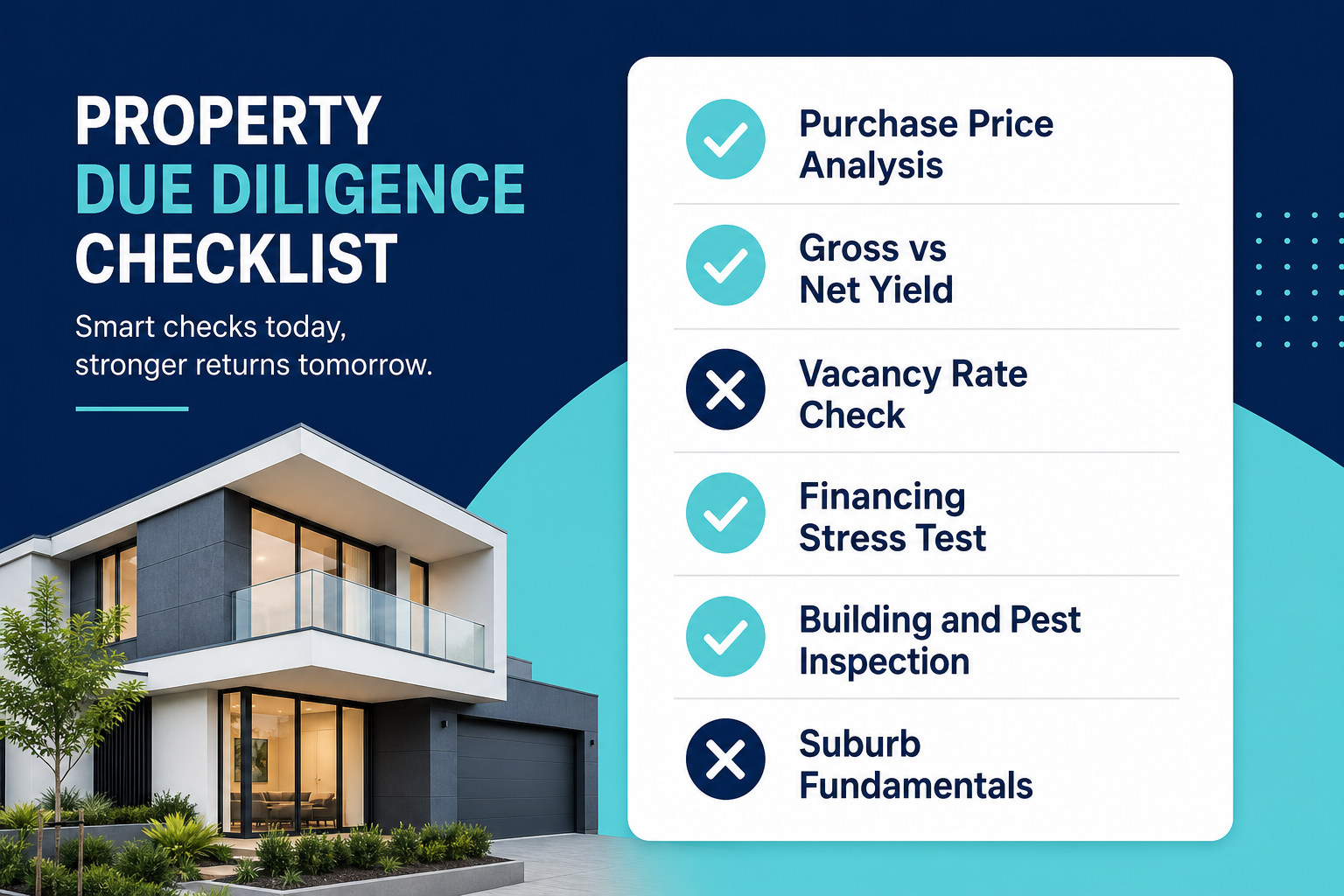
Common mistakes investors make when chasing positive cash flow
The appeal of income-positive property can push investors into poor decisions if the search for yield replaces disciplined analysis. Several patterns appear consistently among investors who end up disappointed with cash flow assets.
Overpaying to secure the deal. A property bought 10–15% above market value needs a materially higher yield just to recover from the purchase. The cost of overpaying relative to what a buyers agent fee might have prevented is often far greater than investors expect.
Buying in weak or single-industry locations. Regional markets with high gross yields often carry concentration risk – a dominant employer, mining operation, or seasonal workforce can collapse rental demand rapidly. A yield of 9% in a town dependent on one employer is not the same quality asset as a 6% yield in a diversified regional centre with multiple demand drivers.
Ignoring due diligence. Building and pest inspections, title searches, flood overlays, zoning checks, and body corporate records all matter. A property with structural issues, litigation risk in the strata, or planning restrictions on future use can destroy the investment thesis regardless of its yield.
Confusing headline yield with long-term investment quality. A cheap property in a low-demand suburb that happens to yield 7% might never deliver meaningful capital growth. An investor who holds it for a decade ends up with income but no equity progression – which undermines the portfolio compounding effect they were building toward. The biggest property investment mistakes Australians are making in 2026 often come back to exactly this trade-off, where short-term yield metrics crowd out long-term fundamentals.
Where a buyers agent adds value
For investors assessing positive-geared opportunities in the post-Budget landscape, the challenge is not simply finding a high-yield listing – it is finding a high-yield asset in a location with genuine long-term tenant demand, verifiable comparables, and a purchase price that reflects reality rather than optimism.
That is precisely where Buyers Agency Australia operates. Dragan Dimovski, who brings more than 20 years of property investment experience, has built the firm's approach around data-led suburb selection, disciplined due diligence, and access to off-market stock that does not reach the open market. For investors seeking income-positive established properties, off-market access matters – it means negotiating from an informed position without competing against a field of buyers who have also spotted the same publicly advertised yield.
The strategic value of a buyers agent in this environment goes beyond sourcing. Running the actual cash flow numbers – accounting for your specific loan rate, management costs, vacancy assumptions, and maintenance reserves – requires both data access and real-world experience. Modelling a deal incorrectly at this stage is a structural risk, not just a paperwork error. A disciplined acquisition process protects the integrity of the investment thesis from day one.
For investors building or restructuring a portfolio around the top property investment hotspots and strategies for 2026, having experienced representation on the buy side is not a luxury – it is a structural advantage in a more policy-sensitive and cost-conscious market. If you want to understand how the negative gearing and CGT changes interact with your specific holdings, our detailed breakdown of negative gearing and CGT changes for Australian property investors is a useful starting point.
If you are navigating your property investment strategy in the post-Budget environment, book a free strategy session to map out a clear acquisition framework before committing capital.
Next steps for investors
The policy environment has changed. The analytical discipline required to invest well has not – if anything, it has increased. Here is a practical framework for investors assessing positive-geared established properties right now:
- Clarify your borrowing position. Know your actual investor loan rate and maximum LVR before assessing any property's cash flow viability.
- Run net cash flow, not gross yield. Build a full holding cost model before shortlisting any asset.
- Check vacancy at the suburb level. National averages mask significant local variation. Use current data sources for the specific suburb you are assessing.
- Stress-test at higher rates. The position should remain serviceable at 1–1.5% above your current rate.
- Assess the location fundamentals, not just the yield. Tenant demand drivers, employment diversity, infrastructure access, and comparable sales depth all matter for long-term hold quality.
- Get proper due diligence on every shortlisted property. Building and pest, strata records (where relevant), flood and planning checks.
The investors who navigate this environment well will be those who treat cash flow discipline and location quality as inseparable – not as a trade-off. Buyers Agency Australia works with investors at each of these stages, from initial strategy through to settlement and beyond.
Ready to take the next step? Book a free strategy session with the team, or contact the team directly to discuss your investment brief.
Frequently Asked Questions
What is a positive-geared property in Australia?
A positive-geared property generates rental income that exceeds all holding costs – mortgage repayments, rates, insurance, management fees, and maintenance – leaving a net surplus each period.
Does the 2026 Budget make established property a worse investment?
Not automatically. It changes the tax treatment for new purchases, making cash flow quality more important. Well-selected established properties with strong yields remain viable investment assets.
What gross yield do I need for positive gearing in 2026?
At standard 80% LVR with investor rates around 6.2–6.8%, a gross yield above 6.5–7% is generally needed to approach neutral or positive cash flow before tax, depending on location costs.
Are the 2026 Budget negative gearing changes already in effect?
The changes were announced on 12 May 2026 and apply to properties acquired after that date, but full legislation is still pending. The proposed start date for the negative gearing limit is 1 July 2027.
How does a buyers agent help with positive cash flow property selection?
A buyers agent provides data-led suburb analysis, realistic cash flow modelling, due diligence oversight, and access to off-market stock – reducing the risk of overpaying or buying in the wrong location.
 General
Discover why positive-geared established properties are a compelling strategy after the 2026 Budget's negative gearing changes, and how...
Investing in property through a self-managed super fund (SMSF) is one of Australia's most discussed retirement strategies, but it's also one of the most misunderstood. The rules are strict, the costs are real, and the consequences of getting it wrong can be severe. This guide covers what SMSF property investing actually involves in 2026, how to assess whether the strategy suits your goals, and what the acquisition process looks like when done properly.
Disclaimer: This article is general information only and does not constitute personal financial, tax, legal, or investment advice. Speak with a licensed SMSF specialist, registered financial adviser, and accountant before acting on any of the information discussed.
What SMSF property investing means in Australia
An SMSF allows its members to take direct control of how their superannuation savings are invested, including the option to purchase residential or commercial investment property. Unlike a standard investment property purchase in your own name, property bought through an SMSF sits inside the superannuation environment, which means different tax treatment, different legal obligations, and a completely different compliance framework.
According to ATO data for December 2025, there are now 663,867 SMSFs in Australia holding $1.06 trillion in total assets. Property, both residential and non-residential, accounts for a meaningful portion of that allocation, though it remains a minority of the overall sector.
The key attraction of holding property inside super is tax efficiency. Rental income earned within a complying SMSF is taxed at a concessional rate of 15%, compared to a marginal tax rate of up to 47% outside super. Capital gains tax reduces to 10% for assets held longer than 12 months, and in pension phase, if the sale falls within the member's transfer balance cap, no capital gains tax may be payable at all.
For many investors, those numbers are compelling. The reality, however, is that the strategy carries significant structural complexity, ongoing compliance obligations, and liquidity demands that require careful planning before any purchase.
This guide focuses on general education about how the strategy works. It is not personal advice. Anyone considering SMSF property investing should engage a licensed SMSF specialist before proceeding.
Key SMSF rules to understand before you buy
The SMSF framework is governed by the Superannuation Industry (Supervision) Act 1993 (SIS Act) and enforced by the Australian Taxation Office. Breaching the rules can result in the fund being declared non-compliant, which means the fund's assets could be taxed at 45% rather than 15%. The penalties are severe and not worth risking.
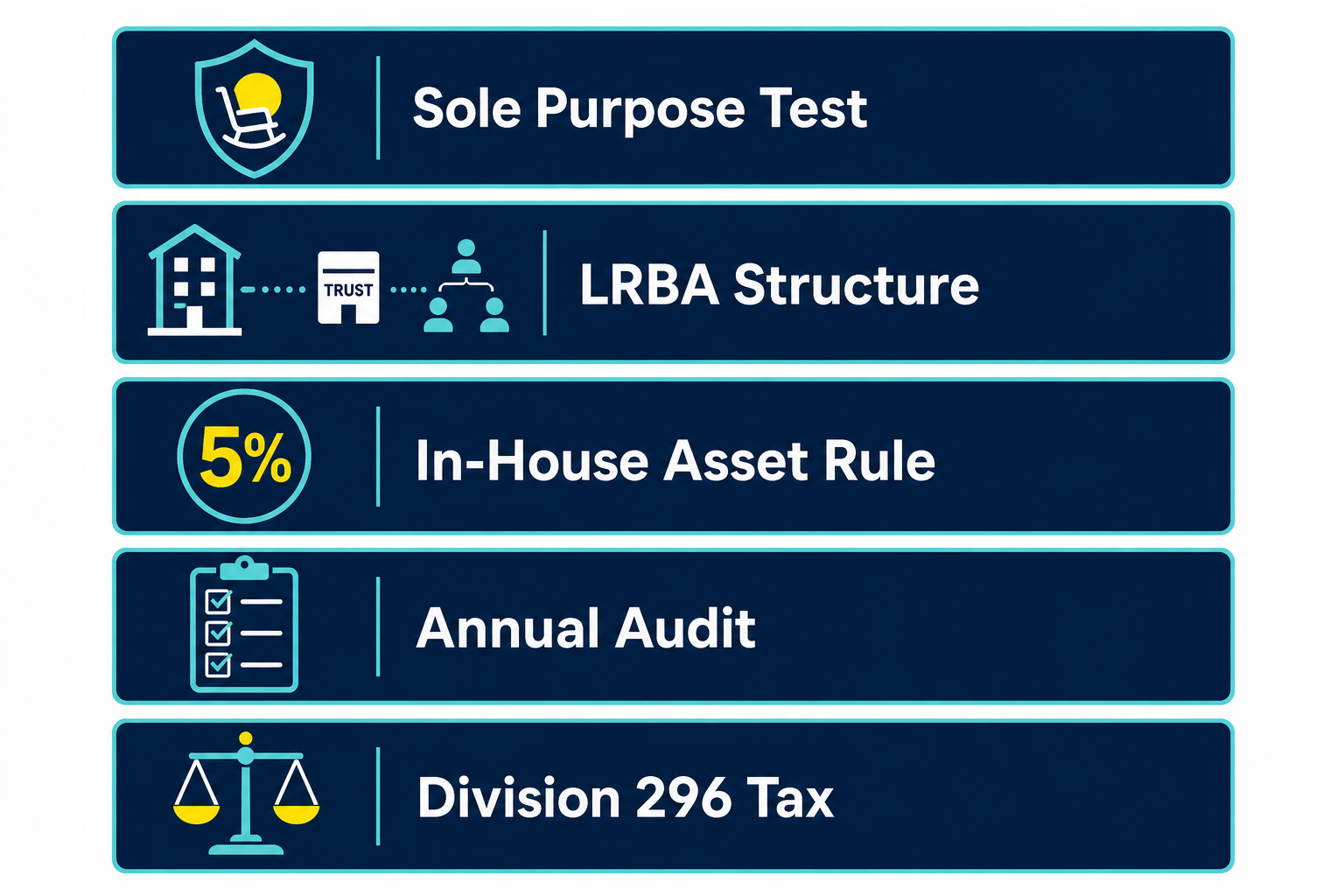
Here are the core compliance considerations every trustee must understand:
The sole purpose test
Every investment decision inside an SMSF must be made solely to provide retirement benefits to members. This means no member or related party can live in, holiday in, or derive any personal benefit from an SMSF-owned residential property. Even allowing a family member to stay in the property for a short period is a breach. The ATO's SMSF investment restrictions guidance outlines these obligations in full.
Limited Recourse Borrowing Arrangements (LRBAs)
An SMSF cannot take out a standard mortgage. If the fund needs to borrow to buy property, it must use a Limited Recourse Borrowing Arrangement (LRBA) under section 67A of the SIS Act. Under this structure, the property is held in a separate bare trust until the loan is fully repaid. The "limited recourse" element protects the fund's other assets: if the fund defaults, the lender can only take the property itself.
LRBA loans come with stricter lending criteria than standard investment loans. In April 2026, SMSF loan rates sat around 6.6% to 6.8% for residential property, compared to roughly 5.5% to 6% for standard investment loans. Most lenders require a 20% to 30% deposit and a minimum fund balance of $200,000 to $300,000 before approving the loan.
Borrowed funds can only be used to acquire the property, cover acquisition costs such as stamp duty, and fund repairs and maintenance. They cannot be used to improve the property in a way that changes its fundamental character. A cosmetic repaint is fine; a structural extension is not while the loan remains outstanding.
The in-house asset rule
SMSFs are restricted from holding more than 5% of their total assets in in-house assets, which includes investments in or loans to related parties. Residential property leased to a related party breaches this rule. Commercial property is the main exception: a related business can lease commercial premises owned by an SMSF at market rates, which is one reason business owners find commercial SMSF property particularly attractive.
Related party acquisition restrictions
Your SMSF generally cannot purchase residential property from a related party. You cannot transfer an investment property you personally own into your SMSF; it must be purchased from an unrelated third party at market value.
Ongoing valuations and compliance costs
The ATO requires annual market-based valuations for SMSF property assets. The fund must also be independently audited each year and lodge an annual return. Running costs for an SMSF holding property typically sit in the range of $5,000 to $7,000 per year before standard property holding costs are factored in.
Division 296: the new tax for high balances
From 1 July 2026, the Division 296 tax applies a tiered additional tax on superannuation earnings for individuals with a total super balance above $3 million. Balances between $3 million and $10 million will attract an additional 15% tax on earnings attributable to that portion, bringing the effective rate to 30%. The legislation passed both houses of Parliament on 10 March 2026 and applies to realised earnings only, not unrealised gains. Trustees with balances approaching that threshold should model their position with a qualified SMSF adviser before the end of the 2025-26 financial year.
| Compliance area |
Key requirement |
| Sole purpose test |
Property held for retirement benefit only; no personal use by members or related parties |
| LRBA (borrowing) |
Must use a bare trust structure; one asset per LRBA; borrowed funds cannot fund improvements |
| In-house assets |
No more than 5% of fund assets in related-party investments; residential leases to family not permitted |
| Related party acquisition |
Residential property must be purchased from unrelated third party at market value |
| Annual obligations |
Independent audit, annual return lodgement, market-based valuations |
| Division 296 (from 1 July 2026) |
Additional 15% tax on earnings above $3M total super balance; applies to realised earnings only |
How to assess whether SMSF property investing suits your goals
Not every investor with an SMSF should put property in it. The strategy makes most sense when the fund has a meaningful balance, trustees have a clear long-term retirement horizon, and the purchase genuinely serves the fund's retirement objectives rather than satisfying a short-term property impulse.
Before progressing further, consider these questions honestly:
Does your fund have the cash flow to sustain the strategy? A property inside super needs to be serviced entirely from within the SMSF. Loan repayments, council rates, property management fees, insurance, and vacancy periods all come from the fund. You cannot top up a shortfall from your personal bank account. Concessional contributions are capped at $30,000 per member per year (2025-26 figure), with the cap rising to $32,500 from 1 July 2026. Non-concessional caps sit at $120,000 for 2025-26, rising to $130,000 from 1 July 2026. Fund liquidity needs to be modelled across realistic scenarios, including periods of vacancy.
Is your fund balance sufficient to make the strategy cost-effective? Most advisers consider $200,000 to $300,000 the minimum realistic fund balance before SMSF property purchasing becomes cost-justified. Below that level, ongoing running costs represent too large a drag on returns.
What does concentration risk look like for your portfolio? A single residential property inside an SMSF can easily represent 70% to 90% of the fund's total assets. That level of concentration in one illiquid asset is a risk that needs to be factored into your overall property investment strategy. Diversification matters, especially as members approach pension phase and require minimum drawdowns.
What is your time horizon? SMSF property works best as a long-term hold. Selling property in a fund that is in pension phase and needs to fund member drawdowns can create serious liquidity pressure if the timing does not align with market conditions.
Does the property choice support genuine investment returns? Property selected with clear investment logic, including strong fundamentals around rental yield, capital growth potential, and suburb-level demand, produces different outcomes than property selected based on familiarity or convenience. Emotion and geography are two of the most common drivers of poor SMSF property decisions.
For investors building a property portfolio over time, the SMSF can be one piece of a broader, structured strategy, rather than the whole plan. It works best alongside personal holdings, serviced by a clear overall financial plan.
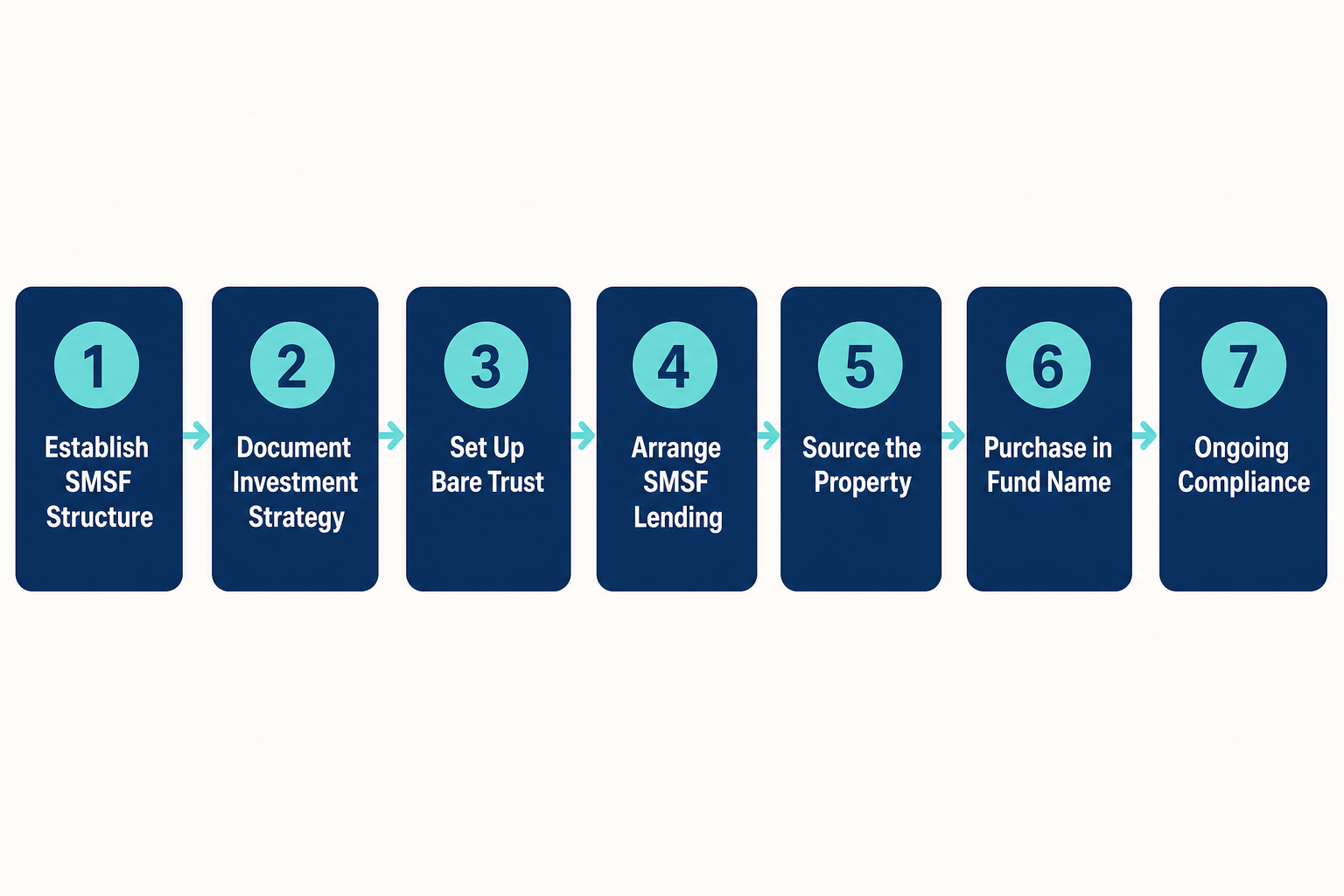
Step-by-step: how to buy property using superannuation
The process of buying property through an SMSF involves more moving parts than a standard property purchase. Getting the structure right from the start prevents expensive and difficult-to-unwind problems down the track.
Step 1: Establish or review your SMSF structure
If you do not already have an SMSF, it needs to be established with a properly drafted trust deed that explicitly permits property investing and LRBA borrowing. A corporate trustee structure is generally preferred for its governance and estate planning benefits. Initial setup costs typically range from $1,500 to $3,000 depending on complexity. If your existing SMSF is already established, have your trust deed reviewed to confirm it allows for the contemplated investment.
Step 2: Document an investment strategy
All SMSFs are legally required to maintain a written investment strategy that considers risk, return, diversification, liquidity, and the members' circumstances. Before any property purchase, the strategy must be updated to specifically reflect the intended acquisition. This document is reviewed by your independent auditor each year and must align with how the fund actually invests.
Step 3: Establish the bare trust
If you are borrowing to buy the property, a separate bare trust must be established before settlement. The bare trust holds legal title to the property during the loan term; the SMSF holds the beneficial interest. A specialist SMSF solicitor should prepare the bare trust deed. Using the wrong trust structure is one of the most common and costly compliance errors.
Step 4: Arrange SMSF lending pre-approval
SMSF property lending is a specialist product not offered by all lenders. Approach a mortgage broker with demonstrated SMSF experience to identify suitable lenders and obtain pre-approval before committing to a purchase. SMSF loan rates are higher than standard investment loans, and lenders apply stricter criteria including higher deposit requirements and liquidity buffers.
Step 5: Source and assess the property
This is where investment discipline matters most. The property must be selected based on its investment merit within your fund's documented strategy, not on personal preference or lifestyle appeal. Strong indicators of investment quality include off-market access to properties with genuine demand-side fundamentals, manageable vacancy rates, and clear long-term capital growth logic. Conduct thorough property investment due diligence before making any offer, including building and pest inspections, strata reports where applicable, and an independent market valuation.
Step 6: Purchase in the fund's name
Settlement must occur in the name of the bare trust (if borrowing) or directly in the SMSF trustee's name (if buying outright). The property cannot be purchased in your personal name and transferred later. Stamp duty and conveyancing apply as normal. Your SMSF solicitor should handle conveyancing or at minimum review all documents before settlement.
Step 7: Manage ongoing compliance
Post-settlement, the fund must ensure rent is collected into the SMSF's bank account, all expenses are paid from the fund, annual valuations are conducted, and the independent audit is completed each year. The property must not be used by any member or related party at any time.
Common SMSF property mistakes to avoid
The most expensive mistakes in SMSF property investing are structural, not market-based. Most of them are avoidable with the right preparation.
Poor liquidity planning. Running a property with an LRBA inside an SMSF means the fund must absorb loan repayments, vacancy costs, rates, insurance, and management fees entirely from within the super environment. Funds that do not model worst-case scenarios, including extended vacancy or major maintenance, can find themselves unable to meet obligations without breaching compliance.
Overconcentration in a single asset. When a $500,000 property represents 80% of a fund's total balance, the fund's entire retirement outcome becomes dependent on one asset in one suburb. This is a risk profile that few trustees would accept in any other context. Understanding the biggest investment mistakes Australians make helps frame why diversification inside the fund matters.
Buying for the wrong reasons. Choosing a property because it is nearby, familiar, or emotionally appealing rather than because it meets clear investment criteria is one of the most common drivers of underperformance. SMSF property must be purchased at arm's length and justified by its investment merits.
Using borrowed funds for improvements. Under LRBA rules, borrowed money cannot be used to improve a property in a way that changes its character. Using LRBA funds for anything beyond repairs and maintenance risks a compliance breach. Improvements must be funded from the SMSF's own cash reserves.
Weak or missing documentation. The ATO has increased data matching and audit activity in 2025-26. Every transaction, valuation, trust deed, investment strategy update, and bare trust document must be properly maintained. Late lodgements and missing records are among the most common triggers for deeper scrutiny.
Ignoring Division 296 implications. For investors approaching the $3 million total super balance threshold, buying property inside super without modelling the Division 296 impact could result in an unexpected tax outcome. The legislation applies from 1 July 2026 and only covers realised earnings, but the cost-base reset election available to SMSFs must be lodged by the due date of the 2026-27 annual return.
| Common mistake |
Why it happens |
How to avoid it |
| Poor cash flow modelling |
Contributions underestimated; vacancy not stress-tested |
Model fund cash flow across 2 to 3 vacancy scenarios before purchase |
| Overconcentration |
Single property dominates the fund |
Consider portfolio mix; property should sit within a broader asset plan |
| Wrong purchase structure |
Legal title held incorrectly |
Use a specialist SMSF solicitor; never settle before bare trust is established |
| LRBA used for improvements |
Misunderstanding of borrowing rules |
Fund improvements from SMSF cash only; get legal advice before any renovation |
| Related party breach |
Member or family uses property |
Strict no-personal-use policy from day one; document and audit annually |
How a buyers agent can support SMSF property acquisition
The compliance framework governing SMSF property purchases does not reduce the importance of buying the right property. It increases it. Mistakes inside super are harder to unwind and carry greater financial consequences than mistakes made in personal name. That is one reason why buyer-side representation adds meaningful value in this context.
A buyers agent operating within an SMSF purchase works on the buyer's side exclusively. Their role covers sourcing, assessing, negotiating, and managing due diligence on the property itself. They do not provide financial advice, SMSF structuring advice, or legal counsel. Those services remain the domain of licensed SMSF specialists, financial advisers, and solicitors.
Where buyer-side support genuinely helps in an SMSF context:
Property sourcing with investment discipline. The property must meet the fund's documented investment strategy. A buyers agent focused on investment-grade assets applies consistent sourcing criteria, including suburb fundamentals, rental yield, tenant demand, vacancy rates, and long-term capital growth indicators, rather than personal preferences.
Off-market access. A proportion of quality investment properties change hands before they are publicly listed. Access to off-market properties that most buyers never see is a genuine advantage in a compliance-sensitive purchase where the selection process must be defensible and documented.
Objective due diligence. Thorough property due diligence, including building reports, strata reviews, and independent valuation confirmation, is particularly important inside an SMSF. A buyers agent coordinates and reviews these reports objectively, without the emotional bias that often affects self-directed purchasers.
Negotiation at arm's length. SMSF property must be purchased at market value from an unrelated third party. Professional negotiation supports this requirement while also working to achieve the best possible terms for the fund.
Buyers Agency Australia works with investors across the country seeking to build portfolios with conviction. Led by Dragan Dimovski, a property expert with over 20 years of experience in investment-grade acquisition, the team brings a data-led, strategy-first approach to sourcing properties that meet clear investment criteria, whether purchased inside an SMSF or in personal name.
For investors who want to understand how buyer-side support fits their SMSF strategy, booking a free strategy session is a practical starting point for mapping out the property side of the acquisition plan before committing to anything.
Next steps and when to seek professional advice
SMSF property investing is a legitimate and potentially powerful strategy for the right investor with the right structure. It is not a shortcut to property wealth, and it is not suitable for every fund or every stage of life.
Before proceeding, work through this checklist:
- Speak with a licensed SMSF specialist to confirm your fund structure supports property investment and LRBA borrowing
- Engage a registered financial adviser to assess whether the strategy aligns with your overall retirement objectives
- Have your SMSF trust deed reviewed by a specialist solicitor before any purchase
- Confirm your fund has the cash flow and liquidity to service the loan and absorb vacancy without relying on additional contributions beyond current caps
- Update your SMSF investment strategy document to reflect the intended acquisition before settlement
- Engage an SMSF auditor early to ensure the fund's records, bare trust documentation, and compliance obligations are in order
- Model your total super balance against the Division 296 threshold if your balance is approaching or above $3 million
- Engage a buyers agent for the property sourcing and acquisition component once your structural, legal, and financial foundations are in place
For the property acquisition side of the process, Buyers Agency Australia supports investors in identifying and securing investment-grade properties that align with their documented fund strategy. The team works across major Australian markets and brings both buyers agent expertise for property investment and deep knowledge of what makes a property perform inside a long-term portfolio.
If you are ready to map out the property component of your SMSF acquisition plan, book a free strategy session with the team or contact the team directly to get started.
Frequently asked questions
Can I live in a property owned by my SMSF?
No. ATO rules prohibit SMSF members and related parties from living in or using residential property owned by the fund. Any personal use constitutes a sole purpose test breach.
How much super do I need before SMSF property investing makes sense?
Most advisers recommend a minimum fund balance of $200,000 to $300,000. Below that level, ongoing SMSF running costs typically outweigh the tax benefits of the structure.
Can my SMSF buy property from a family member?
Generally no. Residential property cannot be purchased from a related party. Commercial business real property is an exception when acquired at market value on arm's length terms.
What happens to SMSF property when I retire?
The property can be sold with proceeds retained in the fund, transferred out as an in-specie payment, or continue to be held in pension phase where income may attract a lower or zero tax rate depending on your transfer balance cap.
Does my SMSF need a separate bank account for property?
Yes. All SMSF transactions, including rental income received and property expenses paid, must flow through the fund's dedicated bank account, kept separate from any personal or business accounts.
 General
Investing in property through an SMSF is one of Australia's most discussed retirement strategies, but it comes with...
Owning property in Australia does not automatically mean building wealth. Thousands of investors hold one or more assets yet remain financially stretched, cash-poor, and no closer to the freedom they were working toward. This article examines the patterns behind that gap and the disciplined approaches that change the outcome.
Why many investors look successful on paper but remain cash-poor
There is a persistent illusion in Australian property circles: if you own an investment property, you must be getting ahead. The reality is far more complicated. A growing body of data shows that holding assets and actually building wealth are two very different things.
KPMG modelling released in May 2026 found that Australian average household wealth rose nearly 23.6% in real terms between 2019-20 and 2024-25, yet median household wealth was essentially unchanged at around $700,000 over the same period. The gains went to those with the right assets, held in the right way. Owning property did not guarantee inclusion in that group.
The gap between paper wealth and actual financial progress is driven by a set of recurring, avoidable patterns. An investor can hold a property worth $900,000, carry $750,000 in debt, face ongoing holding costs that exceed rental income, and sit on an asset that is growing slowly in a suburb they chose because a seminar presenter said so. The spreadsheet looks impressive. The bank account tells a different story.
Buyers Agency Australia works with investors across every stage of this journey, and the same themes appear repeatedly: asset ownership without asset quality, growth without cash flow, and activity without strategy. Understanding where wealth quietly leaks is the first step toward stopping it.
This is not a commentary on whether property investment works. It does, when approached with genuine discipline. The question is why so many investors never reach the outcome they planned for, and what separates them from those who do.
The most common mistakes that quietly erode investor wealth
Most of the damage done to Australian property portfolios is self-inflicted and slow-moving. The mistakes that cost investors the most are rarely dramatic. They are structural, and they compound over time.
Overleveraging without a cash flow buffer
The Reserve Bank of Australia's May 2026 Bulletin on housing investors found that around 20% of leveraged investors had a housing debt-to-income ratio above 6, a level both APRA and the RBA classify as higher risk. High leverage is not inherently reckless, but high leverage without adequate cash reserves is a genuine vulnerability.
When rates move, vacancy appears, or a repair bill arrives, thinly buffered investors are forced into reactive decisions: drawing on lines of credit, delaying maintenance, or selling at the wrong point in the cycle. The property itself may be sound. The structure around it is not.
| Common Investment Mistake |
Why Investors Make It |
The Long Term Cost |
| Overleveraging |
Chasing rapid growth without properly stress testing cash flow |
Financial pressure, refinancing issues, and potential forced sales during downturns |
| Poor suburb selection |
Buying based on hype, emotion, or familiarity rather than research |
Weak growth performance and lower future demand |
| Emotional buying |
FOMO at auctions or pressure from agents and developers |
Overpaying and purchasing the wrong type of property |
| Ignoring holding costs |
Focusing only on the purchase price and loan approval |
Ongoing negative cash flow that reduces overall returns |
| Skipping due diligence |
Rushing to secure a deal before completing proper checks |
Hidden defects, council restrictions, or costly legal issues |
Poor asset selection driven by emotion or convenience
Around 70% of Australian housing investors own a single property, and the remaining 30% with multiple properties hold roughly half of all investment stock. The investors who expand their portfolios consistently tend to have one thing in common: they buy based on criteria, not feelings.
Emotional buying shows up in several forms. It is the investor who purchases in their own suburb because they know it. It is the one who buys off-the-plan because the display suite felt aspirational. It is the couple who stretched their budget on a renovated terrace because they could picture themselves living there. In each case, the decision process prioritised comfort over evidence.
The biggest property investment mistakes Australians are making in 2026 frequently trace back to this single issue: the asset was chosen for the wrong reasons. Growth fundamentals, rental demand, supply constraints, and long-term owner-occupier appeal were secondary considerations at best.
Ignoring ongoing holding costs and true cash flow
A property that looks marginally positive on a back-of-envelope calculation can look very different when council rates, insurance, property management fees, maintenance, land tax, and vacancy periods are modelled properly. A useful benchmark is to budget approximately 2% of the property's value annually for ongoing holding costs, excluding loan repayments. On a $750,000 asset, that is $15,000 per year before a single mortgage dollar is counted.
Investors who skip this modelling tend to be the ones surprised by their cash position twelve months in. They planned for the rent they hoped for, not the rent the market delivers after a vacancy gap or a lease renegotiation. The result is a drain on personal income that was never expected, reducing the ability to service additional debt or act on future opportunities.
For a clear checklist on what to examine before committing to any investment property, the due diligence process should begin before the contract, not after.
Skipping due diligence to move quickly
In a market where competition for quality assets is real, the pressure to act fast can override sound process. Investors who skip building and pest inspections, title searches, zoning checks, and rental appraisals to secure a deal faster often discover problems that a few extra days of scrutiny would have surfaced. Speed is not a competitive edge if it means buying a liability.
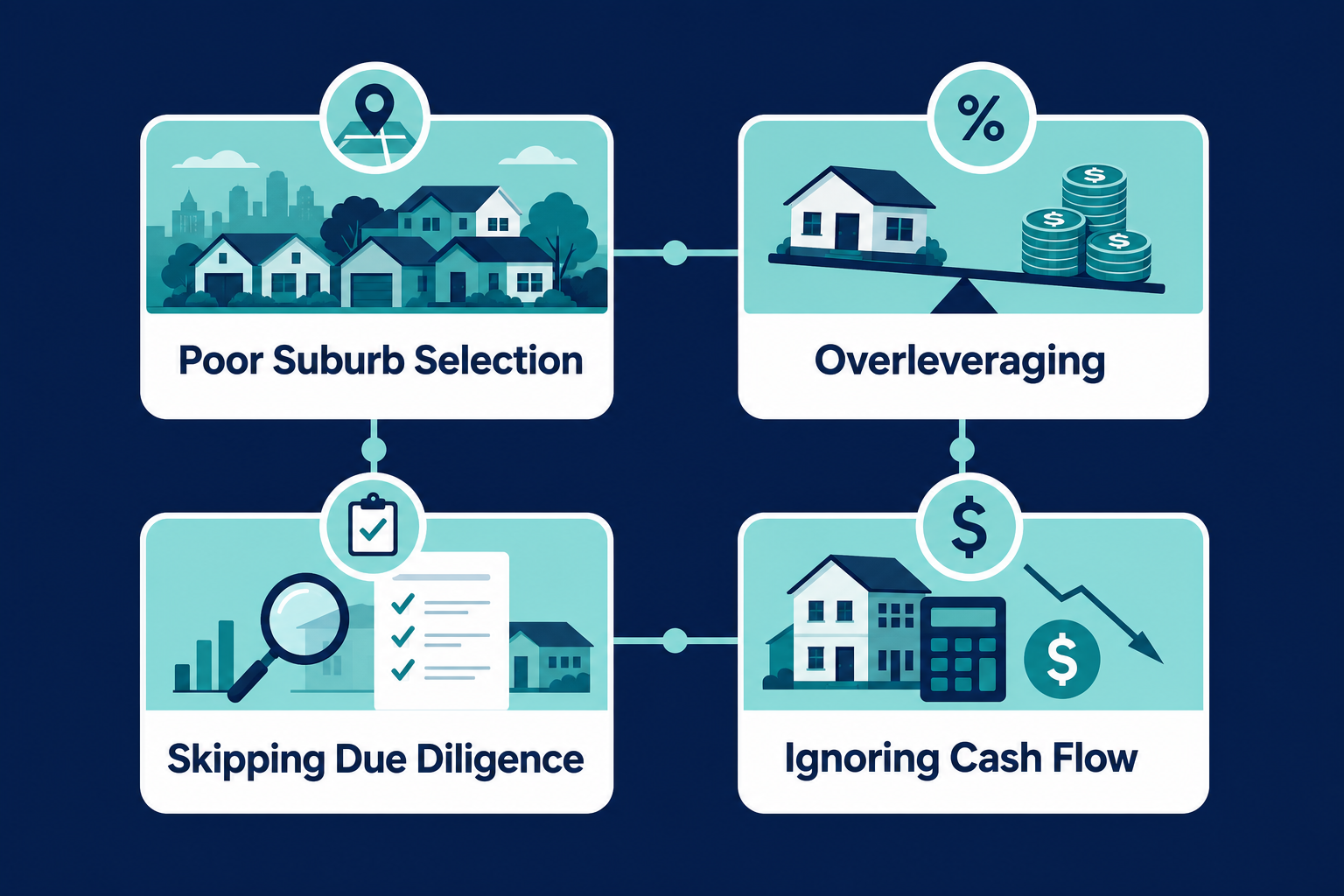
Why strategy beats speculation in 2026
The Australian property market in 2026 is not uniform. Performance is increasingly determined by local supply constraints, infrastructure spending, population inflows, and the depth of owner-occupier demand. The broad market cycles that once lifted almost every suburb have fragmented. Picking the right market now requires genuine analysis, not assumption.
This is precisely why a clearly defined property investment strategy matters more in this environment than it did even five years ago. Strategy is not a vague commitment to buying well. It is a documented set of buy criteria, a cash flow model stress-tested against realistic scenarios, a hold horizon, and a plan for the next acquisition before the current one settles.
Investors who operate from strategy make fundamentally different decisions. They define acceptable yield thresholds before inspecting a property, not after falling in love with it. They set a maximum acquisition cost and treat it as a real boundary. They model what happens to cash flow if their borrowing rate increases by one percentage point, and they only proceed if the numbers still work.
Speculation, by contrast, relies on the market doing the heavy lifting. It assumes that any property in a growing city will perform. That assumption is increasingly expensive to hold.
The top property investment trends for 2026 reinforce this point consistently: asset selection precision, cash flow discipline, and suburb-level research are the characteristics separating investors who grow their portfolios from those who remain stuck at one property for a decade.
How a buyers agent can help investors avoid costly missteps
A buyers agent for property investment provides something most investors do not have on their own: an independent, research-backed perspective applied consistently across every acquisition decision.
The value is not simply access. It is structure. A skilled buyers agent works through a systematic evaluation process for every potential asset: suburb fundamentals, supply pipeline, rental demand depth, comparable sales, asset quality, and negotiation positioning. That process removes the emotional variables that compromise most self-directed investment decisions.
Dragan Dimovski, founder of Buyers Agency Australia and a property expert with more than 20 years of experience, has observed that the investors who struggle most are rarely short of capital or market access. They are short of discipline. They buy when they should wait, overpay because the negotiation felt uncomfortable, or select an asset that fits their lifestyle rather than their portfolio goals.
Buyer-side representation addresses each of these gaps directly:
- Research depth: A buyers agent assesses fundamentals that most investors do not know to look for, including absorption rates, development approval pipelines, and owner-occupier demand ratios.
- Off-market access: Many of the strongest investment-grade properties are acquired before they reach listing portals. Access to off-market properties in Australia is a structural advantage that compounds across a portfolio.
- Negotiation: An experienced buyers agent negotiates without emotional attachment, which consistently produces better acquisition prices.
- Decision quality: Having a professional accountability partner prevents the reactive decisions that tend to destroy returns.
First-time investors who have worked with a buyers agent consistently report that the greatest value was not finding the property. It was avoiding the wrong one.
For investors in Sydney, Brisbane, Melbourne, or anywhere across Australia's major markets, Buyers Agency Australia provides end-to-end acquisition support from strategy through to settlement.
A practical checklist for smarter property decisions
This framework is designed as a decision-quality tool, not financial advice. It reflects the kind of discipline that separates investors who build genuine portfolio momentum from those who stay stuck.
Before selecting a suburb:
- Is population and employment growth in this area structurally supported, not just cyclically elevated?
- What does the supply pipeline look like over the next three to five years?
- Is owner-occupier demand strong enough to support prices if investor sentiment softens?
- What is the median vacancy rate, and how has it trended over the last two years?
Before selecting an asset:
- Does the property have broad appeal across multiple tenant and buyer segments?
- Are land content and scarcity characteristics strong relative to comparable assets?
- Can the asset service itself at a 1% higher interest rate than your current loan rate?
- Have you obtained an independent building and pest inspection, not just a vendor-provided report?
Before signing a contract:
- Have you obtained a written rental appraisal from a property manager, not an estimate from the selling agent?
- Have you modelled total annual holding costs, including land tax at your cumulative portfolio value?
- Does this asset fit your portfolio plan, or does it just look good in isolation?
- Have you had the contract reviewed by a solicitor or conveyancer with investment property experience?
| Due Diligence Area |
Key Question to Ask |
Potential Red Flag |
| Suburb Fundamentals |
Is long term demand supported by jobs, infrastructure, and population growth? |
Reliance on a single industry, employer, or mining sector |
| Asset Quality |
Does the property have strong land value and solid construction quality? |
High strata fees, poor maintenance, or aging complexes |
| Cash Flow |
Can the property comfortably hold at higher interest rates? |
Negative cash flow under current lending conditions |
| Legal & Planning |
Is the title clear and zoning suitable for the intended strategy? |
Unapproved structures, easements, or planning restrictions |
| Rental Demand |
Is the projected rental return supported by real market evidence? |
Rental estimates without comparable leasing data |
The property investment hotspots and strategies shaping 2026 share a common thread: the investors performing best are those working from a clear framework, not reacting to headlines.
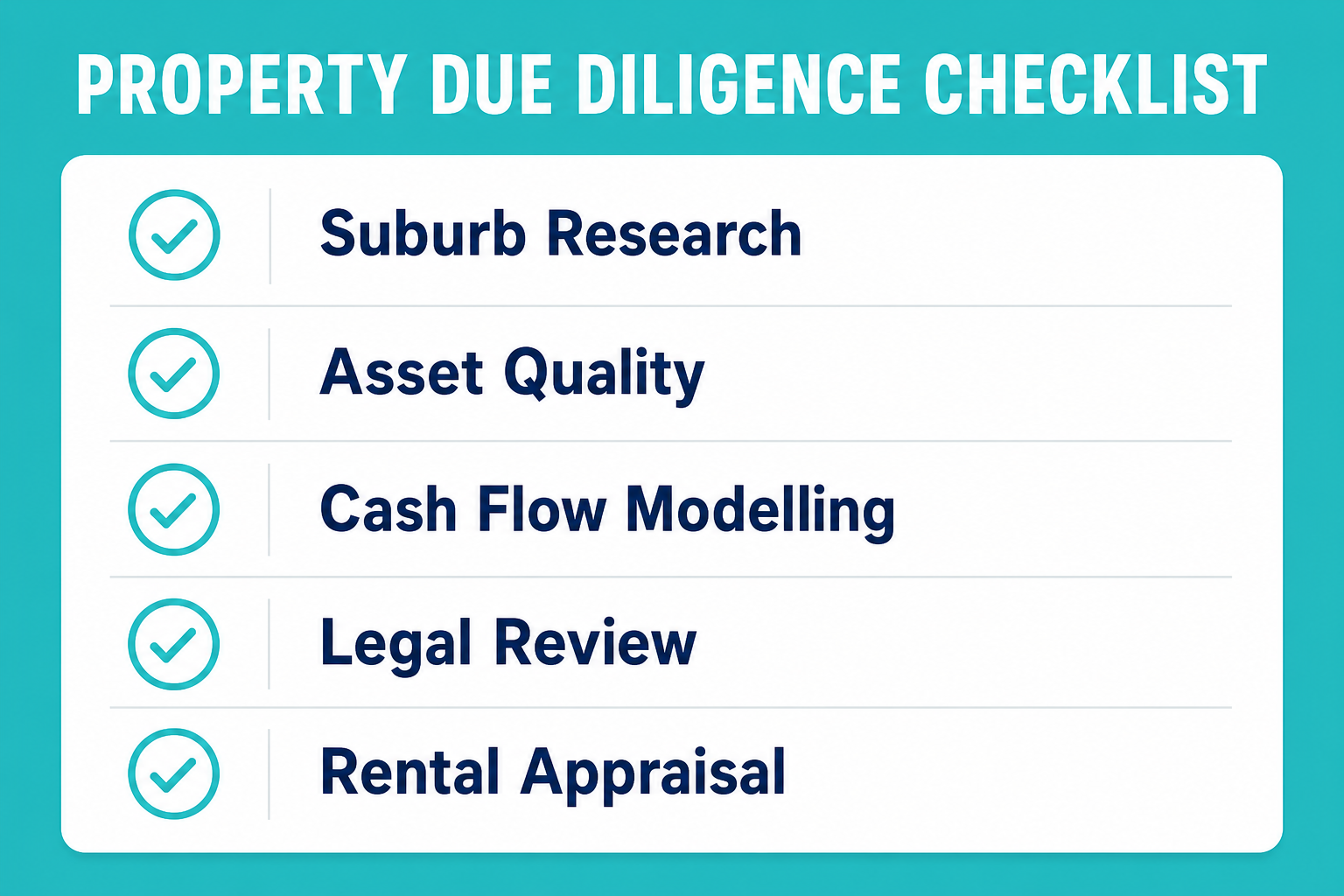
When to seek tailored guidance
This article provides general information about common investor behaviours and strategic frameworks. It is not personal financial advice, and every investor's situation involves specific circumstances that general guidance cannot account for. Before making any property acquisition or portfolio decision, you should consider seeking advice from a licensed financial adviser and a qualified property professional who can assess your individual position.
That said, the difference between investors who move forward with confidence and those who stay stuck is almost always the same thing: access to a structured, accountable process. Not more information. Not more time. A clear process applied consistently.
If you are reviewing your property investment approach for 2026 or preparing to add to your portfolio, book a free strategy session with the Buyers Agency Australia team to map out your next property move. The session is obligation-free and focused on your specific goals, market, and timeline.
For investors ready to take the next step, contact the team directly to discuss acquisition support, suburb research, and off-market opportunities across Australia's major markets.
Frequently Asked Questions
Why do so many Australian property investors only ever own one property?
High property prices, overleveraging early, and poor cash flow planning limit borrowing capacity. Without a clear strategy, many investors simply cannot qualify for or sustain a second acquisition.
What is the biggest mistake first-time property investors make?
Buying based on emotion or convenience rather than researched criteria. This often results in poor suburb selection, overpaying, and holding an asset that underperforms for years.
How does a buyers agent help with property investment strategy?
A buyers agent provides research-led suburb and asset analysis, negotiation support, off-market access, and an independent decision-making process that removes emotion from acquisitions.
What holding costs should Australian property investors budget for?
Budget approximately 2% of the property's value annually for council rates, insurance, management fees, and maintenance, plus land tax based on your cumulative portfolio value across each state.
Is property investment still worth pursuing in 2026?
Yes, when approached with disciplined strategy, clear buy criteria, and proper due diligence. The market rewards structure over speculation, particularly in a fragmented cycle where suburb selection matters more than ever.
 General
Owning property in Australia does not automatically mean building wealth. Discover the common mistakes quietly eroding investor returns...
The question every investor is asking right now deserves a straight answer, not a sales pitch. With the RBA cash rate sitting at 4.35% after three consecutive hikes in 2026, borrowing costs have climbed sharply from where they sat just eighteen months ago. Markets in Sydney and Melbourne are softening, consumer confidence is near multi-decade lows, and a federal budget that rewrites the rules on negative gearing has added another layer of complexity. Yet rental vacancies remain critically tight, housing supply is structurally behind demand, and disciplined investors are still finding opportunities worth acting on. The real question is not whether property investing works in Australia. The question is whether it works for you, right now, with the right asset and the right approach.
Introduction: Is property investing still worth it in Australia in 2026?
If you bought in 2020 or 2021, you likely rode a wave of emergency-low interest rates and surging values. That environment is gone. What has replaced it is considerably more demanding: higher holding costs, tighter serviceability assessments, a more fragmented market, and an investing public that is either overconfident or paralysed by uncertainty.
None of that means property has stopped working as a wealth-building tool. It means the bar for a good decision has risen. Buyers Agency Australia works with investors across the country who are navigating exactly this environment, and the consistent finding is that strategy-led buying still produces results when everything else is harder.
This guide covers the market forces shaping investor decisions in 2026, when property still makes sense, what risks to weigh carefully, and how a clear property investment strategy can help you make better decisions in a more complex market.
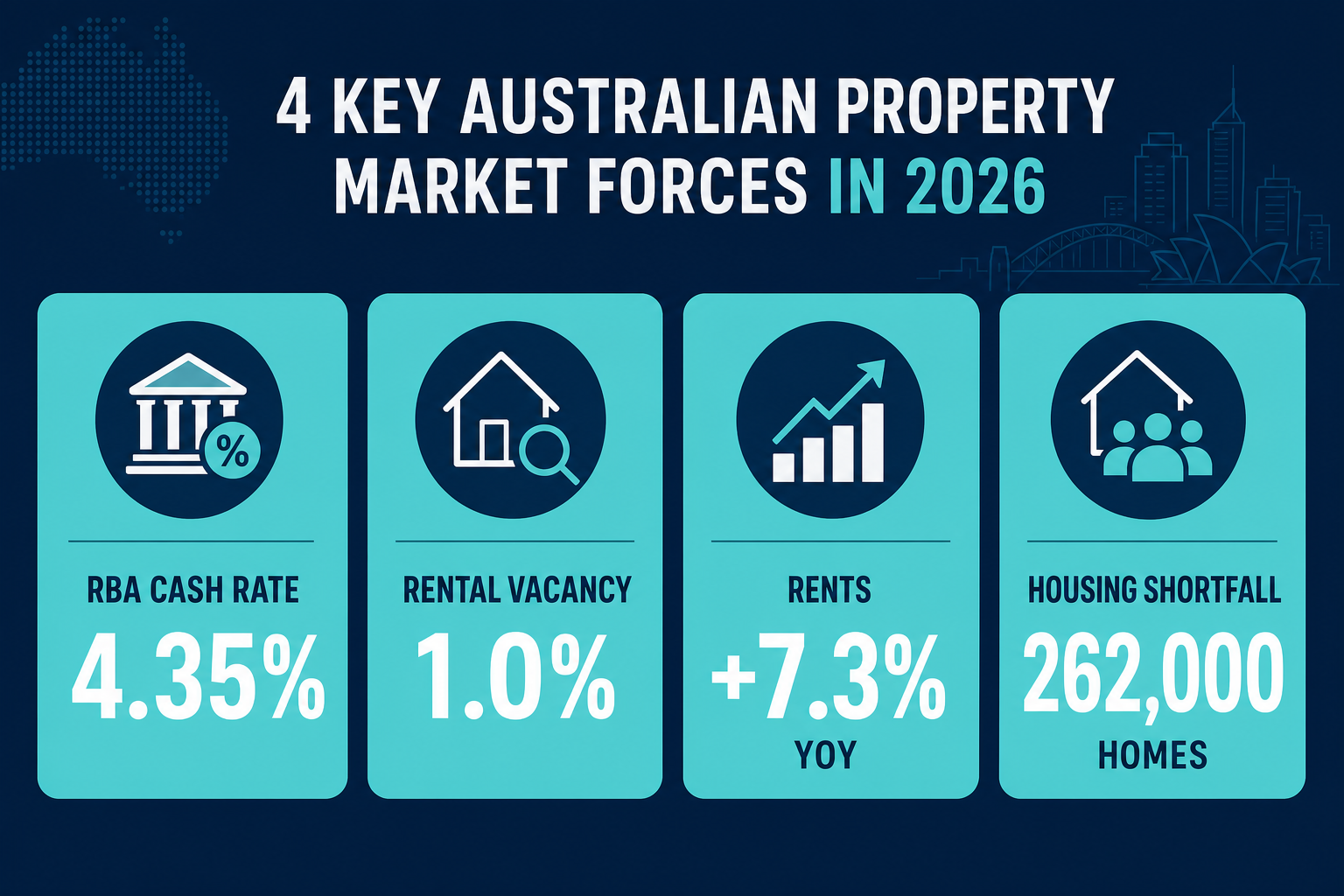
What has changed for Australian property investors in 2026
The single biggest shift for investors in 2026 is the interest rate environment. The RBA raised the cash rate to 4.35% at its May meeting, the third consecutive hike this year, as inflation picked up materially in the second half of 2025 and geopolitical pressures added to the cost of fuel and goods. Investment property loan rates are currently averaging around 5.66% to 5.74% on outstanding balances, according to RBA data, meaning serviceability is tighter than at any point since 2012.
At the same time, the federal government's May 2026 budget introduced changes to negative gearing and the capital gains tax discount for existing properties, creating material uncertainty for investors who have historically relied on these structures. The full impact of these reforms is still being absorbed by the market.
On the supply side, the structural picture still favours landlords. The national rental vacancy rate hit 1.0% in April 2026, well below the 2.5% to 3.5% range considered a balanced market, according to SQM Research data. National advertised rents have risen 7.3% year-on-year, with the average capital city rent above $794 per week. The National Housing Supply and Affordability Council forecasts the government's Housing Accord target of 1.2 million new homes will fall short by approximately 262,000 dwellings, meaning structural undersupply is set to persist.
| Market Force |
2024 Conditions |
2026 Conditions |
| RBA Cash Rate |
4.35% (post-cuts) |
4.35% (post-hikes) |
| National Vacancy Rate |
~1.4% |
1.0% (April 2026) |
| Annual Rent Growth |
~6% |
7.3% YoY |
| New Housing Loan Commitments |
Rising strongly |
Down 6.2% in Q1 2026 |
| Sydney/Melbourne Values |
Stabilising |
Modest decline |
According to ABS Lending Indicators for Q1 2026, total new housing loan commitments fell 6.2% in the March quarter, with investor loans down 5.3% in number and 3.0% in value. Despite the quarterly dip, investor lending activity remains 18.5% higher in value compared to a year earlier, signalling that serious investors have not exited the market.
The market is fragmented. Brisbane, Adelaide, and Perth are still delivering solid fundamentals for investors, while Sydney and Melbourne present a more nuanced picture. Understanding which market suits your goals is now more important than ever. The top property investment hotspots and strategies for 2026 are not uniform across the country.
When property investing can still make sense
Property does not suit every investor in every market phase, but there are clear scenarios where it still makes strong sense in 2026.
Long-term portfolio builders with a five-to-ten year horizon are positioned to absorb short-term rate volatility. Residential property has historically doubled in value over roughly every ten years in well-located Australian markets, though past performance does not guarantee future results. Investors who hold quality assets through cycles consistently outperform those who try to time the market.
Investors with clear serviceability who have modelled their cash flow at current rates, including a buffer for potential further hikes, are in a fundamentally stronger position than those relying on optimistic rate forecasts. If the numbers work at 5.5% to 6% on the investment loan, they are built on solid ground.
Rentvesting remains relevant for investors who cannot buy where they want to live but can access growth markets elsewhere. This approach separates the emotional decision of where to live from the financial decision of where to build wealth. Explore how positive cash flow properties still fit a portfolio for investors running this kind of strategy.
Investors targeting off-market opportunities are finding that reduced competition in some markets is creating entry points that were not available in 2021 or 2022. Vendor discounting has widened to a median of 3.1% across the combined capital cities, according to Cotality data, which represents better negotiating conditions than have existed for several years.
The key across all these scenarios is clarity: clarity about your budget, your cash flow position, the asset you are targeting, and how it fits your broader property portfolio goals.
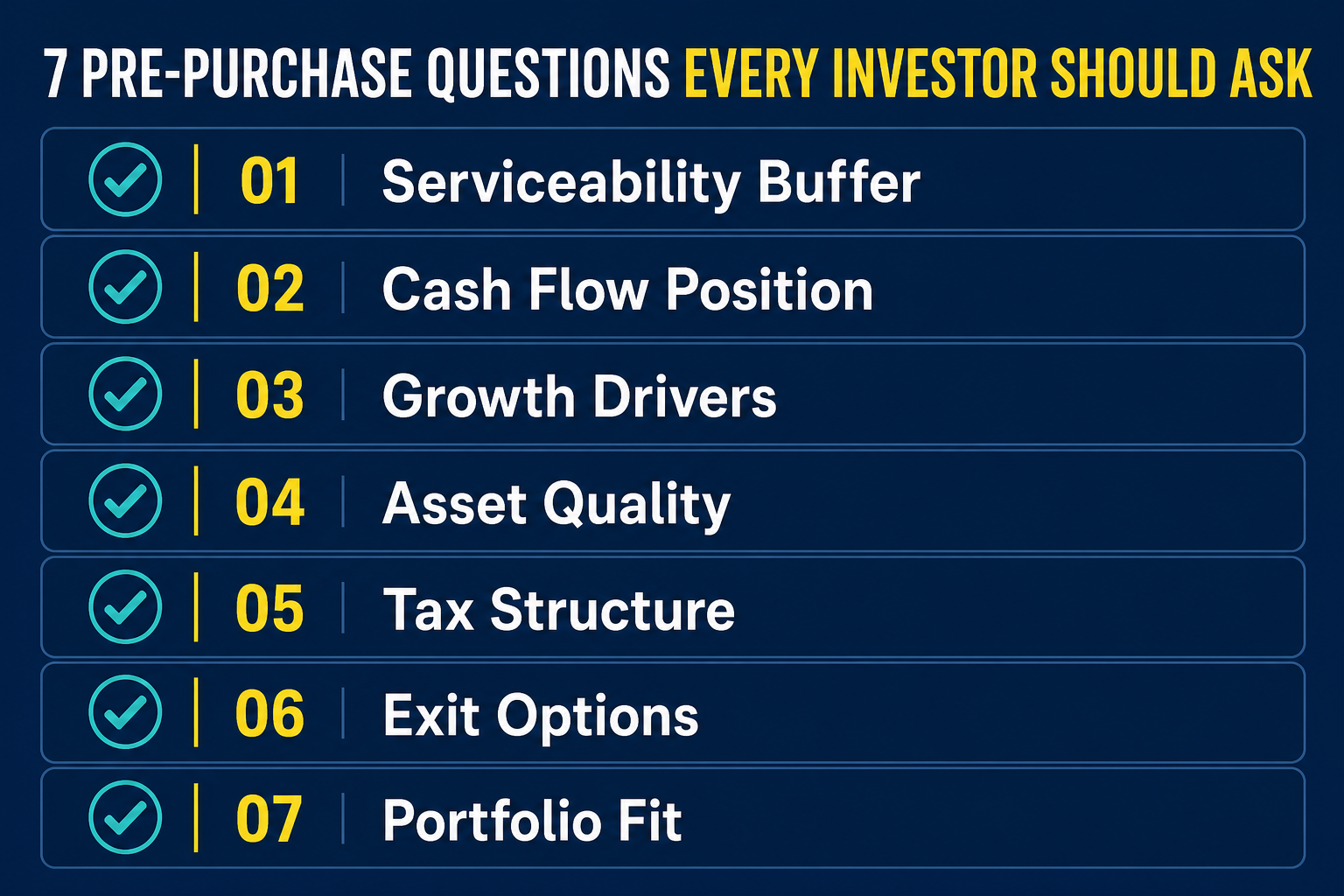
The risks investors need to weigh before buying
The headline risk in 2026 is overpaying for the wrong asset at the wrong price point. Markets are more fragmented than they have been in a decade, and a property that would have sold quickly in 2021 may not perform the same way in the current cycle. Suburb-level research matters more than ever.
Weak suburb selection is one of the most common and costly mistakes. Chasing affordability into markets with limited employment diversity, population growth, or infrastructure investment often produces stagnant capital growth even in good cycles. The biggest property investment mistakes Australians are making in 2026 frequently come back to this point.
Poor due diligence on the property itself, including building and pest inspections, strata records for units, and council zoning checks, remains a risk that is easy to underestimate in a competitive market. Thorough property due diligence before you buy is non-negotiable.
Relying on short-term market timing is a trap. Investors who waited for rates to fall in early 2026 and expected the market to rally sharply were caught off guard by consecutive hikes. No one consistently predicts short-term rate movements, and building an investment thesis around a specific rate cut timeline is a fragile strategy.
Tax structure changes from the federal budget add a new dimension to the risk profile, particularly for investors who have built their cash flow models around full negative gearing deductions on existing properties. Getting proper tax advice before committing to a purchase is now more critical than in previous cycles.
How strategy matters more than chasing headlines
The most consistent thing separating investors who build wealth through property from those who do not is not timing, luck, or market knowledge. It is having a clear property investment strategy and sticking to it.
A well-constructed strategy defines the type of property you are targeting (house versus unit, established versus new), the market characteristics you require (employment diversity, population trends, rental demand), the financial parameters your purchase must satisfy, and the role this property plays in your broader plan. It filters out the noise of daily headlines and keeps you focused on decisions that move your position forward.
Dragan Dimovski, with over 20 years of experience in property acquisition, has consistently observed that investors who come to the table with a clear brief, a realistic budget, and a long-term lens make better decisions than those reacting to market fear or market hype. The 2026 environment rewards precisely this kind of disciplined thinking.
As interest rates rise, smart investors are still buying property in Australia, but they are doing so with sharper criteria and a greater emphasis on asset quality. The shift away from speculative buying toward fundamentals-led selection is, arguably, a healthier dynamic for long-term investors.
For investors considering Brisbane, the 2032 Olympics infrastructure pipeline, population growth, and relative affordability compared to Sydney make it one of the stronger strategic markets in the current cycle. Melbourne presents a different picture, where off-market properties are changing the way buyers search and access quality stock below the noise of the public market.
Questions to ask before buying your next investment property
Before committing to any purchase in 2026, work through this practical checklist:
- Serviceability buffer: Can you service the loan at a rate 2% above your current offer, and does that still leave you with adequate cash reserves?
- Cash flow position: What is the realistic gross yield, and what are the total holding costs including rates, insurance, property management, and maintenance? Is the property positively geared or negatively geared, and by how much?
- Growth drivers: What are the specific demand drivers for this suburb: employment anchors, population trends, infrastructure projects, and rental demand characteristics?
- Asset quality: Is this a property that will attract consistent tenants and hold its value relative to surrounding stock over a full cycle?
- Tax structure: Have you reviewed how the 2026 budget changes to negative gearing and CGT interact with your intended holding structure? Has a qualified accountant reviewed your position?
- Exit options: If you needed to sell in three to five years, is there a liquid buyer pool for this property type and price point in this location?
- Portfolio fit: Does this purchase complement your existing holdings, or does it concentrate your exposure in a single market, sector, or risk profile?
None of these questions have universally right answers, but working through them honestly will tell you whether a property is the right fit for your goals or whether it just looks appealing at first glance. For a full framework, work through a property investment due diligence checklist before signing anything.
How a buyers agent can help investors buy more confidently
The case for using a buyers agent in 2026 is not about outsourcing your thinking. It is about improving the quality of information and access you bring to each decision.
A good buyers agent who works exclusively for the buyer brings three things that are genuinely hard to replicate independently: access to off-market and pre-market stock, data-backed suburb and asset selection, and negotiation discipline that is not clouded by emotional attachment to a property. In a market where vendor discounting has widened and some sellers are more motivated than they have been in several years, negotiation quality matters in a concrete, dollar-figure way.
Buyers Agency Australia operates nationally with deep market coverage across Sydney, Brisbane, Melbourne, and other major markets. The team works purely on the buyer's side, meaning the advice is not influenced by agency listings or vendor relationships. For investors who want off-market property access and a structured acquisition process, this kind of independent representation is particularly valuable in the current market.
If you are actively looking or planning your next move, book a free strategy session with the team to map out what a disciplined approach to your next purchase could look like.
Conclusion: A balanced view for 2026 investors
Property investing in Australia in 2026 is neither as easy as it was in 2020 nor as closed off as some headlines suggest. The market is harder, more fragmented, and more sensitive to the decisions investors make at the asset and suburb level. But the structural case for residential property, namely constrained supply, sustained rental demand, and long-term population growth, has not disappeared.
What has changed is the cost of a poor decision. In a lower-rate, rising-market environment, even average choices produced reasonable returns. In the current environment, asset quality, suburb selection, cash flow modelling, and purchase discipline are the factors that separate investors who build wealth from those who stall or go backwards.
For investors who are serious about their next move, the best starting point is always the same: clarity on your goals, honest assessment of your financial position, and a sound property investment strategy that guides the search rather than chasing whatever the market is talking about this week.
When you are ready to work through that process with someone who has navigated multiple market cycles, map out your next property move with Buyers Agency Australia, or contact the team to discuss your situation directly.
Frequently Asked Questions
Is property still a good investment in Australia in 2026?
Property can still build wealth in Australia in 2026, but only when the purchase aligns with your goals, cash flow capacity, and a sound long-term strategy.
How have RBA rate hikes affected property investors in 2026?
Three consecutive RBA hikes have lifted the cash rate to 4.35%, increasing holding costs and tightening borrowing capacity, which means serviceability modelling is now critical before any purchase.
Which Australian cities are performing best for investors in 2026?
Brisbane, Adelaide, and Perth are showing stronger fundamentals than Sydney and Melbourne, though all markets are fragmented and require suburb-level analysis.
What risks should investors watch most closely in 2026?
Key risks include overpaying in weak suburbs, poor due diligence, reliance on market timing, and the impact of 2026 budget changes to negative gearing and capital gains tax.
What does a buyers agent actually do for a property investor?
A buyers agent searches, evaluates, and negotiates exclusively on behalf of the buyer, providing off-market access, independent research, and disciplined acquisition support.
 General
Is property investing still worth it in Australia in 2026? This guide examines RBA rate hikes, tight rental...
Australian property prices have continued to rise through one of the sharpest rate-hiking cycles in decades. This guide explains the structural forces keeping values elevated, what a responsible property investment strategy looks like right now, and when it makes sense to seek expert guidance rather than act on headlines alone.
Why high interest rates do not always stop property prices rising
The conventional view goes something like this: rates go up, borrowing gets more expensive, fewer people can afford to buy, and prices fall. It is a logical sequence, but Australian property has repeatedly refused to follow that script.
The Reserve Bank of Australia raised its cash rate to 4.35% at its May 2026 meeting, the third consecutive hike this year. Yet national home values still grew 8.6% through 2025, according to Cotality data, the strongest annual result since 2021. The relationship between borrowing costs and prices is more nuanced than most commentary suggests.
Interest rates influence how much a buyer can borrow, not whether demand for housing exists. When the fundamental gap between how many homes are available and how many people need them is wide enough, borrowing costs alone cannot close it. Prices reflect that structural tension.
It is also worth noting that a meaningful share of today's buyers are equity-rich upgraders, downsizing retirees, and SMSF investors who carry little or no new debt. Rate movements have a limited effect on their purchasing decisions. That cohort has continued to compete for a thin pool of listings, keeping clearance rates competitive across many suburbs even as mortgage costs rise.
None of this means property prices will always rise regardless of conditions. It means that in a market with Australia's specific supply and demand characteristics, rate movements are one input among many, and often not the dominant one. Understanding this distinction is the starting point for any credible property market forecast.
The main forces that can keep prices moving up
Several interconnected drivers have been working together to support Australian property values through this rate cycle. None of them are temporary.
Supply that cannot keep up with demand
Australia's population grew by more than 420,000 people in the year to late 2025, yet the net increase in housing stock was only around 165,500 dwellings, well below the pace needed to meet demand. Construction pipelines remain constrained by labour shortages, planning delays, and rising materials costs. The government's National Housing Accord target of 1.2 million new homes by 2030 is already tracking roughly 78,000 units behind schedule.
Population growth and migration
Net overseas migration has been running at historically high levels since borders reopened. Treasury estimates put net migration at around 306,000 for the 2024-25 financial year, with the population still adding more than 300,000 people annually going forward. New arrivals concentrate in Sydney, Melbourne, Brisbane, and Perth, which are already the tightest markets. That sustained inflow sustains rental demand, which in turn supports investor purchasing activity.
Rental vacancy rates nationally sat at approximately 1.7% in late 2025, well below the 3% level considered a balanced market. Extremely tight rental conditions push some renters toward purchasing, adding another layer of buyer demand.
Investor and owner-occupier activity
Buyers who were priced out of Sydney and Melbourne have contributed to strong demand in Brisbane, Adelaide, and Perth. According to KPMG's Residential Property Outlook, Brisbane house prices are forecast to grow by close to 11% in 2026, and Perth by nearly 13%, driven by population growth and constrained supply in those markets. Interstate investors seeking relative affordability and better yields have been an active segment, particularly in Queensland and South Australia.
| Market driver |
Impact on prices in a high-rate environment |
| Chronic housing undersupply |
Strong upward pressure, limits price falls |
| High net overseas migration |
Sustained buyer and renter demand |
| Low rental vacancy rates |
Pushes renters into buying market |
| Equity-rich non-leveraged buyers |
Insulated from rate increases |
| Interstate investor demand |
Supports mid-tier capital markets |
For investors researching where conditions are currently strongest, the top property investment hotspots and strategies for 2026 provide useful context on which markets are outperforming.
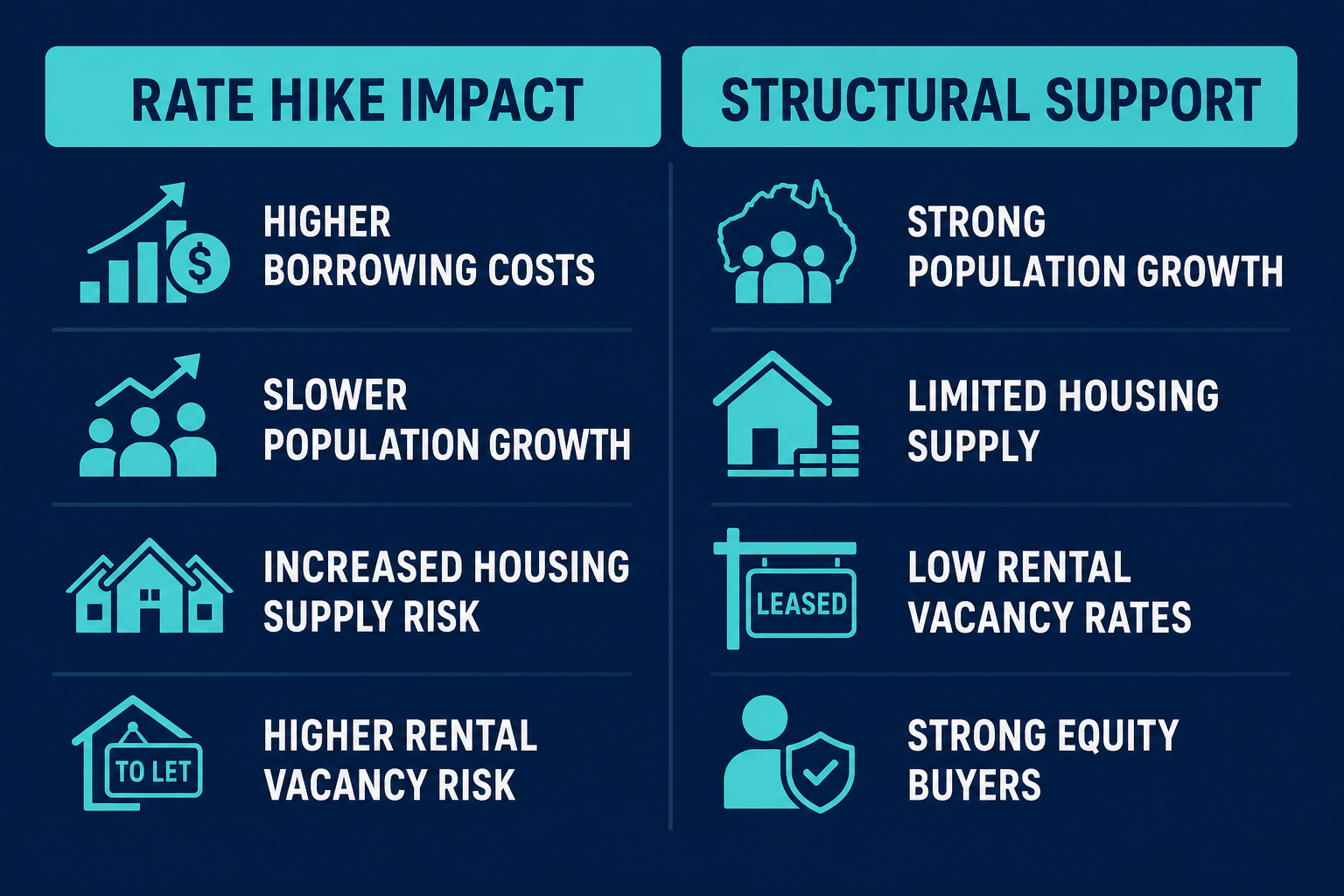
What investors should watch before buying in a high-rate environment
Strong structural drivers do not eliminate risk. A sound property investment strategy in this environment needs to account for the realities of borrowing at elevated rates, not just the macro tailwinds.
Serviceability and cash flow buffers
Lenders currently assess serviceability using a stressed rate typically 2-3% above the actual loan rate. That means your borrowing capacity is being calculated against a notional rate close to 7% or above in many cases. Investors need to stress-test their own numbers: if rates stay elevated for two or three years, can the property still be held comfortably?
Maintaining a meaningful cash flow buffer matters more in this environment than it did when rates were near record lows. Positively geared or near-neutral properties are more attractive for portfolio resilience, particularly for investors looking to preserve borrowing capacity for future acquisitions. For a deeper look at what is still possible, the guide on positive cash flow property in Australia is worth working through.
Suburb selection based on data, not instinct
Not every suburb will hold value or grow through this cycle. Markets with strong employment diversity, infrastructure investment, population inflows, and limited new supply are best positioned. Generic "property goes up" thinking does not survive a close look at local vacancy rates, days on market, or listing volumes.
Investors should examine how each target suburb's rental market is tracking, what the long-term owner-occupier demand profile looks like, and whether the local economy has the depth to support values if sentiment softens further.
Thorough due diligence before committing
In faster-moving markets, buyers sometimes compress their due diligence to avoid losing a property. That trade-off is rarely worth it. Building inspections, strata reports, flood and bushfire overlays, rental appraisals, and contract reviews should be non-negotiable steps. A property investment due diligence checklist is a practical starting point before engaging conveyancers or making offers.
Read More: Interest Rates Are Rising Again But Smart Investors Are Still Buying Property
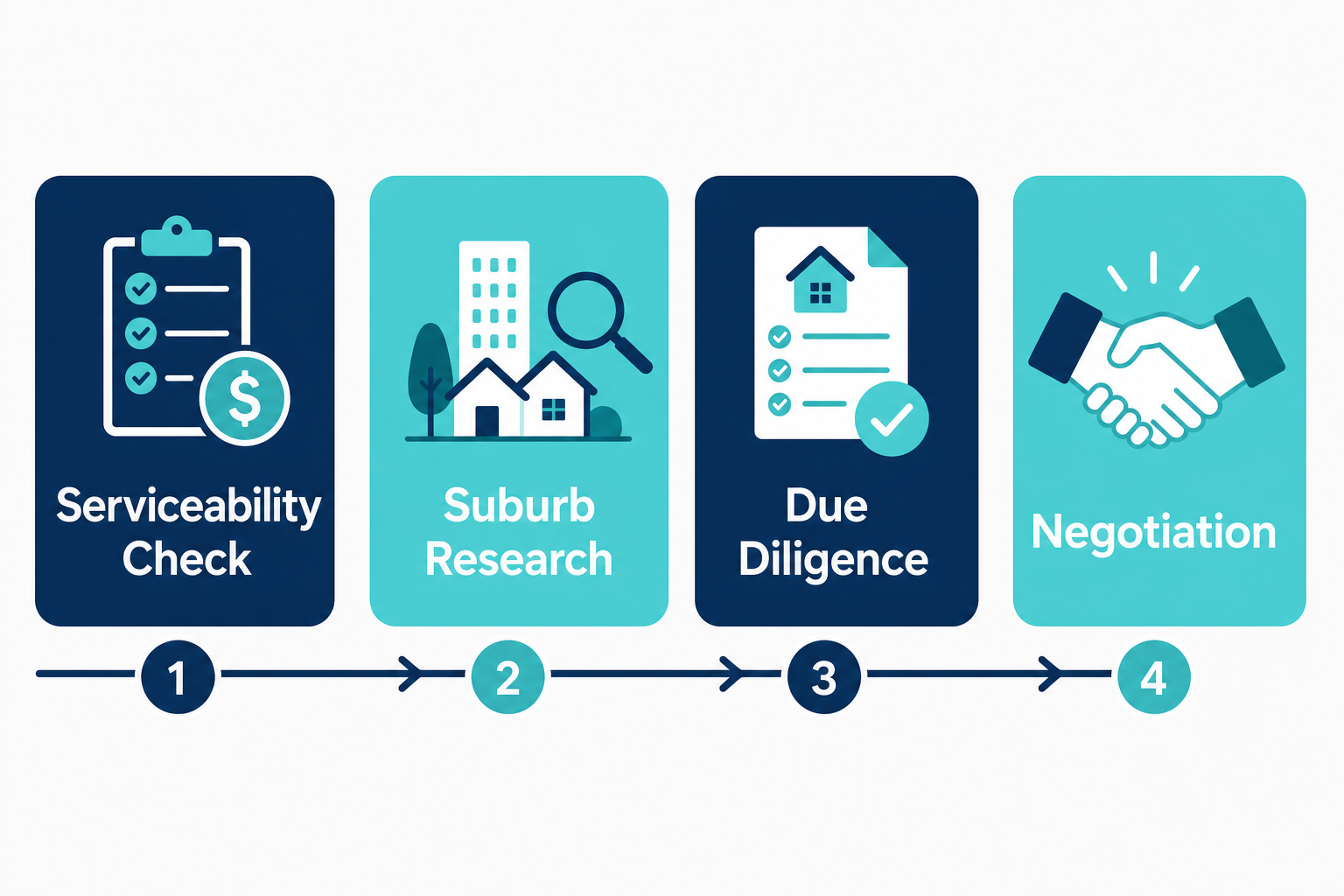
How a buyers agent can help in this market
Buyers Agency Australia works with property investors nationally, taking a research-led approach to suburb selection and acquisition rather than responding reactively to whatever is listed on the major portals.
Leading the team is Dragan Dimovski, a property expert with more than 20 years of experience working across Australian residential markets. In a high-rate environment, where getting the wrong suburb or the wrong price can have outsized consequences on a portfolio's ability to grow, that experience matters in ways a weekend of online research rarely can replicate.
The practical value of a buyers agent in this market comes down to a few specifics:
- Research depth: Buyers Agency Australia analyses suburb fundamentals including vacancy rates, supply pipelines, infrastructure spending, demographic trends, and comparable sales before forming any view on where to buy.
- Negotiation discipline: When sentiment is mixed and some sellers remain anchored to peak prices, professional negotiation can mean the difference between an asset that performs and one that does not.
- Access to opportunities: Many quality properties change hands through agent networks, prior relationships, or vendor referrals before appearing publicly. Having an active buyer-side presence in target markets improves access to those situations.
- End-to-end process management: From initial strategy through to settlement coordination, having a consistent point of accountability reduces the risk of costly errors at each stage.
For investors considering markets like Sydney or Brisbane, the Sydney buyers agent guide and the broader national property investment approach from Buyers Agency Australia are worth reviewing before making any independent moves.
If you want to talk through your current position and what a buying strategy could look like given today's rate environment, book a free strategy session and get a clear-eyed view of your options.
Common mistakes buyers make when they assume rates and prices must move together
Some of the most costly errors in Australian property investment come not from bad analysis but from false assumptions about how markets work.
Waiting for the "perfect time" that may not come
Many prospective investors have been waiting for rates to fall before buying, expecting prices to dip in the interim. In practice, Australia's structural undersupply has meant no Australian capital city is expected to see prices fall through 2026 or 2027, even under scenarios with continued rate pressure. Waiting for a broad correction that may not materialise means missing months or years of rental yield and capital growth.
The opportunity cost of inaction is real, particularly in markets where supply is thin. First-time investors often underestimate how quickly a well-priced property in a strong suburb can attract multiple qualified buyers. For those new to the process, the guide on how first-time investors avoid costly mistakes covers this ground in detail.
Confusing headlines with local market conditions
National property headlines are useful for context but almost meaningless for individual buying decisions. Sydney's inner west, a coastal Queensland town, and a secondary suburb in Adelaide are three completely different markets, each with distinct supply, demand, vacancy, and price momentum dynamics. Treating them as interchangeable because they all sit under the banner of "Australian property" leads to poorly targeted purchases.
Smart investors look at micro-level data: listing volumes relative to historical norms, days on market trends, population growth at the SA3 or suburb level, and infrastructure announcements specific to the area.
Paying above value out of fear of missing out
Emotional urgency is the enemy of disciplined property acquisition. In a market where good properties attract multiple offers, the pressure to overbid is real. Investors who lack an independent analysis of fair market value going into a negotiation are vulnerable to paying a premium that takes years to recover through growth alone.
| Mistake |
Why it is costly |
| Waiting indefinitely for rates to fall |
Misses yield and growth in resilient markets |
| Relying on national headlines for suburb decisions |
Poor targeting, wrong fundamentals |
| Overbidding from emotional urgency |
Compresses returns, increases recovery time |
| Skipping due diligence to move fast |
Exposes portfolio to structural, legal, or financial risk |
For investors curious about why some markets continue outperforming expectations, the analysis on why property isn't crashing despite rising rates adds useful perspective.
When to seek personalised advice
This article covers general market dynamics and common-sense investment considerations. It is not personal financial advice, and the right strategy for any individual investor depends on their income, existing assets, borrowing capacity, risk profile, tax position, and long-term goals.
General education about property markets and investment frameworks is a legitimate starting point. But at the point where a specific purchase, suburb, or portfolio structure is being considered, that is when general information stops being sufficient.
A qualified buyers agent can provide research and negotiation support grounded in your brief. A licensed financial adviser can assess whether a particular investment is appropriate for your overall financial position. These are complementary roles, not competing ones.
Buyers Agency Australia operates as a buyer-side advisory and acquisition service. The team does not sell properties and does not receive commissions from vendors or agents, which means the advice you receive is structured around your outcome, not a transaction fee.
If you are trying to decide whether buying in this market makes sense for your circumstances, map out your next property move with a free strategy session. Or if you are ready to start a conversation directly, contact the team and take it from there.
Frequently Asked Questions
Why are Australian property prices still rising if interest rates are high?
Structural undersupply, strong population growth, and equity-rich buyers insulated from rate movements are keeping prices elevated regardless of borrowing costs.
How do high interest rates affect property investment strategy?
Higher rates tighten serviceability, compress cash flow, and make suburb selection more important. Investors need adequate buffers and data-led market choices.
Will Australian property prices fall when interest rates drop?
Not necessarily. Prices are driven by supply and demand fundamentals. Rate cuts may boost sentiment, but supply constraints will continue supporting values.
What should I check before buying an investment property in a high-rate environment?
Review your serviceability buffer, target suburb fundamentals, rental vacancy rates, and complete thorough due diligence including building and strata inspections.
Does a buyers agent help in a high interest rate market?
Yes. Research-led suburb selection, disciplined negotiation, and access to opportunities not publicly listed become more valuable when every purchase decision carries greater financial consequence.
 General
Australian property prices keep climbing despite high interest rates. This guide explains the structural forces at play and...
Australian investors are rethinking tax-driven property strategies as negative gearing faces its biggest reform in decades and co-living emerges as a credible cash-flow-aware alternative. This guide compares both approaches across income, risk, complexity, and long-term portfolio fit – without the hype – so you can make a clearer decision for your own situation.
Introduction: Why This Topic Matters in 2026
For much of the past two decades, negative gearing sat at the centre of how many Australians built a property portfolio. The logic was straightforward: buy a property that runs at a rental loss, offset that loss against your salary income, and hold for capital growth. Tax relief cushioned the short-term pain while the long-term gain played out.
That model is now under serious pressure. The May 2026 Federal Budget announced that negative gearing on established residential properties will be abolished from 1 July 2027 for properties purchased after Budget night, with new builds remaining exempt. Investors who already hold property – or who were under contract before 12 May 2026 – retain their existing entitlements under a grandfather arrangement. But for anyone buying established residential property from here, the rules have materially changed.
At the same time, co-living has moved from a niche concept to a recognised investment category. According to Knight Frank's Co-Living Report, national co-living supply has now surpassed 10,000 units across completed, under-construction, and planned stock – and Sydney alone accounts for more than 90% of completed schemes. Investor attention has followed. The question is whether co-living actually suits your property investment strategy, or whether it is simply becoming fashionable at a convenient moment.
What Negative Gearing Does – and What It Does Not Do
Negative gearing occurs when the costs of holding an investment property – primarily mortgage interest, but also rates, insurance, and management fees – exceed the rental income it generates. The resulting net loss can be deducted against other income, including wages, which reduces the investor's overall tax liability in that financial year.
In practical terms, an investor earning $120,000 with a $15,000 annual rental loss is taxed as though they earned $105,000. At the 37% marginal rate, that is a $5,550 annual tax saving. The property still costs money each month, but less than it would without the deduction.
Negative gearing is not a profit strategy in isolation. It is a tax-deferral tool that only pays off when capital growth is strong enough to offset years of accumulated cash shortfalls. That trade-off has worked well in rising markets, but negative gearing and capital gains tax changes now mean investors relying on established properties face a fundamentally different return structure from 1 July 2027 onwards. The Australian Tax Office data shows negative gearing reduced personal income tax revenue by $10.9 billion in the 2023-24 financial year – which illustrates just how widely used the strategy has become, and why reform has attracted such political weight.
For a fuller breakdown of how the mechanics work, the negative gearing explainer for Australian investors covers the detail on losses, deductions, and the interaction with capital gains tax.
| Feature |
Negative Gearing (Established) |
Negative Gearing (New Build) |
| Tax deductibility from 1 July 2027 |
Losses carry forward only; cannot offset salary |
Fully deductible against all income |
| CGT discount (50%) |
Still available |
Still available |
| Who benefits most |
Existing holders (grandfathered) |
Buyers of new stock post-May 2026 |
| Cash flow profile |
Negative short-term, relies on growth |
Negative short-term, relies on growth |
| Complexity |
Medium – increasing post-reform |
Medium |
What Co-Living Is in Australian Property Investing
Co-living, in an investment context, refers to a residential property that houses multiple tenants in individual rooms or self-contained spaces, typically with shared common areas such as a kitchen, living room, and laundry. Tenants each sign separate lease agreements. The landlord collects multiple income streams from a single title.
At the residential end of the market, this often means a standard house with three to five bedrooms configured for separate occupation – sometimes called a rooming house or boarding house depending on state definitions. At the institutional end, purpose-built co-living schemes operate more like a hybrid between student accommodation and a serviced apartment, with professional management, shared amenities, and all-inclusive pricing.
The tenant base skews young. Knight Frank's research found that approximately 90% of co-living tenants are aged 20 to 40 – mostly working professionals who prioritise affordability, location, and flexibility over space. This demographic is growing, and national rental vacancy remains historically tight. According to SQM Research, the national vacancy rate sat at 1.0% in April 2026, well below the balanced-market threshold of 2.5% to 3.5%.
For investors, the appeal is income diversification. Because rooms are leased separately, the vacancy risk is spread across multiple tenants rather than concentrated in one household. An investment approach using standard houses not purpose-built assets is one model Buyers Agency Australia has examined for clients exploring this space.
Co-Living vs Negative Gearing: The Core Differences
These two approaches are often discussed as though they are direct opposites. They are not – in fact, a co-living property can technically also be negatively geared if costs exceed income. The real comparison is between a cash-flow-aware strategy and a tax-offset strategy, and understanding that distinction matters more than the label.
| Factor |
Traditional Negative Gearing |
Co-Living Investment |
| Income profile |
Single rental stream, often below costs |
Multiple rental streams from same property |
| Tax strategy |
Offset rental losses against salary (changing post-reform) |
Gross yield improvement may reduce or eliminate losses |
| Tenant demand |
Standard residential tenants |
Working professionals, singles, transient renters |
| Vacancy risk |
High concentration in one household |
Distributed across multiple tenants |
| Management effort |
Lower – single lease, standard PM |
Higher – multiple leases, compliance, room turnover |
| Capital growth potential |
Aligned with general market |
Aligned with general market; property quality still matters |
| Regulatory complexity |
Low for standard residential |
Medium to high – varies by state and council zoning |
The key point is that co-living improves a property's income performance, which is especially relevant now that the tax offset benefit of negative gearing is being narrowed. It does not eliminate risk, and it introduces its own complexity. A genuine property investment strategy considers both the income and the asset quality together.
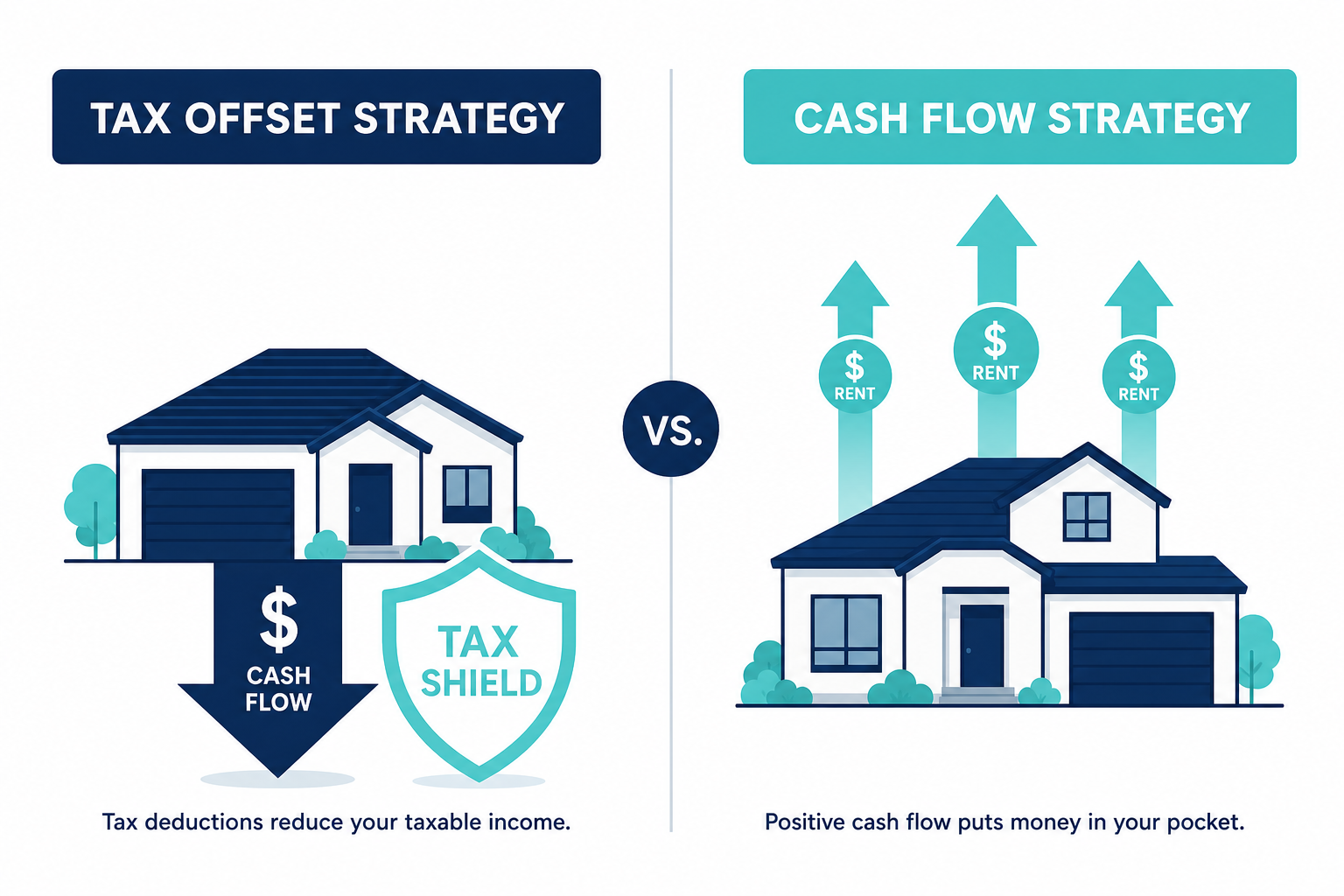
Why More Investors Are Exploring Co-Living Now
Several forces have converged to make co-living a more serious conversation in 2026.
Rental affordability pressure is real and structural. National advertised rents have risen approximately 7.3% year-on-year as of May 2026, according to SQM Research, while the National Housing Supply and Affordability Council forecasts a shortfall of approximately 262,000 dwellings against the government's Housing Accord target. In that environment, co-living offers tenants a more affordable per-room option – and landlords a more resilient income base.
Household structures are changing. More singles, young couples, and transient professionals are actively choosing flexible, well-located shared housing over the long-term lease model. That shift is demand-driven, not just supply-constrained, which matters for long-term vacancy management.
Negative gearing reform has prompted investors to question whether tax-dependency is a sound foundation for a portfolio. When the primary advantage of holding a loss-making property is its ability to reduce your tax bill – and that mechanism is being restricted – it becomes rational to ask whether the underlying investment fundamentals are strong enough to stand on their own. A rentvesting strategy that prioritises income performance alongside growth potential is attracting renewed interest from this cohort.
Institutional validation has also played a role. Knight Frank's research notes that co-living is now attracting high-net-worth individuals, small property companies, and family offices seeking yields above those available from traditional residential unit blocks. That shift in capital signals the asset class is maturing.
Risks, Trade-Offs, and Compliance Considerations
Co-living is not a passive strategy, and anyone presenting it as low-effort is not giving you the full picture.
Zoning and council approval vary significantly by state and local government area. NSW has a relatively clear planning pathway for co-living, established in 2021, which is why Sydney dominates supply. Victoria, Queensland, and Western Australia are still developing their frameworks, and approvals in those states require careful local due diligence before purchase. Buying a property with the intention of operating it as a co-living facility without confirming zoning compliance is a significant risk.
Financing is more complex. Many lenders treat properties with multiple individual leases differently from standard residential investment loans. Loan-to-value ratios may be lower, and some lenders will not finance rooming houses at all. Understanding your financing options before selecting a property is non-negotiable.
Property management is more demanding. Multiple tenants mean more tenancy agreements, more potential for disputes, more frequent room turnover, and additional wear on common areas. Professional management is almost always required, which affects net yield.
Insurance needs to be structured for multi-tenant occupancy. Standard landlord policies may not cover a rooming house arrangement, so specialist cover is required.
Tenancy law differs from standard residential leasing in several jurisdictions. In some states, rooming house occupants have different rights and protections, which affects how vacancies are managed and how exits are handled.
None of these risks are deal-breakers for the right investor in the right market. But they do mean that property due diligence for a co-living asset is more involved than for a standard rental. Skipping that step is where investors get into trouble.
How to Decide Whether Co-Living Suits Your Strategy
The honest answer is that it depends on a combination of factors that differ for every investor. A useful starting framework:
Your income and tax position matter. Negative gearing still works in certain structures – particularly for new builds, which remain exempt from the reform. If you are a high-income earner and you are buying a new build, the traditional tax-offset approach may still be appropriate. If you are buying established property after Budget night, the equation has shifted.
Your tolerance for complexity matters. Co-living adds regulatory, financing, and management complexity that standard residential investment does not carry. If you want a set-and-forget holding, a well-selected standard investment property in a high-demand suburb may serve you better.
Your cash flow profile matters. If your portfolio is already weighted toward negatively geared assets, adding a cash-flow-positive co-living property can improve overall portfolio resilience. If you are starting from scratch, co-living in the right location may allow you to service debt more comfortably from day one.
Your market selection matters more than the format. A co-living property in a suburb with weak rental demand will underperform a standard rental in a suburb with chronic undersupply. Location and fundamentals still dominate strategy choice. The two-speed property market in 2026 illustrates why market selection has become even more consequential than asset type.
The best investors are not choosing between co-living and negative gearing as ideological positions. They are selecting assets and structures that align with their goals, their borrowing capacity, and their tolerance for ongoing involvement.
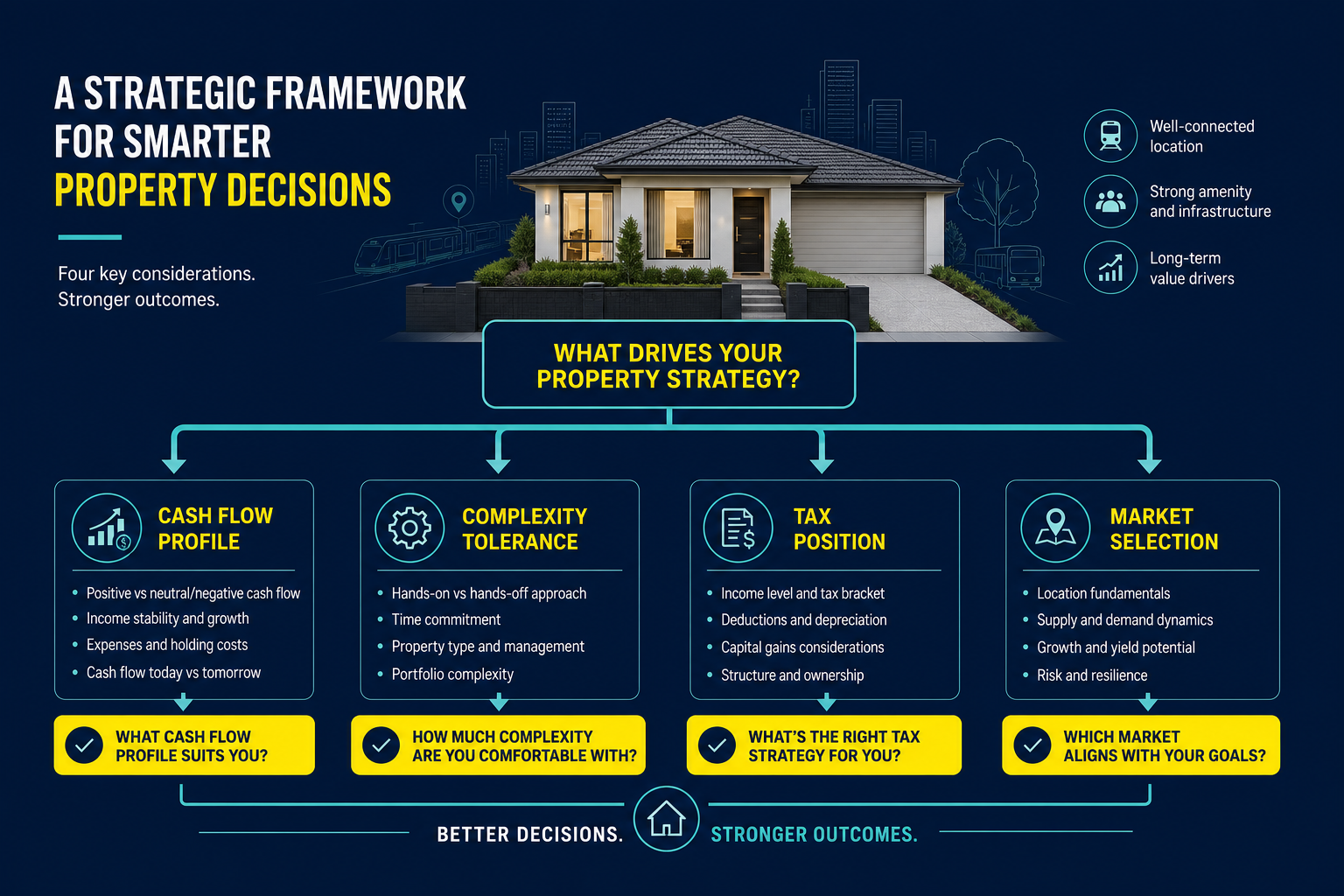
How a Buyers Agent Can Help Assess the Right Property Type
One of the most consistent mistakes investors make is choosing a strategy before they have evaluated the asset. The format – co-living, dual income, standard rental, or new build – should follow from the market analysis, not precede it.
Buyers Agency Australia works with investors to run that process in the right order: first, understand the investor's financial position, borrowing capacity, and goals; then identify markets and suburbs where the selected strategy is viable; then locate assets – including off-market properties – that match the brief.
Dragan Dimovski, who leads the firm and brings more than 20 years of property experience across multiple market cycles, takes the view that no single format suits every investor. A co-living property in inner-western Sydney may suit an investor with strong borrowing capacity, a higher risk appetite, and access to professional management. The same format in a regional market without a supporting tenant base would be the wrong call entirely.
On the negative gearing side, the reform context changes some of the calculations around established property. But for new builds – which retain full negative gearing access – the case for careful site and developer selection remains strong, and buyer representation at that stage can prevent the kind of overpayment that erodes the tax benefit within the first few years of ownership. That is where investment property advice from an independent buyer's agent, rather than a selling agent or a developer's representative, carries the most value.
If you are still mapping out which approach matches your situation, book a free strategy session with the team. It is a starting point, not a sales pitch – and it costs nothing to get a clear picture of your options.
Conclusion: Choosing the Strategy That Fits the Plan
The shift toward co-living is not a rejection of all that negative gearing represented. For many investors, the traditional tax-offset model delivered real wealth over the past two decades, and it will continue to do so in specific structures – particularly new builds – that remain exempt from the 2027 reforms.
What has changed is the risk profile of relying on tax benefits as the primary investment thesis for established residential property. When the deductibility of rental losses against salary income is being removed for new purchases, the underlying asset – its location, its rental demand, its cash flow – becomes the thing that actually carries the investment. That is not a bad thing. It is a return to fundamentals.
Co-living adds genuine tools for managing cash flow and spreading vacancy risk, but it introduces complexity that requires clear-eyed due diligence and local knowledge. The best property investment strategy is not the most fashionable one in a given year – it is the one that reflects your goals, your structure, and the market you are entering.
If you want to work through what that looks like for your situation, map out your next property move with the Buyers Agency Australia team. Or, if you are ready to start a more detailed conversation, contact the team directly.
Frequently Asked Questions
Is co-living still a good investment in 2026 given negative gearing changes?
Co-living may suit investors seeking stronger cash flow, but it carries compliance and management complexity. Whether it fits your portfolio depends on location, structure, and your borrowing profile.
Does negative gearing reform affect all investment properties from July 2027?
No. Properties held before 12 May 2026 are grandfathered. New builds remain fully exempt. Only established residential properties purchased after Budget night are affected.
What types of properties qualify as co-living investments in Australia?
Typically multi-bedroom houses or purpose-built rooming houses with separate tenancy agreements per room. Definitions and approval requirements vary significantly by state and council.
Can a co-living property also be negatively geared?
Yes. If costs exceed the combined rental income, the property is still negatively geared. The format does not determine gearing – the income-to-cost ratio does.
How does a buyers agent help with co-living or negative gearing decisions?
A buyers agent assesses your goals and borrowing profile, identifies suitable markets and assets, and negotiates on your behalf – ensuring the property format matches the strategy, not the other way around.
 General
Australian investors are rethinking tax-driven property strategies as negative gearing faces reform and co-living gains traction. This guide...
Brand-new investment properties are widely marketed as the smart, safe choice. Fresh finishes, depreciation benefits, builder warranties, and the comfort of knowing no previous owner has lived there all make a compelling pitch. But experienced investors know the surface appeal of a display suite rarely tells the full story. This guide cuts through the marketing gloss and covers the risks every buyer should assess before signing a contract on a new or off-the-plan property.
Why brand-new investment properties can look safer than they really are
New builds come with a natural sense of reassurance. There is no maintenance backlog, no tired kitchen from the 1990s, and no tenant-damage history to worry about. For investors new to the market, the depreciation schedule alone can feel like a compelling financial advantage. Developers spend considerable resources making their product look irresistible: polished display suites, glossy brochures, projected rental yields, and early-bird pricing all create a sense of urgency and certainty.
The trouble is that much of this is marketing, not independent analysis. Projected yields are often based on optimistic assumptions about the local rental market. Early-bird pricing structures can obscure how that price compares to genuine comparable sales nearby. And the clean, new-car feeling of a brand-new apartment or house-and-land package can make it emotionally harder to walk away, even when the fundamentals do not stack up.
At Buyers Agency Australia, one of the clearest patterns seen across years of investor client work is that new properties are the most heavily marketed segment in the entire property market, which means buyers face the highest information asymmetry. Understanding why off-the-plan and house-and-land packages carry specific risks is the first step toward making a clear-eyed decision.
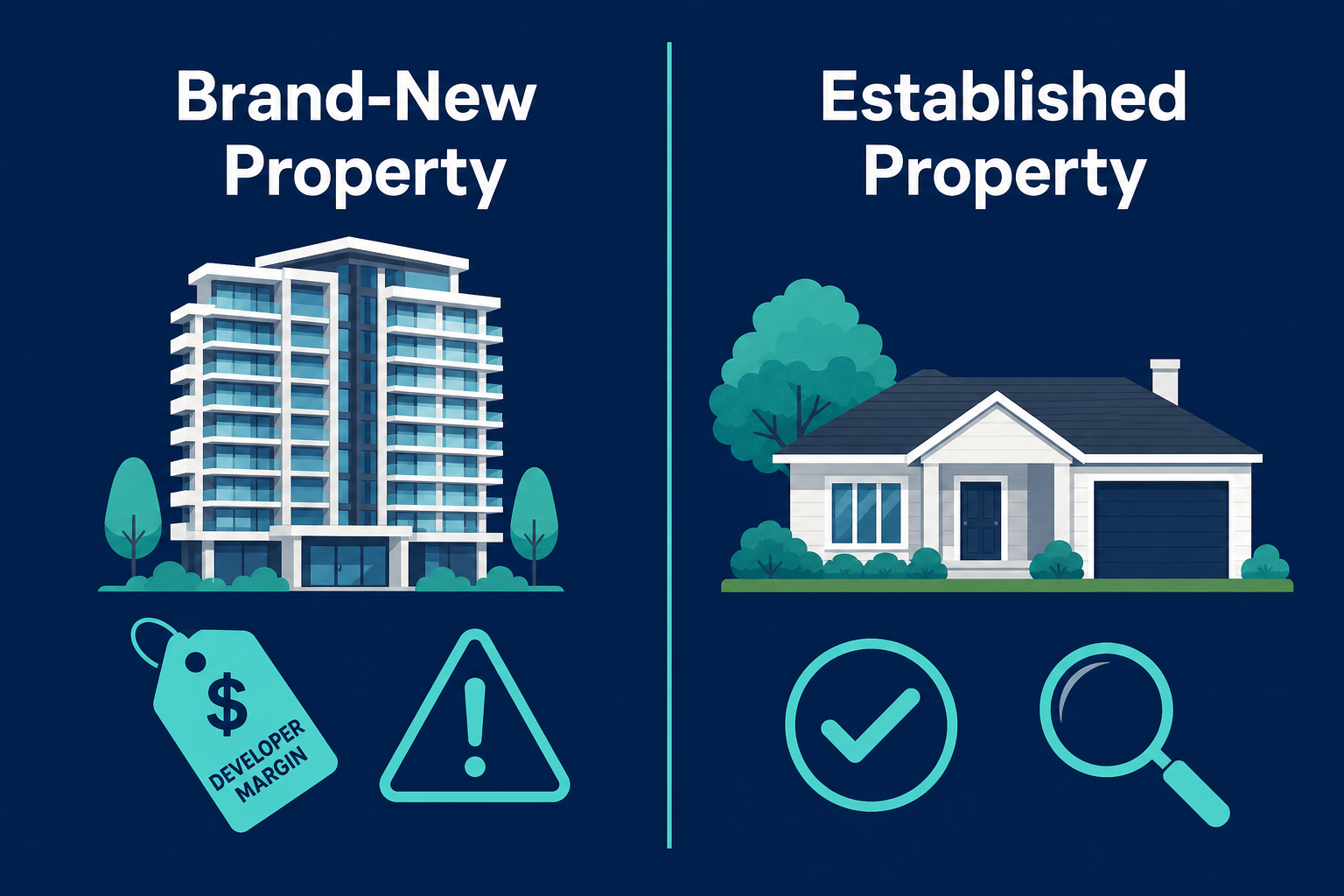
The hidden risks investors should assess before buying
The risks that matter most to investors are rarely the obvious ones. Here is where real exposure tends to hide.
Price premiums and developer margin
New properties carry a built-in developer margin. That margin covers land acquisition, construction, sales commissions, marketing, and project profit. Buyers absorb all of that in the purchase price. In many cases, comparable established properties in the same suburb trade at a genuine discount relative to the new stock, simply because no developer margin is baked in.
According to PropTrack data, building input prices have risen more than 33% since the pandemic. Those cost increases flow directly to buyers. In markets like Sydney and Melbourne, property price growth since 2021 has not kept pace with construction cost inflation, meaning new-build pricing often reflects what it costs developers to build, not what the market independently values the finished product at.
Valuation gaps at settlement
This is the risk that catches the most investors off guard. When buying off-the-plan, banks conduct a formal valuation at settlement, not at the time of signing. If the market softens, or the postcode is oversupplied, that valuation can come in below the contract price. The bank will only lend against the lower figure. The buyer must cover the gap in cash.
Valuation shortfalls of 5 to 15% are not uncommon on off-plan apartments in oversupplied postcodes, and some buyers have faced shortfalls exceeding 20% in market downturns. This is not a hypothetical risk. It played out at scale during the Melbourne and Brisbane apartment corrections between 2017 and 2020. If you cannot fund the gap, you risk losing your deposit and potentially facing legal action from the developer for any resale loss.
| Risk Area |
What Can Go Wrong |
Who Bears the Cost |
| Valuation shortfall |
Bank values below contract price at settlement |
Buyer must fund gap in cash |
| Developer insolvency |
Builder collapses mid-construction |
Buyer faces deposit recovery process |
| Strata defects |
Building has undisclosed structural or waterproofing faults |
Owners Corporation levy holders |
| Rental demand shortfall |
Developer yield estimate does not reflect real market |
Investor absorbs vacancy and cash flow gap |
| Settlement delay |
Construction extends beyond contracted date |
Holding costs, finance expiry, re-approval risk |
Developer and construction risk
Construction companies represented 26% of all Australian business insolvencies in 2024 to 2025, making developer collapse a genuine and live concern. If a developer fails mid-construction, recovering a deposit from a statutory trust account can take months or years. Even where deposits are protected, buyers may find themselves in a partially complete development with no clear path to settlement.
Settlement delays compound this. A contract with a 12-month build timeline can easily stretch to 24 or 36 months. In that time, your finance pre-approval expires and must be renewed under potentially different lending conditions. Your personal financial circumstances may also have changed.
Strata and build-quality risk
The NSW Government's Building Commission found that 53% of strata buildings registered between 2016 and 2022 had serious defects in common property. Waterproofing and fire safety systems were the most prevalent issues at 42% and 24% of defective buildings respectively. NSW Building Commissioner David Chandler stated publicly that 60 to 70% of recently built Sydney apartments likely have defects that have not yet been formally identified or reported.
Defects mean special levies. As an investor owning a strata lot, you have no ability to opt out of those levies. A building with a chronic waterproofing defect can generate six-figure rectification bills, spread across owners who had no knowledge of the problem when they purchased. Checking the sinking fund balance, reviewing strata records, and assessing the developer's track record are not optional steps when buying new strata property.
Rental demand uncertainty
New property developments are frequently marketed with projected rental yields. These projections are produced by the developer's appointed property managers and often assume optimal conditions: 100% occupancy, above-market rents, and no competing supply. Reality rarely cooperates.
New apartment complexes often deliver multiple units to the same rental market simultaneously, creating a temporary supply glut. In suburbs with heavy new construction pipelines, vacancy rates can spike and rents can soften just as buyers settle and begin their search for tenants. Solid property due diligence requires independently verifying actual comparable rents, suburb-level vacancy data, and the supply pipeline before accepting any developer yield projection.
How new properties can affect long-term portfolio strategy
The financial risks of a new property purchase do not always show up immediately. Some of the most consequential ones play out slowly across a portfolio.
Land content and capital growth
Capital growth in Australian residential property is overwhelmingly driven by land value, not the building sitting on it. A new apartment in a high-density tower holds a fractionally small share of the land beneath it. As the building ages and depreciates, the land component does the heavy lifting. Established houses or older units with genuine land content tend to outperform high-density new stock over the long term. This is not speculation; it is reflected in CoreLogic's long-run data showing capital city house values rising almost three times as fast as unit values since the onset of COVID.
Depreciation and the tax story
Depreciation is frequently used to justify new-property purchases. The benefits are real: brand-new buildings carry higher depreciation schedules, and investors can claim deductions on both the building structure and fixtures. But depreciation is a non-cash deduction, not a return on investment. It reduces your taxable income today while your asset may be underperforming on capital growth. The tax depreciation benefit does not compensate for overpaying on the purchase price.
Resale and exit flexibility
New properties sell on marketing, on newness, and on developer-supported launch pricing. When you come to resell, you compete against every other investor in the same building or development who may also be exiting. Resale values in new apartment blocks can be structurally suppressed by ongoing new supply from adjacent projects. Established properties in proven streets with genuine owner-occupier demand tend to have more liquid and resilient resale markets.
A practical due diligence checklist for brand-new purchases
If you are seriously considering a new or off-the-plan property, every item below deserves attention before you exchange contracts. Treating any of these as optional materially increases your exposure.
- Developer track record: Review completed projects, search for disputes or ASIC actions, and speak to strata managers of finished buildings the developer has delivered.
- Contract review by a property solicitor: Specifically assess sunset clauses, variation provisions, and defect rectification obligations. Off-the-plan contracts are far more complex than standard purchase contracts.
- Independent comparable sales analysis: Do not rely on the developer's comparable evidence. Pull your own data from CoreLogic or PropTrack on genuine arm's-length sales of completed, comparable stock in the same suburb.
- Independent rental appraisal: Contact three or more independent property managers in the area, not the developer's appointed PM, and ask for a written rental estimate with vacancy rate data.
- Supply pipeline check: Establish how many similar properties are completing within a 2 km radius over the next 12 to 24 months. A heavy supply pipeline suppresses rents and resale values simultaneously.
- Finance stress test: Model what happens if the settlement valuation comes in 10% below your contract price. Confirm you can fund that gap without defaulting.
- Building and strata report: For completed new strata properties, obtain a full strata report including the sinking fund balance, any outstanding defect claims, minutes of recent Owners Corporation meetings, and the building's insurance history.
- Settlement conditions: Understand the sunset date, the developer's right to vary the plan, and your rights if completion is delayed beyond the contracted period.
Read more: Step By Step Guide To Buying An Investment Property In Australia
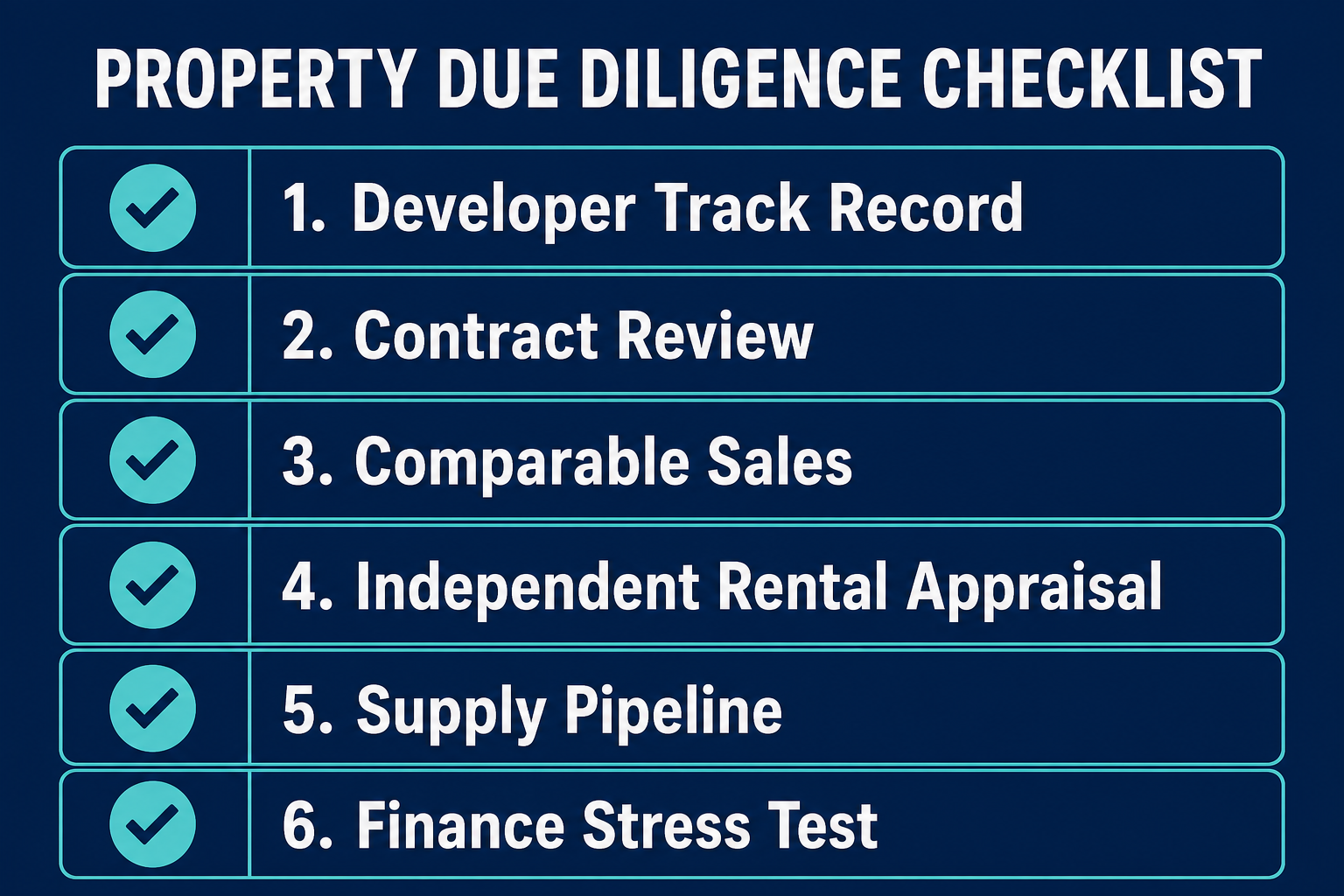
When a brand-new property may still suit an investor
It would be misleading to say new properties are never appropriate for investors. There are limited scenarios where the case is stronger.
An investor with specific SMSF or tax-planning requirements working closely with a qualified accountant may find that the depreciation benefits of a new build align with their strategy. Investors who require a property with no immediate maintenance exposure, such as those managing a portfolio remotely or interstate, may value the reduced short-term maintenance workload of a new build. In tightly held markets where genuine supply is constrained and the developer is highly credible with a strong delivery track record, a new property in an undersupplied suburb can represent reasonable value.
The key caveat in all of these scenarios is this: the decision should start with the evidence, not the display suite. If the comparable sales stack up, the rental demand is verified independently, the developer has a clean track record, and you have stress-tested your finance position, then a new property may be a reasonable fit. If any of those conditions are absent, the risk profile shifts significantly against you.
Investors exploring how off-market and established alternatives compare as part of a broader property investment strategy will generally find far more verifiable value in the established market.
How a buyers advocate can help reduce purchase risk
The structural information gap between developers and buyers is real and persistent. Developers know their product intimately and spend significant resources presenting it in the most favourable light. Buyers, especially those purchasing without independent advice, are making one of the largest financial decisions of their lives based on incomplete or selectively presented information.
A buyers advocate works solely for the buyer, not for the developer, not for the selling agent, and not for any referral fee paid by the development. Dragan Dimovski, the principal of Buyers Agency Australia, brings more than 20 years of property experience to bear when assessing any new-build opportunity. That means independently reviewing the purchase price against genuine comparable evidence, stress-testing the rental demand assumptions, scrutinising the contract terms, and pressure-testing the developer's track record before a client commits.
For investors considering new or off-the-plan stock, the due diligence process runs alongside access to the established and off-market property options that most buyers never see. Having a credible alternative on the table changes the negotiation dynamic entirely and removes the pressure of the developer's artificial scarcity tactics.
If you are weighing up a new-build purchase and want an independent assessment before you commit, book a free strategy session to work through the numbers with the team.
Conclusion: buy the asset, not the marketing
The most common mistake investors make with brand-new property is buying the presentation rather than the underlying asset. A polished display suite, a developer's projected yield, and a headline depreciation benefit are not a substitute for independent comparable sales analysis, verified rental demand, a stress-tested finance position, and an honest assessment of the developer's track record.
Every point in this guide comes back to one principle: your investment decision should be driven by evidence, not enthusiasm. The fundamentals that drive long-term property performance, land content, genuine rental demand, sustainable purchase price, and liquidity on exit, are the same regardless of whether the property is new or established. New properties introduce additional layers of risk that must be actively managed through rigorous property due diligence before you sign anything.
If you would like to map out your next property move with a team that prioritises your result over a developer's commission, book a free strategy session or contact the team at Buyers Agency Australia today.
Frequently Asked Questions
Is it risky to buy a brand-new investment property in Australia?
Yes. New properties carry specific risks including valuation shortfalls, developer insolvency, strata defects, inflated pricing, and rental demand uncertainty that established properties do not.
What is a valuation shortfall on an off-the-plan property?
A valuation shortfall occurs when the bank's independent valuation at settlement comes in below your contract price. You must fund the gap in cash or risk losing your deposit.
How common are building defects in new Australian apartments?
According to the NSW Government's Building Commission, 53% of strata buildings registered between 2016 and 2022 had serious defects in common property.
Does depreciation make a new investment property worth it?
Depreciation reduces taxable income but is a non-cash benefit. It does not compensate for overpaying on the purchase price or underperformance in capital growth.
How can a buyers advocate help with a new property purchase?
A buyers advocate independently verifies comparable sales, rental demand, contract terms, and developer track record so you make decisions based on evidence rather than developer marketing.
 General
Brand-new investment properties look low-risk but often carry serious financial, structural, and strategic dangers. This guide covers what...