A buyers advocate delivers far more than a shortlist of properties. From accessing deals that never reach the portals to negotiating with precision in quiet sales, the right advocate turns a complex search into a confident, strategic acquisition. Understanding exactly what this role involves — and why it matters in today's supply-constrained market — can be the difference between a good investment and a great one.
Why Off-Market Search Is Harder Than It Looks
Most investors assume that a thorough search means checking Domain and realestate.com.au every day. In reality, a significant share of quality residential transactions in Australia never appear on those portals at all. In premium suburbs across major cities, estimates suggest that between 20% and 40% of properties change hands off-market, transacted quietly through agent networks before a single open home is scheduled.
The challenge is not simply finding these properties. It is finding the right ones, fast enough to act, within a budget that makes strategic sense. An unassisted buyer trying to access this layer of the market faces two immediate obstacles: no relationships with selling agents, and no process for screening what surfaces. Without those foundations, most leads either arrive too late or turn out to be poor quality.
Time pressure compounds the difficulty. With national advertised stock sitting roughly 9.6% below the five-year average in early 2026, competition for quality investment-grade assets is real and ongoing. Buyers who wait for properties to list publicly are, by definition, starting behind everyone who has been briefed already.
This is the environment where a buyers advocate earns their value. The access problem is only solved by sustained, trust-based relationships with selling agents built over years — not a few cold calls to local agencies.
At Buyers Agency Australia, principal Dragan Dimovski has spent more than 20 years building exactly those relationships across Sydney, Melbourne, Brisbane, and other key Australian markets. When quality off-market opportunities emerge, the team receives early notification because agents know they bring qualified buyers who settle. That network is not something a self-directed investor can replicate in a weekend.
For investors who want to understand how this access works in practice, the detail behind the off-market buying process at Buyers Agency Australia is worth reading carefully.
How Advocates Filter Opportunities
Access to off-market properties is only half the equation. The other half is knowing which ones to pursue.
Not every off-market listing is a good deal. Some are overpriced relative to comparable sales. Some have structural issues the vendor has quietly decided not to disclose through a formal campaign. Others simply do not match a client's investment brief in terms of yield, growth trajectory, or hold strategy. A buyers advocate adds value precisely because they filter before the client sees anything.
At Buyers Agency Australia, each opportunity is screened against a defined set of investment criteria before it reaches a client. This includes analysis of 10-year growth projections based on infrastructure and demographic trends, rental yield and tenant demand, comparable sales to determine genuine market value, and building and pest considerations. Only properties that genuinely match a client's goals are presented.
This is a meaningful protection for investors. Consider the alternative: a buyer scrolling listings independently will see the property, fall in love with the suburb or the style, and begin rationalising why it works. Selling agents are trained to read that emotional engagement and extract every dollar from it. A disciplined advocate removes that vulnerability entirely.
| What Self-Directed Buyers Often Miss |
What a Buyers Advocate Screens For |
| Overpricing relative to comparable sales |
Verified market value against recent settlements |
| Poor rental demand in the target suburb |
Vacancy rate trends and tenant profile data |
| Structural risk not obvious at inspection |
Building and pest indicators before inspection |
| Misaligned growth potential |
10-year infrastructure and demographic analysis |
| Vendor motivation and timing risk |
Settlement terms that protect the buyer's position |
Vendor motivation matters more in off-market deals than in public campaigns. A vendor who is selling for privacy reasons is in a different position to one under financial pressure or managing an estate. Understanding the motivation shapes the entire negotiation posture — including whether to push on price, terms, or settlement timing. This is the kind of contextual intelligence a buyers advocate applies at the very start of a deal, not at the end.
For Melbourne-based investors, the way off-market searches unfold in that market specifically is explained in more depth in the guide on how off-market properties change the search in Melbourne.
The screening process is also what keeps clients out of trouble. How first-time investors avoid costly mistakes through professional advocacy is one of the clearest arguments for engaging a specialist rather than going it alone.
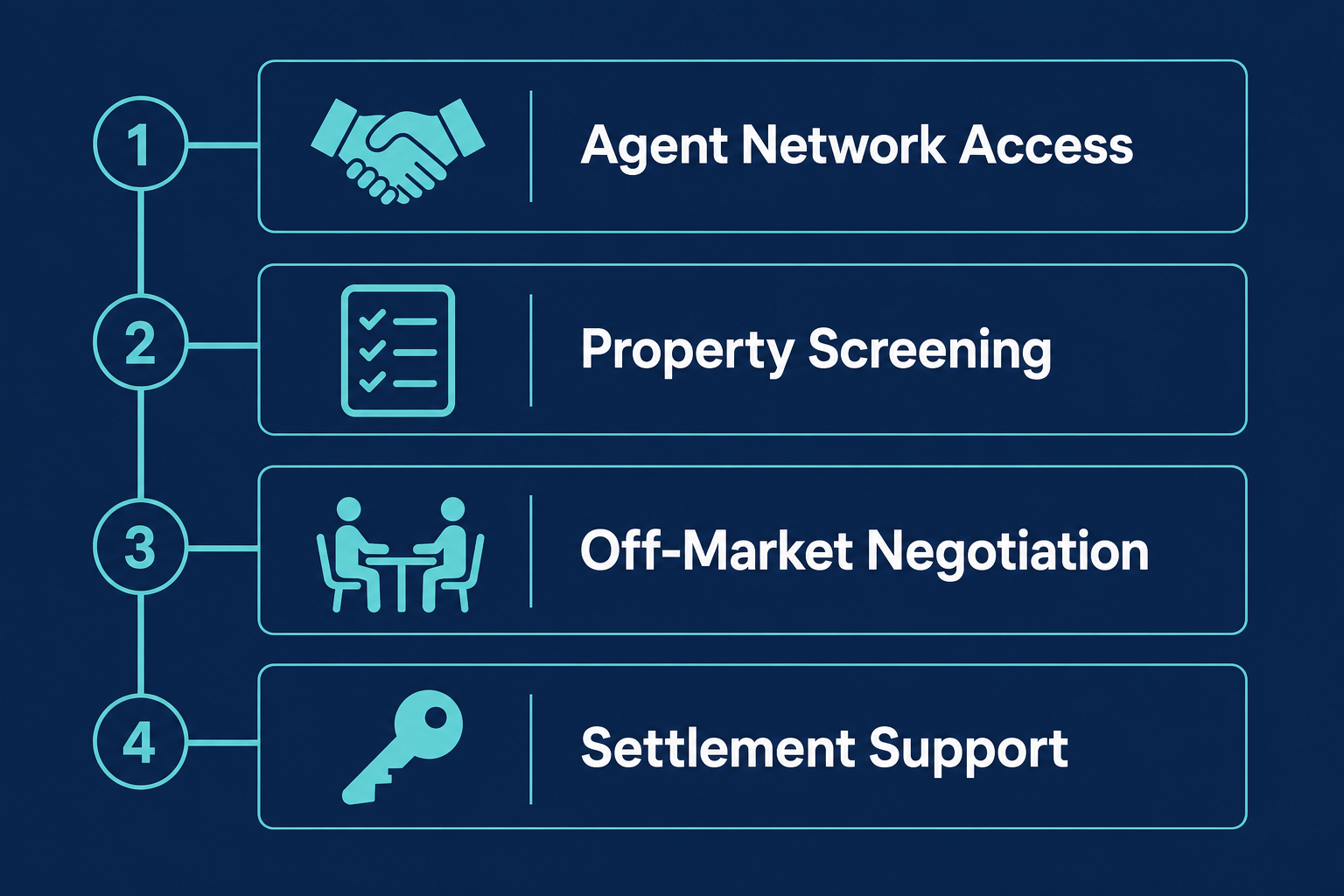
Where Negotiation Matters Most
There is a common misunderstanding about off-market deals: that because there is no public competition, the negotiation is softer. That assumption can be expensive.
In a public auction or listed campaign, buyers at least have visible signals — other bidders, clearance rates, published price guides. In a private off-market transaction, all of that information disappears. The buyer is negotiating without a crowd, which sounds advantageous until they realise the selling agent has far more context about the vendor's position than the buyer does. The information asymmetry is actually greater off-market, not smaller.
This is exactly where a buyers advocate's negotiating experience becomes critical. Off-market negotiations are not softer; they are quieter. And quiet does not mean easy. A skilled advocate knows how to structure an opening offer that creates room to move without insulting a vendor, how to read the agent's responses for signals about reserve expectations, and when to introduce settlement terms — extended or compressed — as tools to bridge a price gap.
For investors who find that terminology useful, property negotiation in this context means far more than offering less money. It includes the deposit amount, settlement length, subject-to-finance clauses, and in some cases, leaseback arrangements. Each of these can be a point of value for the vendor that does not cost the buyer additional purchase price.
Buyers Agency Australia's approach to off-market negotiation is built on the same principles Dragan Dimovski has applied across hundreds of transactions over two decades. The discipline is knowing when the deal is worth fighting for and when the price expectation is simply unrealistic — and having the confidence to walk away when it is the latter.
For investors curious about how advocates locate and then approach these deals across different Australian cities, the tactical detail in how buyers agents find off-market properties before everyone else provides a grounded perspective.
It is also worth noting that the ABS recorded 565,073 dwelling transfers nationally in 2025, a modest 2.6% increase year on year. With volumes rising and quality stock remaining tight, the negotiating discipline an advocate applies at the deal stage is more valuable, not less.
What Buyers Gain From the Process
When an investor works with a buyers advocate through a proper off-market search, three things typically improve: speed, confidence, and decision quality.
Speed matters in a market where good assets move quickly and without fanfare. Rather than spending six to twelve months attending open homes and missing out on listed properties, a client with an active brief at Buyers Agency Australia benefits from the team's daily market activity. Properties are identified, screened, and presented with a clear recommendation — not a dump of options that the client has to evaluate independently.
Confidence comes from knowing the price paid reflects genuine market value. When a buyers advocate presents a comparable sales analysis and a market appraisal alongside the negotiated price, the client knows exactly where they stand. That is a qualitatively different experience from paying what an auction crowd dictated, or what a selling agent managed to extract in a private treaty.
Decision quality improves because the process forces a strategy conversation before the search begins. What yield is the client targeting? What is the hold period? Is the priority cash flow or capital growth? Are there suburb types that fit the brief better than others? These questions shape the search, and a buyers advocate ensures they are answered clearly before any offer is made.
| Benefit |
What It Means in Practice |
| Off-market access |
Properties seen before public competition begins |
| Independent due diligence |
Screening protects against structural and financial risk |
| Negotiation expertise |
Price and terms optimised without emotional involvement |
| Time savings |
Weeks or months removed from the search timeline |
| Strategic alignment |
Every acquisition connects to a broader portfolio plan |
For investors working on property portfolio growth across multiple assets, the cumulative effect of this process is significant. Each acquisition made with better information, at a better price, with terms that suit the buyer's position, compounds over time. The decision to book a free strategy session early — before a search becomes urgent — is often what separates investors who build systematically from those who buy reactively.
For investors thinking about where to focus their next acquisition, the current analysis on top property investment hotspots and strategies for 2026 is a useful starting point for market context before engaging an advocate.
Sydney-focused investors looking for city-specific guidance will also find the Sydney buyers agent guide a practical reference for understanding how advocacy operates in that market.

Frequently Asked Questions
What is the main difference between a buyers advocate and a real estate agent?
A buyers advocate works exclusively for the buyer, not the vendor. A real estate agent represents the seller and is legally obligated to achieve the best outcome for them, not for you.
Can a buyers advocate really access properties that are not listed publicly?
Yes. Advocates with established agent relationships receive early notification of properties before they are advertised, sometimes weeks ahead of any public campaign or not at all.
Is off-market negotiation different from negotiating on a listed property?
Yes. There is no public price guide or visible competition, so the advocate must rely on comparable sales data, vendor context, and relationship intelligence to structure offers correctly.
How long does an off-market property search typically take?
With an active brief, a well-networked advocate can often present suitable off-market properties within weeks. An unassisted buyer searching publicly may take six to twelve months to secure the right asset.
What should I prepare before engaging a buyers advocate?
Have your finance pre-approval confirmed, your budget and yield targets clear, and a rough sense of the markets or property types that suit your strategy. The clearer your brief, the faster the search.
Ready to Access the Off-Market Difference
Working with a buyers advocate is not simply about getting help finding a property. It is about entering the market with the same level of information, relationships, and negotiating discipline that experienced operators use every day. Buyers Agency Australia has been built specifically around this model — giving investors structured access to off-market properties, rigorous screening, and end-to-end support from first brief through settlement.
If you are serious about your next acquisition, map out your next property move with the team before the search begins. Or if you are ready to talk specifics, contact the team directly to get started.
 General
A buyers advocate delivers far more than a shortlist of properties. From accessing deals that never reach the...
Most Australian property buyers focus on the buyers agent fee, but the real cost is what you lose negotiating alone. With national home values at $910,000 and market fragmentation intensifying in 2026, fee-versus-value is now a portfolio-level decision.
Why fee comparisons miss the bigger picture
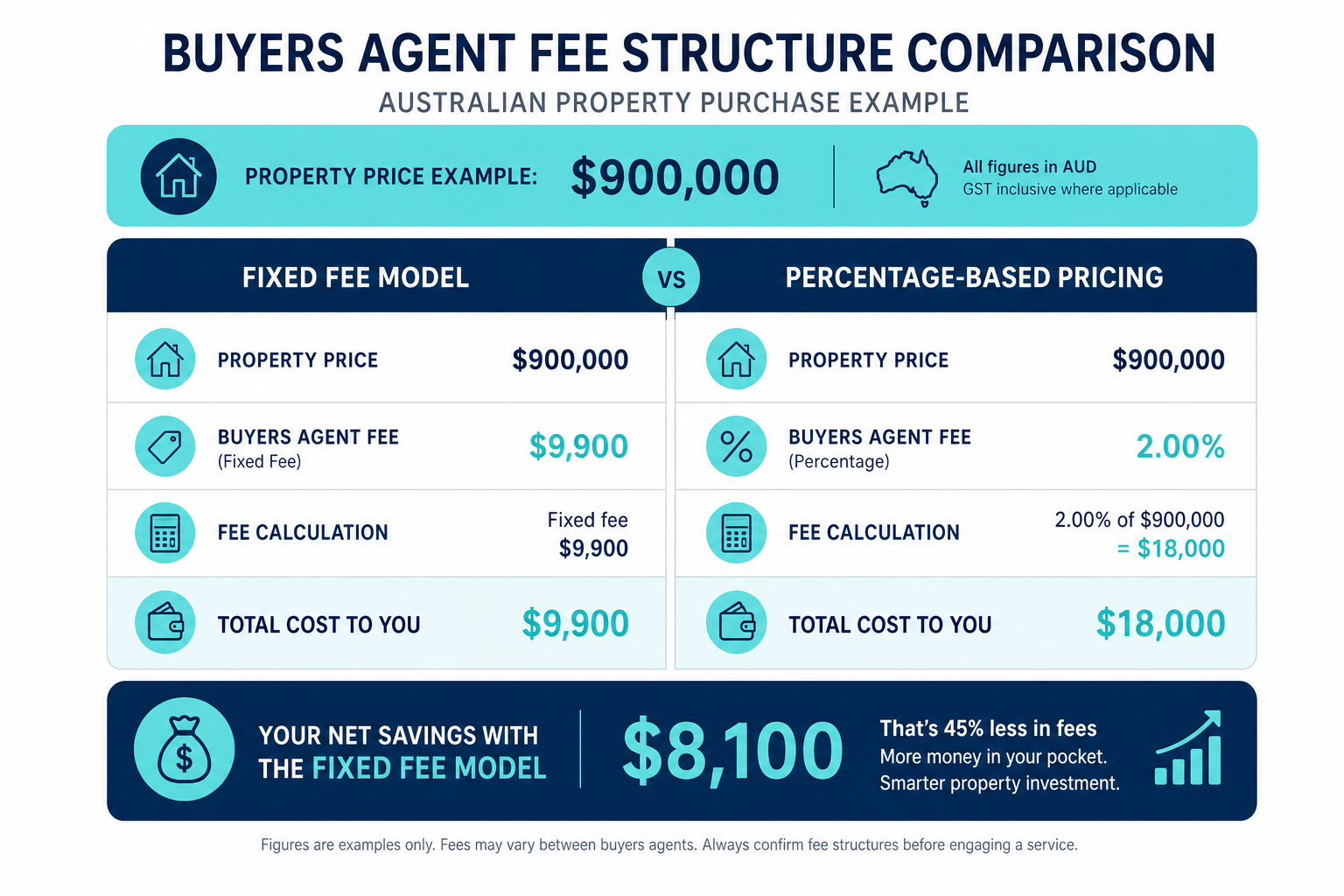
When you're considering a buyers agent, the first question is usually about the cost. In Australia, buyers agent fees typically range between 1.5% to 3% of the purchase price or a fixed fee of $10,000 to $33,000, depending on location and service scope.
But comparing fees to savings is only half the story. The real question is: what does it cost you if you negotiate poorly, miss structural risks, or buy the wrong property altogether?
Buyers Agency Australia operates on a fixed-fee model, which means the fee doesn't rise with the purchase price. That removes the built-in conflict of interest found in percentage-based pricing and keeps negotiation focused on your outcome, not the agent's commission.
According to recent industry data, buyers agents in Australia commonly negotiate savings of 3% to 7% below asking price. On a $900,000 property, that's between $27,000 and $63,000. Even if you pay a $15,000 fixed fee, the net outcome is a savings of $12,000 to $48,000, plus the value of better due diligence, suburb selection, and contract terms.
When Dragan Dimovski applies 20+ years of investment and negotiation experience to your purchase, you're not just saving on price. You're avoiding the property that looks good on paper but underperforms in your portfolio.
Where buyers lose money without support
Property mistakes compound over time. Overpaying by $30,000 today means you start with less equity, face higher holding costs, and delay your next purchase. And that's if the property performs at all.
Here's where buyers lose the most:
Overpaying at auction or in private treaty
Australia's national median home value sits at $910,000 as of April 2026, with prices rising 8.5% annually. In competitive markets like Sydney and Brisbane, buyers regularly overpay by 5% to 10% when bidding emotionally or without clear price ceilings.
A skilled negotiator knows when to hold, when to walk, and when to push. They also know how to read vendor motivation, days on market, and comparable sales data that most buyers never see.
Buyers Agency Australia clients typically see negotiated savings of 3% to 7%, which on a $900,000 property means $27,000 to $63,000 off the final price.
Missed risks and poor due diligence
Structural defects, zoning restrictions, flood overlays, and hidden strata issues can cost tens of thousands to fix or reduce your property's resale value. Buyers agents conduct full due diligence as part of their service, including building and pest inspections, contract reviews, and suburb-level risk assessment.
Without that layer of protection, you're relying on your own research and hoping the selling agent discloses everything.
According to the Reserve Bank of Australia, inflation was 2.4% over the 12 months to December 2024, and borrowing capacity has fallen by $50,000 to $100,000 for millions of buyers due to APRA's serviceability buffer. That means mistakes are more expensive than ever, because your next opportunity is harder to access.
Weak negotiation and settlement terms
Negotiation isn't just about price. It's about settlement dates, finance clauses, inclusions, and contract conditions. A buyer's agent knows how to structure offers that protect your position and create flexibility.
Most owner-occupiers and even experienced investors don't negotiate beyond price, leaving value on the table in areas like extended settlement, vendor repairs, or conditional offers that give you an exit if inspections reveal problems.
Property negotiation services are especially valuable in 2026, when vendor discounting averages -2.9% in Sydney but -3.3% in Melbourne. Knowing which market you're in and how to leverage it makes the difference between a good deal and an average one.
What good service can offset
The value of a buyers agent isn't just what they save you today. It's what they help you build over the next decade.
Here's how professional representation offsets its own cost:
Negotiation strength
Buyers agents negotiate daily. They know how selling agents price properties, how auctions run, and how to read body language and urgency. That experience translates into lower purchase prices, better terms, and faster contracts.
According to Aussie, expert negotiation delivers average savings of $44,000 compared to going it alone. Even if those figures vary by market, the principle holds: professional negotiation delivers measurable value.
Access to off-market properties
About 20% of Australian properties are sold off-market, meaning they never appear on realestate.com.au or Domain. Buyers agents have agent networks and market relationships that give you first access to these opportunities.
Off-market properties typically attract less competition, which means less price pressure and more room to negotiate. For investors building a portfolio, that access is worth thousands per deal.
Buyers Agency Australia leverages off-market access across Sydney, Melbourne, Brisbane, and regional markets to help clients secure properties before they hit the open market.
Time saved and stress reduced
Searching for properties, attending inspections, researching suburbs, and managing contracts takes hundreds of hours. For professionals and business owners, that time has a dollar value.
A buyers agent does the legwork, filters out poor matches, and presents only properties that meet your brief. That means you spend your time making decisions, not searching.
Avoiding the wrong property
Buying the wrong property is the most expensive mistake of all. A property in a low-growth suburb, with poor rental demand, or structural issues can cost you years of portfolio progress.
Buyers Agency Australia uses data-led suburb selection, demographic analysis, and investment strategy to ensure every property fits your long-term plan. That's the difference between a property that looks good and a property that performs.
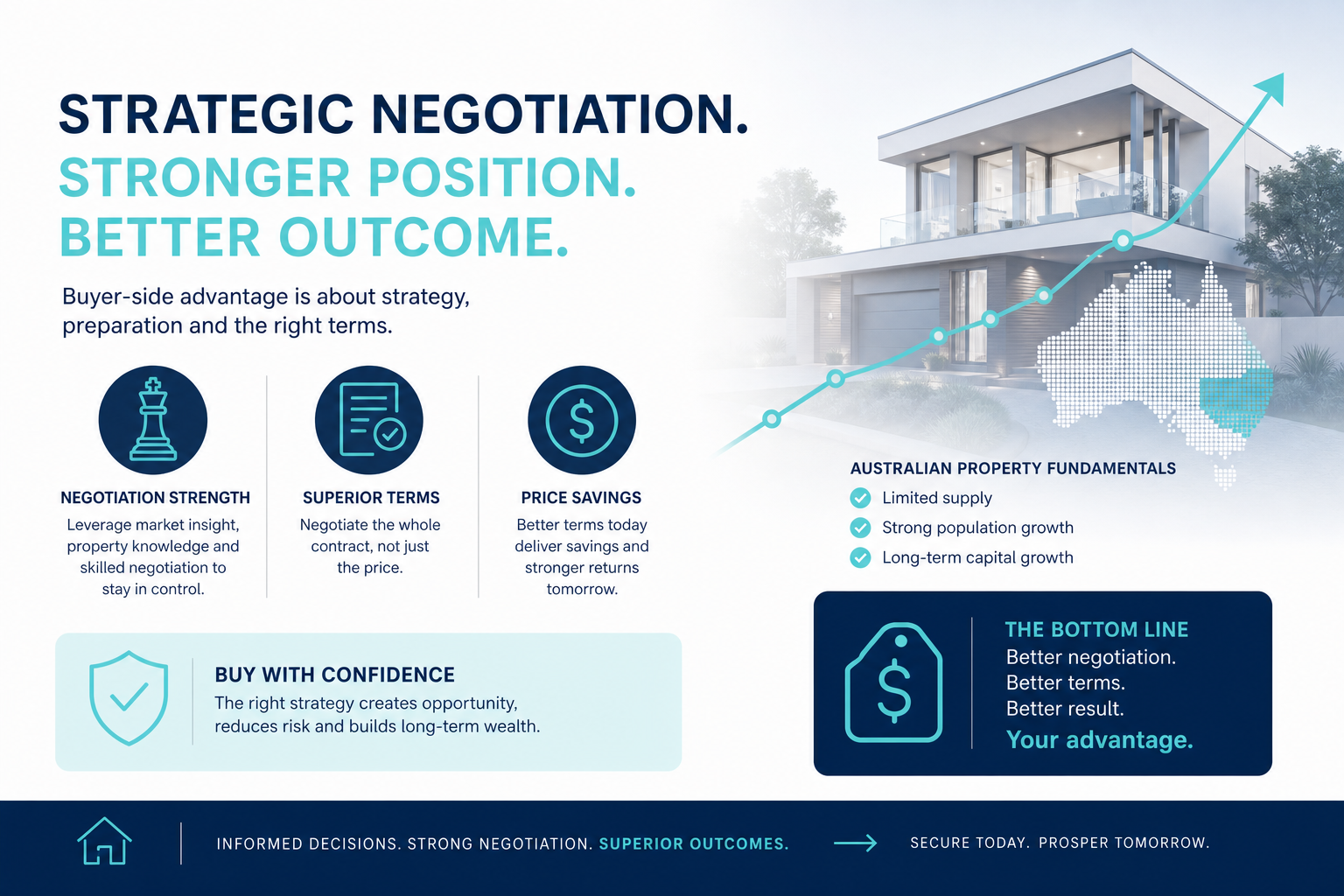
How to assess value before signing
Before you engage a buyers agent, you need a framework for assessing whether the service will deliver value.
Here's what to evaluate:
Fee structure
Ask whether the fee is fixed or percentage-based. Fixed fees align the agent's incentives with yours, because they earn the same regardless of how much you spend. Percentage fees create a conflict, because the more you pay, the more they earn.
Buyers Agency Australia uses a transparent fixed-fee model with no surprise charges. You know the cost upfront, and the focus stays on negotiation and outcomes.
Track record and experience
Ask how many properties the agent has purchased, in which markets, and for what client types. Experience matters, especially in volatile markets like 2026 where Sydney and Melbourne values fell 0.6% in April while Perth rose 2.1%.
Dragan Dimovski has over 20 years of property experience and a $10M+ personal portfolio, which means he applies investor-level rigor to every client purchase.
Service scope
Clarify what's included. Does the fee cover suburb research, inspections, contract review, auction bidding, and settlement support? Or are there additional charges?
Buyers Agency Australia provides end-to-end support from strategy to settlement, with no hidden fees.
Negotiation results
Ask for examples of recent negotiation outcomes. How much below asking price have they secured properties? What terms did they negotiate?
Buyers Agency Australia clients typically see 3% to 7% savings below asking price, which more than covers the fixed fee.
Market knowledge
A good buyers agent knows their markets at a micro level. They can tell you which suburbs are oversupplied, which have infrastructure upgrades coming, and which offer the best risk-adjusted returns.
If an agent can't explain their suburb selection process or relies on generic market reports, that's a red flag.
You can explore Buyers Agency Australia's approach to see how strategy, data, and negotiation come together.
Ask the right questions
Before signing an agreement, ask:
- What's your fee structure, and what's included?
- How many properties have you purchased in my target market in the last 12 months?
- What's your average negotiation discount?
- Do you have access to off-market properties?
- How do you conduct due diligence?
- What's your process for contract review and settlement?
If the agent can't answer clearly, keep looking.
When the cost of doing nothing is higher
The biggest risk in 2026 isn't paying a buyers agent fee. It's paying too much for the wrong property, missing risks, or delaying your portfolio growth because you're trying to do it all yourself.
With Australian property prices forecast to rise 5% to 7.7% in 2026, affordability is tightening, and borrowing capacity is shrinking. That means every purchase decision matters more than it used to.
Buyers Agency Australia removes the guesswork. You get a clear strategy, data-backed suburb selection, professional negotiation, and end-to-end support from planning to settlement. And because the fee is fixed, you know exactly what you're paying before you start.
If you're serious about building wealth through property and want to avoid the mistakes that cost most buyers tens of thousands, book a free strategy session to map out your next move.
Or if you're ready to start the conversation, contact the team to discuss your property goals and how Buyers Agency Australia can help you achieve them.
Frequently Asked Questions
Are buyers agent fees tax deductible in Australia?
For investment properties, yes. Buyers agent fees form part of the property's cost base for capital gains tax purposes, which reduces your taxable gain when you sell.
What's the average buyers agent cost in Australia?
Buyers agent fees typically range from 1.5% to 3% of the purchase price or a fixed fee of $10,000 to $33,000, depending on location and service scope.
How much do buyers agents save on negotiation?
Buyers agents commonly negotiate savings of 3% to 7% below asking price. On a $900,000 property, that's $27,000 to $63,000.
Should I use a percentage-based or fixed-fee buyers agent?
Fixed fees align the agent's incentives with yours, because they earn the same regardless of purchase price. Percentage fees create a conflict of interest.
Do buyers agents have access to off-market properties?
Yes. About 20% of Australian properties are sold off-market, and buyers agents have agent networks that provide early access to these opportunities.
 General
Most Australian property buyers focus on the buyers agent fee, but the real cost is what you lose...
Brisbane's property market rewards disciplined buyers who lead with strategy, not sentiment. Whether you are buying your first investment property, adding to a portfolio, or searching for a family home, a clear plan separates buyers who secure the right asset from those who spend months chasing the wrong ones. This guide breaks down exactly how Queensland buyers can approach Brisbane with structure, confidence, and the kind of clarity that leads to better outcomes.
Brisbane buying strategy starts with the end goal
Before you look at a single listing, the most important question to answer is: what is this purchase meant to do? That single question shapes every decision that follows, from the budget you set to the suburbs you shortlist to the property type you target.
A Queensland investor chasing rental yield in a tight-vacancy market has a completely different brief to a professional couple relocating from Sydney who needs school zones and commute times to stack up. Both buyers might end up in Brisbane, but the suburb, price point, property type, and hold period each look different on paper.
This is where building a disciplined property investment strategy matters more than most buyers realise. Without a defined end goal, it is too easy to pivot toward whatever looks exciting on a Saturday morning or whatever a selling agent frames as a once-in-a-lifetime opportunity. Strategy removes that drift.
For SMSF investors, the stakes are higher still. Compliance rules, borrowing structures, and trustee obligations mean that buying the wrong property inside a self-managed fund is far more damaging than buying it in your own name. Goal clarity is non-negotiable before a single suburb is considered.
Buyers Agency Australia structures every client engagement around this principle: strategy before search. The team, led by Dragan Dimovski, a property expert with over 20 years of experience, starts with a thorough understanding of each buyer's financial position, timeline, risk appetite, and long-term objectives before recommending a single suburb or property type.
What Queensland buyers need to know about the Brisbane market
Brisbane is no longer the affordable alternative it was a decade ago. According to Cotality (CoreLogic) data, Brisbane's median house price crossed the $1 million mark in 2025 and has continued to grow, placing the city firmly behind only Sydney as Australia's most expensive capital city market by median value. That context matters for anyone arriving at the market with assumptions formed years ago.
The supply picture explains a lot of that price pressure. Advertised stock in Brisbane sits roughly 29% below its five-year average, which keeps competition high even as individual suburbs move through their own cycles. New apartment completions are running well short of demand, with the Property Council noting that only around 1,500 units were completed in Brisbane in 2024, far below the 7,500 attached dwellings the South East Queensland Regional Plan identifies as an annual requirement.
At the same time, Queensland's population grew at 2.3% in the year to June 2024, above the national average, with net overseas migration and net interstate migration both contributing strongly. More than 18,000 people relocated from Sydney to Queensland in 2024 alone, maintaining sustained pressure on housing demand across the greater Brisbane area.
The market is not uniform. Inner-ring prestige suburbs have seen price softness in some pockets, while middle-ring and outer growth corridors, particularly in the southern and south-western corridors, have continued to record strong annual gains. Springwood-Kingston, Sunnybank, and Nundah have been among the standout performers, driven by relative affordability and infrastructure access. Cross River Rail's four new underground stations are expected to reshape connectivity and property values around Woolloongabba, Dutton Park, and Bowen Hills across 2026 and beyond.
For investors, Brisbane's rental vacancy rate sits at approximately 0.8% to 1.0% across most data providers, among the tightest of any capital city in Australia. That structural undersupply in rental housing continues to support yields, particularly for well-located units and townhouses in middle-ring suburbs.
Understanding this landscape in detail, rather than relying on headlines, is the first step to buying better. For a closer look at which suburbs and strategies are performing, the top property investment hotspots and strategies for 2026 break down what the data is showing across Brisbane and other outperforming markets.
How a clear buying strategy improves results in Brisbane
A defined strategy does something that market research alone cannot do: it filters out noise. When you know your target suburb criteria, your maximum purchase price, your preferred property type, and your minimum hold period, you stop getting distracted by properties that look interesting but do not serve your goal.
Here is how that filters into practical decisions:
Budget discipline means knowing your borrowing capacity is not the same as your target price. Buying at the upper limit of what the bank will lend, with no buffer for rate movements or holding costs, is a common and expensive mistake.
Suburb filters are more than a wishlist. They should be built on vacancy rates, infrastructure pipelines, owner-occupier demand ratios, days on market trends, and comparable sales data. A suburb with strong lifestyle appeal but rising supply can underperform a less glamorous pocket with structurally tight stock.
Property type criteria should align with your income tax position, depreciation benefits, and risk tolerance. The capital growth versus cash flow decision is not a binary one, but it does need to be made consciously before you start inspections.
Hold period planning changes which assets make sense. If you are planning a five-year hold, you need a suburb with near-term drivers. If you are holding for fifteen years, you can accept slower early growth in exchange for a better land-to-asset ratio or location quality.
All of these filters together create a brief that guides every property shortlisted. Without them, buyers end up negotiating on intuition rather than evidence.
| Strategic Filter |
What to Define Before You Start |
| End goal |
Capital growth, cash flow, owner-occupied, or portfolio diversification |
| Budget ceiling |
Purchase price plus acquisition costs plus 3-month holding buffer |
| Suburb criteria |
Vacancy rate, infrastructure pipeline, owner-occupier ratio, supply trend |
| Property type |
House, townhouse, unit; new vs established; depreciation profile |
| Hold period |
Short (3-5 years), medium (7-10 years), or long term (10+ years) |
| Exit strategy |
Hold and refinance, sell for capital, or develop and hold |
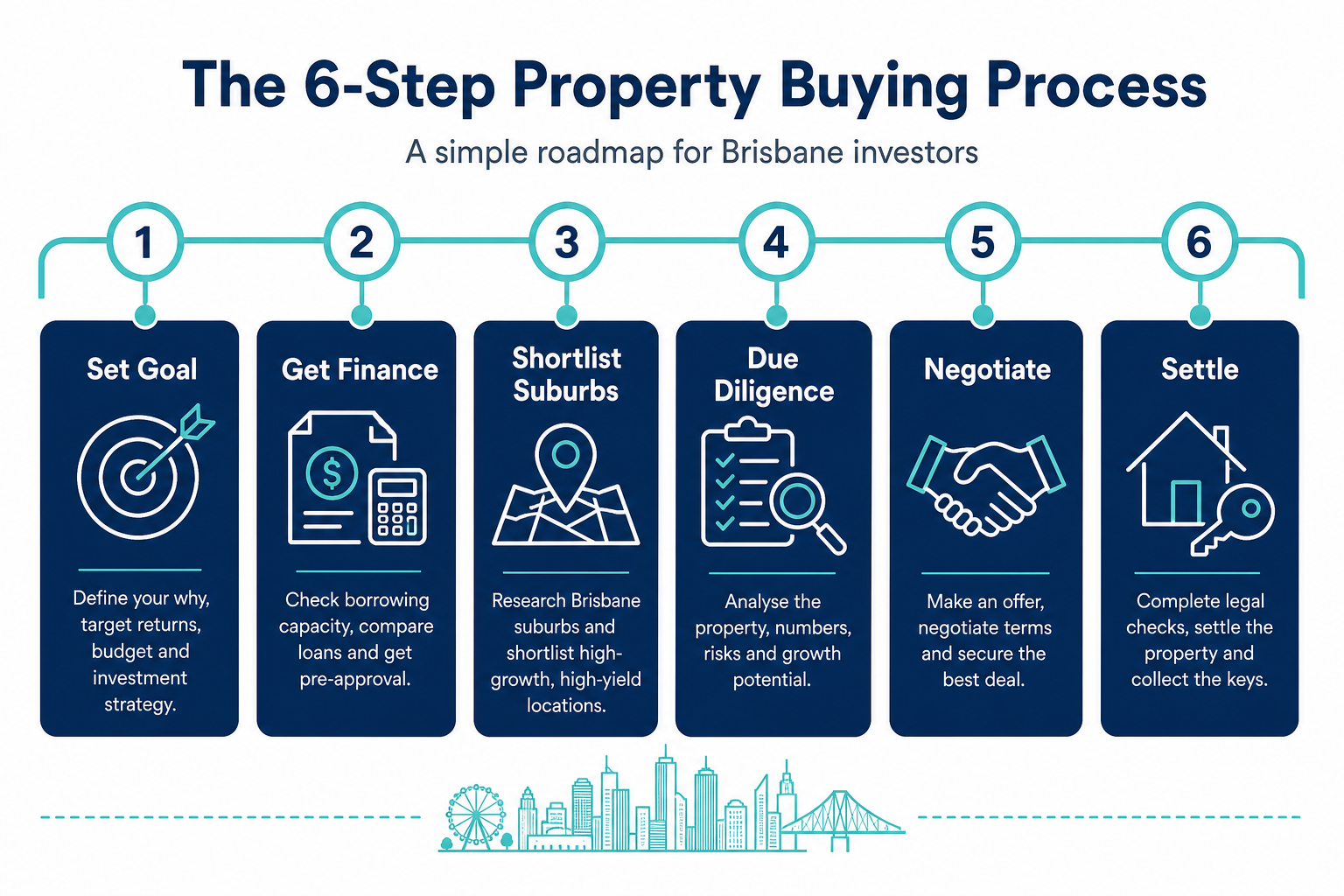
The key steps to buying better in Brisbane
Strategy is only as useful as the process that puts it into action. Here is a practical sequence that reduces risk and improves decision quality at every stage.
1. Define your goal and financial position
Start with a finance pre-approval, not just an estimate. Know your borrowing capacity, your deposit position, your stamp duty liability under current Queensland regulations, and whether any concessions or grants apply to your purchase.
2. Research the market, not just the listings
Look at median price trends, days on market, listing volumes, and rental vacancy by suburb. Compare what is happening at the micro level, not just the city average. This is where working with a buyer's agent in Brisbane who monitors this data continuously gives buyers a clear edge.
3. Shortlist suburbs against your criteria
Use your defined suburb filters, not your preferences, to build a shortlist of three to five target areas. Cross-reference infrastructure plans, zoning changes, and demographic trends. Check the best suburbs to invest in Australia in 2026 for data-backed suburb analysis across Queensland and beyond.
4. Conduct structured due diligence on shortlisted properties
Once a property reaches serious consideration, due diligence should be thorough and systematic. This means independent valuation, building and pest inspection, title search, flood mapping, and rental appraisal if it is an investment. The property investment due diligence checklist is a useful resource for covering each of these steps methodically.
5. Negotiate from evidence, not pressure
The selling agent works for the vendor. Their job is to achieve the highest price. Entering negotiation without independent data on comparable sales and a clear walk-away point puts the buyer at a structural disadvantage. A buyer's advocate negotiates with both market data and emotional detachment.
6. Plan settlement and what comes next
Settlement is not the finish line. For investors, knowing when to refinance, how to structure your depreciation schedule, and whether the asset fits into a broader portfolio plan is part of buying well, not an afterthought.
Where off market opportunities can matter
Off market properties in Brisbane have become a meaningful part of the transaction landscape, and not just for prestige buyers. As market data suggests, a significant portion of Brisbane sales occur without full public campaign, with many sellers choosing quiet transactions over extended marketing periods.
For buyers, accessing off market properties Brisbane offers three advantages that on-market searches simply cannot replicate: more choice, less competition, and better alignment between what is available and what the strategy actually calls for.
Less competition matters enormously when Brisbane's vacancy rate is near 1% and buyer demand is sustained. An off-market offer, negotiated directly through agent relationships and advocate networks, removes the emotion and artificial urgency that a public campaign creates. It also gives buyers the chance to conduct due diligence without a competing offer breathing down their neck.
The quality of off-market access depends almost entirely on the depth of the buying network. Selling agents direct their off-market stock to buyers advocates they know will transact cleanly and quickly. This is a relationship-based market, and individual buyers searching portals simply do not see the same opportunities. Understanding how off-market properties are sourced in Australia gives buyers a realistic picture of what access actually involves.
Buyers Agency Australia maintains active relationships with selling agents across Brisbane and South East Queensland, which means clients are introduced to suitable properties before they are publicly listed. For investors with specific suburb criteria, this can materially reduce time in the market while improving the quality of the assets considered.
How Buyers Agency Australia supports Brisbane buyers
Buyers Agency Australia operates as a full-service buyer's advocacy firm for Queensland buyers approaching the Brisbane market. The approach is research-led and strategy-anchored, not driven by volume or speed for its own sake.
The process begins with a strategy consultation where the team, led by Dragan Dimovski, works through each client's goals, financial position, and risk profile. From there, suburb and property type criteria are set before any searching begins. This mirrors the structure outlined earlier in this guide and is what separates a disciplined engagement from a reactive property search.
For Brisbane-based acquisitions, the team conducts independent market analysis, accesses off-market opportunities through established agent relationships, attends inspections, conducts due diligence, and manages negotiation and contract through to settlement. Clients operating from interstate or internationally benefit from having a dedicated advocate on the ground in Brisbane.
Buyers Agency Australia also applies an AI-powered strategy planning approach that cross-references suburb-level data, rental demand metrics, infrastructure timelines, and portfolio fit before recommending a property. This is not a dashboard exercise. It feeds directly into what suburbs are shortlisted and which specific assets are pursued.
If you are ready to move beyond generic market research and want a structured plan for your Brisbane purchase, book a free strategy session to map out your next property move with the team.

Common mistakes Queensland buyers make when buying in Brisbane
Even buyers who approach Brisbane with good intentions make predictable errors. These are the most common ones worth avoiding.
Chasing headlines instead of data. A suburb that appeared in a property magazine as a hotspot six months ago has already priced in much of that expectation. Buying into momentum after the story has been told often means paying a premium for growth that has already occurred. Finding property hotspots before prices boom requires leading indicators, not lagging ones.
Overextending at auction. Brisbane's auction clearance rates have shown some softening in 2026 as buyers push back on vendor expectations, but auctions still produce emotional spending. Buyers without a firm walk-away price regularly overpay by 3% to 8%, which takes years of rental income to recover.
Ignoring the yield-versus-growth trade-off. A property with a strong gross yield in an outer suburb may have limited capital growth prospects. A tightly held inner-ring suburb may grow strongly but generate minimal cash flow. Neither is wrong, but choosing without understanding the trade-off creates portfolio imbalance. The distinction between positive cash flow property and capital growth assets deserves deliberate attention.
Skipping due diligence to move quickly. In a competitive market, the temptation to skip building inspections or shorten cooling-off periods is real. Properties with structural defects, flood exposure, or zoning constraints can become expensive liabilities. Due diligence is not optional, even when the market feels urgent.
Buying based on suburb names rather than suburb data. Popular suburb names carry brand value that does not always align with investment fundamentals. Some high-profile Brisbane suburbs have seen flat or declining prices in recent years, while less well-known middle-ring pockets outperformed significantly. The data matters more than the postcode's reputation.
| Mistake |
Why It Costs You |
| Chasing headlines |
Buying after growth is priced in, paying a premium for yesterday's story |
| Auction overextension |
Emotional bidding erodes yield and distorts your cost basis |
| Ignoring yield-growth trade-off |
Portfolio imbalance, mismatched cash flow needs |
| Skipping due diligence |
Defect risk, flood liability, zoning constraints discovered post-settlement |
| Buying on suburb brand |
Premium paid for reputation that does not reflect current fundamentals |
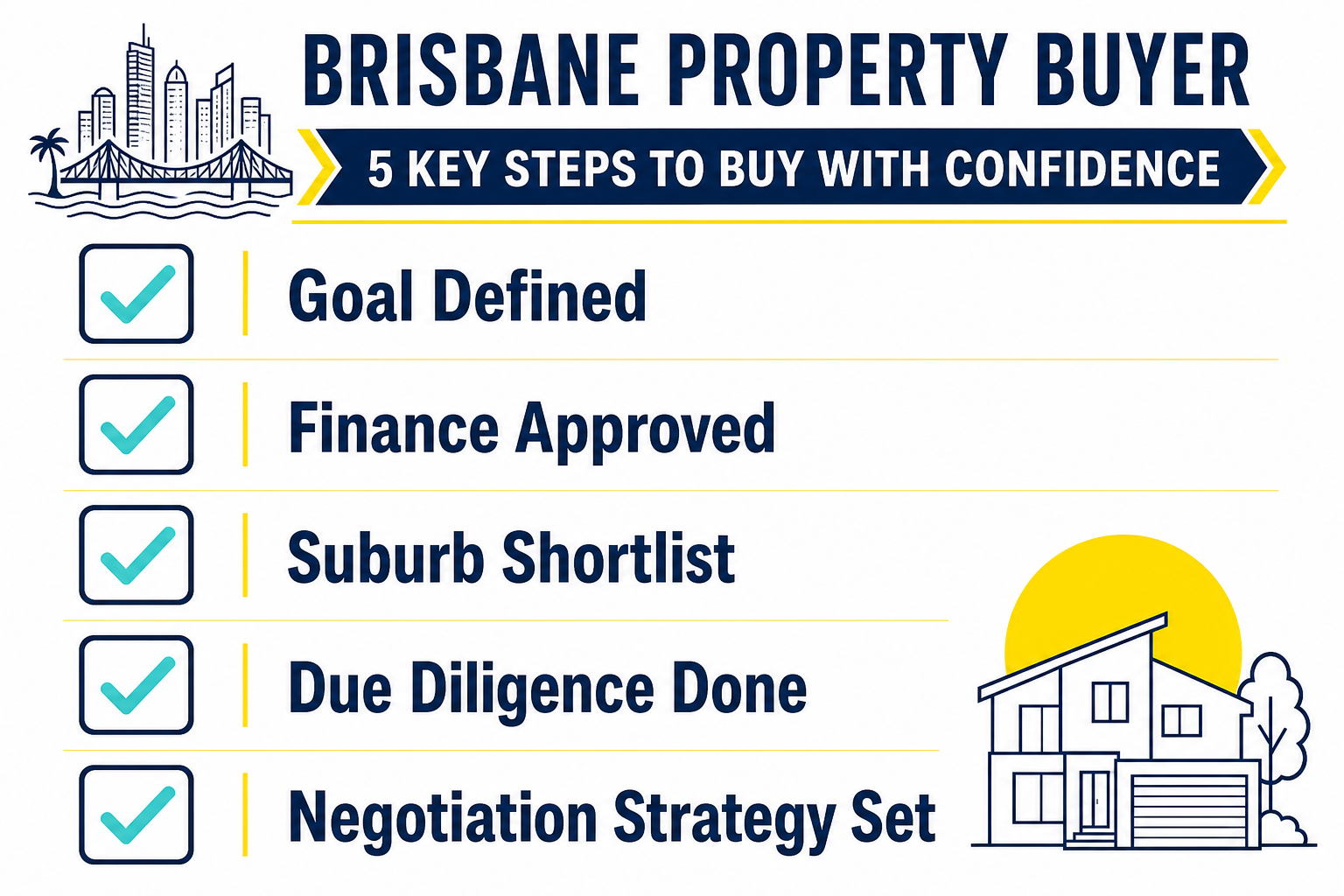
Final checklist for buying better in Brisbane
Before making an offer or formally beginning a property search in Brisbane, work through this checklist to confirm your foundations are in place.
- End goal defined: home, investment, portfolio addition, or SMSF acquisition
- Finance pre-approval confirmed with a buffer above purchase price
- Queensland stamp duty calculated and acquisition costs accounted for
- Suburb shortlist built from data, not preference or headlines
- Property type criteria aligned with your tax position, yield needs, and hold period
- Due diligence process confirmed: building inspection, pest report, title search, flood check, rental appraisal
- Negotiation strategy defined: comparable sales reviewed, walk-away price set before any inspection
- Off-market access considered: are you seeing the full opportunity set, or just what is publicly listed?
- Settlement and post-settlement plan in place: depreciation schedule, property management, refinance timeline
- Professional advocacy engaged: is someone working exclusively for your interests in this transaction?
If several of these boxes remain unchecked, the risk of a poor outcome increases significantly. A buying decision made without this foundation in a market as active and nuanced as Brisbane's is a decision made on hope rather than evidence.
When you are ready to build a plan that covers all of these bases, book a free strategy session with Buyers Agency Australia, or contact the team directly to discuss your Brisbane buying goals.
Frequently Asked Questions
What does a buyer's agent in Brisbane actually do?
A buyer's agent researches suburbs, accesses off-market properties, negotiates on your behalf, and manages due diligence, working exclusively for the buyer, not the vendor.
Is it worth using a buyer's agent for an investment property in Brisbane?
Yes, particularly in a competitive, low-stock market. Buyer's agents typically access off-market deals and negotiate more effectively than individual buyers acting alone.
How do off-market properties in Brisbane work?
Off-market properties are sold without a public campaign. Access depends on agent relationships, which buyer's advocates build over time through consistent transaction volume.
What suburbs in Brisbane are performing well for investors in 2026?
Middle-ring and southern corridor suburbs, including Sunnybank, Springwood-Kingston, and Nundah, have shown strong annual price growth supported by affordability and infrastructure access.
What is the biggest mistake Queensland buyers make in Brisbane?
Buying without a defined strategy. Reactive purchases based on headlines or auction pressure consistently produce worse outcomes than structured, data-driven acquisitions.
 General
Strategic property buyers in Brisbane combine market knowledge, disciplined search processes, and buyer-side support to secure better outcomes....
Off-market properties are sold without public advertising, often through private networks and direct agent relationships. In Melbourne's tightening rental market, where vacancy sits around 1.8% and auction clearance rates have jumped to 75%, these hidden opportunities can offer buyers early access and reduced competition—if approached with the right guidance and thorough due diligence.
Introduction
Melbourne's property market has entered a unique phase in 2026. After years of subdued growth compared to Brisbane and Perth, the city is showing signs of recovery. Auction clearance rates have climbed from 63% to 75% year on year, and the rental vacancy rate has tightened from 5% to 1.8%, signalling renewed demand.
In this environment, off market properties are becoming a strategic option for buyers seeking early access to stock before it hits public portals. These sales happen quietly, through agent networks, private databases, and word of mouth, often before a sign appears or a listing goes live.
Buyers Agency Australia works across all major Australian capital cities, including Melbourne, to help investors and homebuyers identify and secure properties aligned with long-term wealth creation. With a transparent, fixed-fee model and deep market knowledge, the firm helps clients navigate the complexities of off-market transactions without the noise and urgency that can lead to costly mistakes. For property investors seeking long-term wealth, book a free strategy session early in your search to align your brief with real opportunities.
What off-market really means
An off-market property is one that is available for purchase but not publicly advertised on platforms like Domain or realestate.com.au. There are no sale signs, no open inspections, and no marketing campaigns—just discreet conversations between agents and qualified buyers.
Some off-market listings are genuinely private sales. Others are pre-market listings, where the agent is still preparing floorplans, photos, and marketing materials but begins testing buyer interest before launching publicly. In both cases, the property is sold before the broader market knows it exists.
According to industry estimates, between 10% and 15% of property transactions in Australia happen off-market, with the figure climbing even higher in tightly held inner suburbs where privacy and speed are priorities. In Melbourne, up to 20-30% of properties in certain markets sell off-market, meaning many opportunities are never publicly advertised.
Understanding this distinction is critical. A pre-market property may still go to auction if early offers don't meet the seller's expectations. A true off-market sale, by contrast, is handled entirely through negotiation, with no fallback to public marketing.

Why sellers choose it
Sellers opt for off-market transactions for a range of reasons, most of which centre on privacy, speed, and cost.
Privacy is the primary driver for high-profile vendors, professionals, or families managing sensitive circumstances such as separation, estate settlement, or relocation. Public marketing can feel invasive, and many sellers prefer to avoid the disruption of weekly open inspections and broad exposure.
Testing demand is another common reason. Sellers may want to gauge what the market will pay without committing to a full campaign. If early offers are strong, they proceed privately. If not, they can launch a public campaign later without having "failed" to sell.
Reduced market noise also appeals to vendors who want a quieter, more controlled process. Public auctions and marketing campaigns attract competition, but they also bring scrutiny, price expectations, and emotional pressure. Some sellers simply want a clean, fast transaction with minimal fuss.
Cost savings can be significant. Marketing a property in Melbourne can cost tens of thousands of dollars, including styling, photography, print advertising, and agent commissions tied to campaign spend. For sellers confident they can find a buyer privately, avoiding these costs is appealing.
Finally, some vendors are not actively selling but are open to the right offer. These "pocket listings" exist in agent databases and are only presented when a buyer with the right profile appears. For time-poor professionals requiring end-to-end property search and negotiation, understanding seller motivations can unlock opportunities that never reach public portals.
How buyers find these opportunities
Accessing off-market stock requires a combination of relationships, strategy, and timing. Most buyers who succeed in this space do so through one of three channels: buyers agents, direct agent networks, or targeted outreach.
Buyers agents and advocates are the most reliable route. These professionals maintain active relationships with selling agents across Melbourne, and they are often the first to hear about properties before they are listed. A buyers agent Melbourne specialist like Buyers Agency Australia uses these networks to source opportunities that match client briefs, conduct due diligence, and negotiate terms that protect the buyer's interests.
Dragan Dimovski, a property expert with over 20 years of experience, leads the firm's strategic approach, combining market analysis with hands-on negotiation to ensure clients secure the right property at the right price. When a buyer works with a qualified advocate, they gain access not only to hidden stock but also to independent valuation, contract review, and risk assessment.
Direct agent relationships are another pathway. Buyers who have built trust with selling agents in their target suburbs may receive early calls when a property is about to hit the market. However, this approach requires time, local presence, and the ability to move quickly when opportunities arise.
Targeted outreach involves contacting homeowners in desirable streets or buildings to express interest in purchasing, even if the property is not officially for sale. This tactic works best in tightly held suburbs where stock is limited and buyers are willing to pay a premium for the right location.
Off-market opportunities move fast. Buyers who hesitate risk losing the property to another qualified party. Being finance-ready, clear on budget, and supported by a professional team is essential to converting access into ownership.

What risks buyers should watch
Off-market transactions can deliver value, but they also carry distinct risks that require careful management.
Pricing uncertainty is the most common challenge. Without public competition or comparable auction results, buyers often struggle to determine fair market value. Some sellers set ambitious expectations, testing whether a buyer will pay above market to secure the property privately. According to recent analysis, many buyers pay a premium for the opportunity to secure an off-market property without competition, believing this will prevent it from being listed publicly and attracting other buyers.
To mitigate this risk, buyers must conduct thorough property due diligence using recent sales data, independent valuations, and market comparables. Relying solely on the selling agent's price guidance is not sufficient.
Limited transparency is another concern. Off-market properties are often presented with less formal disclosure than public listings. Buyers may have fewer inspections, less time to review contracts, and limited access to strata reports, building inspections, or title searches. Rushing through due diligence because of perceived urgency can lead to costly surprises after settlement.
Every statistic, benchmark, or trend claim must be supported by credible sources. For example, CoreLogic data shows that Melbourne's rental vacancy rate tightened to 1.8% in April 2025, down from 5% the previous year, signalling strong demand. Buyers must verify these figures independently rather than relying on agent commentary.
Urgency and pressure can also distort decision-making. Off-market sales are often framed as exclusive, time-sensitive opportunities that will disappear unless the buyer acts immediately. While speed is sometimes genuine, it can also be a negotiation tactic designed to prevent the buyer from seeking second opinions or exploring alternatives.
A qualified buyers agent can counter this pressure by providing objective analysis, comparing the off-market opportunity against other available stock, and advising whether the deal represents genuine value or inflated expectations.
Seller commitment is not always guaranteed. Some off-market properties are listed to test demand rather than to execute a genuine sale. If early offers do not meet the seller's threshold, the property may be withdrawn or relaunched publicly, leaving the buyer to start the process again.
Finally, contract terms in off-market deals can be less standardised. Buyers may face shorter finance clauses, larger deposits, or limited conditions for building and pest inspections. Negotiating fair terms requires legal review and an understanding of what is reasonable in the current market.
Buyers Agency Australia helps clients navigate these risks by conducting independent valuations, coordinating building inspections, and ensuring all contract terms are reviewed before signing. For first-home buyers looking for expert guidance, understanding these risks early can prevent expensive mistakes.

Melbourne market context
Melbourne's property market in 2026 is best understood as a city in transition. After years of underperformance relative to other capitals, the fundamentals are shifting. The price gap between Melbourne and Sydney is at its widest point since 2003, creating a value proposition for investors who move early.
According to KPMG's current Residential Property Outlook, Melbourne house prices are forecast to grow approximately 6.8% and units 7.3% across 2026, driven by population growth, undersupply, and improving rental yields. The city's rental market is tightening quickly, with vacancy rates around 1.5% and rents rising 4.3% annually for houses and 4.9% for units.
For off-market buyers, this environment presents both opportunity and competition. Stock levels are running approximately 12% above the five-year average, giving buyers more choice, but well-priced properties in tightly held inner suburbs are still finding buyers quickly. The Reserve Bank of Australia raised the cash rate to 4.10% in March 2026, and further increases are forecast, placing pressure on borrowing capacity and buyer confidence.
Investors and homebuyers who understand these dynamics can use off-market channels to access stock before it reaches peak competition, but only if they approach the process with clear strategy, verified data, and professional support.
Final strategy
Off-market properties are not shortcuts. They are simply another channel within a broader property search strategy. For buyers who approach them with the right preparation, independent advice, and realistic expectations, they can deliver early access, reduced competition, and opportunities that align with long-term goals.
But success requires discipline. Buyers must verify pricing, complete full due diligence, and avoid the pressure to act based on urgency alone. Working with a property investment strategy specialist ensures that every opportunity is assessed on merit, not emotion.
Buyers Agency Australia combines market knowledge, agent networks, and data-driven analysis to help clients identify and secure off-market properties across Melbourne and beyond. Whether you are a first-home buyer or a seasoned investor, the firm's transparent approach ensures you move with confidence and clarity.
Ready to explore Melbourne's hidden opportunities without overpaying? Contact the team to map out your next property move and secure the right home or investment with confidence.
Frequently Asked Questions
What does off-market mean in property?
Off-market refers to properties sold without public advertising, typically through private agent networks or direct buyer contact.
Why do sellers choose off-market sales?
Sellers value privacy, speed, cost savings, and the ability to test demand without committing to a full marketing campaign.
How do buyers access off-market properties?
Buyers access off-market stock through buyers agents, direct agent relationships, targeted outreach, or professional advocacy networks.
What are the main risks of buying off-market?
Risks include pricing uncertainty, limited transparency, urgency pressure, potential seller withdrawal, and less standardised contract terms.
Do off-market properties cost less?
Not always. Some sell below market, others at premium. Independent valuation and due diligence are essential to assess value.
 General
Discover how off-market properties operate in Melbourne, why sellers choose privacy, and the critical due diligence buyers must...
First-home buyer grants and schemes can help you buy sooner, but they often come with trade-offs most buyers overlook until contracts are signed. Understanding how these programs shape your budget, restrict your location, and influence your long-term strategy is more important than the headline dollar figure.
Why grants matter less than most buyers think
When you see a $30,000 first home buyer grant advertised, it feels like free money. It is not. It is a conditional payment that arrives only when you meet strict eligibility rules, buy a specific type of property, and commit to living there for a set period.
Most state-based grants apply only to new homes or substantially renovated properties. If you are buying an established house—which represents the majority of transactions for first-home buyers—you will miss the grant entirely. According to the Australian Bureau of Statistics, the median dwelling price across capital cities reached $987,000 in December 2025, yet most grant schemes cap eligible properties far below this threshold.
The First Home Guarantee, which allows you to buy with a 5% deposit without Lenders Mortgage Insurance, expanded significantly in October 2025. Income caps were removed, place limits lifted, and property price caps raised to $1.5 million in Sydney and $1 million in Brisbane. Over 248,000 first home buyers have used this scheme since its launch, saving an average of $17,000 to $22,000 in LMI on a $700,000 property with a 5% deposit.
But here is what the marketing does not tell you: entering the market with a 5% deposit means borrowing 95% of the property value. Your repayments are higher, your equity buffer is thinner, and any downturn in property values leaves you exposed. Buyers Agency Australia has seen firsthand how buyers who stretch to use every available scheme often regret the pressure that follows.
Grants and schemes are tools, not guarantees of success. They help you enter the market earlier, but they do not shield you from poor property selection, overpriced purchases, or unsuitable locations. The real value lies in understanding when to use them and when to wait.

How schemes shape budget and location
Every first-home buyer scheme comes with property price caps. These caps determine where you can buy, what property types you can afford, and whether the scheme is worth using at all.
In Sydney, the First Home Guarantee caps purchases at $1.5 million. In Melbourne, the cap is $950,000. In Brisbane, it is $1 million. For Adelaide, Perth, and Hobart, caps sit at $900,000, $850,000, and $700,000 respectively. These thresholds sound generous until you compare them to median suburb prices in desirable areas.
If you want to buy in an inner-city suburb with strong infrastructure, good schools, and stable capital growth, the price cap may exclude you entirely. You are pushed toward outer suburbs, regional areas, or compromised properties that fit the budget but not your long-term needs. According to Treasury modelling released in January 2026, the expanded Home Guarantee Scheme is expected to result in dwelling prices being 0.6% higher over the medium term due to increased demand.
The average first-home buyer deposit in Australia was approximately $135,000 in 2025, but 70% of first-home buyers are choosing not to wait until they have saved a full 20% deposit before purchasing. This shift reflects the pressure buyers feel to enter the market quickly, often driven by rising prices and the fear of being priced out.
Location trade-offs are real. A $30,000 Queensland First Home Owner Grant, available for new homes with contracts signed before 30 June 2026, might seem attractive. But if it forces you into a new estate 50 kilometres from your workplace, with poor public transport and limited amenity, the grant becomes a long-term liability, not a benefit.
Property investment strategy should always start with location, infrastructure, and growth potential. Schemes should support that strategy, not dictate it. If a grant pushes you into the wrong suburb, you are better off waiting and buying the right property without it.
Buyers Agency Australia works with clients to model the true cost of grants and schemes, including the hidden trade-offs. Sometimes the best decision is to ignore the scheme entirely and focus on a property that delivers long-term value. To explore how this applies to your situation, book a free strategy session and map out your next property move.
What first-home buyers often overlook
Deposit size is only one part of the equation. Buyers who focus exclusively on getting into the market with a 5% deposit often overlook three critical factors: upfront costs, timing pressure, and decision-making under stress.
Upfront costs include stamp duty, conveyancing fees, building and pest inspections, loan application fees, and moving expenses. A good rule of thumb is to budget 3% to 5% of the purchase price for these costs. On a $700,000 property, that is $21,000 to $35,000 on top of your deposit. Many buyers forget this and find themselves scrambling for cash at settlement.
Stamp duty concessions for first-home buyers vary by state. In Tasmania, eligible buyers currently qualify for full stamp duty exemption on properties valued up to $750,000 until 30 June 2026. In South Australia, stamp duty was abolished for all first-home buyers purchasing new homes from June 2024 onwards, regardless of property value, saving buyers purchasing $850,000 homes approximately $45,000.
Timing pressure is another overlooked issue. When you know you qualify for a scheme, there is an urgency to use it before price caps change, grant amounts expire, or interest rates rise. This urgency leads to rushed decisions. You bid higher at auction, skip due diligence, or settle for a property that does not meet your needs.
Decision pressure is compounded by the complexity of stacking multiple schemes. You might be eligible for the First Home Guarantee, a state-based stamp duty concession, and the First Home Super Saver Scheme, which allows you to withdraw up to $50,000 from voluntary superannuation contributions for your deposit. Each scheme has its own eligibility criteria, timing windows, and application processes. Coordinating them all while navigating a competitive property market is overwhelming.
According to data released by Housing Australia, around 1 in 3 first-home buyers were supported by the Home Guarantee Scheme in 2023-24, with 43,800 scheme places taken up over the financial year. This demonstrates strong demand, but also highlights how many buyers are entering the market with minimal deposits and maximum leverage.
The Australian Taxation Office reports that 47,800 Australians withdrew $682 million through the First Home Super Saver Scheme in 2024-25, with average withdrawals of $14,260 supporting deposits. This is a legitimate strategy, but it requires forward planning and an understanding of contribution caps and withdrawal timeframes.
First home buyer advice should include a realistic assessment of your financial readiness, not just your eligibility for a scheme. Property expert Dragan Dimovski, with over 20 years of experience, has guided hundreds of first-home buyers through this process and consistently emphasises one principle: only buy when you are genuinely ready, not when a scheme tells you to.

How support changes the process
Buying your first home without professional guidance is possible, but it is not advisable. Schemes and grants add layers of complexity that most buyers underestimate until they are midway through the process.
A buyers agent removes the guesswork. They understand which schemes apply to your situation, how to structure your finance to maximise benefits, and which properties deliver long-term value regardless of the grant you receive. They also provide access to off-market properties, negotiate on your behalf, and ensure you are not overpaying in a heated market.
Buyers Agency Australia operates across all major Australian capital cities and specialises in data-driven investment strategies that prioritise 10-year portfolio modelling. Their fixed-fee model ensures transparency, and their focus on long-term wealth creation means they are invested in your success beyond the first purchase.
Support also means having someone who can say no on your behalf. When a property does not meet the criteria, when the price is too high, or when the location is wrong, a buyers agent walks away. Emotional buyers rarely do.
The best time to engage a buyers agent is before you start searching, not after you have found a property you think you want. Early engagement allows you to define your strategy, understand your true budget, and align your goals with the right property type and location.
If you are serious about entering the property market with a clear plan, contact the team at Buyers Agency Australia to discuss your next steps.

Frequently asked questions
Can I use the First Home Guarantee and a state grant together?
Yes, the First Home Guarantee and state-based grants such as the First Home Owner Grant operate independently and can be stacked if you meet eligibility criteria for both.
What happens if property prices fall after I buy with a 5% deposit?
You could owe more than your property is worth, a situation known as negative equity, which limits your ability to refinance or sell without a loss.
Do I need to live in the property for a set period to keep the grant?
Yes, most schemes require you to occupy the property as your principal residence for at least six to 12 months, depending on the state or territory.
Can I access the First Home Guarantee if I owned property overseas?
No, you must not have owned residential property in Australia or overseas in the past 10 years to qualify for the First Home Guarantee.
Should I wait to save a 20% deposit or use a scheme now?
It depends on your financial position, the property you want, and market conditions; professional advice tailored to your situation is essential.
Final thoughts
First-home buyer grants and schemes are not magic. They are financial tools with conditions, trade-offs, and long-term implications. Understanding what they deliver and what they cost you is the difference between a smart entry into the market and a stressful decade of regret.
If you are ready to move forward with clarity and confidence, book a free strategy session with Buyers Agency Australia and take the first step toward a property decision you will not regret.
 General
First-home buyer grants and schemes can help you buy sooner, but they often come with trade-offs most buyers...
Off-market properties are never advertised publicly, circulating instead through professional networks that most buyers will never access. Buyers agents build years of trusted relationships with selling agents, vendors, and developers to unlock these opportunities before competition begins.
What counts as off-market
An off-market property is one that will never appear on Domain, REA, or any public listing portal. It won't have a for-sale sign outside the door, no scheduled open homes, and no marketing campaign.
The sale happens quietly, typically between a selling agent and a small circle of pre-qualified buyers presented through trusted buyers advocates.
Many buyers confuse off-market with pre-market. Pre-market means a property is preparing for public launch but hasn't been advertised yet. Off-market means the vendor intends to sell without any public exposure at all. According to recent analysis, off-market transactions are increasingly common as competition and supply constraints reshape how properties are sourced across Australia.
These properties circulate through agent networks, private databases, and direct vendor outreach. Domain now offers matching services for off-market properties in Queensland, New South Wales, and Victoria, but the most valuable opportunities still move through professional relationships long before they reach any platform.
Why vendors choose privacy
Sellers pursue off-market sales for several reasons. High-profile individuals or those undergoing life transitions such as separation, estate settlement, or financial restructuring prefer discretion. Public marketing campaigns can cost $15,000 to $30,000 in major capital cities. Some vendors simply want to test buyer interest without the commitment or disruption of a full campaign.
Off-market sales also allow vendors to control timing, avoid neighbour scrutiny, and reduce the emotional stress of open inspections. When a trusted agent brings a serious buyer who can move quickly, many vendors prefer the certainty of a private transaction over the uncertainty of a public auction.
Serious investors understand the advantage. With investor lending rising 13.6% in recent quarters, competition for quality stock is intensifying. First-home buyers face professional investors with established networks, making early access essential.

How agents build access
Most buyers assume they can replicate a buyers agent's network by calling a few local agents. They underestimate what professional access actually requires.
A buyers agent cultivates relationships with hundreds of selling agents across multiple markets. These aren't casual contacts collected at weekend open homes. They're trusted professional relationships built on years of successful transactions, pre-qualified buyers, and reliable follow-through.
Selling agents prefer working with buyers agents because they bring buyers who can move quickly and won't waste time. When an agent has an off-market opportunity, they contact their trusted buyers agent network first. According to property industry research, agents naturally cultivate relationships with selling agents, property developers, buyers, sellers, and private vendors who provide early insights before properties officially hit the market.
Daily market engagement matters
Professional buyers agents maintain daily contact with the market. They attend industry events, send regular check-ins to selling agents, and stay visible across multiple suburbs and price points. This consistent presence ensures they receive the first call when an off-market opportunity emerges.
At Buyers Agency Australia, founder Dragan Dimovski brings over 20 years of property experience to every client relationship. That depth of market engagement creates access that individual buyers cannot replicate in months or even years of independent searching.
Buyers agents also match sellers with buyers in their existing database. If an agent already has buyers ready at multiple price points, a sale can be facilitated within days. This speed appeals to vendors who value certainty over maximum exposure.
The relationship advantage extends beyond selling agents. Buyers agents build connections with property developers offering pre-construction opportunities, estate executors managing probate sales, and private vendors testing the market before committing to a campaign.
Technology supports but doesn't replace relationships
Platforms like Listing Loop democratise some off-market access, allowing buyers to view pre-market opportunities matched to their preferences. However, the most valuable off-market deals circulate through established professional networks first, long before they reach any platform.
Technology improves visibility but doesn't replace trust. Selling agents call the buyers agents they know will deliver, not the platform with the most users.

Why the best opportunities never hit portals
Quality properties in tightly held suburbs often sell off-market because vendors don't need public exposure to achieve strong prices. In Sydney's Inner West or Melbourne's Bayside, many vendors prefer private transactions because local demand is already strong.
Sellers of premium assets know they'll achieve competitive results without the disruption of a marketing campaign. Off-market sales allow them to control who views their property, when inspections occur, and how negotiations proceed.
Less competition creates better outcomes
Public auctions and on-market sales attract emotional bidding. According to CoreLogic data, homes sold at auction still clear about 1.0% higher quarter-on-quarter nationally, but that premium often reflects bidding wars rather than genuine property value.
Off-market purchases help avoid those bidding wars that push prices beyond rational investment thresholds. When you're one of two or three buyers viewing a property instead of twenty, negotiation dynamics shift dramatically.
For investors focused on property investment strategy, off-market access means evaluating opportunities based on data and long-term fundamentals rather than auction-day emotion. The Australian Bureau of Statistics reported the mean price of residential dwellings rose by $28,700 to $1,074,700 in the December 2025 quarter, highlighting continued upward pressure across the market.
Speed and certainty appeal to vendors
Vendors value speed and certainty. A buyers agent representing a pre-approved buyer with clear criteria can often present an offer within 24 to 48 hours of viewing a property.
This responsiveness appeals to vendors managing time-sensitive circumstances such as interstate relocation, estate settlement, or financial restructuring. It also reduces the vendor's holding costs and stress associated with prolonged marketing campaigns.
Market forecasts predict property price growth to slow to around 5 to 7% in 2026 according to multiple economists, but that still means rising prices. Brisbane, Perth, and Adelaide lead growth predictions, making off-market access particularly valuable in these markets.

How to avoid overpaying for exclusivity
Off-market access creates advantage, but it doesn't eliminate risk. Without comparable sales data from recent public transactions, determining fair market value requires discipline and expertise.
Buyers agents rely on deep market knowledge, recent comparable sales, and independent valuation tools to ensure clients don't overpay for the privilege of early access. Exclusivity is valuable, but only when the price reflects genuine property value.
Independent valuation protects buyers
Every off-market purchase should include independent valuation before contract exchange. Buyers agents coordinate building and pest inspections, strata reports for apartments, and bank valuations to confirm the purchase price aligns with market evidence.
This due diligence protects buyers from paying a premium simply because a property wasn't publicly marketed. The goal is securing a quality asset at or below market value, not paying extra for discretion.
Experienced buyers agents also structure offers with appropriate conditions. Off-market transactions sometimes require faster settlements or unconventional terms, but buyers should never waive due diligence to secure a property.
Assemble your property team early
Successful off-market buyers prepare before opportunities arise. Assemble your property team early: buyers agent, mortgage broker, conveyancer, and building inspector. Established relationships enable fast responses when opportunities emerge.
Off-market deals often move quickly. Having professionals on standby prevents delays that lose opportunities. Adequate cash reserves also provide negotiating flexibility and demonstrate serious buyer intent.
Budget for deposit, purchase costs, immediate repairs or improvements, and three to six months of holding costs. Financial readiness signals to vendors that you're a credible buyer worth prioritising.
Know when to walk away
Not every off-market opportunity represents value. Buyers agents assess dozens of off-market properties for every one they recommend to clients. Discipline and selectivity matter more than access alone.
If an off-market property doesn't meet your investment criteria or the vendor's expectations exceed market evidence, walk away. Off-market access creates opportunity, but successful investors only act when fundamentals align.
The Reserve Bank of Australia flagged potential rate increases if inflation cannot be contained, adding complexity to property investment decisions throughout 2026. Buyers need expert guidance to navigate both market timing and property selection.
If you're ready to access off-market properties most buyers never see, book a free strategy session with Buyers Agency Australia. We'll map out your next property move using our established network across all major Australian capital cities. Our fixed-fee model and 10-year portfolio planning approach ensure you're building long-term wealth, not just buying a property. Contact the team today to start your property journey with confidence.

Frequently Asked Questions
What makes a property genuinely off-market?
A property is off-market when it's never advertised publicly on Domain, REA, or any portal, with no for-sale sign or open homes.
Can individual buyers access off-market properties without an agent?
Yes, but it requires years of relationship building with agents and daily market engagement that most buyers cannot sustain.
Do off-market properties sell for less than on-market properties?
Not always. They avoid bidding wars, but price depends on vendor motivation, market conditions, and negotiation skill.
How quickly do off-market opportunities move?
Often within 24 to 72 hours. Selling agents contact trusted buyers agents first, and pre-qualified buyers must act fast.
Are off-market properties riskier than public listings?
No, if proper due diligence is completed. Independent valuations, building inspections, and market analysis protect buyers from overpaying.
 General
Off-market properties are never listed on Domain or REA. Buyers agents access them through professional networks built over...
A Sydney buyers agent helps property buyers research, shortlist, inspect, negotiate, and secure property in one of Australia's most competitive markets. With median house prices around $1.62 million and auction clearance rates hovering near 51%, having a professional advocate on your side can make the difference between overpaying and securing a property that meets both your lifestyle and investment goals.
What a Sydney Buyers Agent Does
A Sydney buyers agent represents you, the buyer, throughout the entire property purchasing process. Unlike selling agents who work for vendors, a buyer's agent works exclusively in your interest.
Their role typically includes property research, suburb analysis, private inspections, due diligence coordination, negotiation, and auction bidding. They act as your eyes, ears, and strategic adviser in a market where information asymmetry can cost tens of thousands of dollars.
In Sydney, where dwelling values recently recorded a monthly fall of 0.6% in April 2026 according to market data, buyers agents help clients interpret short-term volatility within long-term market fundamentals. They understand that Sydney's auction clearance rate of 51% means roughly half of all properties taken to auction do not sell on the day, giving buyers more negotiating power than in previous years.
A quality buyers agent in Sydney will also coordinate building and pest inspections, strata reports, contract reviews, and settlement logistics. This end-to-end support is particularly valuable for time-poor professionals and interstate investors who cannot attend every inspection or auction in person.
Dragan Dimovski, with over 20 years of property experience, built Buyers Agency Australia on the principle that transparency and data-driven strategy deliver better long-term results than commission-based incentives.

Who Should Use a Sydney Buyers Agent?
Not every buyer needs a buyers agent, but three groups benefit most.
Time-poor professionals who lack the capacity to attend weekend inspections, research comparable sales, or sit through multi-hour auctions often turn to buyer representation. A buyers agent handles the legwork, filters out unsuitable properties, and presents only shortlisted options that meet strict criteria.
First-home buyers navigating Sydney's market for the first time face a steep learning curve. Understanding suburb price ceilings, identifying red flags during inspections, and negotiating without emotion are skills that take years to develop. A buyers agent levels the playing field, ensuring first-time buyers avoid costly mistakes.
Property investors seeking long-term capital growth and rental yield rely on buyers agents to identify suburbs with strong fundamentals. In 2026, infrastructure investment in Western Sydney around the new airport and Metro corridors is driving double-digit growth in affordable suburbs, while premium Eastern Suburbs properties have softened. A buyers agent helps investors target the right pockets at the right stage of the cycle.
Interstate and overseas buyers also benefit significantly. Local market knowledge, agent relationships, and on-the-ground inspection capacity are difficult to replicate remotely. A Sydney-based buyers agent provides that local presence and removes geographic barriers.
Key Benefits of Hiring a Buyers Agent in Sydney
The primary benefits are time savings, market access, negotiation support, due diligence, and reduced stress.
Time savings: Property search and evaluation can consume 8 to 12 weekends. A buyers agent compresses that timeline by pre-screening properties, attending inspections on your behalf, and presenting only the best options.
Market access: Buyers agents often hear about properties before they hit the market. According to industry data, agents with strong selling-agent networks can access off-market and pre-market listings that never appear on public portals. This access reduces competition and can create better pricing outcomes.
Negotiation support: Skilled negotiation can save thousands. Buyers agents negotiate unemotionally, use comparable sales evidence to justify offers, and understand vendor psychology. They know when to push and when to walk away.
Due diligence: A buyers agent coordinates building inspections, reviews contracts, checks planning overlays, and identifies risks that untrained buyers might miss. In Sydney, where termites are a significant concern due to high rainfall and Eucalypt forests, a thorough pest inspection is non-negotiable.
Reduced stress: Buying property in Sydney is stressful. A buyers agent manages the process, handles agent communication, and provides objective advice, allowing you to focus on your day-to-day life.
Research suggests buyers agents can negotiate savings that often exceed their fee, particularly in markets where emotional bidding inflates prices.
How Buyers Agents Help Across Sydney Submarkets
Sydney is not one market. It is a collection of submarkets with different drivers, buyer demographics, and price sensitivities.
Eastern Suburbs like Randwick, Coogee, and Bondi attract owner-occupiers seeking lifestyle, beaches, and proximity to the CBD. These suburbs have seen strong long-term growth but have softened in early 2026 as higher interest rates squeezed borrowing capacity at the premium end. A buyers agent in the Eastern Suburbs focuses on boutique apartments and family homes with scarcity value.
Inner West suburbs like Five Dock, Croydon, and Marrickville offer a blend of affordability, transport links, and café culture. The Inner West records some of the highest auction clearance rates in Sydney, driven by fierce competition between investors and owner-occupiers. A buyers agent here needs to act fast and negotiate with precision.
North Shore suburbs like Mosman, Chatswood, and Willoughby appeal to families seeking quality schools, leafy streets, and established infrastructure. Prices are high, but demand remains steady. A buyers agent on the North Shore helps buyers identify value within tightly held pockets.
Western Sydney growth corridors around Parramatta, St Marys, and Liverpool are benefiting from billions in infrastructure investment, including the Western Sydney Airport and Metro extensions. These suburbs are posting 6 to 7% annual growth and offer strong rental yields. A buyers agent targeting Western Sydney focuses on infrastructure-driven capital growth and investor fundamentals.
Each submarket requires different research, different agent relationships, and different negotiation strategies. A buyers agent with Sydney-wide coverage can match your goals to the right suburb.
What to Look for in a Sydney Buyers Agent
Not all buyers agents are created equal. Here are practical selection criteria.
Local knowledge: Does the agent understand Sydney submarkets, recent sales, and infrastructure timelines? Ask them to explain why one suburb will outperform another.
Transparency: How do they charge? Fixed-fee structures align incentives. Percentage-based fees can create conflicts of interest, as the agent earns more when you pay more.
Experience: How many transactions have they completed? What types of properties do they specialise in? Residential, investment, commercial?
Network: Do they have strong relationships with selling agents across Sydney? Can they access off-market properties?
Process: What does their end-to-end process look like? Do they coordinate inspections, due diligence, and settlement support?
References: Ask for client testimonials and case studies. Speak to past clients if possible.
Licensing: Verify their license on the NSW Fair Trading register. All buyers agents must hold a real estate license in NSW.
Buyers Agency Australia offers a transparent, fixed-fee model and data-driven 10-year portfolio modelling to ensure every purchase aligns with long-term wealth creation.
How the Process Works from Search to Settlement
A typical buyers agent process follows these stages.
1. Strategy session: You meet with the buyers agent to discuss budget, goals, timeline, and property criteria. They explain their process, fees, and expected outcomes.
2. Research and shortlisting: The agent researches suburbs, analyses market data, and shortlists properties that meet your criteria. They filter out unsuitable options and focus on high-potential listings.
3. Inspections: The agent attends inspections, takes notes and photos, and provides detailed feedback. If you wish to inspect in person, they coordinate access.
4. Due diligence: The agent arranges building and pest inspections, reviews the contract, checks planning overlays, and identifies any red flags.
5. Negotiation or auction: For private sales, the agent negotiates directly with the selling agent. For auctions, they develop a bidding strategy, set a walk-away price, and bid on your behalf.
6. Contract and settlement: Once terms are agreed, the agent coordinates contract exchange, settlement logistics, and any post-purchase requirements.
The entire process typically takes 4 to 12 weeks, depending on market conditions and how quickly suitable properties become available.

Why Buyers Agency Australia Is a Strong Sydney Option
Buyers Agency Australia differentiates through three pillars: fixed fees, data-driven strategy, and end-to-end support.
Fixed fees: Unlike percentage-based models, Buyers Agency Australia charges a transparent fixed fee. This removes conflicts of interest and ensures the agent is incentivised to negotiate the best price, not the highest price.
Data-driven strategy: Every recommendation is backed by 10-year portfolio modelling, comparable sales analysis, and market fundamentals. This long-term approach ensures clients build wealth through property, not just buy property.
End-to-end support: From initial strategy to settlement, Buyers Agency Australia manages every step. They coordinate inspections, handle paperwork, and provide ongoing support beyond the purchase.
With a national presence across all major Australian capital cities, Buyers Agency Australia combines local market expertise with a scalable, modern service model. Dragan Dimovski's two decades of experience and transparent approach have rapidly built the brand into a result-oriented alternative to traditional commission-based agents.
For buyers seeking a professional, empathetic, and data-driven partner in Sydney's complex property market, Buyers Agency Australia delivers clarity, confidence, and results.
Next Steps: Book a Strategy Call
If you're serious about buying property in Sydney and want expert guidance without the guesswork, the next step is simple.
Book a free strategy session with Buyers Agency Australia. You'll discuss your goals, budget, and timeline, and receive a tailored roadmap for your Sydney property purchase.
Whether you're a first-home buyer navigating the market for the first time, an investor targeting long-term capital growth, or a time-poor professional who needs someone to handle the heavy lifting, Buyers Agency Australia provides the expertise, transparency, and support you need.
Don't leave your biggest financial decision to chance. Contact the team today and take the first step toward securing the right Sydney property at the right price.
Frequently Asked Questions
What does a Sydney buyers agent charge?
Buyers agent fees in Sydney typically range from 1.7% to 3% of the purchase price for percentage-based models, or fixed fees between $8,000 and $20,000 depending on service level. Buyers Agency Australia uses a transparent fixed-fee structure.
Can a buyers agent save me money?
Yes. Skilled buyers agents negotiate savings that often exceed their fee by preventing overpaying, accessing off-market properties, and avoiding costly mistakes.
Do I need a buyers agent for an auction?
While not mandatory, buyers agents provide significant value at auctions by setting disciplined bidding limits, reading auction dynamics, and negotiating post-auction if the property passes in.
How long does the buying process take with a buyers agent?
Typically 4 to 12 weeks from engagement to settlement, depending on market conditions, property availability, and your decision timeline.
Are buyers agent fees tax deductible?
For investment properties, buyers agent fees are generally tax deductible as part of the cost base. For owner-occupiers, they are not. Consult a tax advisor for your specific situation.
 General
Independent buyer representation helping Sydney property buyers research submarkets, negotiate purchase price, and navigate auctions with market insight...
Property buying in Australia has become a maze of complexity, stress, and hidden costs. Buyers Agency Australia exists to cut through the noise with transparent pricing, proven expertise, and a step-by-step process designed to give buyers confidence, not confusion.
What confused buyers need most
The Australian property market has never been more competitive or overwhelming. A recent Finder First Home Buyer Report revealed that 65% of first home buyers expect to spend more than 30% of their income on mortgage repayments, meeting the technical definition of mortgage stress. Almost half of buyers in 2025 paid over their original budget, and 45% now regret their purchase.
This level of confusion and anxiety isn't surprising when buyers are navigating a market where average property prices surpassed $1 million nationally in early 2026, according to the Australian Bureau of Statistics. But confusion doesn't just come from rising prices. It comes from unclear agent motives, variable fee structures, and a lack of structured guidance when it matters most.
Buyers need three things above all else: clarity on what they should buy, confidence in their negotiation position, and certainty about what they're paying for. These elements aren't just nice-to-haves. They're the foundation of every good property decision. Without them, buyers overpay, overextend, or walk away from the process entirely.
Buyers Agency Australia was built to deliver all three. The firm's national presence, fixed-fee model, and data-driven investment frameworks provide structure where buyers previously faced guesswork. Property buyers don't need more options. They need better decisions, and those come from working with a team that prioritises transparency from the first conversation.
Why traditional agent models create confusion
Most selling agents are compensated through commission-based fees, which means their incentive is tied to the sale price, not the buyer's best interest. This structure naturally creates conflicts, particularly when negotiating. Buyers often discover too late that the agent they trusted was working for the seller all along.
The shift toward buyers agents has been driven partly by this realisation. Over 1,000 buyers agents now operate across Australia, according to the Property Investment Professionals of Australia, double the number from a decade ago. Demand for representation that truly serves the buyer is growing, particularly in high-stakes markets like Sydney, Melbourne, and Brisbane.
Buyers Agency Australia works exclusively for buyers, never taking commissions from vendors or selling agents. That alignment alone removes layers of ambiguity that sabotage many property purchases.
How the brand approach differs
Clarity begins with pricing. Buyers Agency Australia operates on a fixed-fee structure, eliminating the unpredictability and hidden costs that plague traditional commission models. Buyers know exactly what they're paying before the process starts, with no surprises at settlement.
This transparent fee approach contrasts sharply with percentage-based pricing, where final costs fluctuate depending on purchase price. With a fixed fee, buyers can budget with confidence and focus their energy on finding the right property, not second-guessing their advisor's motivations.
End-to-end buyer support
Buyers Agency Australia doesn't just help with negotiation. The firm provides comprehensive support across every stage of the property journey, from initial strategy and suburb selection through to settlement and beyond. Services include property research, due diligence, auction bidding, and post-purchase portfolio reviews.
This complete service model reduces stress and ensures buyers don't fall into common traps. Many first-time buyers struggle to interpret market data, assess property value, or navigate off-market opportunities. Dragan Dimovski, a property expert with over 20 years of experience, leads a team that brings deep local knowledge and strategic insight to every transaction.
Data-driven 10-year portfolio modeling
One of Buyers Agency Australia's strongest points of differentiation is its focus on long-term wealth creation through 10-year portfolio modeling. Rather than chasing short-term gains, the firm helps investors build property portfolios designed to perform over the next decade and beyond.
This approach is particularly valuable for investors seeking sustainable growth. According to the Gratta Institute standard Australian house has tripled in value every 20 years since World War II, requiring an average annual growth rate of 6%. Buyers Agency Australia's modeling helps clients identify markets and property types positioned to achieve or exceed this benchmark.
The firm's national footprint across all major Australian capital cities gives clients access to insights and opportunities that single-market agents simply can't match. Whether buying in Adelaide, Perth, or Canberra, buyers benefit from research-backed recommendations tailored to their financial goals.
Why clarity matters in property buying
Property is the largest financial commitment most Australians will ever make. Yet the buying process is often emotional, rushed, and poorly informed. Lack of clarity leads to poor decisions, buyer's remorse, and financial stress that can last for years.
The Finder report found that 77% of buyers who purchased at auction later regretted their decision, compared to just 37% who bought off-market or through private treaty. Auctions create pressure, urgency, and competition, all of which favour the seller. Buyers without expert representation often overpay or make compromises they later regret.
Clarity changes this dynamic. When buyers understand their budget, know the true value of a property, and have a clear negotiation strategy, they make better decisions. They don't overpay. They don't settle for the wrong property. And they don't lie awake at night wondering if they made a mistake.
The emotional and financial payoff
Beyond the immediate transaction, clarity delivers long-term confidence. Buyers who work with Buyers Agency Australia gain peace of mind knowing their property purchase aligns with their broader financial strategy. They're not guessing about capital growth potential or cash flow. They're making informed decisions based on data, market trends, and expert advice.
This level of support is especially critical for first home buyers navigating the market for the first time. With Domain research showing that entry-level buyers in Sydney need to allocate 57.6% of combined income toward mortgage repayments, every decision matters. A single mistake can push a household into mortgage stress or derail their long-term financial plans.
Buyers Agency Australia's empathetic approach recognises the stress buyers face and provides structure to manage it. The firm's process is designed to reduce overwhelm, answer questions before they become problems, and guide buyers through each decision with clarity and confidence.
Transparency builds trust
Trust is earned through consistency, honesty, and results. Buyers Agency Australia's fixed-fee model, alignment with buyer interests, and track record of successful purchases build trust from the first conversation.
In an industry where nearly half of homebuyers don't know how much their agent was paid, according to U.S. Federal Reserve research on commission transparency, this level of openness is rare. Buyers Agency Australia's commitment to transparent pricing and clear communication sets a new standard for what buyers should expect from their representation.

Where to go next
If you're ready to take control of your property journey, Buyers Agency Australia offers the clarity, expertise, and support you need. Whether you're a first home buyer, an investor building a portfolio, or a time-poor professional who needs expert guidance, the team is here to help.
Start by booking a free strategy session to map out your next property move. During this session, you'll discuss your goals, explore market opportunities, and learn how Buyers Agency Australia's process works.
The firm's services are available across every major Australian capital, including Sydney, Melbourne, Brisbane, Perth, Adelaide, and Canberra. Wherever you're buying, you'll benefit from national market insights and local expertise.
For more guidance on navigating the property market, explore recent insights on first home buyer grants, investment property strategy, and buyers agent fees.
Property buying doesn't have to be confusing, stressful, or overwhelming. With the right guidance, it can be clear, confident, and rewarding. Contact the team at Buyers Agency Australia today to start your journey with clarity.
Frequently Asked Questions
What does a buyers agency do?
A buyers agency represents property buyers exclusively, providing research, negotiation, and purchase support without conflicts of interest.
How much do buyers agents charge in Australia?
Fees vary by agency and service level. Buyers Agency Australia uses a transparent fixed-fee model with no hidden costs.
Is a buyers agent worth it for first home buyers?
Yes. Buyers agents help first-time buyers avoid costly mistakes, negotiate better prices, and access off-market properties.
Can buyers agents help with investment properties?
Absolutely. Many buyers agents specialise in investment strategy, portfolio modeling, and identifying high-growth opportunities.
What is the difference between a buyers agent and a selling agent?
Selling agents represent vendors and earn commissions from sales. Buyers agents represent buyers and work solely in their interest.

 General
Discover how Buyers Agency Australia brings structure, transparency, and expert guidance to property buyers navigating an overwhelming Australian...
Australia's residential property market has split into two distinct performance tiers in 2026, with resource-driven cities like Perth and Brisbane posting double-digit annual gains while Sydney and Melbourne face their first meaningful price corrections in years. Understanding where capital is flowing—and why—has never been more critical for investors seeking long-term wealth creation.
What the Two-Speed Market Actually Means for Investors
We've all been there—watching property prices in one city skyrocket while another market stalls, trying to figure out which trend will last and which is just noise. The phrase "two-speed market" has become the defining feature of Australia's 2026 property landscape, but what does it actually mean for someone building a portfolio today?
In simple terms, Australia's housing market is no longer moving as one. National dwelling values rose 0.7% in March 2026, bringing first-quarter growth to 2.1%. But that headline figure masks a dramatic divergence: Sydney home prices fell 0.2% over the first three months of the year, while Melbourne recorded a 0.6% decline. Meanwhile, Perth surged 24.3% over the year to March, with vacancy rates sitting at just 0.5%.
Let's be honest—if you're investing based on national averages in 2026, you're missing the entire story. The truth is that local supply dynamics, migration patterns, and affordability thresholds are now driving city-by-city outcomes more than interest rate settings alone.
Why Perth, Brisbane, and Adelaide Are Outperforming
Three capital cities are carrying the national growth story right now: Perth, Brisbane, and Adelaide. Each has benefited from a perfect storm of tight housing supply, strong interstate migration, and relative affordability compared to Sydney and Melbourne.
Perth dwelling values climbed 2.3% in February alone, adding more than $22,500 to the median in just 28 days. The WA capital has posted 27.1% annual growth and maintains advertised stock levels roughly 45% below the five-year average. Western Australia is also recording the fastest population growth in the country, yet construction has struggled to keep pace.
Brisbane's median dwelling value now exceeds $1.08 million, with values up 1.6% in February and 5.1% over the quarter. Properties are receiving multiple offers within a week of the first open home, and average days on market sit at just 21 days. The city's 2032 Olympic Games infrastructure pipeline continues to support long-term structural demand.
Adelaide has delivered consistent gains with less volatility than Perth or Brisbane, recording 1.3% monthly growth in February. The city remains one of the most affordable major capitals relative to income, yet vacancy rates remain tight and rental growth remains strong.
Sydney and Melbourne: Temporary Correction or Longer-Term Shift?
Australia's two largest property markets—which account for roughly 55-60% of the national market—are now exerting downward pressure on the broader index. Both cities recorded zero growth in February and are now down over the past three months.
The primary driver? Listings. Sydney's for-sale stock has surged to levels well above the five-year average, giving buyers more choice and reducing competitive pressure. Melbourne faces similar conditions. When buyers have options, fear of missing out evaporates—and with it, the urgency that drove 2025's price gains.
Higher interest rates are also playing a bigger role in these markets. Sydney's average clearance rate in March 2026 was 56%, 7% lower than March 2025. Melbourne's clearance rate was 57%, down 5% year-on-year. The Reserve Bank's back-to-back rate hikes in February and March have reduced borrowing capacity, particularly for higher-priced properties.
ANZ Research expects Sydney to finish 2026 down 0.7% and Melbourne down 1.7%, before both cities bounce back to lead a national recovery in 2027. For patient investors, this could present a rare entry opportunity in Australia's most expensive markets.

The Data Behind the Divergence: Supply, Migration, and Affordability
Three structural factors explain why some cities are booming while others cool: housing supply, population growth, and affordability constraints.
Supply Imbalances Are Driving City-by-City Performance
CommBank Senior Economist Trent Saunders notes that "in Sydney and Melbourne, construction has actually outpaced population growth," easing pressure on prices. By contrast, in Perth, Brisbane, and Adelaide, population growth has been much stronger relative to dwelling supply—driving sustained price growth even as interest rates rise.
Perth's advertised stock levels remain around 45% below the five-year average. Brisbane listings are similarly constrained. This scarcity creates fierce competition for the limited number of available homes, and "fear of missing out" still prevails in these markets.
Sydney and Melbourne, meanwhile, have a surplus of homes for sale. Buyers can be selective, reducing the need to compete aggressively at auction. This shift from seller-dominated to buyer-friendly conditions explains much of the recent price softening.
Interstate Migration Is Reshaping Demand Patterns
Population growth remains a key driver of housing demand, but the distribution of that growth has shifted dramatically. Western Australia continues to attract new residents thanks to employment opportunities, lifestyle appeal, and relative affordability compared to the eastern states. Queensland has also benefited from strong interstate migration, particularly from Sydney and Melbourne.
This migration pattern creates a self-reinforcing cycle: as more people move to Perth or Brisbane, demand for housing increases, which drives prices higher, which in turn attracts more investor capital seeking growth and yield.
Affordability Ceilings Are Creating a Two-Speed Market Within Cities
It's not just city-versus-city anymore. Within each capital, lower-priced properties are seeing stronger demand and faster price growth than higher-priced stock. Recent data shows most markets are running as a two-speed market: cheaper properties are seeing stronger demand and faster price growth than higher-priced stock.
This trend is most evident in Sydney and Melbourne, where prices in the top quartile have declined for five consecutive months. First-home buyers backed by the expanded Home Guarantee Scheme and investors seeking positive cash flow are concentrating demand in the sub-$1 million segment.
For investors, this means even in slower markets, opportunities exist at the affordable end if you know where to look.
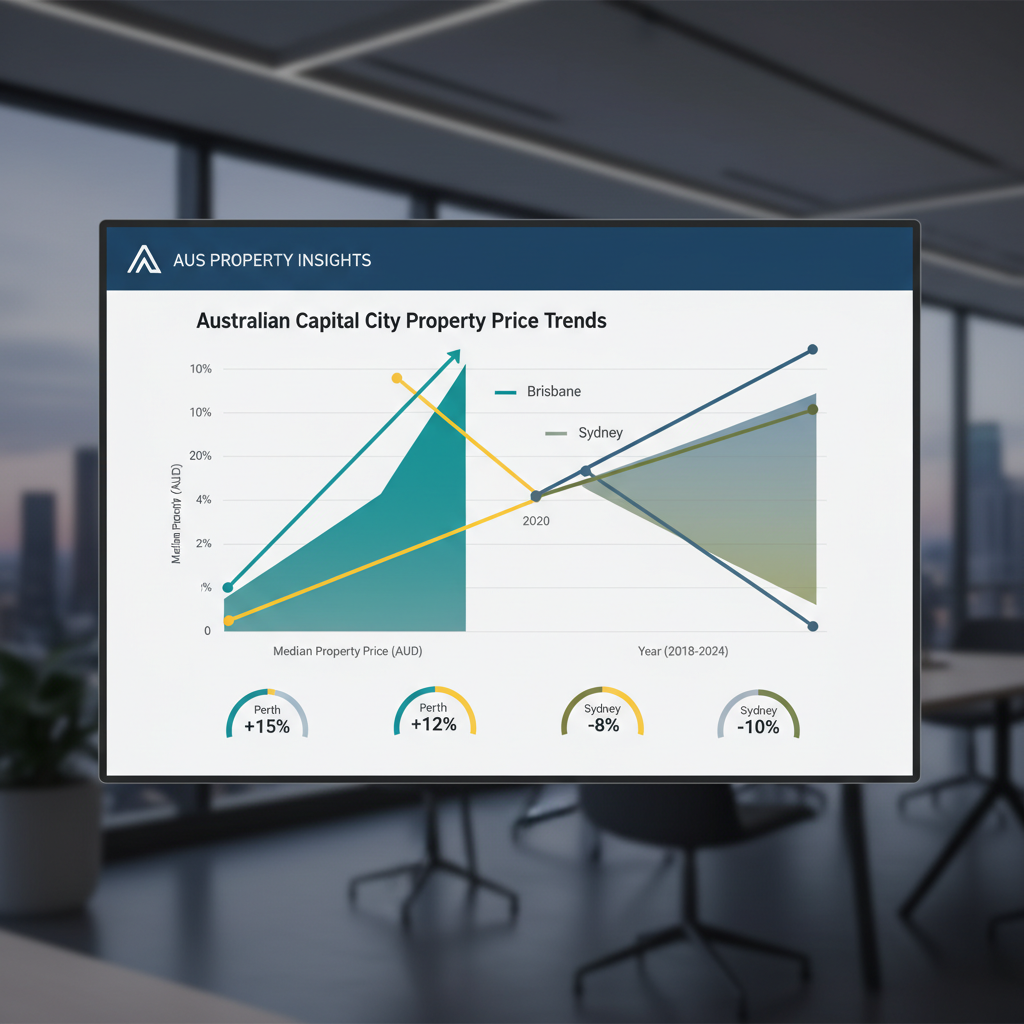
What This Means for Investment Strategy in 2026
If you're buying investment property in 2026, your strategy needs to account for the two-speed dynamic—or you risk chasing yesterday's growth.
Yield Versus Growth: Which Markets Deliver What
Perth offers gross rental yields of around 4.3% on houses and 5.9% on units, with vacancy at 0.5%. If you're seeking both capital growth and strong cash flow, Perth remains the standout. However, affordability constraints are beginning to emerge as the median house price now sits around $845,000.
Brisbane delivers strong capital growth with ANZ forecasting 9.7% in 2026, though that pace is expected to moderate to 1.4% in 2027 as affordability ceilings bite. For investors with a medium-term horizon, Brisbane's Olympic infrastructure pipeline provides a structural growth story through to 2032.
Melbourne and Sydney offer lower capital growth in the short term but may present entry opportunities for investors willing to wait. CBRE estimates that investment returns for apartments in Sydney and Melbourne should outpace historic levels over the next three years as rental growth accelerates and supply constraints tighten.
The Risk of Buying at the Wrong Point in the Cycle
Here's the thing about two-speed markets: timing matters more than ever. Buying into Perth or Brisbane now means paying a premium for growth that has already occurred. Perth's growth cycle only kicked off in mid-to-late 2022, suggesting it's still relatively early, but rapid gains could moderate as affordability constraints spread.
Conversely, buying into Sydney or Melbourne during a correction requires conviction that the long-term fundamentals remain intact—which they do. Both cities benefit from established infrastructure, strong employment markets, and deep liquidity. Patient investors who can weather short-term volatility may be rewarded in 2027 and beyond.
Why Off-Market Properties Matter More in a Two-Speed Market
In tight markets like Perth and Brisbane, competition for listed properties is intense. Properties in Brisbane are selling within one week of the first open home, with buyers often facing multiple-offer scenarios. In this environment, access to off-market deals becomes a genuine competitive advantage.
Off-market properties allow investors to negotiate without competing against a dozen other bidders. They also tend to be marketed by vendors who value discretion and speed over maximum price extraction—creating room for strategic buyers to secure value.
For Sydney and Melbourne, where listings are abundant, the advantage shifts toward negotiation power and due diligence. Buyers have time to inspect thoroughly, compare options, and negotiate terms without the pressure of auction day.

How Buyers Agency Australia Identifies Opportunity in a Two-Speed Market
Navigating a two-speed market requires local expertise, data-driven analysis, and an understanding of where each city sits in its growth cycle. Buyers Agency Australia has built its reputation by helping investors identify high-growth opportunities before they become obvious to the broader market.
Founder Dragan Dimovski brings more than 20 years of property investment experience and manages a successful personal portfolio himself. His approach centers on 10-year portfolio modeling, ensuring every acquisition contributes to long-term wealth creation rather than short-term speculation.
In a two-speed market, that long-term focus becomes even more critical. While headlines chase the latest boom suburb, Buyers Agency Australia focuses on fundamentals: supply constraints, infrastructure investment, rental demand, and gentrification potential. This methodology has helped clients build diversified portfolios across all major Australian capital cities, positioning them to capture growth regardless of which market is leading at any given time.
The firm's transparent, fixed-fee model eliminates conflicts of interest. Unlike commission-based agents who profit from higher sale prices, Buyers Agency Australia's fee structure ensures recommendations are aligned with client outcomes—not vendor interests. For time-poor professionals and interstate investors, this alignment matters.
Whether you're targeting Perth's tight rental market, Brisbane's Olympic infrastructure boom, or opportunistic entry points in Sydney and Melbourne, working with a buyers advocate who understands the nuances of each city's cycle can mean the difference between buying at the peak and securing value at the right point.
Book a free strategy session with Buyers Agency Australia to map out your 10-year portfolio plan and identify where the two-speed market is creating opportunity for long-term investors.
Frequently Asked Questions
What does "two-speed property market" mean?
A two-speed property market refers to divergent performance across Australian capital cities, with Perth, Brisbane, and Adelaide posting strong growth while Sydney and Melbourne experience price declines or stagnation.
Which Australian cities are growing fastest in 2026?
Perth leads with 24.3% annual growth, followed by Brisbane at 9.7% and Adelaide with consistent gains above the national average, driven by tight supply and strong migration.
Are Sydney and Melbourne property prices falling?
Yes, Sydney prices fell 0.2% in Q1 2026 and Melbourne dropped 0.6%, driven by higher listings, rising interest rates, and reduced buyer competition at the upper end.
Is Perth property overvalued in 2026?
Perth remains relatively affordable compared to Sydney, though rapid price growth and constrained supply mean investors should assess yield and long-term fundamentals carefully before buying at current price points.
Should I invest in a booming or cooling market?
Both offer opportunities: booming markets like Perth deliver strong cash flow and capital growth; cooling markets like Sydney may present entry points for patient investors targeting long-term appreciation and gentrification.
Conclusion: How to Position Your Portfolio for a Two-Speed Market
Australia's property market has entered a phase where national averages tell you almost nothing about where to invest. Understanding which cities are benefiting from supply constraints, migration inflows, and affordability advantages—and which are correcting after years of outsized gains—is now the core skill for successful property investment.
The two-speed dynamic isn't a temporary blip. It reflects structural shifts in population distribution, housing construction, and buyer behavior that will shape the market for years to come. Investors who adapt their strategy to these realities—targeting high-growth corridors, accessing off-market deals, and building diversified portfolios across multiple cities—will be best positioned to build long-term wealth.
For those seeking expert guidance through this complexity, Buyers Agency Australia offers data-driven property search, transparent fixed-fee pricing, and 10-year portfolio modeling to ensure every acquisition moves you closer to financial independence. Whether you're chasing yield in Perth, infrastructure-driven growth in Brisbane, or opportunistic value in Sydney, the right strategy starts with understanding where each market sits in its cycle—and acting accordingly.
 General
Perth and Brisbane are delivering 20%+ annual gains while Sydney and Melbourne prices slip—here's what the two-speed market...
Australia's property market is running on two speeds in 2026. While Sydney and Melbourne prices have softened under the weight of affordability constraints and rising interest rates, Brisbane and Adelaide are delivering exceptional capital growth backed by infrastructure pipelines, population inflows, and rental markets so tight that vacancy rates have dropped below 1% in multiple suburbs.
Why Brisbane and Adelaide Are Outperforming the Eastern Capitals
Let's be honest. The predictable playbook of buying Sydney or Melbourne property for guaranteed growth no longer works the way it used to. ANZ Research forecasts Brisbane to grow 9.7% in 2026, one of the strongest performances of any capital city. Adelaide is projected to deliver between 6% and 9% growth, supported by a median house price of $998,933 and an unemployment rate that remains competitive compared to larger capitals.
Sydney and Melbourne, by contrast, are forecast to record falls of 0.7% and 1.7% respectively in 2026, according to ANZ. Higher borrowing costs, stretched affordability, and softening auction clearance rates are dragging performance. PropTrack data shows Sydney home prices fell 0.2% in Q1 2026, while Melbourne recorded a 0.6% decline. These markets aren't collapsing, but they are no longer delivering the momentum investors have relied on for decades.
Buyers Agency Australia works exclusively with property investors across all major Australian capital cities, and our 10-year portfolio modelling consistently shows that mid-sized capitals with strong fundamentals are outperforming premium-priced metro markets in both yield and total return.
Infrastructure Investment Driving Brisbane's Growth Cycle
Brisbane's growth is not speculative. The city is experiencing a once-in-a-generation infrastructure boom tied to the 2032 Olympics. The $7.1 billion funding agreement between federal and Queensland governments is driving projects including the $3.7 billion Victoria Park stadium, Brisbane Metro, Cross River Rail, and 17 venue upgrades.
According to Domain forecasts, Brisbane house prices are expected to reach $1.09 million by mid-2026, while units are expected to deliver faster growth due to their relative affordability and tight supply. Vacancy rates in middle-ring suburbs like Albany Creek, Taigum, and Newport have dropped below 1%, well under the 2-3% range typically considered balanced.
Rental yields in these suburbs are currently sitting at around 4.5-5.5%, creating a compelling opportunity for investors seeking both capital growth and cashflow. When vacancy rates fall this low, rents rise due to scarcity in supply, and investors enjoy both capital appreciation and income stability.
Adelaide's Remarkable Catch-Up Phase
Adelaide has been Australia's standout property success story over the past 25 years, delivering 570% house price growth since 2000, the strongest of any capital city. Over the same period, unit and apartment prices jumped 600%, outperforming Brisbane, Sydney, and Melbourne.
In March 2026, Adelaide's median dwelling value reached $937,021, with house values at $998,933 and unit values at $684,698, according to NAB Property Market Insights. The city has recorded 11.4% annual dwelling growth, with consistent monthly gains of 1.2% across both houses and units.
While growth is expected to moderate compared to previous years, Adelaide's fundamentals remain strong. Population growth is projected to add 700,000 residents by 2051, and job growth across health, defence, and education sectors is supporting sustained demand. Suburbs in the City of Playford and the City of Salisbury are delivering cashflow-positive opportunities for investors willing to look beyond the inner ring.
Buyers Agency Australia applies transparent, fixed-fee pricing and data-driven suburb selection to ensure clients acquire investment-grade properties in markets with durable demand, not speculative bubbles.
Identifying Cashflow-Positive Properties in 2026
With mortgage rates sitting above 6% for investors, achieving positive cashflow requires deliberate suburb selection backed by data, not guesswork. A property is cashflow-positive when rental income exceeds all holding costs, including mortgage repayments, rates, insurance, management fees, and maintenance, leaving the investor with a net surplus each month.
What Yield Do You Need to Be Cashflow-Positive?
For a standard 80% LVR investor in 2026, positive cashflow requires a gross yield of approximately 6.8-7.2% or higher, depending on the state, property type, and management cost structure. Sydney's median house gross yield sits at approximately 2.9% in Q1 2026, Melbourne at 2.8%, and Brisbane at 3.4%, meaning metropolitan markets are largely unsuitable for cashflow-focused strategies.
Regional markets, smaller capitals, and specific property types such as smaller houses, dual-income configurations, and townhouses are where the numbers begin to work. According to HtAG Analytics' analysis of 15,000+ Australian suburbs, fewer than 12% of residential markets currently deliver gross yields above the 6.8% threshold required for positive cashflow at 80% LVR financing with a 6.2% interest rate.
Top Cashflow-Positive Suburbs in 2026
Regional Queensland remains Australia's most consistent high-yield region. Townsville delivers gross yields around 5.5%, Mackay and Rockhampton offer similar profiles, and suburbs in North Queensland with strong defence, healthcare, and education employment are generating rental demand that translates to consistent cashflow.
Western Australia's outer metropolitan and regional fringe markets also deserve attention. Suburbs in Kalgoorlie, Geraldton, and Karratha deliver yields above 7%, though single-industry risk requires careful due diligence on employment base stability.
Outer Adelaide suburbs, particularly in the City of Salisbury and City of Playford, are delivering yields in the 5.5-6.5% range with lower median prices and strong rental demand from healthcare workers, families, and first-home buyers priced out of inner-ring markets.
The Trade-Off Between Yield and Capital Growth
The classic property investment trade-off positions yield against capital growth. Suburbs with 7%+ gross yields typically deliver modest capital growth of 2-4% per annum over 10 years, while suburbs with 3% yields and strong capital growth can outperform on total return if the investor can sustain negative cashflow through the cycle.
The choice is a function of cash reserves, borrowing capacity, and risk tolerance. For investors building a portfolio strategy that balances cashflow and growth, the highest-conviction entry points in the current market are convergence zones where early-cycle growth momentum is emerging in the same markets that currently deliver yield above the cashflow threshold.
Buyers Agency Australia uses 10-year portfolio modelling to ensure long-term wealth creation, not short-term speculation.

Sydney and Melbourne: Why the Major Markets Are Underperforming
Sydney and Melbourne are not broken markets. They are simply overvalued markets facing affordability constraints that have reached levels pricing out many potential buyers. The Reserve Bank of Australia's rate settings have curbed borrowing capacity, particularly for buyers in premium segments.
Sydney home prices fell 0.2% over the first three months of 2026, while Melbourne recorded a 0.6% decline, according to Cotality. Together, these two cities account for roughly 55-60% of the national market and are exerting downward pressure on the broader index.
Auction clearance rates have moved to their lowest point of 2026, with Sydney recording clearance rates between the mid-50s and mid-60s depending on the reporting stage. Buyer competition has softened, and a growing share of sales are now being negotiated after auction day rather than decided under the hammer.
Affordability Ceilings and Borrowing Capacity
The median house price in Sydney is $1.76 million, and in Melbourne $955,000. At current interest rates, the borrowing capacity required to service these prices is beyond the reach of most first-home buyers and time-poor professionals, forcing demand into outer suburbs or interstate markets.
Lower-quartile properties in these cities have held up better, while higher-end homes have seen noticeable softening. PropTrack data shows that only about 30% of properties in Sydney fall below $700,000, intensifying competition in the affordable segment while leaving the premium segment vulnerable to price falls.
For investors seeking yield and growth potential, Perth, Brisbane, and Adelaide offer stronger prospects in the near term, though analysts warn that rapid gains could moderate as affordability constraints spread.
How Buyers Agency Australia Identifies High-Yield, High-Growth Properties
Buyers Agency Australia is a national property advocacy firm specializing in data-driven investment strategies and end-to-end purchasing solutions. We differentiate through a transparent, fixed-fee model and a heavy emphasis on 10-year portfolio modeling to ensure long-term wealth creation, not speculative short-term gains.
While a newer brand compared to veteran strategists, we have rapidly built a presence across all major Australian capital cities, positioning ourselves as a modern, result-oriented alternative to traditional commission-based agents. Our clients are property investors seeking long-term wealth, first-home buyers looking for expert guidance, and time-poor professionals requiring end-to-end property search and negotiation.
Our Data-Driven Suburb Selection Process
We assess each suburb using a set of reliable indicators designed to support long-term investment success: capital growth potential based on infrastructure, demand, and local economy; rental yield that supports cashflow and offsets holding costs; affordability relative to rising median prices; tenant demand measured by vacancy rates, rental applications, and lifestyle appeal; and upcoming development including infrastructure projects, rezoning, or gentrification that could unlock future value.
Every suburb in our acquisition pipeline is carefully chosen based on this approach, blending market data with local insights only an experienced buyers advocate can provide. We access off-market properties through our network of agents and vendors across all major capital cities, giving our clients first-mover advantage before properties hit public listings.
Our FastTrack event is designed for investors seeking clarity on the next 12-24 months of market opportunity. Book a free strategy session to discuss your portfolio goals and acquisition timeline.

FAQs
What makes Brisbane and Adelaide better investment markets than Sydney and Melbourne in 2026?
Brisbane and Adelaide offer stronger capital growth forecasts, lower median prices, and higher rental yields, supported by infrastructure investment and tight supply.
What gross rental yield do I need to achieve positive cashflow in 2026?
Most investors need a gross yield of 6.8-7.2% or higher at 80% LVR financing to cover all holding costs and achieve positive cashflow.
Are Sydney and Melbourne markets crashing in 2026?
No, Sydney and Melbourne are experiencing modest price declines due to affordability constraints, not crashes. ANZ forecasts Sydney down 0.7% and Melbourne down 1.7% in 2026.
Which regional markets offer the best cashflow-positive opportunities?
Regional Queensland (Townsville, Mackay, Rockhampton), outer Adelaide suburbs (City of Salisbury, City of Playford), and regional Western Australia offer the highest yields.
How does Buyers Agency Australia help investors secure high-performing properties?
We use 10-year portfolio modelling, data-driven suburb selection, transparent fixed-fee pricing, and access to off-market properties to ensure long-term wealth creation for clients.
Conclusion: Position Your Portfolio for the Next Growth Cycle
The Australian property market is no longer a uniform growth story. Brisbane and Adelaide are delivering exceptional performance driven by infrastructure, population growth, and tight supply. Sydney and Melbourne are softening under affordability constraints and rising rates. For investors seeking both capital growth and cashflow, the opportunity lies in regional Queensland, outer Adelaide, and Perth markets where yields exceed 6% and vacancy rates remain below 2%.
Buyers Agency Australia applies transparent, fixed-fee pricing and 10-year portfolio modelling to ensure clients acquire investment-grade properties in markets with durable demand. Book a free strategy session today to discuss your acquisition strategy, or explore our FastTrack event for insights into the next 12-24 months of market opportunity.
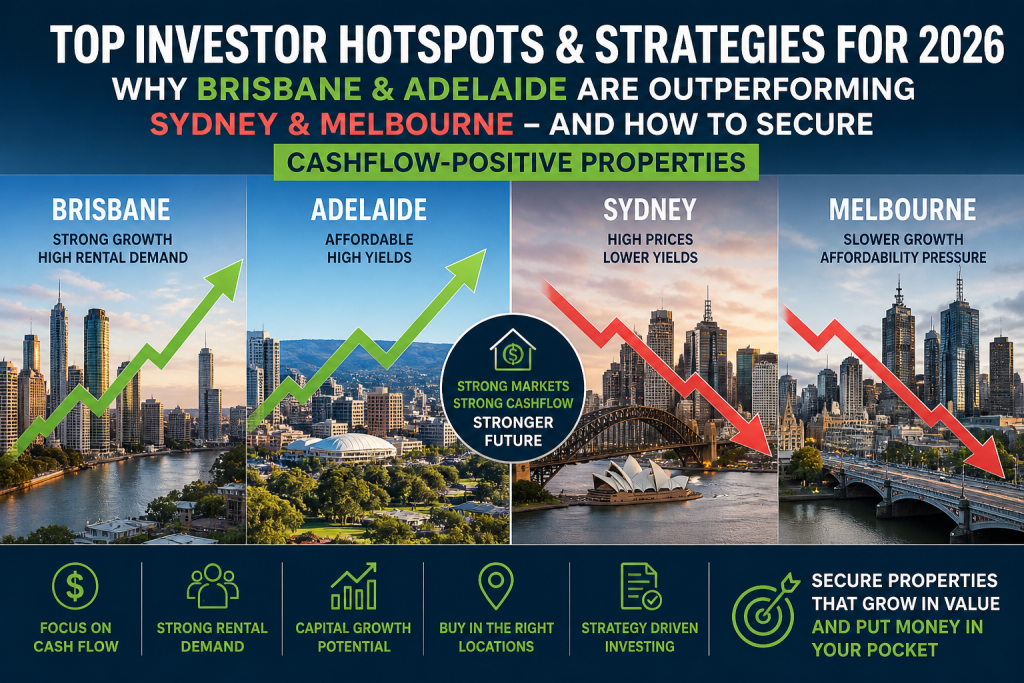 General
Brisbane and Adelaide lead Australian property growth in 2026, outperforming Sydney and Melbourne with capital gains driven by...