Rising interest rates haven't crashed Australia's property market because the nation faces a structural housing deficit of 200,000 to 300,000 dwellings. Strong population growth, record-low rental vacancy rates near 1.6%, and chronic construction underperformance create demand floors that outweigh borrowing cost pressures. While Sydney and Melbourne are slowing, Brisbane, Perth, and Adelaide continue posting double-digit gains.
The RBA raised the cash rate to 4.1% in March 2026, marking the second consecutive hike. Variable mortgage rates now sit between 6.5% and 7%, up from pandemic lows of 2.5%.
Yet national property prices rose 8.6% through 2025, adding $71,400 to the median dwelling value. Every major forecast predicts further gains in 2026, defying traditional interest rate logic.
This isn't a temporary anomaly. It's a fundamental shift driven by supply constraints that interest rates alone can't fix. Buyers Agency Australia helps investors cut through media fear to identify where these structural forces create genuine opportunity.
Why Interest Rates Haven't Crashed Property Prices in 2026
The RBA's Rate Pivot Created Confusion Not Collapse
The Reserve Bank delivered three rate cuts through 2025, lowering the cash rate from 4.35% to 3.6%. Markets priced in more easing.
Then inflation spiked to 3.8% by December 2025. The Middle East conflict drove oil prices above US$100 per barrel. Petrol jumped 15% in weeks.
The RBA hiked 25 basis points in February 2026, then again in March. Markets now expect the cash rate to reach 4.85% by year-end, according to Canstar data.
But here's what the headlines miss: property prices didn't crash during the 2022-2023 hiking cycle either. Sydney and Melbourne dipped temporarily, then recovered. Brisbane, Perth, and Adelaide powered through with double-digit growth.
The reason is simple. Australia isn't building enough homes to meet demand.
Australia's 200,000 Dwelling Shortage Is the Real Story
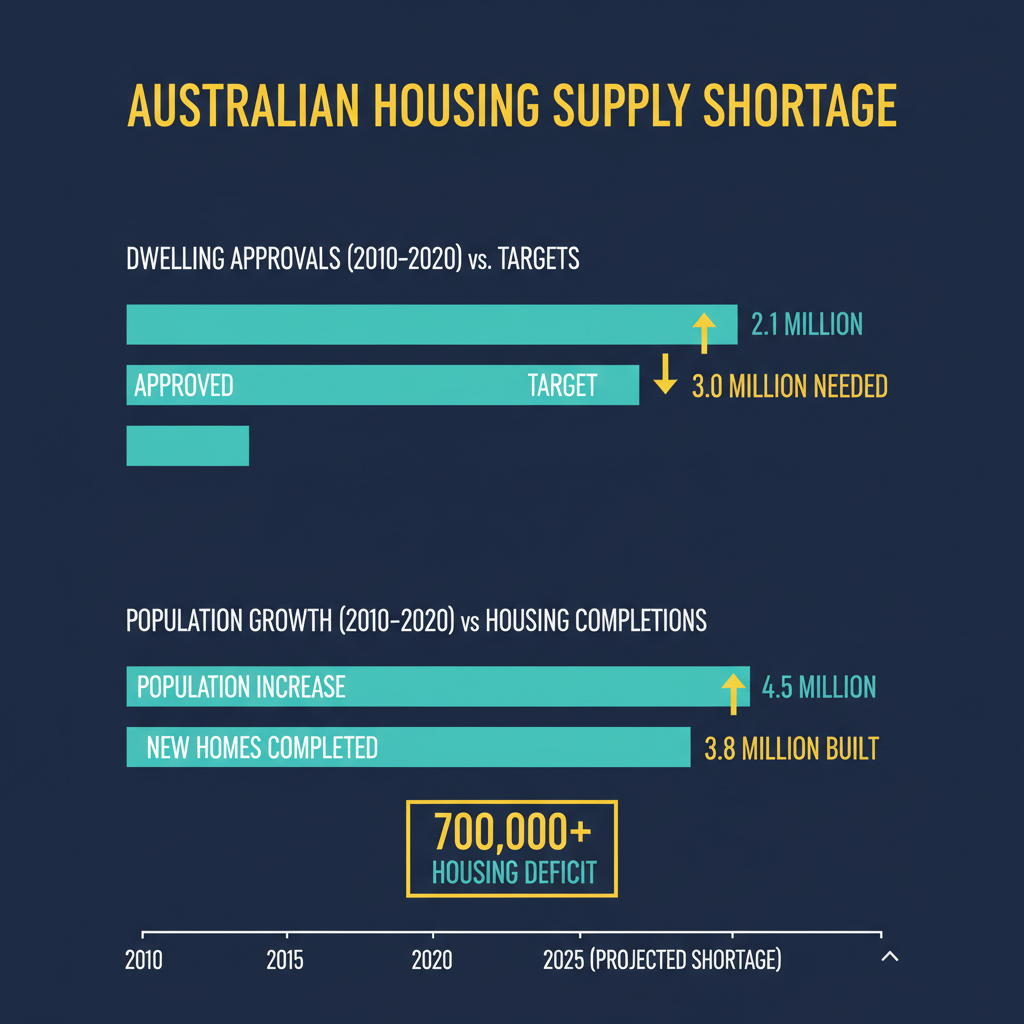
Shane Oliver, AMP's chief economist, estimates Australia's cumulative housing deficit sits between 200,000 and 300,000 dwellings. The National Housing Supply and Affordability Council projects the shortage could hit 400,000 by 2028-29 if migration remains strong.
The government's Housing Accord targets 1.2 million new homes over five years. That's 240,000 annually.
Dwelling approvals in the year to February 2026 totaled 196,500. That's 77,660 homes (19%) below target. Completions lag approvals by roughly 5%, according to MacroBusiness analysis.
Construction costs rose 40% since 2020. Labour shortages persist. Interest rate hikes make development finance more expensive. The result: supply is getting worse, not better.
Property prices can't crash when there aren't enough homes to meet demand.
Population Growth Outpaces Construction by 73,000 Homes Annually
Australia's net overseas migration hit record levels post-pandemic. While slowing from peak 2023 levels, migration still added 423,000 people in the year to March 2025.
The government forecasts 365,000 net arrivals for 2025-26. Even at lower levels, migration creates housing demand of roughly 180,000 dwellings per year when accounting for average household size.
Australia is completing around 165,000 to 190,000 dwellings annually. The gap between demand and supply is approximately 40,000 to 75,000 homes per year.
This isn't a short-term mismatch. It's a structural problem compounding annually. Every year the shortage grows, it puts upward pressure on prices and rents.
Interest rates influence how quickly prices rise. They don't determine whether prices rise.
Rental Vacancy Rates Near Record Lows Create Price Floors
National rental vacancy rates sit at 1.6%, near record lows. Any rate below 3% signals a tight rental market. Below 2% indicates crisis conditions.
NAB's Housing Monitor shows advertised rents rose 5.9% on a six-month annualized basis in December 2025. Brisbane's forecast vacancy rate could drop to 0.7% by 2030.
Low vacancy rates have two effects. First, they support investor demand. Strong rental returns offset higher mortgage costs. Second, they force renters into buying, maintaining purchase demand despite affordability constraints.
When vacancy rates are this low, landlords can't exit the market without creating rental chaos. This creates a floor under property values.
Queensland Markets Show How Supply Beats Rate Movements
Brisbane Property Prices Up 11% Despite Higher Rates
Brisbane house prices are forecast to grow 10-11% in 2026, according to KPMG's Residential Property Outlook. Units are forecast up 8%.
This isn't speculative froth. It's genuine supply-demand imbalance.
Brisbane's population is growing faster than construction. Infrastructure projects like Cross River Rail and the 2032 Olympics are concentrating demand in supply-constrained suburbs.
Advertised stock is 29% below the five-year average. Properties sell in a median of 22 days. Investors are achieving strong rental yields while prices appreciate.
Buyers Agency Australia works with clients buying Brisbane properties that deliver 5-6% rental yields with capital growth potential. The combination is rare in Sydney or Melbourne.
Regional Queensland Recording 12.6% Annual Growth
Regional Queensland delivered 12.6% growth in the 12 months to January 2025, according to Cougar Homes data.
Townsville house prices jumped 24.75% to $695,000. Mackay rose 24% to $598,800. Cairns increased 10.82% to $764,020.
These aren't fringe markets. They're regional cities with defense, mining, tourism, and healthcare employment bases.
Affordability relative to capital cities is driving migration. Sydney and Melbourne buyers are cashing out equity and purchasing multiple properties in Queensland.
This trend accelerates when rates rise. Higher rates don't stop buyers—they redirect them to markets where yields and growth align.
Perth Leading the Nation with 13% Growth in 2025
Perth house prices rose approximately 13% in 2025. The median exceeded $1 million for the first time in early 2026.
Western Australia's population is growing through interstate and overseas migration. Mining and resources continue driving high wages. More than 20,000 new homes were completed in 2024, but demand still exceeds supply.
Advertised stock is 40% below the five-year average. Properties sell in 7-8 days. Rental yields remain strong.
Perth demonstrates a critical principle: supply-constrained markets with employment strength outperform regardless of interest rates.
Why Media Headlines Get Property Crashes Wrong
Confusing Borrowing Capacity with Market Demand

Every 0.25% rate hike reduces borrowing capacity by approximately $12,000 for average earners, according to Canstar research.
Media reports focus on this reduction. They assume lower borrowing capacity equals lower prices.
But borrowing capacity is only one demand input. Cash buyers, investors with equity, downsizers, and international buyers aren't rate-sensitive.
In supply-constrained markets, rate-insensitive buyers set the price floor. Marginal buyers get priced out, but transactions continue at higher prices.
Ignoring That Crashes Require Supply Surplus
Property markets crash when supply exceeds demand. Classic examples include Irish and Spanish property crashes following construction booms.
Australia has the opposite problem. We're building 40,000 to 75,000 fewer homes per year than population growth requires.
You can't crash a market that doesn't have enough product. Prices might stop rising. They might plateau. But they won't crash while the shortage persists.
The last significant Australian property price correction occurred in 1990-1991, when unemployment hit 10.8% and construction had overshot demand. Neither condition exists today.
Overlooking Employment as the True Crash Trigger
Australia's unemployment rate sits at 4.0%, near multi-decade lows. Labour force participation is strong. Wage growth is positive.
Forced sales drive property crashes. Forced sales occur when unemployment spikes and mortgage holders can't service debt.
As long as employment remains strong, most borrowers can absorb higher rates. They reduce discretionary spending, not housing payments.
The RBA knows this. Their stress testing assumes borrowers can service rates above 9%. Most loans were written with 3% serviceability buffers.
Missing That Investors Are Still Buying
Investor lending increased through 2025 despite rate rises. Experienced investors understand that long-term property performance depends on location fundamentals, not rate cycles.
Domain forecasts show rental yields rising across most capitals. Negative gearing remains intact. Depreciation benefits continue.
Smart investors are buying now because supply constraints create multi-year tailwinds. Rate movements are short-term noise against structural shortage.
How Dragan Dimovski Identifies Rate-Resistant Properties
Focus on Supply-Constrained Suburbs Not Rate Forecasts
Dragan Dimovski has over 20 years of property investment experience and a successful personal portfolio. His methodology centers on supply-demand fundamentals that persist across rate cycles.
Buyers Agency Australia analyzes:
- Dwelling approval rates versus population growth
- Zoning constraints limiting future supply
- Infrastructure projects concentrating demand
- Historical capital growth through previous rate cycles
- Rental vacancy trends over 5-10 year periods
Properties meeting these criteria perform whether rates are 3% or 6%.
Target Owner-Occupier Desirable Investment Grade Assets
Buyers Agency Australia defines investment-grade properties as owner-occupier desirable, in supply-constrained suburbs, within 10-15km of employment hubs, and demonstrating historical capital growth.
These properties maintain demand across economic conditions. When rates rise and marginal buyers exit, owner-occupiers with genuine housing needs continue purchasing.
This creates downside protection. It's not about chasing the highest short-term growth. It's about buying properties that won't fall when conditions tighten.
Avoid Emotional Properties and Oversupplied Precincts
The biggest investor mistake in rising rate environments is buying trendy, overpriced, or fringe locations with no long-term demand drivers.
Off-the-plan apartments in oversupplied precincts are particularly risky. Unit completions are forecast to exceed demand in several inner-city areas.
Buyers Agency Australia steers clients away from government stimulus-dependent markets, areas with excessive supply pipelines, and properties without genuine scarcity.
Maintain Cash Reserves for Rate Volatility
Buyers Agency Australia recommends clients maintain a minimum 20% deposit to avoid lenders mortgage insurance, plus an additional six-month cash reserve for vacancy, repairs, and interest rate increases.
This buffer allows investors to hold through rate cycles without forced sales. It's the difference between building wealth and becoming a distressed seller.
The Data That Proves Supply Beats Rates Every Time
Property Prices Rose 20% During Pandemic Border Closures
The clearest evidence that rates don't determine prices comes from 2020-2021.
Net overseas migration fell dramatically. Over 100,000 more people left Australia than entered. Population growth slowed to unprecedented lows.
If population growth drove prices, this should have crashed the market. Instead, property prices rose an astonishing 20% in 18 months, according to The Australia Institute research.
Why? Record-low interest rates, fiscal stimulus, and construction that still didn't match underlying demand. The supply problem predates the pandemic.
Dwelling Stock Grew 19% While Population Grew 16% Yet Prices Jumped 70%
Over the past decade, Australia's dwelling stock increased 19% while population grew 16%. Supply outpaced population.
Yet house prices increased 70%, far exceeding household income growth.
This proves supply isn't just about raw dwelling numbers. It's about household formation, location preferences, dwelling type mismatches, and investor activity.
Australia could build more dwellings than population growth and still have shortages if those dwellings are in the wrong locations or don't match demand.
CoreLogic Data Shows Capital Cities Up 8.2% in 2025
CoreLogic's Home Value Index shows dwelling prices across Australia's capital cities rose 8.2% during 2025, according to NAB's Housing Monitor.
This occurred during a year of rate cuts, then hikes, then uncertainty. The median national home value hit approximately $900,000.
Regional areas modestly outperformed at 9.7%. Properties are selling in a median 28 days. Rental growth continues at 5.9% annualized.
The data doesn't show a market on the verge of collapse. It shows a market adjusting to structural shortage.
Strategy Beats Timing in Every Property Cycle
Buying Well Matters More Than Buying at Perfect Rates
Timing interest rate bottoms is impossible. Even economists who forecast rates professionally get it wrong.
Bank of Queensland analysis of four decades of data shows property prices typically rise 10-15% following rate cut cycles, regardless of how many cuts occur.
The critical factor isn't when you buy. It's what you buy and whether you can hold it through cycles.
Buyers Agency Australia clients bought Brisbane properties in 2022 when media predicted crashes. Those properties are now up 20-30% while delivering strong rental yields.
Waiting for Perfect Conditions Means Missing Compounding Growth
Every year you wait is a year of potential capital growth and equity build lost. Property doubling times in supply-constrained markets are typically 7-10 years.
Delaying one year can cost $50,000-$100,000 in foregone growth plus lost rental income and tax benefits.
The best time to buy is when you find the right property at a price you can afford, with a buffer for rate volatility.
Smart Investors Are Buying Contrarian While Others Wait
Melbourne's comparatively lower price base and forecast 6.8% growth in 2026 make it an attractive re-entry point for long-term investors, according to KPMG forecasts.
Sydney's status as a major jobs hub supports underlying demand, even as affordability constraints slow short-term momentum.
Contrarian buyers are accumulating while media fear keeps competitors sidelined. This is how generational wealth is built.
Frequently Asked Questions
Will Australian property prices crash in 2026?
Unlikely. Supply shortages, migration, and rental market tightness support price floors. Expect divergence, not crash.
How do rising interest rates affect property prices?
Rising rates reduce borrowing capacity and demand, but supply constraints and migration can offset impacts in tight markets.
Should I wait to buy property until rates fall?
Strategic selection matters more than timing. Australia's 200,000-300,000 dwelling shortage supports ongoing price appreciation.
What are the best cities to invest in 2026?
Perth, Brisbane, and Adelaide forecast the strongest growth. Melbourne offers contrarian value for long-term investors.
How much deposit do I need to invest in property in 2026?
Aim for 20% deposit plus six-month cash reserves to avoid mortgage insurance and buffer rate rises.
Why Investors Choose Buyers Agency Australia in Volatile Markets

Dragan Dimovski founded Buyers Agency Australia on a simple principle: data-driven property selection beats market timing every time.
With over 20 years of experience and a $10M+ personal portfolio, Dragan understands that rising rates create opportunity for buyers who know where to look. His team analyzes supply pipelines, infrastructure impacts, and demographic trends to identify properties that perform across cycles.
Buyers Agency Australia operates nationally across all major capitals. The firm's transparent fixed-fee model aligns incentives with clients. No commissions mean no pressure to buy the wrong property.
Clients receive 10-year portfolio modeling showing how properties perform under various rate scenarios. This removes emotion and grounds decisions in evidence.
The 'Passive with Property' podcast shares weekly insights on market conditions, investment strategies, and case studies from real transactions.
Ready to stop worrying about rates and start building wealth through strategic property investment? Book a free strategy session with Buyers Agency Australia to discuss your goals and discover which markets offer the best risk-adjusted returns in 2026. Or contact the team directly to learn how a national buyers agency can help you buy with confidence, regardless of what interest rates do next.
 General
Rising interest rates haven't crashed Australia's property market. Supply shortages, strong migration, and rental demand create price floors...
A dual occupancy property in Australia is a single block of land with two separate dwellings that generate two distinct rental income streams, typically delivering gross rental yields of 5–8% compared to 3–4% for single-dwelling houses. These properties include duplexes, granny flats, and dual-key homes that let investors earn more rent per dollar invested without buying multiple properties.
We've all been there—hunting for positive cash flow while watching auction prices climb into the stratosphere. You want investment property that actually pays for itself, not another negatively geared drain on your monthly budget.
That's where dual occupancy and granny flat conversions come in. Instead of buying two separate properties, you get two income streams from one asset. The maths is simple: more rent, same mortgage, better cash flow. Regional Queensland, Perth's outer suburbs, and Brisbane's growth corridors are delivering 6–8% gross yields right now, and investors are using these properties to scale portfolios faster than traditional single-dwelling strategies ever allowed.
What Dual Occupancy Properties and Granny Flats Actually Are
Let's cut through the jargon. A dual occupancy property contains two separate dwellings on one parcel of land. That could be a duplex (two side-by-side homes), a house with a detached granny flat, or a dual-key property where one structure houses two self-contained units.
Granny flats—also called secondary dwellings—are self-contained living spaces with their own kitchen, bathroom, and bedroom. They're built on the same lot as your primary dwelling but generate standalone rental income.
Here's the difference that matters for investors:
Duplex vs Dual Key vs Granny Flat
A duplex is two separate homes on one lot, often mirror images, each with its own title. You can sell one side later if you choose. Construction costs run higher because you're building two full-size homes, typically $400,000–$700,000 total in regional markets.
A dual-key property is one building split into two lockable, self-contained sections—usually a larger 3-bedroom and smaller 1-bedroom. Both sit on the same title. Build costs are lower than duplexes because shared walls and services cut expenses. You can't sell them separately, but rental returns rival duplex performance at 60–70% of the build cost.
Granny flats are the most affordable entry point. Construction ranges from $120,000–$200,000 depending on size and finishes. They're capped at 60 square metres in most states but deliver gross yields of 5–8% because land is already owned.
According to planning regulations in Queensland, secondary dwellings can now be rented to anyone—not just family members—opening up investor demand statewide.
Why Council Rules Matter More Than You Think
Every council has different rules. Brisbane allows duplexes on blocks over 400 square metres in most zones. Sydney's complying development rules cap granny flats at 60 square metres and require minimum 450-square-metre lots.
Some councils limit secondary dwelling size to 48 square metres. Others ban dual occupancy outright in certain zones. That's why Buyers Agency Australia screens every property for council restrictions before clients waste time on dead-end deals.
You'll need development approval (DA) or complying development certificates (CDC). CDCs are faster—10 days instead of 12 weeks—but only if your design ticks every box. Miss one setback requirement and you're back to a full DA.
Fire separation, parking (usually one space per dwelling), and BASIX energy ratings also apply. Budget $5,000–$12,000 for approvals, surveys, and certifiers before construction even starts.
How Dual Income Properties Create Multiple Revenue Streams
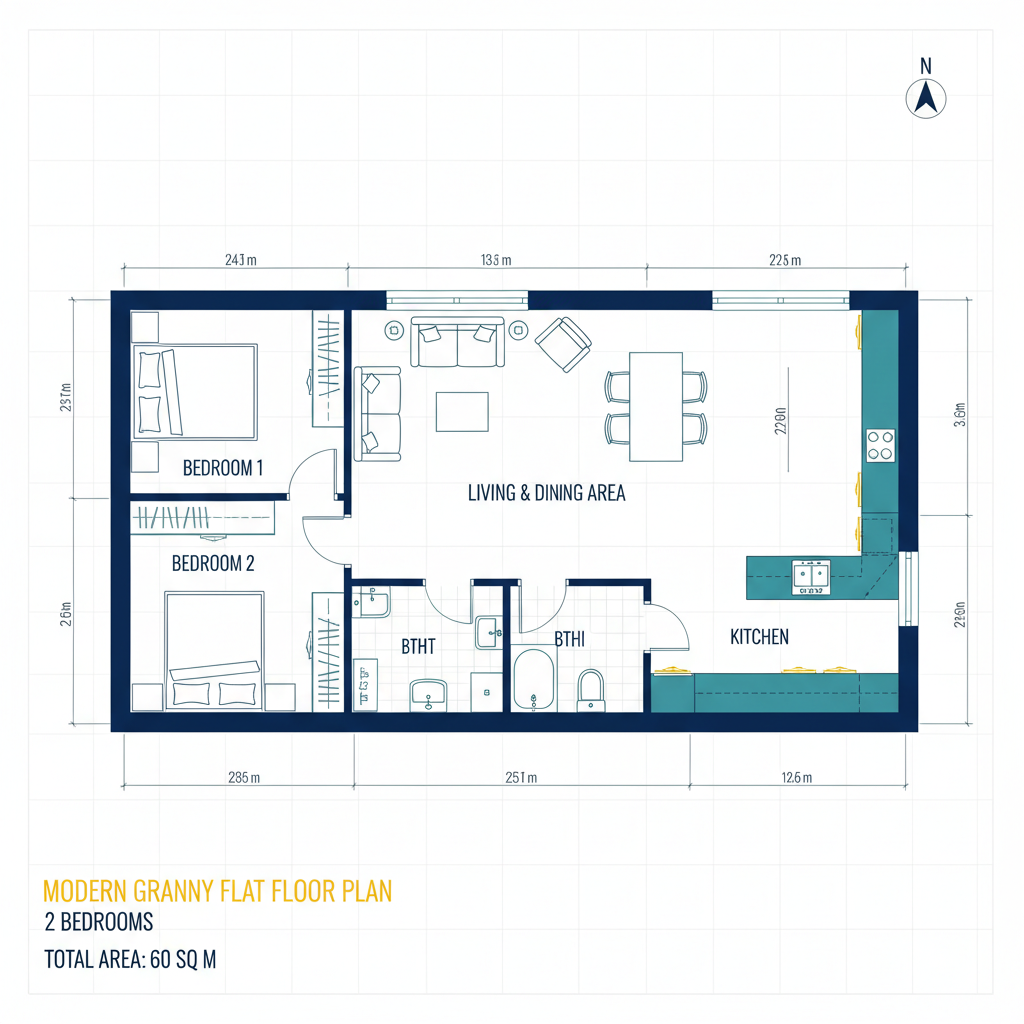
Two tenants, two leases, two rent payments hitting your account every month. That's the core appeal.
Let's say you buy a house in regional Queensland for $550,000. Rent it as a single dwelling and you'll collect $450–$500 per week—roughly 4.2% gross yield.
Now add a $150,000 granny flat. Your total investment is $700,000. The main house still rents for $450/week. The granny flat pulls $350/week. Combined weekly income: $800. That's $41,600 per year on a $700,000 asset—5.9% gross yield.
You've lifted cash flow by 40% without buying a second property in a different suburb. One mortgage, one set of council rates, one insurance policy.
Real Numbers from Brisbane and Perth Markets
A client of Buyers Agency Australia purchased a 3-bedroom house in Brisbane's northern growth corridor for $580,000. They built a 2-bedroom granny flat for $180,000, bringing total outlay to $760,000.
Rental income:
- Main house: $520/week
- Granny flat: $380/week
- Total: $900/week = $46,800/year
- Gross yield: 6.15%
Compare that to a standalone $760,000 house in the same suburb renting for $550/week (3.76% yield). The dual-income setup generated an extra $18,200 per year before expenses.
In Perth's outer suburbs, investors are seeing similar patterns. A $480,000 house plus $140,000 granny flat delivers combined rent of $780/week—6.5% gross yield in markets where standalone houses yield 4.2%.
According to SQM Research, vacancy rates across Brisbane and Perth sit below 1.2% in early 2026, meaning tenants compete for available properties. Dual-income properties rarely sit vacant because you're targeting two tenant profiles at once—families in the main house, couples or singles in the flat.
Tax Benefits and Depreciation Advantages
Granny flats qualify for tax depreciation on both structure (Division 43) and plant & equipment (Division 40). First-year depreciation claims on a $180,000 granny flat can exceed $5,000, according to Duo Tax Quantity Surveyors.
You're also deducting:
- Loan interest on the construction cost
- Council rates (proportionate to rental use)
- Insurance, repairs, and property management fees
- Depreciation on appliances, carpets, blinds, and air conditioning
If you're negatively geared overall, losses offset your taxable income. But with dual-income properties, many investors achieve positive cash flow after tax, meaning the property pays for itself and puts money in your pocket monthly.
Capital gains tax splits proportionally if you live in one dwelling and rent the other. The ATO's granny flat exemption also applies to family arrangements, removing CGT on creation or termination of certain life-tenancy agreements.
Typical Yields and Cash Flow Benefits Across Australia
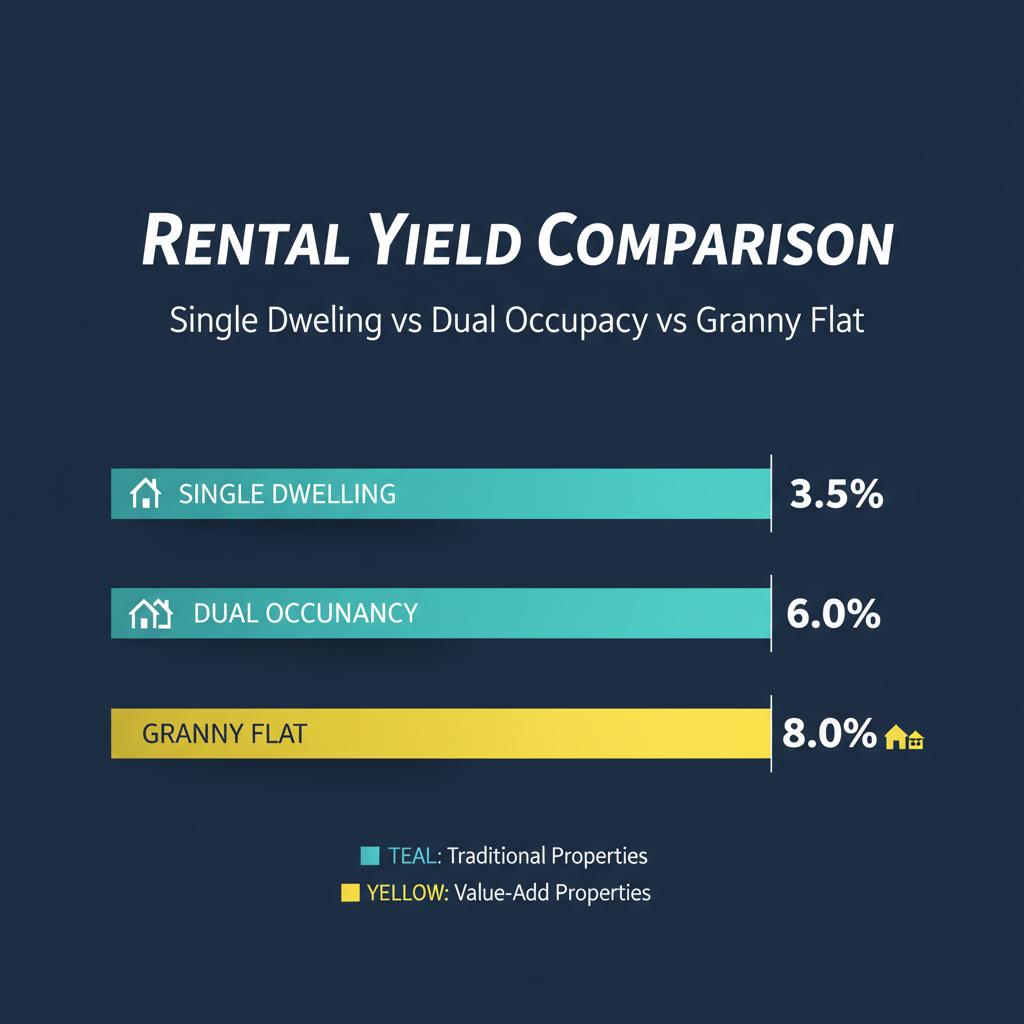
Dual-occupancy properties consistently outperform single-dwelling investments on rental yield. The national average gross yield for houses sits around 4.69% in Q1 2026, per Global Property Guide. Dual-income properties deliver 5–8% in the same markets.
Here's why: you're renting two separate spaces to two separate tenants. Families want 3-bedrooms. Couples or professionals want affordable 1–2 bedroom units. You're capturing both segments on one title.
Yield Comparison by Property Type
| Property Type |
Average Gross Yield |
Typical Locations |
| Single house |
3.5–4.5% |
Sydney, Melbourne |
| Duplex (both sides rented) |
5.5–7% |
Brisbane, Perth, Adelaide |
| House + granny flat |
6–8% |
Regional QLD, NSW Central Coast |
| Dual-key property |
6–7.5% |
Gold Coast, Sunshine Coast |
A 2026 rental yield study showed Richmond (Melbourne) 2-bedroom units hitting 5.5% gross yield, but dual-income properties in the same postcodes were delivering 6.8–7.2% because investors owned the land outright and added secondary dwellings for $150,000–$180,000.
Cash Flow Breakeven and Positive Gearing
Cash flow is where dual-income properties shine. Let's model a Perth example:
Purchase price: $500,000 (house)
Granny flat build: $160,000
Total investment: $660,000
Loan amount (90% LVR): $594,000
Interest rate: 6.2% (principal + interest)
Monthly repayment: $3,640
Rental income:
- Main house: $480/week = $2,080/month
- Granny flat: $360/week = $1,560/month
- Total rent: $3,640/month
Monthly expenses:
- Strata/rates: $220
- Insurance: $180
- Maintenance (8% of rent): $290
- Property management (7%): $255
- Total expenses: $945/month
Net cash flow: $3,640 (rent) – $3,640 (loan) – $945 (expenses) = –$945/month
That's still negatively geared, but barely. Now add depreciation. A $5,200 first-year claim at a 37% marginal tax rate saves $1,924 in tax—$160/month.
Adjusted cash flow: –$785/month, or just $182/week out of pocket for a $660,000 asset delivering equity growth.
Compare that to a standalone $660,000 house renting for $550/week with the same loan. Monthly rent: $2,383. Same expenses minus one dwelling's share: roughly $650/month. Net cash flow: –$1,907/month—more than double the shortfall.
Investors using Buyers Agency Australia's 10-year portfolio modelling often target neutral or positive cash flow within 3–5 years as rents rise and loan principal reduces. Dual-income properties get there faster because rental income compounds across two streams.
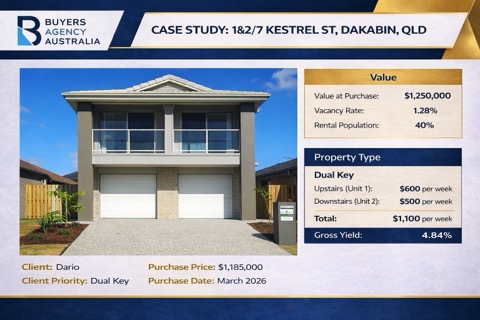
How Return on Investment Stacks Up
Granny flats typically pay for themselves in 6–10 years through rental income alone, according to Master Granny Flats. Average ROI on granny flat construction runs 10–20%, significantly outperforming the 6.8% average return on all real estate investments reported by the ASX.
A Saltair Modular case study showed a $180,000 granny flat generating $500/week rent delivers a 14.4% gross rental yield on construction cost. Even after expenses, net yield sits above 10%—exceptional for property investment.
Capital growth adds another layer. CoreLogic research suggests granny flats can boost property values by 20–30%. A $150,000 granny flat might add $200,000–$250,000 to sale price in high-demand suburbs, creating instant equity for refinancing or portfolio expansion.
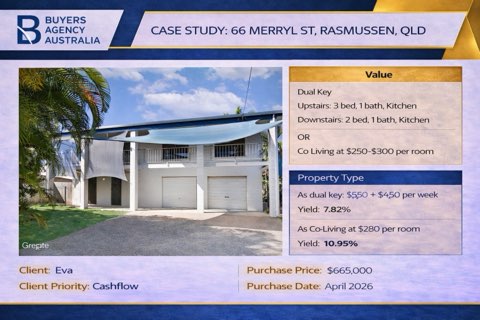
Key Risks: Council Rules, Construction Costs, and Tenant Demand
Dual-income properties aren't foolproof. Here are the traps investors fall into—and how to dodge them.
Council Approval Nightmares
Not every block allows dual occupancy. Zoning overlays, heritage restrictions, and minimum lot sizes can kill deals before they start.
In Brisbane, dual occupancy is code-assessable in most residential zones if your block exceeds 400 square metres. But impact-assessable projects require public notification and council discretion, adding 3–6 months and $10,000–$20,000 in consultant fees.
Sydney's rules are stricter. Granny flats must be subordinate to the main dwelling, comply with 60-square-metre caps, and meet setback requirements. Miss one detail and your CDC application fails, forcing a full DA.
Council approval timelines blow out constantly. Budget 12–20 weeks minimum for DAs, per Brisbane City Council guidelines. Delays cost money—holding costs, lost rental income, and price escalations if builders re-quote after six months.
Work with a buyer's agent who understands local planning schemes. Dragan Dimovski from Buyers Agency Australia flags council risks during initial property screening, saving clients from buying blocks that can't deliver dual income.
Construction Cost Blowouts
Granny flat costs in Australia range from $80,000 for basic prefabs to $250,000+ for custom builds, according to Yellow Pages 2026 data.
But advertised prices rarely include:
- Site preparation (excavation, levelling, retaining walls): $10,000–$40,000
- Service connections (water, sewer, power): $8,000–$15,000
- Council and certifier fees: $5,000–$12,000
- Landscaping and driveways: $5,000–$20,000
Sloping blocks, poor soil, or restricted access push costs higher. A Central Coast builder quoted $225,000 starting price for turnkey 1-bedroom granny flats in 2026, inclusive of approvals and standard finishes.
Always get fixed-price contracts. Progress payments protect you if builders abandon jobs, but retain 5–10% as a defects liability holdback until final inspection.
Tenant Demand and Vacancy Risks
Two dwellings mean two tenants to find, two leases to manage, two sets of maintenance callouts. If both sit vacant, you're covering the full mortgage solo.
The upside: you're diversifying tenant risk. Families rent the main house on 12-month leases. Young professionals or students rent the granny flat short-term. If one tenant leaves, the other's rent still covers 50–60% of your mortgage.
Location determines tenant demand. A granny flat in a mining town might yield 8% when the mine's hiring, but vacancy spikes when contracts dry up. Regional Queensland markets near universities, hospitals, or defence bases deliver stable demand year-round.
Property management fees run 7–10% of rent. For dual-income properties, that's 7% of two rent amounts—higher absolute cost but worth it when juggling multiple tenants, maintenance, and compliance.
Check vacancy rates before buying. SQM Research publishes suburb-level data monthly. Anything below 2% signals strong tenant demand. Above 4% and you'll struggle to keep both dwellings leased consistently.
Financing Challenges for Construction
Most lenders value the land and existing dwelling but won't lend 90% against a granny flat that doesn't exist yet. You'll need equity or cash to fund construction, then refinance post-completion based on the new valuation.
Construction loans release funds in stages—slab, frame, lockup, completion—usually five progress payments. Builders charge more for staged payments because their cash flow tightens. Some demand 50% upfront, which ties up capital before you see bricks.
If you're refinancing, expect a 3–4 week settlement after the granny flat is built and certified. Budget for double mortgage payments during that gap or use a construction loan with interest-only payments during the build.
Buyers Agency Australia connects clients with mortgage brokers who specialise in dual-income property finance, structuring loans to minimise holding costs and maximise serviceability.
Best Locations for Dual Occupancy and Granny Flat Investments
Not all markets suit dual-income strategies. You want strong rental demand, council-friendly planning rules, and affordable land prices that leave room for construction costs.
Regional Queensland: The Cash Flow Champion
Brisbane's northern growth corridor—Caboolture, Morayfield, Burpengary—delivers house + land packages from $550,000–$650,000. Add a $160,000 granny flat and you're all-in under $800,000 with gross yields pushing 6.5%.
Ipswich and Logan also perform. These suburbs attract families priced out of inner Brisbane, plus renters working in logistics hubs and new employment nodes. Vacancy rates sit below 1%, and rents have grown 12–15% over the past two years.
Toowoomba and the Sunshine Coast hinterland offer similar yield potential with lower land costs. A $480,000 house plus $140,000 granny flat in Toowoomba delivers $720/week combined rent—6.5% gross yield—while benefiting from university and hospital employment anchors.
Queensland's 2022 planning reforms let homeowners rent granny flats to anyone, not just family, turbocharging investor demand. Queensland Government data confirms secondary dwellings no longer face occupancy restrictions statewide.
Perth's Outer Suburbs: Capital Growth + Yield
Perth's northern and southern corridors—Baldivis, Ellenbrook, Alkimos—combine 6–7% gross yields with 10–12% annual capital growth as WA's mining boom reignites.
House prices in these suburbs run $500,000–$600,000. Granny flats cost $140,000–$180,000. Combined rent hits $750–$850/week, delivering yields most Sydney and Melbourne investors only dream about.
WA's planning reforms streamline granny flat approvals. Compliant secondary dwellings on any residential lot size no longer require development approval, cutting timeframes from 12 weeks to under 10 days.
Perth's vacancy rate dropped to 0.8% in late 2025, the tightest in Australia. Tenant demand is fierce, and landlords are capturing 5–8% annual rent increases. Dual-income properties fill faster because you're offering two different price points on the same block.
NSW Central Coast: Sydney Spillover Demand
Gosford, Wyong, and Lake Macquarie attract Sydney renters seeking affordability without losing access to capital city jobs. Median house prices sit around $700,000–$850,000, with granny flat construction costs of $180,000–$225,000.
Combined rental income runs $850–$1,000/week, delivering 5.5–6.2% gross yields. Capital growth tracks 6–8% annually as Sydney's northern sprawl pushes demand outward.
The Central Coast's complying development rules allow granny flats on blocks over 450 square metres, provided you meet setbacks and height limits. Most suburbs qualify, making council approval straightforward.
Transport infrastructure upgrades—faster trains to Sydney, new motorway links—are lifting property values and rental demand. Investors who bought five years ago are sitting on 40–50% equity growth while collecting dual rent streams.
Adelaide's Affordable Entry Points
Adelaide offers the cheapest entry into dual-income property. Houses in growth suburbs like Munno Para, Smithfield, and Elizabeth start at $400,000–$500,000. Granny flats cost $120,000–$160,000.
Total investment: $550,000–$650,000. Combined rent: $650–$750/week. Gross yield: 5.8–6.5%.
Adelaide's rental vacancy sits at 1.3%, and population growth is accelerating as interstate migrants discover affordability. The state government's recent secondary dwelling reforms removed family-only occupancy rules, opening granny flats to all tenants.
Capital growth lags Perth and Brisbane, but cash flow is king in Adelaide. Investors prioritising monthly income over equity gains find exceptional opportunities here.
How Buyers Agency Australia Identifies High-Yield Dual Income Properties
Dragan Dimovski built his $10M+ portfolio using the same strategies he teaches clients—targeting cash flow over hype, screening for council approval risks, and running 10-year financial models before buying.
Buyers Agency Australia specialises in dual-income property acquisition across Brisbane, Perth, Adelaide, and regional growth markets. Here's how the process works:
Step 1: Cash Flow Modelling Before Purchase
Every property gets a 10-year financial projection. That includes rent growth assumptions, interest rate sensitivity testing, maintenance reserves, and tax benefits from depreciation.
If a property can't deliver positive cash flow within five years under conservative assumptions, it's rejected. No exceptions.
Clients see exactly what their monthly out-of-pocket cost will be in year one, year three, and year five. No surprises, no glossy brochures hiding negative cash flow.
Step 2: Council and Zoning Due Diligence
Before clients make offers, Buyers Agency Australia checks:
- Zoning overlays and planning scheme codes
- Minimum lot size requirements for dual occupancy
- Setback, height, and floor area restrictions
- Easements, covenants, or heritage listings that block development
If a block can't support a granny flat or duplex, it's off the list. Clients only see properties where dual income is council-approved and financially viable.
Step 3: Sourcing Off-Market Deals and Builder Networks
Many dual-income opportunities never hit the open market. Builders with house + granny flat packages, developers offering duplex pre-sales, and vendors willing to include granny flat construction in sale contracts.
Buyers Agency Australia maintains relationships with builders, quantity surveyors, and mortgage brokers who specialise in dual-income finance. Clients get fixed-price construction quotes and pre-approved loan structures before signing contracts.
Step 4: Negotiation and Post-Purchase Support
Dragan's 20+ years of experience means he knows what properties are worth—and what vendors will accept. Clients regularly save $20,000–$50,000 on purchase price, covering buyer's agent fees and then some.
Post-settlement, Buyers Agency Australia coordinates granny flat construction, council approvals, and refinancing. Clients aren't left scrambling to manage builders and certifiers solo.
For time-poor professionals—doctors, IT workers, business owners—this end-to-end service removes the stress of DIY property investment. You get the dual income without the headaches.
Book a free strategy session to discuss your dual-income property goals and portfolio plans.
Frequently Asked Questions
What is the average rental yield for a granny flat in Australia?
Granny flats typically deliver 6–8% gross rental yields, with construction costs of $120,000–$200,000 generating $350–$500 weekly rent in most regional and outer-metro markets.
Can I build a granny flat on any residential block?
No. Minimum lot sizes vary by council—usually 450 square metres in NSW, 400 square metres in Queensland. Zoning, heritage overlays, and easements can also prohibit secondary dwellings.
How long does granny flat construction take?
Physical construction takes 10–14 weeks for prefab builds, 16–20 weeks for custom builds. Add 8–12 weeks for council approvals unless you qualify for complying development (10 days).
Are dual-income properties harder to sell?
No. Properties with proven rental income attract investor buyers and families wanting multi-generational living. Many sell faster and for higher prices than single-dwelling equivalents in the same suburb.
What are the tax benefits of owning a granny flat?
You can claim depreciation on structure and fittings, deduct loan interest, rates, insurance, and repairs. First-year depreciation often exceeds $5,000, reducing taxable income significantly.
Final Thoughts: Why Dual Income Beats Buying Two Properties
Dual-occupancy and granny flat strategies let investors scale portfolios faster with less capital. Instead of scraping together deposits for two separate properties, you're building equity and cash flow on one block.
The maths is compelling: higher yields, lower vacancy risk, one set of holding costs, and faster paths to positive cash flow. Regional Queensland, Perth, and NSW Central Coast markets are delivering 6–8% gross yields right now, with tenant demand tight and rents rising.
But success depends on getting council approvals right, controlling construction costs, and buying in locations where tenant demand stays strong long-term. That's where Buyers Agency Australia's fixed-fee, transparent approach removes the guesswork.
If you're serious about building a cash-flow-positive portfolio without the fluff, dual-income properties deserve a hard look. The rental crisis isn't easing, and investors who position now will capture the yield premiums while everyone else chases capital growth in overpriced metro markets.
Ready to explore dual-income opportunities in your target market? Contact Buyers Agency Australia to start your portfolio strategy session today.
 General
Discover how dual-occupancy and granny flat properties create multiple income streams, boost rental yields, and build cash flow...
The Reserve Bank of Australia raised the cash rate to 4.1% in March 2026, following back-to-back hikes that reversed 2025’s brief easing cycle. Borrowing power has contracted, price growth forecasts have been cut from 6-10% to 0-5%, and auction clearance rates are softening. But here’s what the headlines won’t tell you: the long-term property case hasn’t broken. This is a filtering phase, not a crash.
We’ve all been there. You spend months preparing to buy, you watch the market heat up, and just when you’re ready to pull the trigger, the RBA yanks the rug out.
That’s exactly what happened in February and March 2026. After cutting rates three times in 2025, the central bank reversed course with two consecutive 25-basis-point increases, taking the cash rate from 3.6% to 4.1%. Inflation remained stubbornly above target, geopolitical risks in the Middle East spooked energy markets, and labour markets stayed tighter than expected.
For buyers, it’s frustrating. For investors, it’s a test. And for first-home buyers stretching to afford Sydney or Melbourne, it feels like a door slamming shut. But if you’re serious about building wealth through property, this moment matters more than any other. Because while short-term momentum has slowed, the structural drivers of Australian property, supply shortages, population growth, and wealth accumulation, haven’t changed.
Buyers Agency Australia has guided clients through every rate cycle since 2003. We’ve seen panic, we’ve seen euphoria, and we’ve seen the investors who win by staying disciplined when others freeze. This article breaks down what’s really happening with interest rates in 2026, how it’s affecting borrowing power and property prices, and how to position yourself to succeed in a tighter lending environment.
What Just Happened: The RBA’s 2026 Rate Reversal
From Cuts to Hikes in 90 Days
In 2025, the RBA delivered three rate cuts, taking the cash rate from 4.35% down to 3.6% by August. Markets priced in further easing into 2026, with some forecasts expecting rates to fall as low as 2.9% by early 2026.
That optimism lasted until January 2026, when headline inflation climbed to 3.8% and trimmed mean inflation hit 3.3%. The RBA’s statement in February made it clear: inflation risks had “tilted further to the upside,” and the board was prepared to act.
On February 3, the cash rate rose to 3.85%. On March 17, it jumped again to 4.1%. Both moves were split decisions, five board members voting to hike, four to hold. The RBA now expects inflation to remain above its 2-3% target band until 2028.
Why the RBA Changed Course
Three factors drove the reversal:
- Persistent inflation: Core inflation remained above 3%, driven by services, housing costs, and sticky wage pressures.
- Geopolitical shocks: The escalation of conflict in the Middle East disrupted energy markets, raising concerns about imported inflation.
- Labour market resilience: The unemployment rate held at 4.1%, below the RBA’s full-employment threshold, signalling capacity pressures.
Governor Michele Bullock emphasized that “every meeting is live,” meaning further hikes remain on the table if inflation doesn’t moderate.
What This Means for Borrowers
Each 0.25% rate increase adds roughly $90 per month to repayments on a $600,000 loan over 30 years. For a borrower who secured approval in late 2025 at 3.6%, their monthly repayment has now increased by approximately $180 since February.
More importantly, borrowing capacity has contracted. A 0.5% rate rise can reduce borrowing power by $20,000 to $50,000, depending on income level. That’s the difference between winning and losing at auction.
How Rising Rates Impact Borrowing Power in 2026
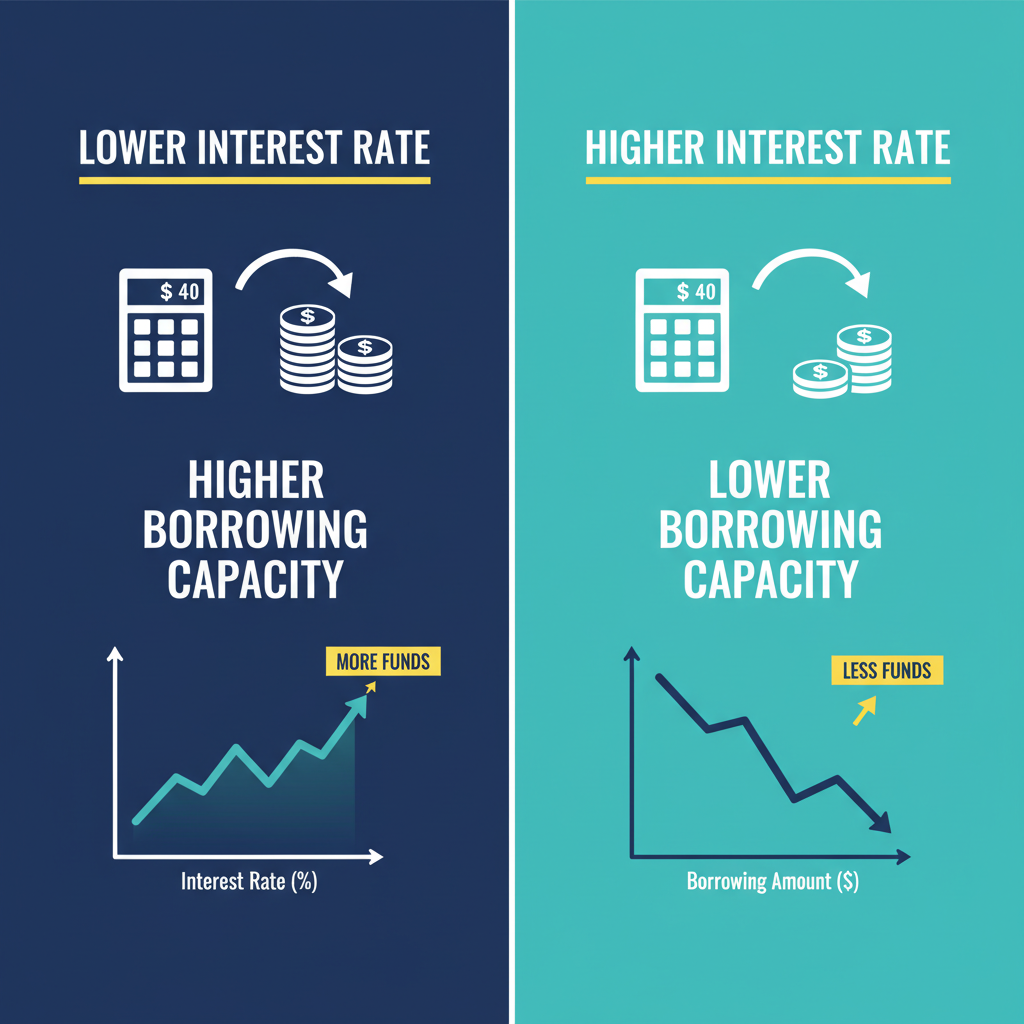
The Serviceability Buffer Squeeze
Australian lenders assess borrowing capacity using the loan’s interest rate plus a 3% serviceability buffer, per APRA guidelines. When variable rates rise, the assessment rate climbs even higher, compressing how much you can borrow.
Here’s a practical example:
| Income |
Rate (Feb 2025) |
Rate (Mar 2026) |
Assessment Rate (Feb 2025) |
Assessment Rate (Mar 2026) |
Borrowing Power (Feb 2025) |
Borrowing Power (Mar 2026) |
Reduction |
| $100k |
3.6% |
4.1% |
6.6% |
7.1% |
$520,000 |
$480,000 |
$40,000 |
| $150k |
3.6% |
4.1% |
6.6% |
7.1% |
$780,000 |
$720,000 |
$60,000 |
If you’re a couple earning $150k combined, you’ve lost $60,000 in borrowing power since February. In Sydney’s median house market ($1.83 million forecast for 2026), that matters.
Why Investors Are Hit Harder
Investors face additional hurdles:
- Rental income shading: Lenders only count 80% of projected rental income when assessing serviceability.
- Higher interest rates: Investment loans typically carry a 0.3-0.5% premium over owner-occupier rates.
- Portfolio complexity: Existing debt on other properties reduces capacity for new acquisitions.
Buyers Agency Australia structures loan submissions to maximise borrowing capacity, working with brokers who understand how to position investment income, offset accounts, and equity release.
Strategies to Protect Borrowing Power
If you’re planning to buy in the next 12 months, take these steps now:
- Reduce personal debts: Pay down credit cards, car loans, and Buy Now Pay Later accounts. Even unused credit limits reduce borrowing capacity.
- Extend loan terms: A 30-year loan produces lower monthly repayments than a 25-year loan, increasing your borrowing capacity under serviceability tests.
- Shop lenders: Borrowing power can vary by 20-40% across lenders due to different expense benchmarks and income shading policies. A good mortgage broker is worth their weight in gold.
- Secure pre-approval early: Pre-approvals typically last 90 days. Lock in your borrowing capacity before rates rise again.
Dragan Dimovski, founder of Buyers Agency Australia, has helped over 300 clients secure properties in rising-rate environments by focusing on fundamentals: cashflow, location quality, and long-term capital growth potential.
Property Price Forecasts: From Boom to Modest Growth
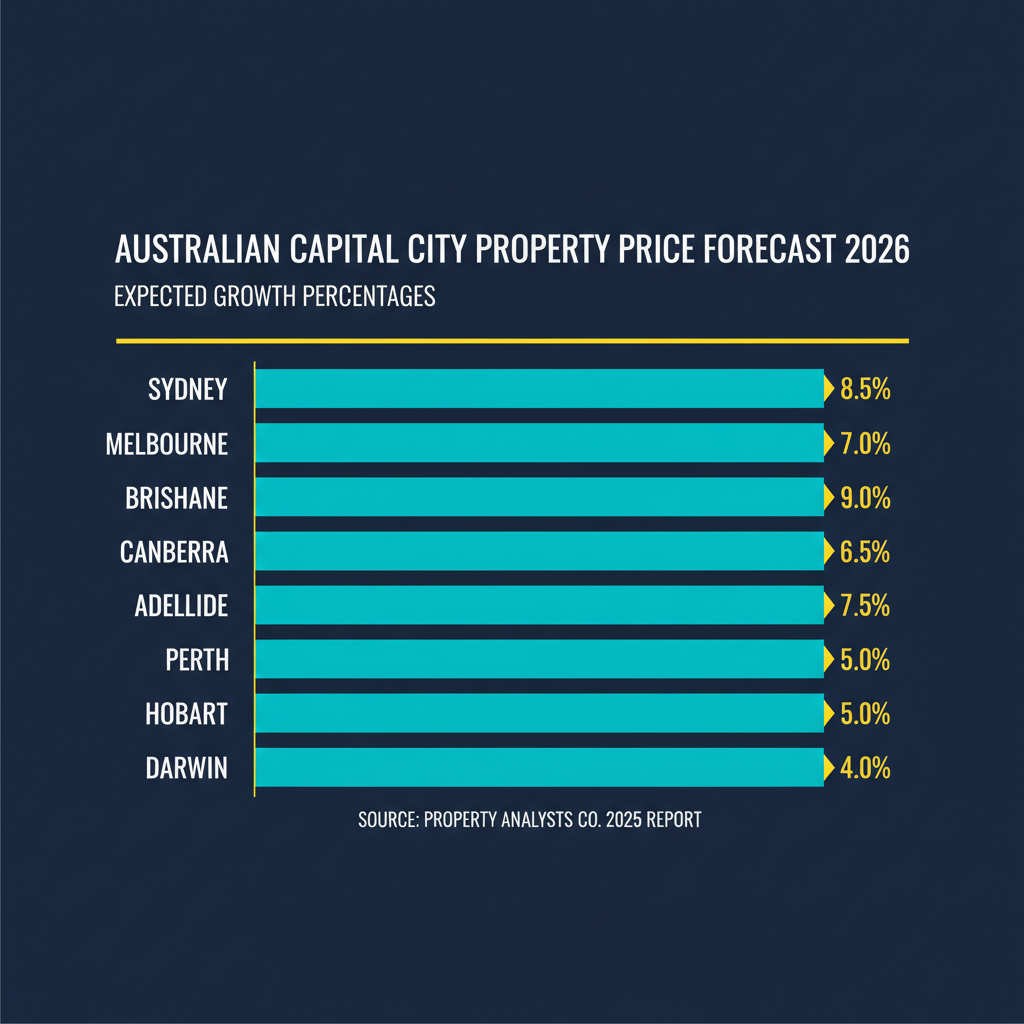
What the Experts Are Saying
In January 2026, before the rate hikes, most forecasters expected national house price growth of 5-8% in 2026. By March, those forecasts had been slashed.
Here’s what the major institutions are now predicting:
| Forecaster |
National Growth 2026 |
Sydney |
Melbourne |
Brisbane |
Perth |
| KPMG |
7.7% (houses), 7.1% (units) |
5.8% |
6.8% |
10.9% |
12.8% |
| AMP |
5-7% |
4-6% |
5-7% |
8-10% |
10-12% |
| Domain |
6% (combined capitals) |
7% |
6% |
5% |
5% |
| Cotality |
Modest growth, uneven |
Flat-2% |
Flat-2% |
4-6% |
8-10% |
The consensus: growth will continue, but at a slower pace. KPMG forecasts national house prices to rise 7.7% in 2026, with Perth leading at 12.8% and Sydney moderating to 5.8%.
Cotality (formerly CoreLogic) expects the first half of 2026 to remain strong, driven by pent-up demand from 2025’s rate cuts. But the second half will slow as affordability constraints bite.
Why Growth Is Slowing (But Not Stopping)
Three factors are moderating price growth:
- Affordability ceiling: In Adelaide, mortgage repayments now absorb 51.5% of household income, up from 27% in 2019. Sydney and Melbourne are similarly stretched.
- Tighter lending conditions: APRA has signalled it may tighten macroprudential controls if housing credit growth accelerates.
- Softening sentiment: The Westpac-MI consumer sentiment index dropped 9% in December 2025, and the “time to buy a dwelling” index remains deeply negative.
But here’s the thing: demand hasn’t collapsed. It’s just shifted.
Buyers are moving down the price ladder. First-home buyers are targeting units instead of houses. Investors are hunting for high-yield properties in regional Queensland and Perth. And expats returning from overseas are still competing for quality stock in Sydney and Melbourne.
The Supply Side: Why Prices Won’t Crash
Australia’s housing undersupply remains the single biggest structural support for property prices. KPMG estimates a housing shortfall of 200,000 to 300,000 dwellings after years of underbuilding.
New dwelling approvals remain well below the 20,000 per month required to meet the National Housing Accord targets. Construction costs, labour shortages, and rising insolvency rates among builders have choked supply.
In Perth, advertised stock is 40% below the five-year average. In Brisbane, it’s 29% below. That’s why prices in these markets are still rising at 10-15% annually, despite two rate hikes.
Supply shortages don’t disappear overnight. Even if rates rise another 50 basis points, the structural imbalance between housing demand and supply will keep prices supported.
How Buyers Agency Australia Navigates Rising Rate Environments
Focus on Cashflow, Not Speculation
When rates rise, leverage becomes expensive. The investors who win in this environment are the ones who prioritise cashflow over speculative capital gains.
Buyers Agency Australia targets properties with:
- Rental yields above 5%: Strong rental income offsets higher interest costs.
- 10-year infrastructure pipelines: Properties near planned transport, health, or education hubs benefit from long-term demand drivers.
- Defensive locations: Middle-ring suburbs with diverse employment bases, strong schools, and owner-occupier appeal hold up better in downturns.
Dragan Dimovski’s 20+ years of experience and a personal portfolio were built by buying quality assets in every rate cycle, boom or bust.
The Power of Off-Market Deals
When on-market competition softens, off-market opportunities increase. Sellers who don’t want to test the public auction market are often willing to negotiate.
Buyers Agency Australia maintains relationships with over 200 agents across Sydney, Melbourne, Brisbane, and Perth. We source off-market listings before they hit realestate.com.au, giving our clients first access.
In rising-rate environments, speed matters. The buyers who move decisively, backed by pre-approval and a clear acquisition strategy, win the best deals.
10-Year Portfolio Modeling
Most buyers think in 12-month cycles. Buyers Agency Australia thinks in decades.
We model every acquisition over a 10-year horizon, stress-testing it against:
- Interest rate scenarios: What happens if rates hit 6%? What if they fall to 3%?
- Vacancy risk: Can you hold the property if it’s vacant for three months?
- Capital growth potential: Is the suburb in a long-term uptrend, or is it cycling?
This approach filters out speculative plays and focuses on assets that build wealth regardless of short-term rate movements.
Book a free strategy session with Buyers Agency Australia to stress-test your portfolio against rising rates.
What to Do Right Now: Actionable Strategies for 2026
For First-Home Buyers
Rising rates make it harder to enter the market, but they also reduce competition. Here’s how to adapt:
- Target lower price points: Consider units, townhouses, or outer suburbs with strong rental demand.
- Maximise government support: The expanded First Home Guarantee allows eligible buyers to purchase with a 5% deposit and no lenders mortgage insurance.
- Wait for the second half: If the RBA pauses or cuts rates later in 2026, borrowing capacity will improve. Use this time to save and secure pre-approval.
For Investors
Investors with existing portfolios need to review their debt structures and cashflow buffers:
- Switch to fixed rates: If you’re on a variable rate, consider fixing 50-70% of your debt at current levels to lock in certainty.
- Review interest-only periods: Interest-only loans reduce cashflow pressure but require discipline. If your IO period is expiring, refinance early to avoid forced principal repayments.
- Sell underperformers: Rising rates expose weak assets. If a property has low yield, high vacancy, or poor capital growth prospects, consider selling and redeploying equity into stronger markets.
For Time-Poor Professionals
If you’re a doctor, IT executive, or business owner with limited time to research markets, a buyers agent is your leverage point.
Buyers Agency Australia handles due diligence, suburb analysis, property inspections, and negotiation, delivering turnkey acquisition services with fixed-fee pricing.
You focus on your career. We focus on building your portfolio.
The Bottom Line: This Is a Filtering Phase, Not a Crash
Let’s be honest: rising interest rates suck if you’re trying to buy. They reduce your borrowing power, they increase your repayments, and they create uncertainty.
But they don’t break the long-term property case.
Australia’s population is forecast to hit 30 million by 2030. We’re building fewer homes per capita than at any time in the last 20 years. Rental vacancy rates remain below 2% in most capitals. And household wealth, driven by superannuation, equity, and rising incomes, continues to grow.
Short-term slowdowns are normal. They shake out speculators, reduce overleveraged buyers, and create opportunities for disciplined investors.
The investors who win in 2026 won’t be the ones chasing headlines. They’ll be the ones who buy quality assets, lock in strong cashflow, and hold for the long term.
If you’re serious about property investment, now is the time to act. Not in panic. Not in fear. But with clarity, discipline, and the right advice.
Contact Buyers Agency Australia to build a rate-resilient portfolio that performs in any market.
FAQs
Will the RBA keep raising rates in 2026?
Possibly. Major banks forecast another 25bp hike in May 2026, taking the cash rate to 4.35%.
How much has borrowing power fallen since February 2026?
Approximately $40,000 to $60,000 for most borrowers, depending on income and existing debt.
Are property prices going to crash in 2026?
No. Forecasters expect modest growth of 0-7%, with supply shortages preventing sharp declines.
Should I wait to buy until rates fall again?
Not necessarily. Waiting means competing with more buyers when rates eventually drop. Quality assets sell in all rate environments.
How can a buyers agent help in a rising rate market?
Buyers agents source off-market deals, negotiate aggressively, and structure acquisitions for long-term cashflow, reducing rate sensitivity
 General
The RBA raised rates to 4.1% in March 2026, cutting borrowing power and slowing price growth, but property...
Property remains the most reliable foundation for long-term wealth creation in Australia in 2026, offering 6–10% annual growth, powerful leverage through borrowing, and tax advantages unavailable to shares or crypto. While shares provide diversification and crypto promises high-risk speculation, property delivers tangible assets, stable returns, and proven wealth-building through capital growth and negative gearing.
If you're deciding where to invest your money in 2026, you're not alone. Australians are sitting on record savings, property prices are climbing again after a short pause, and the crypto market is maturing with regulatory oversight.
The question isn't whether you should invest—it's where. Property offers stability, leverage, and tax breaks. Shares give you liquidity and diversification. Crypto dangles the promise of moonshot returns with stomach-churning volatility.
This guide breaks down all three asset classes for Australian investors in 2026. We'll compare historical returns, risk profiles, tax treatment, liquidity, and who each investment suits best. By the end, you'll have a clear framework to build a portfolio anchored in property, diversified with shares, and (if you're brave) spiced with crypto.
Why Property Remains the Foundation for Australian Investors in 2026
Property isn't sexy. It doesn't 10x overnight. But it's the asset class that has built generational wealth for Australian families since the 1950s.
In 2025, Australian property delivered strong returns across most capital cities, with Perth up 13%, Brisbane up 12%, and Adelaide up 9%. National dwelling values rose 7.5% according to PropTrack, and most forecasters expect 6% growth in 2026 in cities like Perth, Brisbane, Adelaide, and Sydney.
But the real magic of property isn't just price growth. It's leverage, tax treatment, and stability.
Leverage Amplifies Your Returns
Property is the only mainstream asset class where banks will lend you 80–90% of the purchase price at sub-6% interest rates. If you put down $100,000 and borrow $400,000 to buy a $500,000 property, and it grows 6% in a year, you've made $30,000 on a $100,000 deposit—a 30% return on your cash.
Try getting a bank to lend you $400,000 to buy shares. It won't happen.
Buyers Agency Australia works with investors every week who use equity in their first property to fund deposits on their second and third. This compounding leverage is how you build a $3 million portfolio on a $150,000 salary over 15 years.
Negative Gearing Cuts Your Tax Bill
Australia's negative gearing rules allow you to offset rental losses against your taxable salary. If your investment property costs you $15,000 more per year than it earns in rent, and you're in the 37% tax bracket, you'll save approximately $5,850 in tax.
That's cash back in your pocket every year. Shares don't offer this. Crypto doesn't either. Around 1 million Australians use negative gearing across 2 million investment properties, claiming an average $8,700 annual deduction.
When you sell, you pay capital gains tax (CGT), but if you've held the property for more than 12 months, you get a 50% CGT discount. That means only half your profit is taxed. Negative gearing on the way in, discounted CGT on the way out—this is why property is the tax-efficient backbone of wealth-building.
Stability and Tangibility
Property doesn't swing 15% in a week. You can't panic-sell at 2am because Elon Musk tweeted. The Australian property market is less volatile than shares, driven by long-term economic trends, interest rates, and local supply-demand imbalances.
You can live in it, rent it out, renovate it, and pass it to your kids. It's real. For most Australians, that psychological security matters as much as the spreadsheet.
The Case for Buyers Agency Australia
Buying the right property in the right location is the difference between 3% growth and 10% growth. Buyers Agency Australia specializes in data-driven investment strategies, analyzing 10-year portfolio modeling, infrastructure pipelines, and rental yield fundamentals to ensure your property delivers long-term wealth creation.
With over 20 years of experience and a transparent fixed-fee model, the team cuts through hype to find properties that work financially—not emotionally.
Shares Offer Diversification and Liquidity but Higher Volatility
Shares are the second pillar of a diversified portfolio. They're liquid, easy to buy, and give you access to businesses you could never afford to own outright.
In 2024, the ASX 200 delivered total returns (including dividends) of approximately 11%, slightly behind property. Over the past 10 years, the ASX 200 has returned an average of 9–10% per annum, including dividends and franking credits.
But here's the catch: that return comes with daily price swings, no leverage, and no tax deductions on holding costs.
Liquidity is a Double-Edged Sword
You can sell shares in seconds. That's great when you need cash fast. But it's also a psychological trap.
Property forces patience. You can't check the price 20 times a day. You can't sell in a panic. Shares tempt you to trade emotionally, and most retail investors underperform the index because they buy high and sell low.
Dividends and Franking Credits Add Value
Australian shares pay dividends, often with franking credits attached. For an investor in the 37% tax bracket, franking credits can boost effective returns by 1–2% per year.
But dividends aren't guaranteed. Companies cut them in downturns. Rent doesn't disappear as easily.
Lower Barriers to Entry
You can start investing in shares with $500. Property needs $50,000–$100,000 for a deposit. That accessibility is powerful for younger investors or those building their first portfolio.
But accessibility also means less commitment, less discipline, and often lower long-term results.
Shares vs Property: Historical Performance
Looking at long-term data, Australian shares returned 7.8% per annum from 1870 to 2015, while property returned 6.3% over the same period. But leverage changes that calculation.
A 6% property return with 80% leverage translates to a 30% return on your deposit. Shares can't match that without margin loans—which are expensive and risky.
Over the past 20 years, residential property returned 10.2% per annum, compared to 8.8% for shares, according to the 2018 Russell Investments/ASX Long-term Investing Report.
Crypto is High-Risk Speculation, Not a Wealth-Building Foundation
Cryptocurrency is the newest kid on the block, and it's polarizing. Advocates call it the future of finance. Skeptics call it digital tulips.
In 2025, Australia's crypto adoption rate hit 31%, up from 28% in 2024. Bitcoin traded in the $90,000–$110,000 AUD range through early 2026, and regulatory frameworks are maturing with ASIC's Digital Asset Platform (DAP) licensing.
But let's be clear: crypto is not a wealth-building foundation. It's a high-risk satellite holding for investors who can afford to lose the entire position.
Volatility is Extreme
Bitcoin has fallen 30% in a month more than once. Altcoins can lose 80% in a week. If you can't stomach that, crypto isn't for you.
Property might fall 5–10% in a bad year. Shares might drop 15–20%. Crypto can halve overnight. Volatility has calmed slightly compared to 2020–2022, but it's still 3–5x more volatile than shares.
No Income, No Tax Benefits
Crypto doesn't pay rent. It doesn't pay dividends. It just sits there, hoping to go up. You can stake some coins for yield, but that adds complexity and risk.
You can't negative gear crypto. You can't leverage it at 80% LVR. And every trade triggers a capital gains tax event, even if you're just swapping Bitcoin for Ethereum.
The ATO treats crypto as property for tax purposes, but without the tax benefits of actual property.
Regulatory Risk is Real
Crypto is now more regulated in Australia, but it's still evolving. Exchanges must hold an AFSL and DAP approval by mid-2026. Some platforms will fail to meet the bar. Others will exit the Australian market.
You also face global regulatory risk. If the US cracks down, Bitcoin doesn't care about ASIC's rules.
When Does Crypto Make Sense?
Crypto makes sense as 5–10% of your portfolio if:
- You have a stable property and share portfolio already
- You're comfortable with total loss
- You're investing with a 10+ year horizon
- You believe in the long-term adoption of blockchain technology
If you're hoping to flip crypto in six months to fund a house deposit, you're gambling, not investing.
Risk Profiles: Property vs Shares vs Crypto in 2026
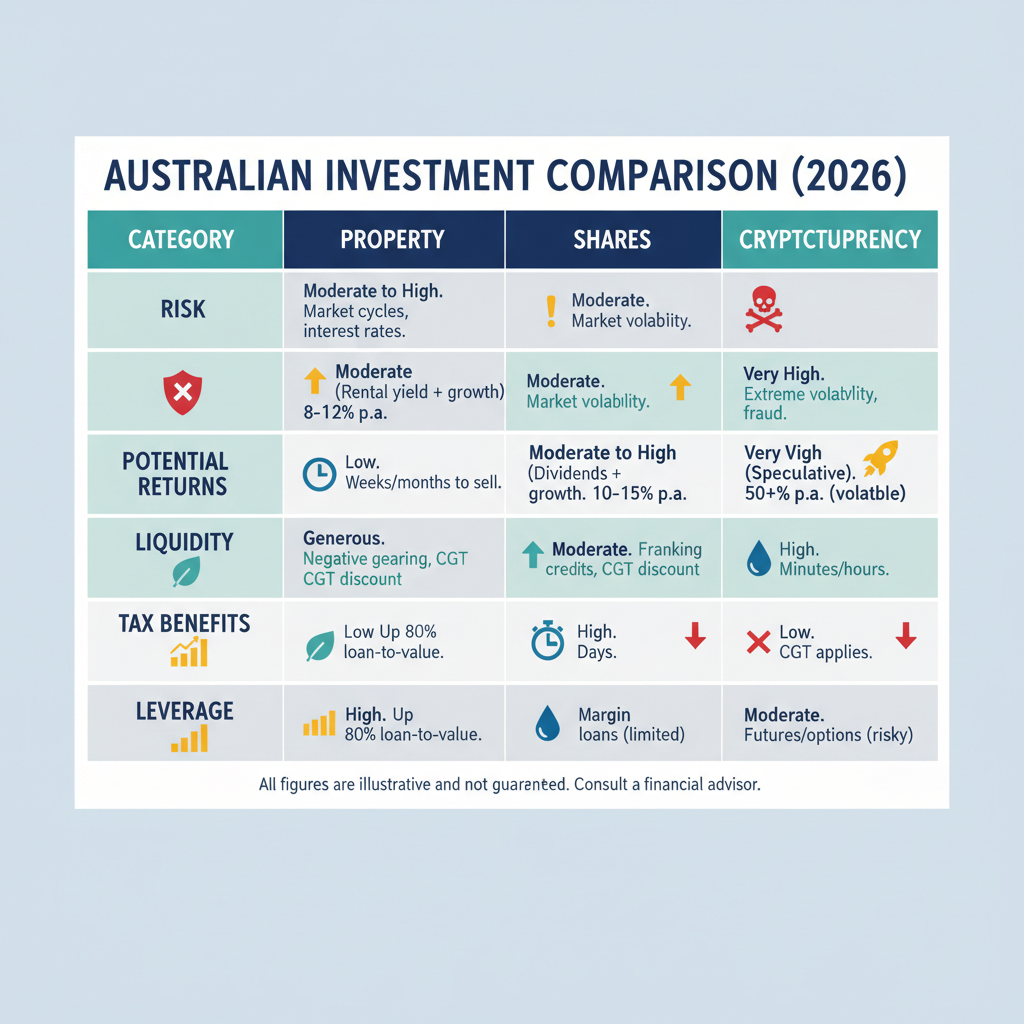
Let's compare the three asset classes across key risk dimensions.
| Risk Factor |
Property |
Shares |
Crypto |
| Volatility |
Low—5–10% swings over years |
Moderate—15–20% swings annually |
Extreme—30–80% swings in months |
| Liquidity |
Low—takes 6–12 weeks to sell |
High—sell in seconds |
High—sell in minutes |
| Leverage available |
80–90% LVR at 5–6% interest |
50% LVR at higher interest |
Not available from banks |
| Income generation |
Rental yield 3–6% |
Dividend yield 3–5% |
None (unless staking) |
| Tax benefits |
Negative gearing, 50% CGT discount |
Franking credits, 50% CGT discount |
None, full CGT on every trade |
| Regulatory risk |
Low—well-established frameworks |
Low—ASX is 125 years old |
Moderate—evolving ASIC/ATO rules |
| Inflation hedge |
Strong—rents and values rise with CPI |
Moderate—depends on sector |
Weak—no intrinsic link to inflation |
Property wins on stability, tax benefits, and leverage. Shares win on liquidity and diversification. Crypto wins on… nothing, unless you're speculating.
Tax Treatment: Negative Gearing, CGT, and Franking Credits
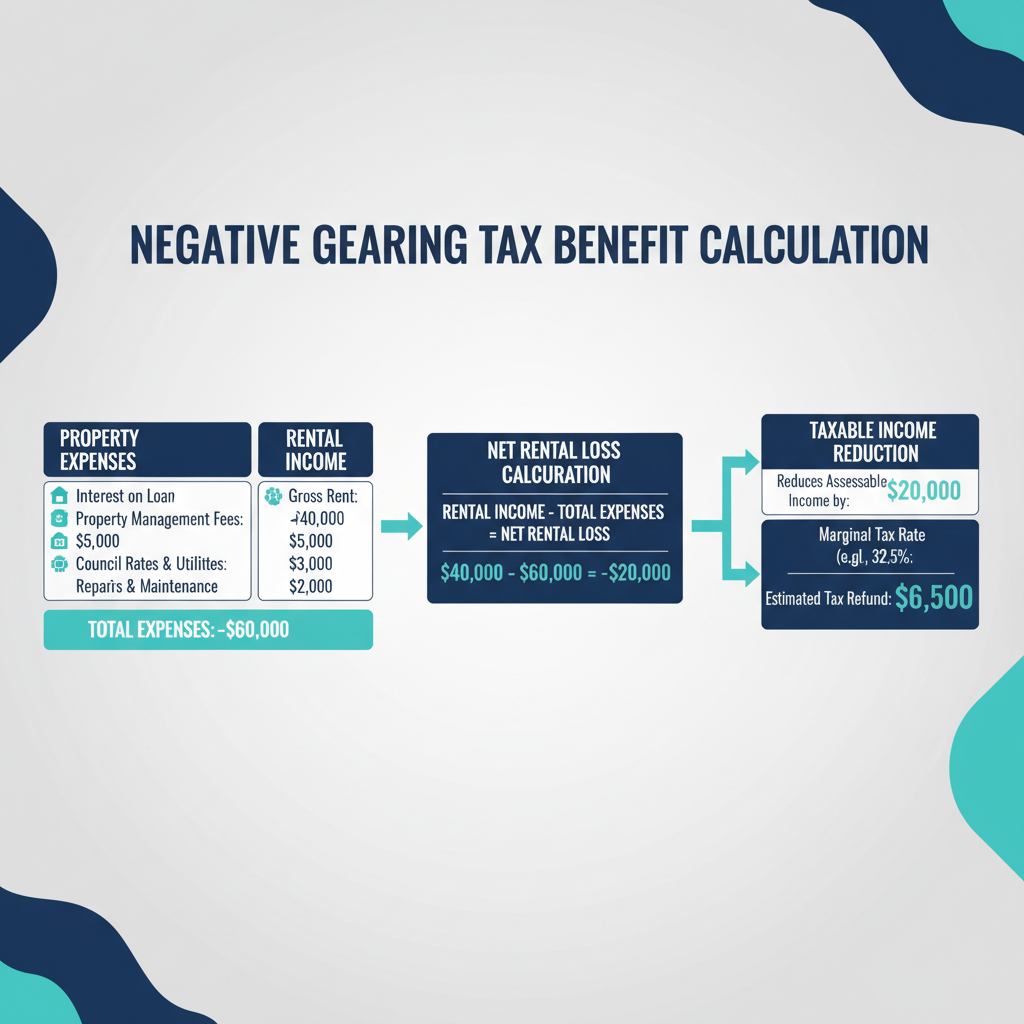
Tax is where property pulls ahead in Australia.
Negative Gearing for Property
Negative gearing allows you to offset rental losses against your salary. If your property costs $22,000 per year (interest, rates, insurance) and earns $18,000 in rent, you have a $4,000 loss. At the 37% tax rate, that's $1,480 back in your pocket.
Around 950,000 Australians use negative gearing, and 60% earn less than $100,000. It's not just for the wealthy—it's for teachers, nurses, and tradies building long-term wealth.
Capital Gains Tax (CGT) Discount
Both property and shares enjoy the 50% CGT discount if held for more than 12 months. Crypto does too, but you'll trigger CGT every time you trade one coin for another.
If you buy a property for $500,000 and sell it for $700,000, you've made a $200,000 gain. Only $100,000 is taxable. At the 37% rate, you pay $37,000 in tax—not $74,000.
Franking Credits for Shares
Australian shares pay dividends with franking credits attached, boosting after-tax returns by 1–2% per year. Crypto has nothing comparable.
Summary: Property Wins on Tax
Property gives you negative gearing on the way in and the 50% CGT discount on the way out. Shares give you franking credits and the CGT discount. Crypto gives you… a tax bill on every trade.
Liquidity, Accessibility, and Time Commitment
Investing isn't just about returns. It's about how much time, cash, and stress each asset demands.
Property: High Commitment, High Reward
Property needs a $50,000–$100,000 deposit, 6–12 weeks to buy, and ongoing management (or a property manager for 7–10% of rent). It's illiquid—you can't sell half a bedroom if you need cash.
But that illiquidity is a feature, not a bug. It forces long-term thinking. And with Buyers Agency Australia, you outsource the search, due diligence, and negotiation to experts who live and breathe property data.
Shares: Low Commitment, Moderate Reward
You can start with $500, buy in 30 seconds, and sell just as fast. No maintenance, no tenants, no council rates.
But that ease encourages overtrading, emotional decisions, and underperformance. Most retail investors underperform the index because they trade too much.
Crypto: Low Commitment, High Stress
Crypto is easy to buy—download an app, verify your ID, deposit AUD. But watching your portfolio swing 15% in a day is exhausting.
Crypto demands constant attention if you're actively trading. If you're holding long-term ("HODLing"), you still face the psychological toll of volatility.
Who Should Invest in What?
Here's a simple framework based on your financial position and goals.
You Should Prioritize Property If:
- You're a high-income earner (above $90,000) and can benefit from negative gearing
- You have $50,000–$100,000 saved for a deposit
- You're focused on long-term wealth (10–20 years)
- You want leverage to amplify returns
- You value stability and tangible assets
- You're prepared to hold through short-term rate rises or price dips
Book a free strategy session with Buyers Agency Australia to build a portfolio grounded in data, not hype.
You Should Add Shares If:
- You want liquidity and diversification
- You have a smaller starting capital (under $10,000)
- You're comfortable with daily price swings
- You want exposure to global growth (US tech, Asia, Europe)
- You're disciplined enough to hold through volatility
You Should Only Touch Crypto If:
- You already have a stable property and share portfolio
- You're allocating 5–10% of your portfolio at most
- You can afford total loss without impacting your financial goals
- You're investing with a 10+ year horizon
- You believe in the long-term adoption of blockchain technology
If you're betting your house deposit on crypto, you're gambling, not investing.
How Buyers Agency Australia Helps Investors Build Long-Term Property Portfolios
Buying property isn't hard. Buying the right property is.
Most investors overpay for emotionally appealing properties in stagnant suburbs. They chase "hot tips" from mates, buy off-the-plan apartments with zero capital growth, or stretch their budgets so far they can't survive a rate rise.
Buyers Agency Australia eliminates those mistakes. The team uses 10-year portfolio modeling, infrastructure mapping, and rental yield analysis to identify properties that deliver capital growth and cash flow over the long term.
Dragan Dimovski brings over 20 years of experience and a successful personal portfolio. He's lived through multiple property cycles, understands the nuances of every Australian capital city, and runs the 'Passive with Property' podcast to share no-fluff insights.
The fixed-fee model means no conflicts of interest. You get honest advice, not a sales pitch. Whether you're buying your first investment property or scaling to your fifth, Buyers Agency Australia builds portfolios designed for long-term wealth, not short-term hype.
FAQs: Property vs Shares vs Crypto in Australia 2026
Which investment has the highest historical returns in Australia?
Over 20 years, residential property returned 10.2% per annum, shares returned 8.8%, and crypto's history is too short to measure reliably.
Is property still worth it with high interest rates in 2026?
Yes—negative gearing offsets holding costs, and long-term capital growth outweighs short-term rate pain. Most forecasters expect 6% growth in 2026.
Can I use negative gearing for shares or crypto?
No—negative gearing only applies to income-producing assets like rental property. Shares and crypto don't qualify.
Should I sell property to buy shares or crypto?
No—property is your foundation. Add shares and crypto as diversification, but never at the expense of your property portfolio.
What's the minimum amount I need to start investing in each asset class?
Property: $50,000–$100,000 deposit. Shares: $500. Crypto: $100.
Final Verdict: Property is the Foundation, Shares are Diversification, Crypto is Speculation
If you're serious about building long-term wealth in Australia in 2026, property is your foundation. It offers leverage, tax benefits, stable growth, and tangible security that shares and crypto can't match.
Shares belong in your portfolio for liquidity, diversification, and exposure to global growth. But they're the second layer, not the base.
Crypto is a speculative satellite—5–10% of your portfolio at most, only if you've already secured your property and share positions.
The investors who build $2 million+ portfolios over 15 years don't chase crypto moonshots. They buy quality property in growth corridors, hold through cycles, and let leverage and negative gearing do the heavy lifting.
Ready to start building?
Book a free strategy session with Buyers Agency Australia and get a personalized 10-year portfolio roadmap designed for your income, goals, and risk tolerance. No sales pitch. No fluff. Just data-driven property investment that builds generational wealth.
Your property portfolio is the foundation. Everything else is diversification. Start with the foundation first.
 General
Property remains the foundation for Australian wealth-building in 2026, delivering 6–10% growth, leverage benefits, and tax advantages. Shares...
A mortgage broker for investment property Australia isn't just about finding the lowest interest rate. The right broker structures loans to maximize borrowing capacity, protect future portfolio growth, and align finance with your 10-year wealth strategy. For investors scaling from one property to five or more, loan structure is 8.5 times more valuable than a 0.5% rate discount.
If you're searching for a mortgage broker to fund your next investment property, you're probably comparing rates and asking about fixed versus variable. Here's the truth: most investors focus on the wrong metrics.
Interest rates matter, but they're not the deciding factor between building a thriving portfolio and hitting a lending wall at property two. The real differentiator is whether your broker understands loan structuring, lender serviceability policies, and how to position your finances for multiple acquisitions. Buyers Agency Australia works with investors daily who've been knocked back by brokers who treated investment loans like home loans, and the cost of that mistake is measured in missed opportunities and locked equity.
Why Investment Property Brokers Are Different from Home Loan Specialists
The Investment Loan Landscape in 2026
Investment loans in Australia carry different serviceability calculations than owner-occupied mortgages. Lenders typically assess only 75-80% of expected rental income when calculating borrowing power, and interest rates sit 0.3-0.5% higher than owner-occupier products. According to recent industry analysis, "investment mortgage brokers understand rental yields, negative gearing, and tax benefits."
But the real complexity emerges when you're building a portfolio. Each new loan impacts your debt serviceability for the next acquisition. A broker who doesn't structure loans with future purchases in mind will inadvertently cap your growth at two or three properties.
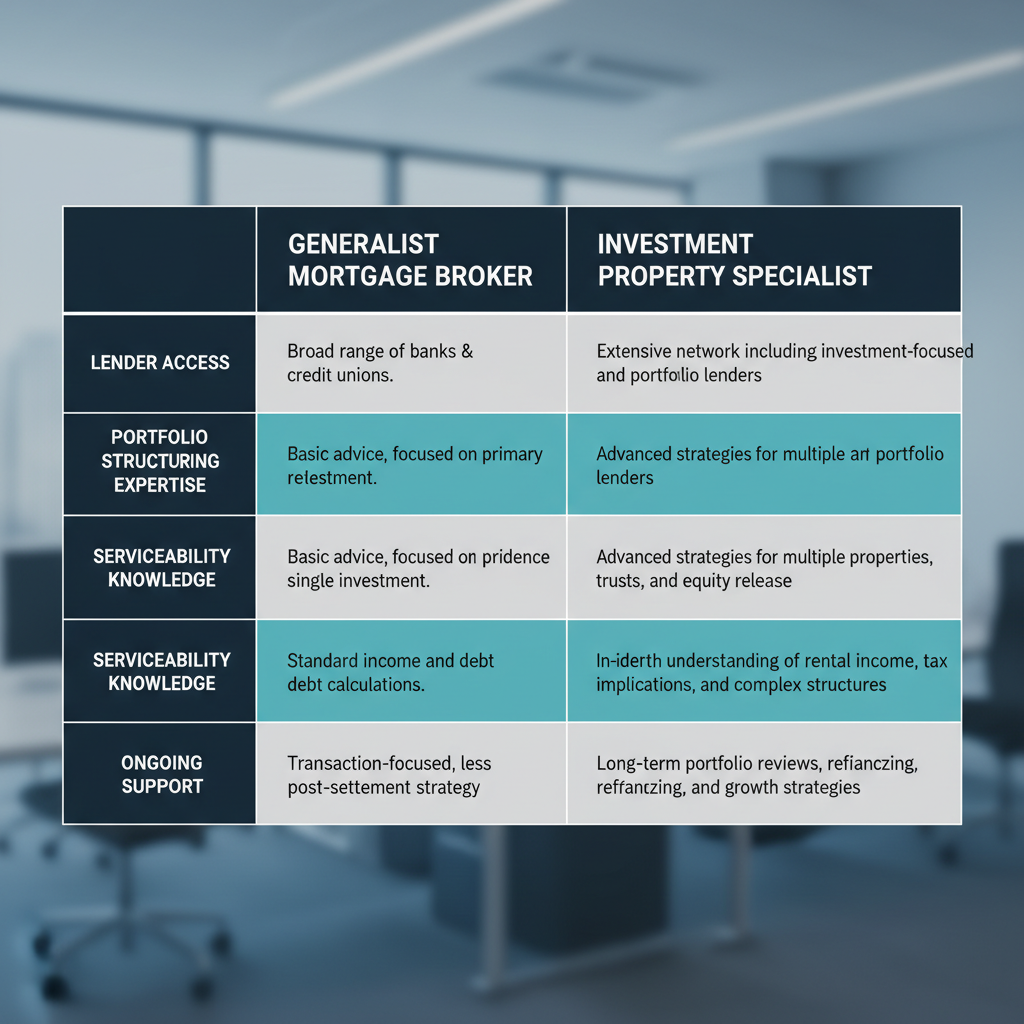
What Separates Generalist Brokers from Investment Specialists
A home loan broker helps first-time buyers secure finance for a single property. An investment specialist architects a lending structure that supports acquisitions three, five, and ten years into the future.
The distinction isn't just experience. It's about understanding which lenders offer the most investor-friendly serviceability policies, how to split loans across entities, when to use interest-only periods strategically, and how to access off-market lending products designed for portfolio growth.
Most brokers who helped you buy your family home won't have relationships with the 8-12 lenders in Australia that actively support multi-property investors. They won't know which banks shade rental income at 80% versus 75%, or which lenders allow you to refinance Property A to release equity for Property B without re-assessing your entire portfolio.
The Cost of Using the Wrong Broker
Let's be specific about the financial impact. Say you borrow $800,000 through a broker who structures your loan poorly. You pay 0.5% extra in interest annually because you're locked into a single lender.
That's an additional $53,000 in after-tax interest over 20 years. But here's the bigger problem: if that structure limits your borrowing capacity, you might miss out on acquiring a second property that would have generated $450,000 in equity growth over the same period. That's an 8.5x return difference, according to loan structuring analysis.
The wrong broker doesn't just cost you money. They cost you opportunity.
Key Selection Criteria for Investment Property Mortgage Brokers
Specialization in Investment Lending
Does the broker dedicate 60% or more of their practice to investment property finance? Ask directly. A broker who primarily serves first-home buyers won't have the depth of knowledge required for portfolio structuring.
You want someone who works daily with clients scaling from one property to five, who understands construction loans for renovations, and who can navigate SMSF property loans if that's part of your strategy. Specialization matters because lender policies for investors change frequently, and a generalist won't track those shifts.
Lender Panel Depth and Relationships
How many lenders does the broker have access to? The answer should be 30-40 minimum, with at least 8-10 of those being specialist lenders who actively court investor business.
More importantly, does the broker maintain direct relationships with credit assessors at those lenders? When your application sits in a gray area (perhaps you're self-employed, or you want to buy interstate), those relationships determine whether you get approved or declined. According to mortgage advisory research, "specialist brokers maintain relationships with lenders who actively seek investment property business."
Proven Track Record with Portfolio Investors
Ask for case studies. How many clients has the broker helped scale from one investment property to three or more? Can they provide examples of complex structuring scenarios they've navigated, such as cross-collateralization releases, equity extraction, or refinancing to improve serviceability?
If the broker can't articulate specific strategies they've employed to maximize borrowing capacity for previous clients, keep searching.
Understanding of Tax and Entity Structures
While a mortgage broker isn't a tax advisor, they should understand how different ownership structures (individual, joint, trust, company, SMSF) impact lending. They should ask whether you've spoken to an accountant about the optimal structure before recommending loan products.
A broker who never mentions entity structure or who dismisses it as irrelevant isn't thinking long-term about your wealth strategy. Buyers Agency Australia integrates finance, tax, and property strategy discussions from day one, ensuring every decision supports your 10-year plan.
Loan Structuring Strategies That Maximize Borrowing Capacity
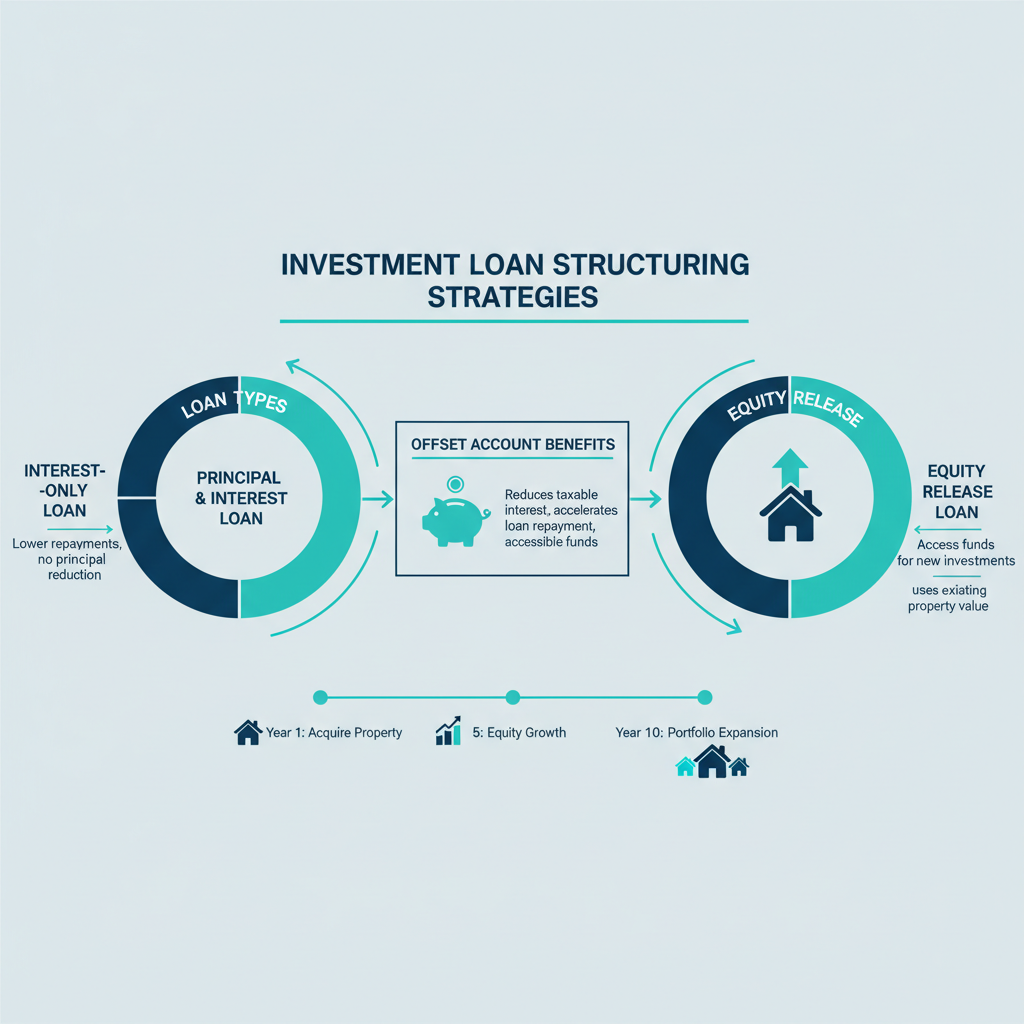
Why Structure Matters More Than Rate
You can't build a multi-property portfolio by accident. Every loan you take out either enables or restricts your next acquisition. The way you structure debt today determines how much equity you can access tomorrow.
Here's a concrete example. Say you buy an investment property for $600,000 with a 20% deposit ($120,000). You borrow $480,000. If you structure that as a single principal-and-interest loan, your repayments will be higher, which reduces your debt serviceability for future loans.
Instead, an experienced broker might split the loan: $400,000 interest-only for the first five years (maximizing cash flow) and $80,000 principal-and-interest (building a repayment buffer). This structure keeps your monthly outgoings lower, preserving borrowing capacity for the next property.
That's basic. Now scale it across three properties, add equity release loans, and factor in rental income shading across different lenders. This is where investment specialists earn their value.
Interest-Only vs Principal-and-Interest Repayments
Interest-only loans reduce monthly repayments by 30-40%, which directly increases your borrowing capacity for subsequent purchases. According to portfolio lending analysis, "by only paying the interest component, your monthly repayments are lower. This maximises your cash flow."
But interest-only periods are temporary, typically 1-5 years. When that period ends, repayments jump significantly as you start paying down principal. A strategic broker plans for this, either by refinancing before the interest-only period expires or by ensuring your portfolio's rental income can absorb higher repayments.
Offset Accounts and Redraw Facilities
An offset account linked to your investment loan reduces the interest charged without technically paying down the principal. This preserves tax deductibility (since the loan balance remains unchanged) while lowering your effective interest rate.
A redraw facility lets you access extra repayments you've made on a loan. However, using redraw for personal expenses can muddy the tax treatment of your loan, which is why most investment-focused brokers recommend offset accounts instead.
These aren't minor details. They're the difference between a loan that supports your strategy and one that creates tax headaches down the line.
Splitting Loans Across Lenders
Here's a strategy most brokers won't mention: deliberately spreading your loans across multiple lenders. Why? Because lenders assess serviceability differently. Some cap investment loan portfolios at three properties. Others have no hard limit but tighten serviceability at higher debt levels.
By splitting loans across lenders, you avoid hitting any single lender's internal risk threshold. You also create flexibility to refinance individual properties without triggering a full portfolio review. According to investment loan structuring research, "structuring loans strategically (e.g. spreading across different lenders) can also help manage risk and borrowing capacity."
This requires a broker who thinks three moves ahead and who maintains active relationships with 8-10 lenders simultaneously.
How Borrowing Capacity Calculations Work for Investors
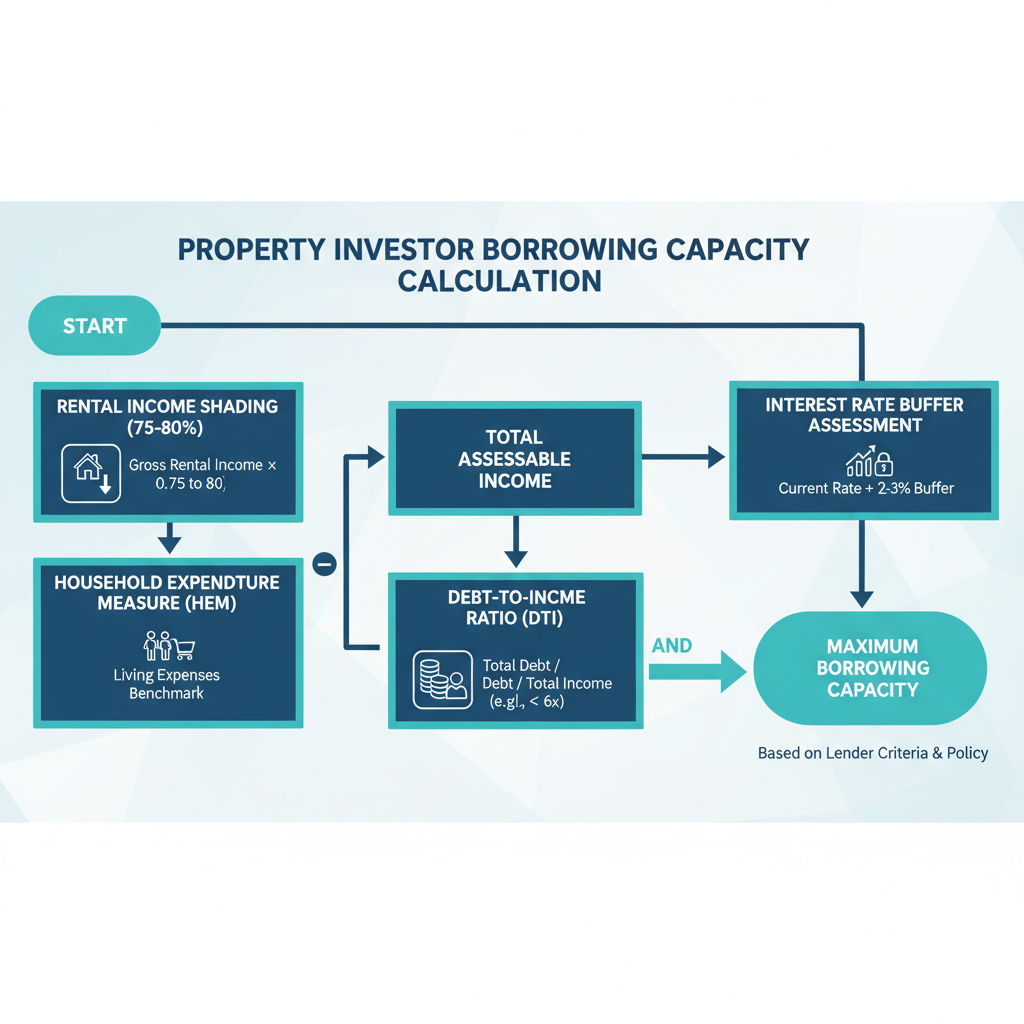
Rental Income Shading
Lenders don't count 100% of your expected rental income when calculating serviceability. Most apply a "shading" factor of 75-80%, meaning if your property generates $30,000 annual rent, the lender only credits you with $22,500-$24,000.
Some specialist lenders shade at 85%, which can increase your borrowing power by $50,000-$100,000. An investment-focused broker knows which lenders offer the best shading and structures your applications accordingly. Mortgage advisory services note that "some specialist lenders use higher percentages, which can increase your borrowing power significantly."
The Household Expenditure Measure (HEM)
Australian lenders use the HEM to estimate your living expenses based on household size and location. If your actual expenses are lower than the HEM, lenders still use the HEM figure, which can reduce borrowing capacity.
However, if your expenses exceed the HEM, lenders use your actual spending, which reduces capacity even further. This is why brokers advise cleaning up discretionary spending (subscriptions, dining out, personal loans) 3-6 months before applying for investment finance.
Interest Rate Buffers
Lenders don't assess your ability to repay at today's interest rate. They add a buffer of 2-3% to ensure you could still service the loan if rates rose. This "stress test" is a major factor in determining how much you can borrow.
Some lenders use a 2% buffer, others use 3%. A broker who knows which lenders apply the lowest buffer can increase your borrowing capacity by tens of thousands of dollars without changing any other variable.
Debt-to-Income Ratios
Australian lenders are increasingly adopting debt-to-income (DTI) ratios, capping total borrowing at 6-8 times your gross annual income. For high-income professionals (doctors, IT executives, business owners), this can be a hard ceiling that limits portfolio growth.
An experienced broker structures your applications to stay within DTI limits while maximizing property value, often by focusing on higher-yield, lower-price properties in the early stages of portfolio building.
Common Mistakes Investors Make When Choosing a Broker
Prioritizing Rate Over Structure
The biggest mistake is choosing a broker who leads with interest rate comparisons. Rate matters, but it's a secondary consideration for investors.
A broker who saves you 0.2% on your interest rate but structures your loan in a way that limits future borrowing has cost you far more than they saved. Ask prospective brokers how they approach loan structuring before you ask about rates.
Using the Same Broker Who Did Your Home Loan
Your home loan broker might be excellent at what they do. But if they don't specialize in investment lending, they're the wrong choice for your portfolio.
Investment loans require different expertise, different lender relationships, and different strategic thinking. Don't conflate competence in one domain with competence in another.
Not Asking About Portfolio Strategy
If a broker doesn't ask about your 5-year and 10-year property goals in the first meeting, they're not thinking strategically. Investment lending isn't transactional. It's a multi-year relationship where each loan builds on the previous one.
A portfolio-focused broker will ask how many properties you want to own, what your target yield and capital growth metrics are, and whether you're planning to hold or sell properties in the medium term. They'll structure loans that support that vision, not just the immediate purchase.
Failing to Review Loan Structure Annually
Your first investment loan structure might be optimal in Year 1. By Year 3, when property values have risen and rental income has increased, a refinance to release equity could be the difference between buying your next property or waiting another two years.
The best brokers schedule annual reviews, not to churn loans unnecessarily, but to ensure your structure remains aligned with your portfolio goals. Buyers Agency Australia recommends quarterly check-ins with your mortgage broker during active acquisition phases.
How Buyers Agency Australia Supports Investment Loan Success
Integrating Property Strategy and Finance
Buyers Agency Australia operates on a simple principle: property acquisition and finance strategy are inseparable. You can't select the right property without understanding your borrowing capacity, and you can't structure loans effectively without knowing your investment timeline.
That's why Buyers Agency Australia works with a network of investment-focused mortgage brokers who understand portfolio structuring. When you engage Buyers Agency Australia, your property search is informed by what you can borrow today and what you'll be able to borrow in 18-24 months after the first property appreciates.
This integrated approach prevents the most common investor mistake: buying a property you can afford now but that limits your ability to scale later.
Fixed-Fee Transparency in a Commission-Driven Industry
Most mortgage brokers earn commissions from lenders, which creates an inherent conflict of interest. While reputable brokers disclose this and act in your best interest, the commission structure can influence which lenders they recommend.
Buyers Agency Australia uses a transparent fixed-fee model for property acquisition services. When they refer you to a mortgage broker, they're recommending someone based on expertise and client outcomes, not referral fees. This matters because you want advice that's genuinely in your best interest, not advice that maximizes someone else's commission.
Case Example: Scaling from One Property to Three
Let's look at a recent client scenario. A Sydney-based IT professional earning $180,000 annually bought his first investment property in Brisbane for $550,000. His home loan broker set up a standard principal-and-interest loan at 6.2% variable.
Two years later, he wanted to buy a second property. His borrowing capacity had increased slightly due to rental income, but not enough to purchase another $550,000 property. He was stuck.
Buyers Agency Australia reviewed his structure and immediately saw the problem. The loan was structured for repayment, not portfolio growth. They connected him with an investment specialist broker who refinanced the existing loan into an interest-only structure, released $80,000 in equity, and spread the debt across two lenders to preserve future borrowing capacity.
Within 12 months, he'd acquired two additional properties, both in high-yield markets identified by Buyers Agency Australia's research team. His portfolio now generates $72,000 in annual rental income, and his path to five properties is clear.
That's the difference between a transactional broker and a strategic one.
Access to Off-Market Deals That Require Fast Finance
Many of the best investment properties never hit the open market. Buyers Agency Australia sources off-market deals through direct relationships with selling agents, but these opportunities often require fast finance approval.
If your mortgage broker takes three weeks to get pre-approval, you'll miss out. The brokers Buyers Agency Australia works with can turn around pre-approvals in 48-72 hours when needed, giving you a competitive advantage in off-market negotiations.
Speed matters, but speed without accuracy is worthless. These brokers combine fast turnaround with meticulous structuring, ensuring you're both competitive and strategically positioned. If you're serious about off-market acquisitions, book a free strategy session to discuss how Buyers Agency Australia coordinates finance and property search.
Questions to Ask Before Hiring a Mortgage Broker
What Percentage of Your Clients Are Property Investors?
If the answer is less than 50%, you're talking to a generalist. That's not necessarily bad for a first investment property, but it's insufficient if you're planning to scale.
You want a broker who lives and breathes investment lending, who tracks lender policy changes weekly, and who has structured loans for clients with 5+ property portfolios.
How Many Lenders Do You Work With, and Which Ones Favor Investors?
A broker with access to 40+ lenders but who only actively uses 5-6 isn't much better than a bank employee. You want to know which lenders the broker places most investor loans with and why.
Ask for specifics: Which lenders offer the best rental income shading? Which ones have the lowest interest rate buffers? Which ones will still lend to you at property five or six?
Can You Provide Examples of Complex Structuring You've Done?
This is where you separate experienced brokers from novices. Ask them to walk you through a recent case where they had to get creative to maximize borrowing capacity.
Maybe they refinanced multiple properties to consolidate debt and release equity. Maybe they split a loan across three lenders to avoid hitting a single lender's portfolio cap. Maybe they structured a loan in a family trust to protect assets while maintaining borrowing power.
If they can't articulate specific examples, they don't have the experience you need.
What's Your Process for Annual Reviews?
A broker who only talks to you when you're buying a new property isn't managing your portfolio proactively. The best brokers schedule annual reviews to assess whether your current structure is still optimal.
Property values change. Rental income changes. Lender policies change. Your structure needs to adapt. Ask how the broker approaches ongoing portfolio management, not just one-off loan approvals.
How Do You Get Paid, and Does That Influence Your Recommendations?
Most brokers earn commissions from lenders, typically 0.6-0.7% of the loan value upfront plus ongoing trail commissions. There's nothing wrong with this model as long as it's disclosed.
But you should ask: Does the commission structure vary across lenders? Do you receive higher commissions from certain lenders? How do you manage that conflict of interest?
A trustworthy broker will answer these questions directly and explain how they prioritize your interests even when commission structures vary.
The Role of the Broker in Your Investor Team
Coordinating with Accountants and Tax Advisors
Your mortgage broker should work collaboratively with your accountant, especially when entity structures are involved. If you're buying in a trust or through a company, the broker needs to understand the tax implications and ensure the loan structure supports your accountant's strategy.
This coordination isn't optional. It's essential. A broker who dismisses your accountant's input or who doesn't understand basic trust and company structures will create problems down the line.
Working with Buyers Agents
When you're working with both a buyers agent and a mortgage broker, they need to communicate. The buyers agent should understand your borrowing capacity before recommending properties. The broker should understand the buyers agent's strategy before structuring loans.
Buyers Agency Australia has cultivated relationships with investment-focused brokers precisely because this coordination dramatically improves client outcomes. When your buyers agent and broker are aligned, you move faster, avoid mis-matched purchases, and structure loans that support long-term growth. Explore how this integrated approach works by attending a FastTrack Event.
Ongoing Portfolio Monitoring
Your broker isn't just a service provider during acquisition. They're a long-term partner who monitors your portfolio, tracks lender policy changes, and proactively recommends refinancing when it makes strategic sense.
This ongoing relationship is how sophisticated investors stay ahead of the market. When a lender changes serviceability criteria, your broker knows immediately and assesses whether it impacts your portfolio. When interest rates shift, your broker models whether refinancing saves money or frees up borrowing capacity.
Frequently Asked Questions
What's the typical cost of using a mortgage broker for investment property?
Most mortgage brokers don't charge clients directly. They're paid commissions by lenders, typically 0.6-0.7% upfront. Some brokers charge fees for complex structuring, usually $2,000-$5,000 for multi-property portfolios.
How long does investment loan approval take?
Pre-approval typically takes 3-7 days with a specialist broker. Full approval after you've found a property takes 2-4 weeks, depending on lender workload and application complexity.
Can I use different brokers for different properties?
Yes, but it's not recommended. A single broker who manages your entire portfolio has a complete view of your finances and can structure loans cohesively. Multiple brokers create fragmentation and increase the risk of poor structuring.
How often should I review my investment loan structure?
Annually at minimum. More frequently if you're actively acquiring properties, if interest rates change significantly, or if lender policies shift. Your broker should initiate these reviews proactively.
What's the difference between pre-approval and formal approval?
Pre-approval is a conditional indication that you can borrow a certain amount, based on preliminary assessment. Formal approval comes after you've found a property and the lender has verified all details and valued the property. Pre-approval is essential before you start searching.
 General
Learn the critical criteria for selecting a mortgage broker who understands investment loan structuring, maximizing borrowing capacity, and...
Using your super to buy property in Australia requires setting up a Self-Managed Super Fund and following strict compliance rules. You can purchase residential or commercial investment property through a Limited Recourse Borrowing Arrangement, provided it meets the sole purpose test.
More Australian investors are exploring SMSF property investment in 2026 as traditional lending tightens and super balances grow. With approximately $83 billion invested in residential property across SMSFs and LRBA borrowing now reaching 90% LVR, the strategy is gaining momentum.
The attraction is clear. You gain direct control over a tangible asset inside a tax-advantaged structure. But SMSF property isn't a shortcut—it's a structured retirement strategy demanding time, expertise and capital. Done right, it can deliver long-term wealth. Done wrong, it triggers penalties that can cost you nearly half your retirement savings.
This guide walks you through the complete SMSF property process in 2026, from setup to compliance, so you can decide if it's the right path for your financial future.
Why SMSF Property Investment Is Growing in 2026
SMSF property investment has surged because it combines control, tax efficiency and long-term capital growth.
According to the ATO's 2022–23 statistical overview, total SMSF investment in property reached $200.5 billion, up from $196.1 billion the prior year. Residential property alone accounts for $83.1 billion.
The numbers reflect investor confidence. Property is tangible, understood, and historically reliable. Over the decade to September 2025, Australia's median property price rose 71.1%.
But 2026 brings new dynamics. Interest rates remain elevated, with the big four banks ruling out rate cuts. Lenders are offering more competitive SMSF loan products, with some packages starting from 6.19% p.a.
For investors who've hit personal borrowing limits, an SMSF offers a separate capacity pathway. You're not just buying property—you're redirecting retirement capital into an asset you control.
That control comes with responsibility. The ATO has ramped up compliance scrutiny, particularly around Limited Recourse Borrowing Arrangements and related-party transactions.
Buyers Agency Australia works with clients nationally to identify investment-grade properties that fit SMSF compliance requirements and long-term wealth strategies.
What Is a Self-Managed Super Fund
A Self-Managed Super Fund is a private superannuation structure where you act as both trustee and member.
Unlike retail or industry funds, you make all investment decisions. You control where the money goes—whether that's shares, term deposits, or property.
That control is the main appeal. But it also means you're responsible for compliance, administration, audits and tax reporting.
SMSFs can have up to six members. Most are set up with a corporate trustee structure, where a company acts as trustee and all members are directors. This reduces costs if membership changes and simplifies compliance.
Key SMSF Obligations
You must maintain the fund for the sole purpose of providing retirement benefits. Every decision, transaction and investment must align with that goal.
You're required to:
- Prepare and implement a documented investment strategy
- Keep detailed records of all transactions
- Lodge an annual tax return and supervisory levy
- Appoint a registered SMSF auditor annually
- Ensure all dealings are conducted at arm's length
The ATO outlines your obligations clearly. Breaches can result in penalties, disqualification, or the fund being deemed non-compliant and taxed at 45%.
SMSFs are not suitable for everyone. You need time, financial literacy, and a balance typically above $200,000 to justify the setup and ongoing costs.
For property investors, SMSFs offer a vehicle to acquire real estate using superannuation capital—but only if you follow the rules strictly.
Step by Step SMSF Property Investment Process
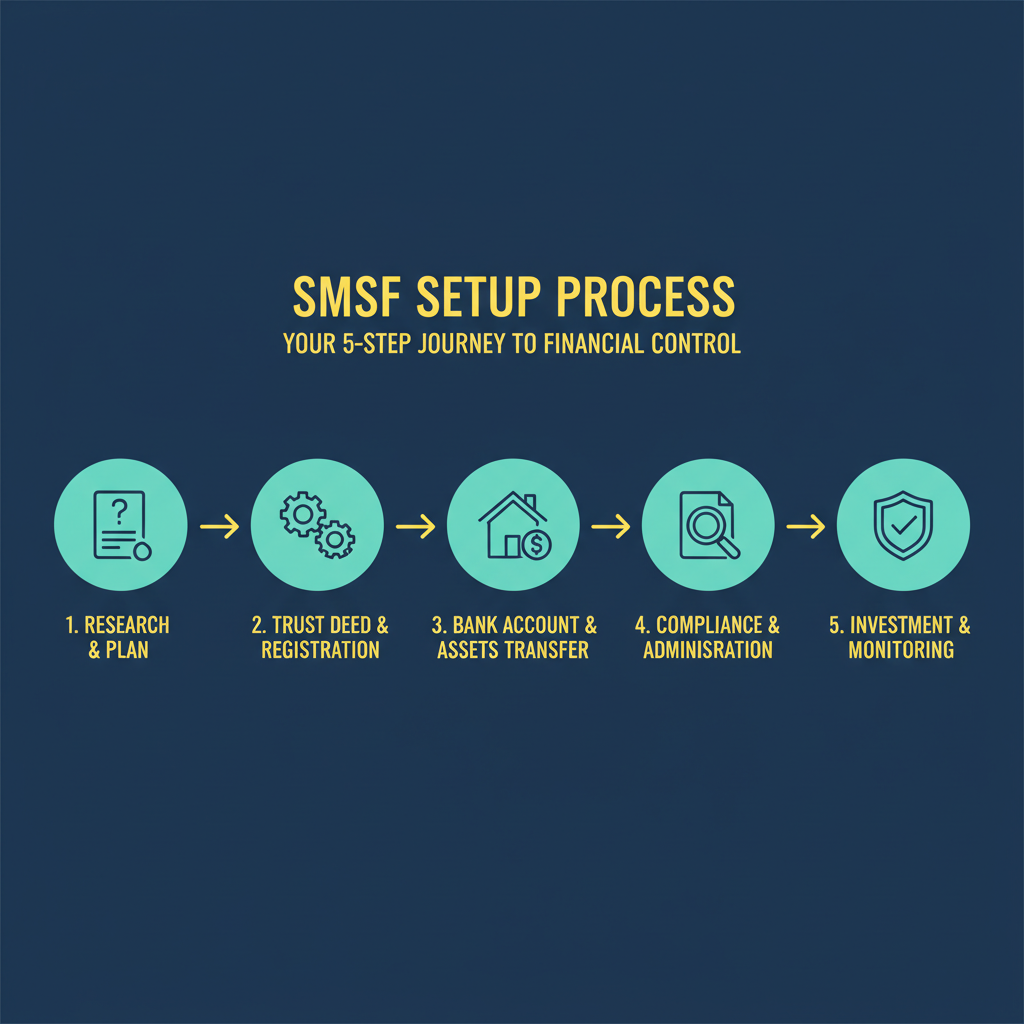
Buying property through your super requires a specific sequence. Miss a step or breach a rule, and you risk compliance penalties.
Here's the process broken down into clear, actionable stages.
Step 1: Set Up Your SMSF
You start by establishing the legal structure.
This involves registering a corporate trustee company with ASIC, creating a trust deed, obtaining an ABN and TFN, and opening a dedicated bank account.
Setup costs range from $1,000 to $3,000 depending on your chosen provider and structure. A corporate trustee adds around $600 to $800 but simplifies future changes.
You'll also need to prepare an investment strategy that documents your objectives, risk tolerance, diversification approach, and how property fits your retirement goals.
Many advisors recommend engaging an SMSF specialist accountant from day one. They'll ensure your deed allows borrowing and property investment, which not all template deeds do.
Your investment strategy must be reviewed annually and updated when circumstances change.
Step 2: Understand Limited Recourse Borrowing Arrangements
SMSFs can't borrow freely. You must use a Limited Recourse Borrowing Arrangement.
Under an LRBA, the property is held in a separate trust (called a bare trust or holding trust) until the loan is repaid. The SMSF holds a beneficial interest in the property and makes loan repayments.
If the SMSF defaults, the lender's recourse is limited to the property. They can't pursue other SMSF assets.
Key LRBA rules include:
- You can only borrow to purchase a single acquirable asset
- The asset cannot be altered in a way that changes its character while the loan is in place
- All costs must be paid from the SMSF bank account
- The loan must be on commercial terms if from a related party
LRBA interest rates are typically 2–3% higher than standard investment loans due to the limited recourse nature.
For 2025–26, the ATO safe harbour rates for related-party LRBAs are 8.95% for real property and 10.95% for listed securities.
Most lenders cap LVRs at 70–80% for SMSF residential property. If the loan exceeds 80%, trustees often provide a personal guarantee—but that guarantee must not give the lender recourse to SMSF assets.
Step 3: Calculate SMSF Setup and Ongoing Costs
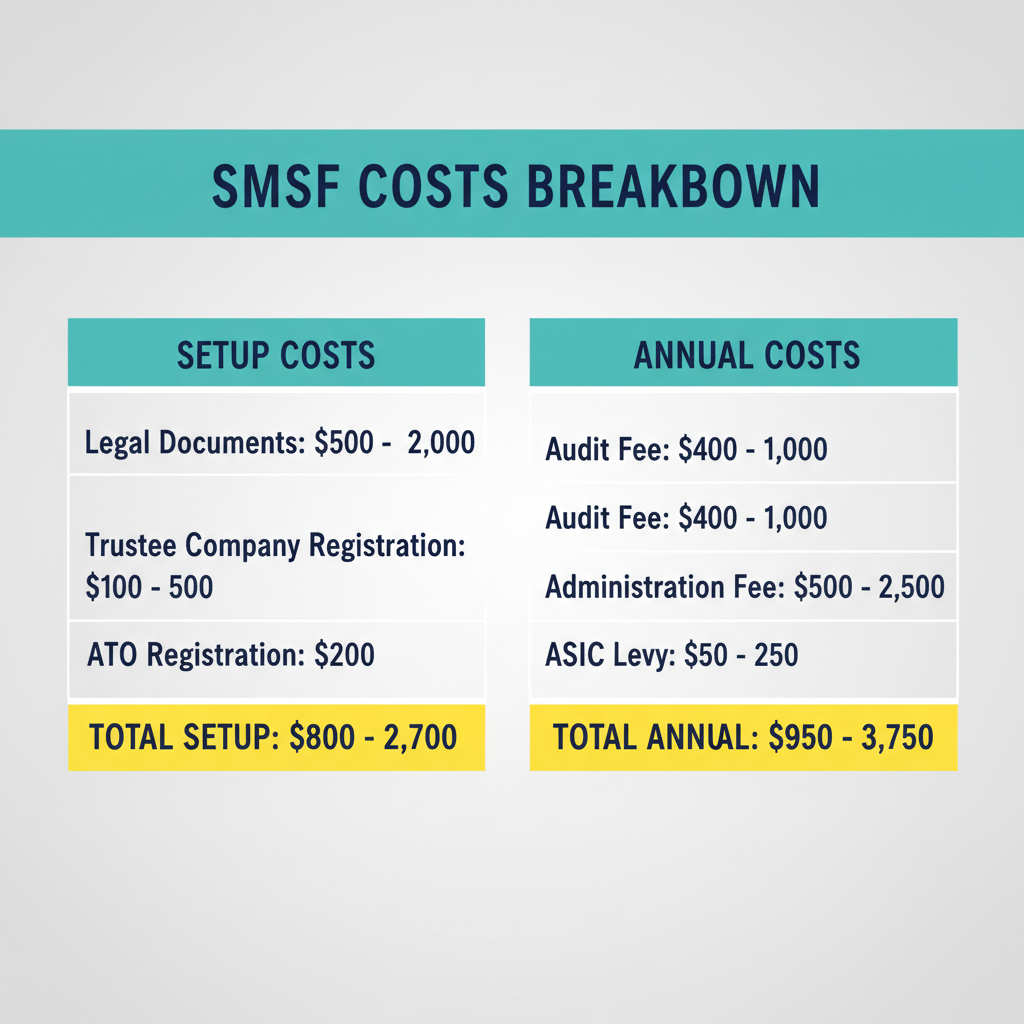
SMSF property investment isn't cheap. You need to budget for both upfront and recurring expenses.
Setup Costs:
- Trust deed and corporate trustee registration: $500–$1,000
- LRBA bare trust structure: $800–$1,500
- Investment strategy and initial advice: $500–$1,200
- Bank account and Electronic Service Address: $280
Annual Costs:
- Accounting and administration: $2,000–$4,500
- Independent audit: $550–$800
- ATO supervisory levy: $259
- ASIC annual review fee: $65
- Actuarial certificate (if in pension phase): $300–$500
Property-Specific Costs:
- Stamp duty, conveyancing, building and pest inspections
- Property management fees: 5–8% of rental income
- Insurance: building, landlord liability, public liability
- Council rates, strata fees, maintenance
According to Superguide, median annual costs for funds between $200,000 and $500,000 sit around $5,674, or 1.14% on a $500,000 balance.
The consensus is that you need at least $200,000 in super to make an SMSF cost-effective, or $250,000 if purchasing property.
Step 4: Choose the Right Property for Your SMSF
Not every property suits an SMSF.
You're investing for retirement, not lifestyle. That means prioritising long-term capital growth, rental reliability, and low maintenance.
Key selection criteria:
- Strong rental demand and low vacancy rates
- Markets with population growth and infrastructure investment
- Properties that don't require constant repairs or tenant turnover
- Purchase price that allows your SMSF to meet loan repayments, expenses and compliance costs
Brisbane, Perth and Adelaide are expected to outperform Sydney and Melbourne in 2026, driven by stronger local economies and tighter supply.
You must also ensure the property meets compliance requirements:
- It cannot be purchased from a related party (unless it's business real property)
- It cannot be lived in by you, members, or related parties
- It cannot be rented to you, members, or related parties
- All transactions must be at market value and arm's length
Buyers Agency Australia helps investors identify properties that meet SMSF compliance standards while delivering strong investment fundamentals.
Work with a buyer's agent who understands SMSF rules. A misstep can be costly—and irreversible.
Step 5: Maintain Strict Compliance and Record Keeping
Once you've purchased the property, compliance doesn't stop.
You must maintain meticulous records of every transaction, lease agreement, repair invoice, and loan repayment.
Key compliance obligations:
- All expenses must be paid from the SMSF bank account
- Rental income must be deposited directly into the SMSF account
- Lease agreements must be documented and at market rates
- Repairs are allowed, but improvements funded by the loan are restricted
- You must not provide any present-day benefit to members or related parties
The sole purpose test is the overarching principle. Your SMSF must be maintained solely to provide retirement benefits.
Common breaches include:
- Renting to a family member at below market rate
- Using the property for personal holidays
- Paying expenses from your personal account
- Making improvements without proper documentation
Your annual audit will review compliance. The auditor reports contraventions to the ATO, which can impose penalties ranging from administrative sanctions to disqualification.
For non-compliant funds, the tax rate jumps to 45% on the entire balance—a catastrophic outcome.
Key SMSF Property Rules You Must Follow
SMSF property investment is governed by strict rules. Understanding them isn't optional—it's the foundation of compliant investing.
The Sole Purpose Test
Every SMSF must be maintained for the sole purpose of providing retirement benefits to members.
This is not a principal purpose or dominant purpose—it's exclusive.
According to SMSFR 2008/2, the test requires a strict standard of compliance. Any benefit that is not incidental, remote or insignificant can trigger a breach.
When you buy property in your SMSF, its primary objective must be investment returns—rental income, capital growth, or both. You cannot live in it, use it as a holiday home, or let friends stay rent-free.
Arm's Length Transactions
All dealings must be conducted on a commercial basis.
If you rent business real property to your own company, the lease must be at market rent. If you borrow from a related party, the interest rate must align with the ATO's safe harbour benchmarks.
You cannot:
- Purchase residential property from yourself or related parties
- Rent residential property to yourself, family members or related parties
- Provide services to the SMSF at below-market rates
Commercial property offers more flexibility. You can lease business real property to a related party, but only if it's used wholly and exclusively for business and leased at market rates.
No Personal Use Ever
This rule is absolute.
You cannot stay in the property, even if you pay market rent. You cannot let your children live there while they study. You cannot use it for weekends or holidays.
The ATO reviews SMSF property transactions closely. In the case of Aussiegolfa Pty Ltd v Commissioner of Taxation (2018), the court examined whether accommodation provided to a member's daughter breached the sole purpose test. While the court found no breach in that specific case, the scrutiny was intense.
The takeaway is clear: avoid any arrangement that could be perceived as providing a present-day benefit.
Property Cannot Be Altered Under an LRBA
While the loan is in place, you cannot make changes that alter the character of the property.
Repairs and maintenance are allowed. Painting, fixing a leaking roof, or replacing a hot water system are fine—provided funds come from the SMSF, not the loan.
But you cannot:
- Build on vacant land
- Subdivide the property
- Add a granny flat or second dwelling
- Convert residential to commercial use
Once the loan is repaid and legal ownership transfers to the SMSF trustee, you regain flexibility—but major changes still require careful compliance review.
Costs and Fees for SMSF Property Investment
SMSF property investment involves multiple cost layers. Understanding them upfront helps you budget accurately and avoid cash flow stress.
Establishment Costs
Setting up an SMSF with property capability typically costs between $1,500 and $4,850.
This includes the trust deed, corporate trustee registration, LRBA bare trust structure, investment strategy, and initial accounting setup.
Providers like Superannuation Warehouse offer packages from $1,400, while full-service advisors may charge $3,000+.
You also need to account for stamp duty, legal fees, and property acquisition costs—these are paid by the SMSF, not you personally.
Annual Compliance and Administration
Ongoing SMSF costs are unavoidable.
Typical annual fees include:
- SMSF accounting and administration: $1,800–$4,500
- Independent audit: $550–$800
- ATO supervisory levy: $259
- ASIC annual review fee: $65
If your SMSF holds both accumulation and pension accounts, you may need an actuarial certificate to determine exempt income, adding $300–$500.
Property-specific expenses include:
- Property management: 5–8% of rental income
- Building and landlord insurance: $800–$1,500 annually
- Council rates, strata fees, repairs and maintenance
All expenses must be paid from the SMSF bank account. Commingling personal and SMSF funds is a red flag for auditors.
Loan Costs
SMSF loans carry higher interest rates due to their limited recourse nature.
Expect to pay 2–3% above standard investment loan rates. In 2026, SMSF refinance rates start from around 6.19% p.a., depending on LVR and lender.
Lenders typically cap LVRs at 70–80%. Some now offer up to 90% LVR, but higher ratios attract stricter serviceability tests and often require personal guarantees.
Most SMSF loans are interest-only to preserve cash flow, but principal and interest options are available.
Is It Cost-Effective?
The consensus is clear: SMSFs become cost-effective once balances exceed $200,000 to $250,000.
Below that threshold, retail super fees (typically 0.5–1% of balance) are often cheaper than the flat costs of running an SMSF.
For a $500,000 SMSF holding property, annual costs might sit around $5,000–$7,000. That's roughly 1–1.4% of the balance—comparable to retail super.
But the real comparison is control and asset class. If you want direct property exposure with tax efficiency, an SMSF may be the only viable path.
Pros and Cons of SMSF Property Investment
SMSF property investment offers significant benefits, but it's not a shortcut to wealth. Understanding both sides helps you decide if it suits your circumstances.
Advantages
Tax Efficiency
Rental income is taxed at 15% in accumulation phase. Capital gains on assets held more than 12 months are taxed at 10%.
If the property is held in pension phase and within your transfer balance cap, rental income is tax-free and capital gains are exempt.
Control and Flexibility
You choose the property, manage the investment strategy, and make all decisions.
You're not reliant on fund managers or limited to listed securities.
Long-Term Wealth Building
Property historically delivers reliable capital growth and income. Over the decade to September 2025, Australian property rose 71.1%.
For investors with long time horizons, property can significantly enhance retirement outcomes.
Separate Borrowing Capacity
If you've reached personal lending limits, an SMSF provides a separate capacity pathway.
You can continue building your property portfolio using super capital.
Disadvantages
Complexity and Compliance Risk
SMSFs demand time, expertise, and meticulous record-keeping.
Breaches can result in penalties or the fund being deemed non-compliant and taxed at 45%.
Liquidity Risk
Property is illiquid. You can't quickly sell a portion if you need cash.
Pension accounts require minimum annual drawdowns, which can strain cash flow if the property isn't tenanted.
Concentration Risk
Many SMSFs hold just one property, creating overexposure to a single asset class.
If the property underperforms or requires significant repairs, your retirement savings suffer.
Higher Costs
SMSF costs are fixed and ongoing, regardless of performance.
For balances under $200,000, retail super is often cheaper.
No Personal Use
You can never live in the property or let family use it.
This restriction is permanent and non-negotiable.
Common SMSF Property Mistakes to Avoid
SMSF property investment is unforgiving of errors. These are the most common mistakes trustees make—and how to avoid them.
Buying the Wrong Property
Many investors chase capital growth without considering rental reliability or cash flow.
Your SMSF must meet loan repayments, expenses, and compliance costs from rental income and contributions. A property with weak rental demand or high vacancy creates cash flow stress.
Prioritise investment-grade properties in high-demand markets with strong infrastructure and population growth.
Breaching the Sole Purpose Test
Even minor breaches can have severe consequences.
Common mistakes include staying in the property during inspections, renting to family at mates' rates, or paying expenses from personal accounts.
The sole purpose test applies throughout the fund's entire life. Even after you retire, the property must remain an investment.
Poor Cash Flow Planning
Property generates income, but it also demands cash.
You need buffers to cover vacancies, repairs, insurance, and unexpected costs. Many trustees underestimate how quickly cash reserves deplete.
Ensure your SMSF has sufficient liquidity to meet obligations without forced asset sales.
Ignoring Diversification
Holding 80% or more of your SMSF in a single property is high-risk.
If the property underperforms or the market softens, your retirement savings suffer.
Consider diversifying across asset classes or geographic locations.
Not Engaging Professional Advisors
SMSF property investment requires specialist knowledge.
Engaging an SMSF accountant, financial advisor, and buyer's agent reduces compliance risk and improves investment outcomes.
Buyers Agency Australia specialises in identifying investment-grade properties that align with SMSF compliance requirements and long-term wealth strategies.
How Dragan Dimovski and Buyers Agency Australia Support SMSF Investors
SMSF property investment demands expertise across compliance, finance, and market selection.
Buyers Agency Australia, led by Dragan Dimovski, provides end-to-end support for SMSF investors nationally.
With over 20 years of experience and a personal portfolio exceeding $10 million, Dragan understands the intersection of property investment and superannuation strategy.
Buyers Agency Australia offers:
- Property sourcing that meets SMSF compliance requirements
- Market research identifying high-growth, high-yield opportunities
- Negotiation services to secure properties at fair value
- Portfolio modelling to ensure long-term wealth creation
The firm operates across Sydney, Melbourne, Brisbane, Perth, and Adelaide, with a fixed-fee, transparent pricing model.
Dragan hosts the 'Passive with Property' podcast, sharing insights on investment strategy, market trends, and wealth creation.
For SMSF investors, Buyers Agency Australia provides boots-on-the-ground expertise, removing emotion from the buying process and ensuring properties align with retirement objectives.
Book a free strategy session to explore if SMSF property investment fits your goals.
Real Example: SMSF Property Purchase Scenario
Let's walk through a realistic scenario to illustrate how SMSF property investment works in practice.
Meet Sarah and Tom
Sarah (52) and Tom (54) are high-income professionals with combined super balances of $450,000.
They've reached their personal borrowing capacity but want to continue building wealth through property.
After consulting with their SMSF accountant and financial advisor, they decide to set up an SMSF and purchase an investment property in Brisbane.
The Setup
- SMSF establishment cost: $2,200 (corporate trustee, LRBA structure, investment strategy)
- Property purchase price: $650,000
- SMSF deposit (20%): $130,000
- LRBA loan amount: $520,000 at 6.5% p.a. interest-only
- Stamp duty and acquisition costs: $25,000
Year One Financials
- Rental income: $32,500 ($625/week)
- Loan interest: $33,800
- Property management (7%): $2,275
- Insurance, rates, maintenance: $4,200
- SMSF compliance costs: $3,500
- Net cash flow: -$11,275
Sarah and Tom contribute $15,000 annually to cover the shortfall and build liquidity.
Tax Position
The SMSF reports a net rental loss of $11,275. No tax is payable.
Depreciation and capital allowances further reduce taxable income in future years.
Five-Year Outlook
Assuming 6% annual capital growth, the property is worth $870,000 after five years.
Equity gain: $220,000
Loan balance (interest-only): $520,000
Net equity: $350,000
Sarah and Tom's SMSF has grown from $450,000 to approximately $650,000 (including contributions and compounding), with a tangible asset they control.
They're positioned to transition to pension phase in 7–10 years, where rental income becomes tax-free.
When SMSF Property Investment Makes Sense and When It Doesn't
SMSF property investment is powerful—but it's not for everyone.
When It Makes Sense
You have a combined super balance of $200,000 or more
Below this threshold, setup and ongoing costs make SMSFs less cost-effective than retail funds.
You have at least 7–10 years until retirement
Property is a long-term asset. Short time horizons increase liquidity risk.
You're confident managing compliance obligations
You need financial literacy, time, and attention to detail. If you're not prepared to engage professional advisors, SMSFs aren't suitable.
You've hit personal borrowing limits
An SMSF provides separate borrowing capacity, allowing you to continue building your property portfolio.
You want direct property exposure
If property aligns with your investment strategy and risk tolerance, an SMSF offers the most tax-efficient vehicle.
When It Doesn't Make Sense
Your super balance is under $200,000
Costs outweigh benefits. Stick with retail super.
You're within 5 years of retirement
Liquidity risk is too high. You may need to access capital quickly to fund pension drawdowns.
You lack time or expertise
SMSFs demand ongoing attention. If you can't commit, the compliance risk is too great.
You want lifestyle property
If you're tempted to use the property personally, an SMSF is the wrong structure.
You prefer simplicity
SMSFs are complex. If you value convenience over control, retail super is a better fit.
Frequently Asked Questions About SMSF Property Investment
Can I live in a property owned by my SMSF?
No. Residential property owned by an SMSF cannot be lived in by members or related parties at any time.
What is the minimum super balance for SMSF property investment?
Most experts recommend at least $200,000 to $250,000 to justify setup and ongoing costs.
Can I borrow to buy property in my SMSF?
Yes, through a Limited Recourse Borrowing Arrangement. The property is held in a bare trust until the loan is repaid.
What happens if I breach SMSF property rules?
Breaches can result in penalties, disqualification, or the fund being deemed non-compliant and taxed at 45%.
Can I buy property from a family member?
No. Residential property cannot be purchased from related parties. Commercial property may be allowed if it qualifies as business real property.
 General
This guide shows you how to use your super to buy property through an SMSF in 2026. Learn...
Dual income properties are investment properties that generate two separate rental income streams from a single asset—typically through a duplex, granny flat, dual key layout, or co-living configuration. In 2026, they're delivering rental yields of 6% to 13% in high-demand Australian markets, offering investors stronger cash flow, lower vacancy risk, and faster mortgage paydown in a high interest rate environment.
If you're searching for a property strategy that actually pays for itself, dual income properties deserve your attention.
While most investors chase capital growth and accept years of negative cash flow, dual income setups flip the script. You're collecting two rents instead of one, which means better serviceability, faster equity buildup, and breathing room when interest rates stay elevated.
In 2026, Buyers Agency Australia is seeing more investors pivot toward dual income strategies as rental shortages intensify and vacancy rates sit below 1.5% nationally. The numbers are clear: properties with two income streams outperform single-dwelling investments on yield, and they attract a broader tenant pool, reducing the risk of extended vacancies.
What Is a Dual Income Property in Australia
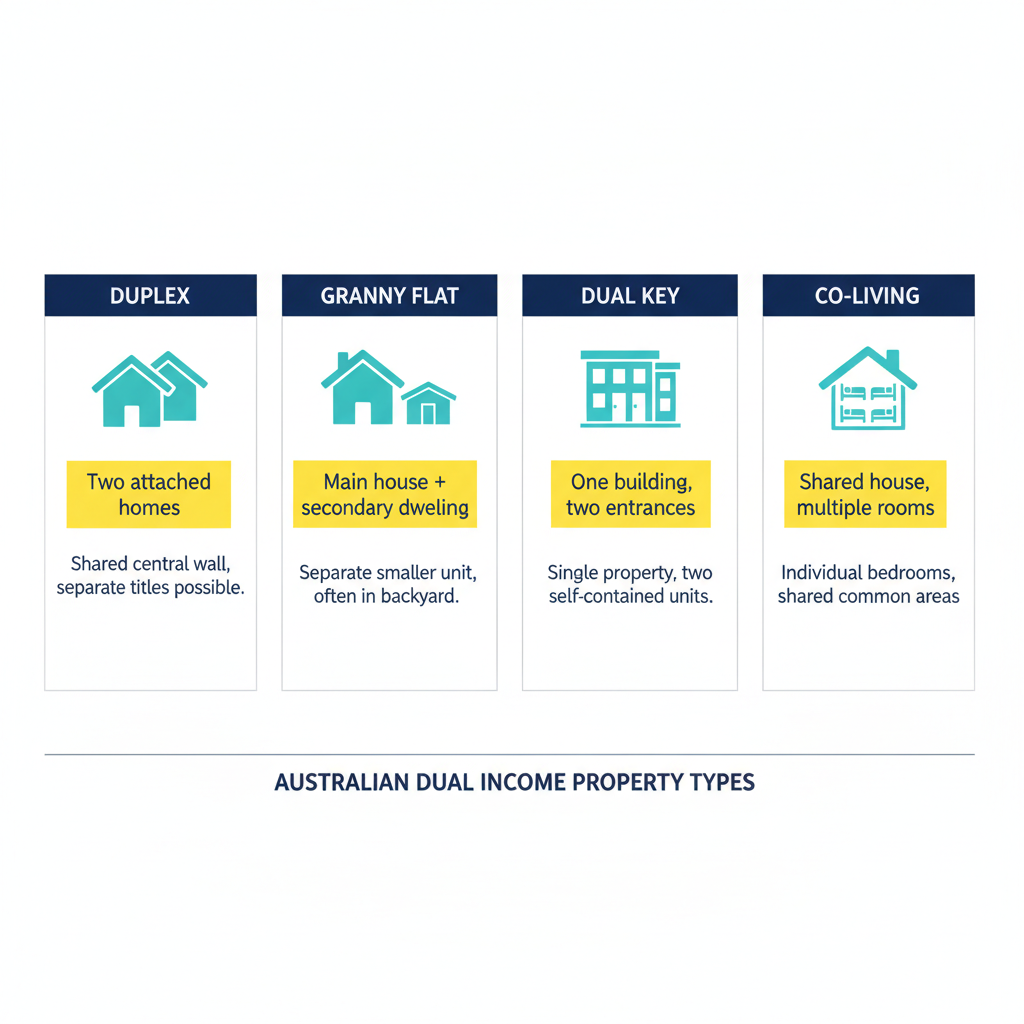
A dual income property contains two separate, rentable living spaces on one title or parcel of land.
Each space can be leased independently, generating two rental income streams for the owner. The property types that qualify include duplexes (two attached or detached dwellings), granny flats (secondary dwelling on the same lot as the main house), dual key apartments or houses (two self-contained units within one structure, each with separate entry), and co-living or boarding house setups (multiple private rooms with shared common areas).
The defining feature is always the ability to collect rent from two or more separate tenants or households simultaneously.
Duplex Properties
A duplex consists of two dwellings on one lot of land, either attached (sharing a common wall) or detached (side-by-side or front-to-back). Each dwelling functions as a standalone home with its own kitchen, bathroom, living area, and entrance.
In NSW, dual occupancy regulations were updated in 2025, standardising lot size requirements at 450 square metres with a 12-metre minimum frontage across most of Greater Sydney. This reform unlocked thousands of previously ineligible lots for duplex development.
Duplex properties can be subdivided into separate titles, allowing investors to sell one dwelling while retaining the other, or hold both for dual rental income. Typical rental returns for a duplex in Brisbane or Perth range from $400 to $600 per dwelling per week in 2026, depending on location and finish quality.
Granny Flats and Secondary Dwellings
A granny flat is a self-contained secondary dwelling built on the same lot as the main house. It includes a kitchen, bathroom, and sleeping area, making it fully independent.
Granny flats deliver some of the highest rental yields in the dual income category. Research shows granny flats generate gross rental yields of 8% to 14% on construction cost alone, compared to 3% to 5% for traditional standalone houses.
Typical construction costs range from $120,000 to $200,000, depending on size, finishes, and site preparation requirements. Weekly rents for granny flats in Sydney and Melbourne sit between $350 and $600 in 2026, with strong tenant demand and low vacancy periods.
State governments have introduced streamlined planning pathways to fast-track granny flat approvals. In NSW, secondary dwellings of up to 60 square metres can be built on most residential lots without council consent, subject to conditions. This makes granny flats one of the most accessible entry points for investors seeking dual income strategies.
Dual Key Properties
A dual key property is one dwelling designed to accommodate two separate households on a single legal title. Each area has its own entrance, allowing occupants to live or rent independently, though they may share facilities like laundry areas.
Dual key properties are often designed to look like standard houses from the street but feature a separate side door or internal partition. They differ from duplexes because they remain on one title and typically share more infrastructure.
Investors benefit from two rental incomes without the need to subdivide land or manage two separate properties. However, financing dual key properties can be more restrictive, with lenders requiring higher deposits and stricter serviceability assessments due to the reliance on sustained rental income.
Dual key properties appeal mainly to investors rather than owner-occupiers, which can limit resale demand. Rental yields remain strong in high-demand markets, but investors should model vacancy risk for both units when stress-testing cash flow projections.
Co-Living and Boarding House Models
Co-living properties feature multiple private bedrooms with shared common spaces like kitchens, living rooms, and bathrooms. Each bedroom is rented separately, generating multiple income streams from one property.
This model suits properties near universities, hospitals, and CBDs where single professionals, students, and shift workers seek affordable accommodation. Weekly rents per room range from $200 to $350 in metro markets, depending on location and amenities.
Co-living setups require more active tenant management due to higher turnover and shared-space dynamics. However, they offer income diversification—if one room sits vacant, the other rooms continue generating rent. Investors should check local council regulations, as some areas restrict boarding houses or require development approval for co-living configurations.
Why Dual Income Properties Are Growing in Popularity in 2026
Australian investors are shifting toward dual income properties as affordability pressures, rental shortages, and higher interest rates reshape the investment landscape.
Rental Shortage and Low Vacancy Rates
Australia's national vacancy rate sits around 1.2% in early 2026, signalling critically tight rental conditions. Rental demand continues to absorb available housing faster than new supply can be delivered, keeping vacancy rates below historical averages.
This supply-demand imbalance creates strong tenant competition, particularly for affordable housing options. Dual income properties appeal to a broader tenant pool—families, single professionals, students, shift workers—reducing the likelihood of extended vacancies.
Properties with granny flats or dual key layouts attract tenants seeking privacy and independence at a lower cost than renting a standalone home. Migration-driven demand is outpacing housing supply, with new arrivals typically entering the rental pool before considering long-term purchases. This sustained demand benefits investors holding multi-income properties in employment corridors and growth regions.
Higher Interest Rates and Cash Flow Pressure
Interest rates remain elevated in 2026, increasing mortgage repayments and putting pressure on negatively geared investment strategies. Investors relying on a single rental income stream often face shortfalls between rental income and total holding costs.
Dual income properties address this by generating two separate rent payments, improving cash flow and reducing reliance on personal income to cover mortgage repayments. A duplex generating $800 per week across two tenancies delivers $41,600 annually, compared to $20,800 from a single $400-per-week rental.
This additional income improves serviceability when refinancing or acquiring additional properties. Lenders assess rental income against loan repayments, and dual income properties demonstrate stronger cash flow resilience, which can unlock higher borrowing capacity for portfolio growth.
For investors holding properties through rate hikes, dual income configurations provide a buffer, reducing the risk of forced sales or financial stress.
Multigenerational Living Trends
The number of multigenerational households increased by 22% between 2016 and 2021, with around 335,000 Australian homes comprising three or more generations. Rising housing costs and rents are driving more families to consolidate under one roof.
Properties with granny flats, dual key layouts, or separate living areas cater to this demand. Adult children, elderly parents, and extended family members can live close while maintaining privacy and independence.
For investors, this trend broadens the tenant pool beyond traditional families. Properties offering two self-contained living areas appeal to multi-generational tenants willing to pay premium rents for flexible, private accommodation.
Buyers Agency Australia sees growing interest from clients seeking properties that support long-term tenancy stability. Multigenerational tenants tend to stay longer, reducing turnover costs and vacancy periods for landlords.
Government Planning Reforms
State governments have introduced planning reforms to fast-track dual income property development and address housing shortages. In NSW, the Low-Rise Housing Diversity Code allows dual occupancies, granny flats, and secondary dwellings to be approved as complying development, reducing approval timeframes from 60 to 90 days to around 20 business days.
Victoria introduced reforms in late 2023 allowing small secondary dwellings of up to 60 square metres to be built without a planning permit in most residential zones. These reforms have shifted granny flats from restricted, family-only accommodation into a category of income-producing assets.
Queensland, South Australia, and Western Australia have implemented similar reforms, removing barriers that previously limited dual income property development. These changes unlock thousands of backyards for secondary dwellings, creating fresh opportunities for investors to add rental income to existing holdings.
Buyers Agency Australia works with investors to identify properties in council areas with favourable dual income regulations, ensuring projects align with local planning requirements and maximise approval speed.
Benefits of Dual Income Properties for Investors
Dual income properties deliver measurable advantages over single-dwelling investments, particularly in 2026's high-cost, low-vacancy market.
Higher Rental Yield
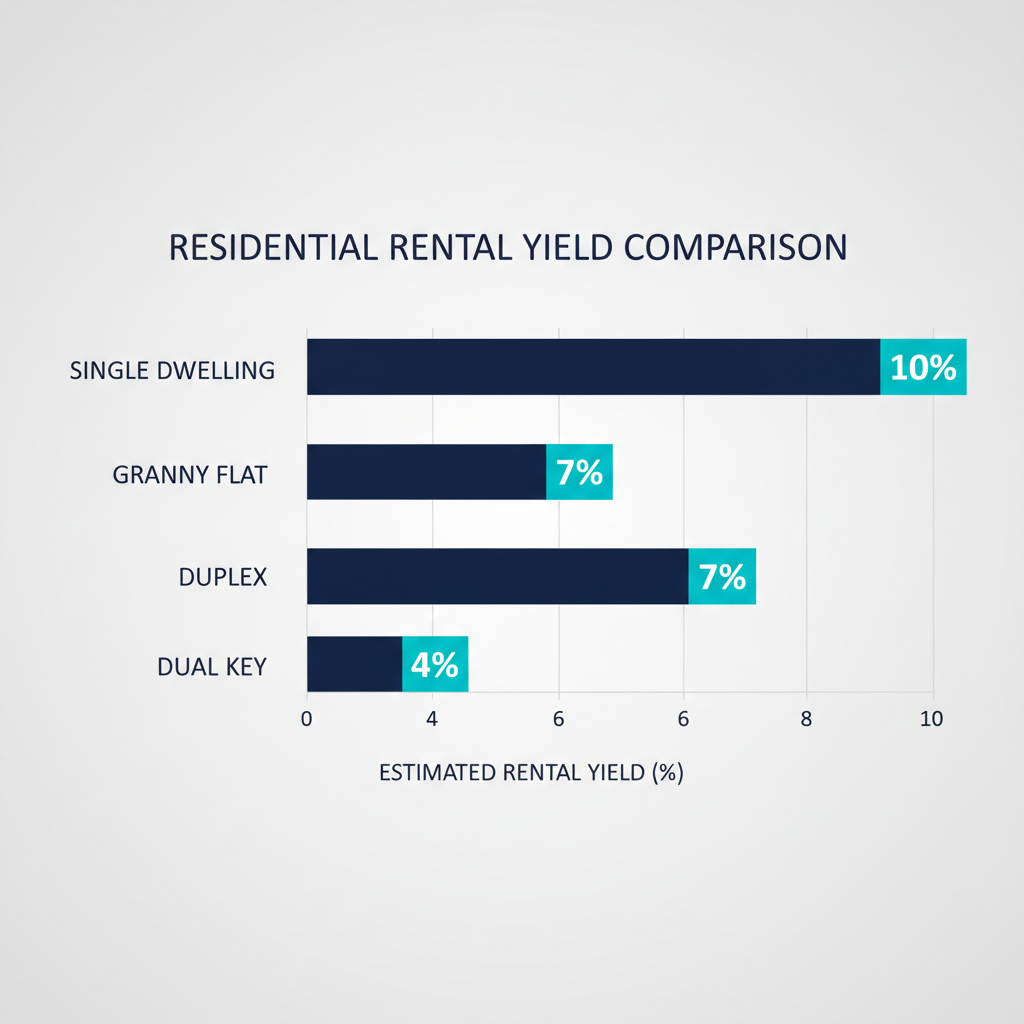
Dual income properties consistently outperform single-dwelling investments on rental yield. Adding a granny flat can increase a property's overall rental yield by 1.4 to 1.65 percentage points compared to similar homes without one.
Granny flats deliver gross rental yields of 8% to 13% on construction cost alone. A $180,000 granny flat generating $450 per week produces a 13% gross yield, compared to 4% to 5% for most standalone houses.
This yield advantage improves cash flow, accelerates equity buildup, and supports faster mortgage paydown. Investors can reinvest surplus income into additional properties or offset holding costs during rate hikes.
In regional markets and outer suburbs where land is more affordable, dual income properties can achieve positive cash flow from settlement, eliminating the need for ongoing top-ups.
Reduced Vacancy Risk
Holding two rental income streams reduces the financial impact of vacancies. If one dwelling sits vacant, the other continues generating rent, maintaining partial cash flow.
This income diversification is particularly valuable in markets with seasonal vacancy fluctuations or during tenant turnover periods. Investors holding single-dwelling properties face 100% income loss during vacancies, increasing financial stress and mortgage repayment shortfalls.
Dual income properties also attract a broader tenant demographic. Granny flats appeal to singles, couples, and downsizers. Main houses suit families. This tenant diversity reduces the risk of both dwellings sitting vacant simultaneously.
Improved Serviceability and Borrowing Capacity
Lenders assess investment property loans based on rental income relative to repayments. Dual income properties demonstrate higher rental income, improving serviceability ratios and unlocking greater borrowing capacity.
An investor generating $800 per week across two dwellings ($41,600 annually) has stronger serviceability than an investor earning $400 per week from a single property ($20,800 annually). This difference can be the margin between loan approval and rejection when acquiring additional properties.
Banks typically assess 80% of rental income when calculating serviceability, so every additional dollar of rent improves borrowing power. Investors building portfolios benefit from this compounding effect, as each dual income property strengthens the case for future acquisitions.
Buyers Agency Australia structures dual income property strategies to maximise serviceability, helping clients scale portfolios faster without hitting lending limits.
Faster Equity Growth
Dual income properties generate higher cash flow, which can be redirected toward mortgage principal repayments. This accelerates equity buildup and reduces loan-to-value ratios faster than single-income properties.
Investors can also add value through strategic development. Building a granny flat on an existing property increases the asset's rental income and overall market value. A well-designed granny flat can add $100,000 to $150,000 in property value, often exceeding construction costs.
This manufactured equity allows investors to refinance and access funds for additional purchases without selling assets. It's a core wealth-building strategy for portfolio investors targeting long-term financial independence.
Realistic Rental Income Examples Across Australia
Rental income for dual income properties varies by location, property type, and market conditions. Here are realistic 2026 examples across major Australian markets.
Sydney Dual Income Property Rents
In Sydney's outer suburbs like Campbelltown, Penrith, and Liverpool, a duplex generates $450 to $550 per dwelling per week. Total weekly income: $900 to $1,100.
Granny flats in Western Sydney rent for $350 to $500 per week, depending on size and finishes. A main house renting for $600 per week plus a granny flat at $400 per week delivers $1,000 weekly income.
Inner suburbs like Marrickville and Earlwood see granny flat rents of $500 to $650 per week, with main houses generating $700 to $900. Total weekly income: $1,200 to $1,550.
Melbourne Dual Income Property Rents
Melbourne's growth corridors—Wyndham, Casey, Melton—deliver duplex rents of $400 to $500 per dwelling per week. Total weekly income: $800 to $1,000.
Granny flats in Melbourne's middle-ring suburbs rent for $350 to $500 per week. Main houses in suburbs like Reservoir and Coburg rent for $500 to $650 per week. Combined income: $850 to $1,150 weekly.
Dual key apartments in Melbourne's CBD and inner suburbs generate $300 to $400 per unit per week. Total weekly income: $600 to $800.
Brisbane Dual Income Property Rents
Brisbane's northern and southern corridors—Logan, Ipswich, Moreton Bay—deliver strong dual income yields. Duplexes rent for $450 to $600 per dwelling per week. Total weekly income: $900 to $1,200.
Granny flats in Brisbane's established suburbs like Chermside, Carindale, and Sunnybank rent for $350 to $500 per week. Main houses generate $550 to $700 per week. Combined income: $900 to $1,200.
Brisbane's tight rental market and strong population growth support consistent tenant demand for dual income properties.
Perth and Adelaide Dual Income Property Rents
Perth's northern suburbs—Baldivis, Ellenbrook, Butler—deliver duplex rents of $400 to $550 per dwelling per week. Total weekly income: $800 to $1,100.
Granny flats in Perth rent for $300 to $450 per week. Main houses generate $450 to $600 per week. Combined income: $750 to $1,050 weekly.
Adelaide's growth suburbs—Munno Para, Seaford, Mount Barker—deliver similar yields. Duplexes rent for $350 to $500 per dwelling per week. Granny flats generate $300 to $400 per week.
Both markets offer relative affordability, making them attractive for investors seeking positive cash flow and strong rental yields.
Key Risks and Considerations for Dual Income Properties
Dual income properties deliver strong yields, but investors must understand the risks and operational complexities before committing capital.
Council and Zoning Regulations
Council regulations determine whether dual income properties are permissible on a given lot. Zoning, lot size, setbacks, and building height restrictions vary across local government areas.
In NSW, dual occupancies require a minimum 450 square metre lot with a 12-metre frontage in most of Greater Sydney. Four councils—Hawkesbury, Blue Mountains, Wollondilly, and Bathurst—remain exempt from 2025 reforms due to bushfire and flood risks.
Granny flats have separate regulations. Most states allow granny flats on residential lots meeting minimum size requirements, but some councils restrict use to family members only, prohibiting open-market rental.
Investors should confirm zoning and council requirements before purchasing. Buyers Agency Australia conducts due diligence on every property, verifying dual income feasibility and council approval pathways to avoid costly surprises post-purchase.
Lending and Finance Challenges
Not all lenders finance dual income properties on standard terms. Dual key properties and boarding houses face stricter lending criteria, with higher deposit requirements and lower loan-to-value ratios.
Banks assess dual income properties based on rental income sustainability. Properties reliant on high rental yields for serviceability may face tougher scrutiny during loan approval or refinancing.
Investors should stress-test cash flow under conservative rental income assumptions. If one dwelling sits vacant for three months, can you still cover repayments?
Construction loans for granny flats require staged drawdowns, meaning investors need sufficient equity or savings to cover initial construction costs before rental income commences.
Working with a mortgage broker experienced in dual income property finance ensures you secure competitive rates and structure loans for long-term flexibility.
Tenant Management Complexity
Managing two tenancies on one property increases administrative workload. Separate lease agreements, bond lodgements, and rent collection processes apply to each dwelling.
Tenant disputes between occupants of the main house and granny flat can arise, particularly around noise, parking, and shared outdoor spaces. Clear lease terms and property rules help mitigate these issues.
Vacancy coordination is another consideration. If both dwellings fall vacant simultaneously, advertising, inspections, and tenant selection double. Property managers experienced in dual income properties streamline this process, but management fees typically range from 7% to 10% of rental income per dwelling.
Investors should budget for higher maintenance costs. Two kitchens, two bathrooms, and two sets of appliances mean more frequent repairs and replacements.
Construction and Development Costs
Building a granny flat or duplex requires upfront capital. Granny flat construction costs range from $120,000 to $200,000. Duplex builds range from $400,000 to $700,000, depending on size, finishes, and site complexity.
Site preparation, council approvals, utility connections, and landscaping add to total costs. Investors should obtain fixed-price contracts to avoid cost blowouts during construction.
Typical payback periods for granny flats range from 6 to 10 years, depending on rental income and construction costs. This timeline assumes consistent tenancy and no major maintenance events.
Investors should model return on investment before committing to construction. If a granny flat costs $180,000 and generates $400 per week ($20,800 annually), the gross payback period is 8.6 years. After accounting for maintenance, insurance, and management fees, net payback extends to 10 to 12 years.
How Buyers Agency Australia Identifies High-Yield Dual Income Opportunities
Buyers Agency Australia specialises in sourcing dual income properties that deliver real cash flow from day one. Dragan Dimovski and his team use a data-driven, boots-on-the-ground approach to identify opportunities that most investors miss.
Property Selection Criteria
Buyers Agency Australia filters properties based on location fundamentals, yield potential, and development feasibility. Every property must pass strict criteria: proximity to employment hubs, rental demand drivers (universities, hospitals, transport), zoning and council approval pathways, land size and configuration for granny flats or duplexes, and rental comparables confirming achievable income.
Properties in growth corridors with strong population inflows take priority. Brisbane's northern suburbs, Perth's Baldivis and Ellenbrook, and Adelaide's northern growth zones consistently deliver dual income opportunities with yields above 6%.
Buyers Agency Australia avoids over-supplied markets and areas with weak rental demand. The goal is long-term tenancy stability, not speculative capital growth.
Due Diligence and Feasibility Analysis
Every property undergoes comprehensive due diligence before purchase. This includes zoning verification (confirming dual occupancy or granny flat permissibility), council pre-lodgement meetings (clarifying approval pathways and development constraints), building and pest inspections, title searches and easement checks, rental appraisals from local property managers, and construction cost estimates for granny flats or subdivisions.
Buyers Agency Australia partners with town planners, builders, and quantity surveyors to deliver accurate feasibility reports. Clients receive clear projections of total investment costs, expected rental income, and cash flow outcomes before making offers.
This eliminates guesswork and ensures investors enter dual income projects with full transparency.
Negotiation and Off-Market Access
Buyers Agency Australia negotiates on behalf of clients, securing properties below market value where possible. Dragan's 20-plus years of experience and established agent relationships provide access to off-market listings before they hit public portals.
Off-market properties often deliver better value because competition is lower. Vendors selling privately avoid auction pressure, creating opportunities for buyers to negotiate favourable terms.
Buyers Agency Australia structures offers based on rental yield targets, ensuring clients pay the right price for the income the property will generate.
Ongoing Portfolio Strategy
Buyers Agency Australia doesn't stop at settlement. The team provides ongoing portfolio support, helping clients refinance, develop granny flats, or acquire additional properties to scale wealth.
Dragan's approach is about building long-term financial independence, not one-off transactions. Clients receive 10-year portfolio projections, showing how dual income properties compound equity and cash flow over time.
If you're serious about building a portfolio that pays for itself, book a free strategy session with Buyers Agency Australia and see how dual income properties fit your investment goals.
Frequently Asked Questions About Dual Income Properties
What rental yield can I expect from a dual income property?
Dual income properties typically deliver gross rental yields of 6% to 13%, depending on property type and location. Granny flats often achieve the highest yields on construction cost.
Do I need council approval to build a granny flat?
Yes. Council approval is required for granny flats intended for rental. Regulations vary by state and council, so confirm requirements before construction commences.
Can I finance a dual key property with a standard home loan?
Some lenders require higher deposits and stricter serviceability for dual key properties. Work with a mortgage broker experienced in dual income property finance.
How long does it take to recover granny flat construction costs?
Typical payback periods range from 6 to 10 years, depending on rental income and construction costs. Net payback extends to 10 to 12 years after expenses.
Are dual income properties suitable for first-time investors?
Yes, if cash flow is the priority. Dual income properties reduce negative gearing and improve serviceability, making them ideal for investors seeking passive income and portfolio growth.
Conclusion: Dual Income Properties Deliver Real Cash Flow in 2026
Dual income properties are one of the smartest strategies for Australian investors in 2026.
While capital growth remains uncertain and interest rates stay elevated, dual income properties deliver immediate cash flow improvements. Two rental income streams reduce vacancy risk, accelerate equity buildup, and improve borrowing capacity for portfolio scaling.
Buyers Agency Australia specialises in identifying dual income opportunities that deliver positive cash flow from settlement. Dragan Dimovski and his team combine data-driven research with boots-on-the-ground market knowledge to source properties most investors never see.
If you're ready to build a portfolio that pays for itself, book a free strategy session with Buyers Agency Australia and discover how dual income properties can accelerate your wealth-building journey.
 General
Dual income properties offer Australian investors two income streams from one property—boosting rental yield, improving cash flow, and...
Most Australians who buy property never build real wealth from it. They overpay, buy emotionally, and get stuck with one negatively-geared property that drains their cash flow for decades. Without a clear strategy, manufactured equity, or access to off-market deals, they remain trapped in the rat race.
We've all been there. You hear about someone who made $200,000 in equity in two years. You see the headlines about property doubling every decade. You think, "I'll buy a property and ride the wave."
But here's the truth: most Australians who buy investment property never build meaningful wealth. They buy one property, watch it appreciate at 3% per year, bleed $300 a week in negative cash flow, and never buy a second. They're not property investors. They're accidental landlords.
If you're reading this, you're probably wondering why so many people fail—and how to avoid their mistakes. Let's break it down with 20+ years of boots-on-the-ground experience.
Why Most Property Investors Fail in Australia
Property investing in Australia isn't hard. But doing it wrong is incredibly easy.
According to the 2024 PIPA Annual Investor Sentiment Survey, 65% of property investors are experiencing negative cash flow. Over 40% report their finances are "tight," and 11% are dipping into savings just to hold their property.
Here's the kicker: 71% of property investors in Australia own just one property. Another 18% own two. These aren't property moguls. They're everyday Australians who bought a house, rented it out, and hoped for the best.
So what went wrong?
Buying Emotionally Instead of Strategically
You walk into an open home. The kitchen is renovated. The backyard has a deck. The agent tells you there are three other offers. You panic and bid over asking price.
Congratulations. You just bought a property that "feels" right but makes no financial sense.
Emotional buying is the silent killer of property wealth. You pay $50,000 over market value because you "fell in love" with a place. You ignore rental yield because the property "has character." You chase aesthetics over fundamentals.
The result? You overpay, over-borrow, and end up cash-flow negative from day one.
Buyers Agency Australia works with clients every week who nearly made this mistake. The difference between a $700,000 property bought emotionally and a $700,000 property bought strategically can be $100,000 in equity and $200 per week in cash flow.
Overpaying at Auction or Accepting Agent Pricing
Australian property prices hit a national median of $922,838 in February 2026, according to CoreLogic data. But median prices don't tell you what YOU should pay.
Most buyers walk into auctions unprepared. They don't know the property's true value. They don't set a walk-away price. They get caught in the emotion of the moment and bid $50,000 more than they planned.
Or worse—they trust the selling agent's "market appraisal" and buy at full asking price, believing they got a "fair deal."
Here's the reality: selling agents work for the vendor. Their job is to get the highest price possible. When you accept their pricing without independent valuation, you're playing a game where the house always wins.
Chasing "Safe" Blue-Chip Areas with Low Yield
Everyone wants to buy in the "safe" suburbs. Mosman. Toorak. Cottesloe. The suburbs your bank loves. The suburbs your parents approve of.
There's just one problem: these suburbs deliver 2-3% rental yields and require huge deposits. You buy a $1.5 million property that rents for $800 per week. Your interest bill is $1,800 per week. You're losing $1,000 per week after expenses.
You tell yourself, "It's okay, I'm buying for capital growth." But here's the uncomfortable truth: capital growth means nothing if you can't afford to hold the property.
According to research on cash flow stress, over 1.5 million Australian borrowers are now classified as "at risk" of mortgage stress. A quarter of mortgage holders face financial strain as interest rates remain elevated.
Cash flow keeps you in the game. Growth gets you out of the rat race. But you need both.
No Clear Investment Strategy or Exit Plan
Here's a question: why did you buy your investment property?
"For capital growth." Okay, when will you sell? "I don't know." How will you know if it's performing? "I guess when the value goes up." What's your target yield? "Um…"
Most investors buy property without a clear strategy. They don't know if they're building a portfolio, manufacturing equity, or generating passive income. They just know "property is a good investment."
Without a strategy, you can't measure success. You can't make informed decisions. You just hold and hope.
Dragan Dimovski has been saying this for 20+ years: "Property is not a lottery ticket. It's a business. And every business needs a plan."
Stuck with One Property Forever
The ultimate failure? Getting stuck with one property.
You buy an investment property. It's negatively geared. Your cash flow is tight. You can't save a deposit for a second property. Your borrowing capacity is maxed out. You're trapped.
Many investors expect to remain cash-flow negative for 5-10 years or longer. That's a decade of paying to hold an asset instead of building a portfolio.
The wealthy don't own one property. They own five, ten, or twenty. They manufacture equity, recycle deposits, and scale strategically.
The Critical Property Investment Mistakes That Trap Australians
Let's get specific. These are the mistakes that keep most Australians poor.
Listening to Banks and Real Estate Agents
Your bank says you can borrow $800,000. Great. But just because you CAN borrow that much doesn't mean you SHOULD.
Banks lend based on serviceability, not strategy. They don't care if you overpay. They don't care if your property delivers 2% yield. They just want you to make repayments.
Real estate agents are even worse. They work for the vendor. Their job is to create urgency, inflate prices, and close deals. They'll tell you "there are three other offers" even when there aren't. They'll push you to "buy now before you miss out."
You need independent advice. That's where a buyers advocate comes in. Someone who works for YOU, not the seller.
Ignoring Cash Flow and Yield Fundamentals
Most investors focus obsessively on capital growth and ignore cash flow entirely.
They buy a property that costs $500 per week to hold. They justify it by saying, "It'll grow 5% per year." Then interest rates rise, vacancy hits, and suddenly they're $800 per week out of pocket.
Positive cash flow properties deliver steady income, reduce risk, and allow investors to scale faster. Negative cash flow might be acceptable short-term, but only if you have a buffer and a clear exit.
The formula is simple:
- Rental income > expenses = positive cash flow
- Rental income < expenses = negative cash flow
If you're bleeding money every week, you can't scale. You're stuck.
Buying in Oversupplied or Declining Markets
You buy off-the-plan in a high-rise development because the developer offers "10% rental guarantee for 2 years."
Two years later, the guarantee expires. You discover 40 identical apartments are on the market. Vacancy rates hit 15%. Your property is worth 20% less than you paid.
Oversupply is one of the biggest wealth destroyers in Australian property. According to market analysis, Sydney and Melbourne both recorded flat or negative monthly growth in early 2026, with oversupply and softening demand creating risks for investors.
Buyers Agency Australia avoids oversupplied markets entirely. We focus on supply-constrained areas with strong population growth and infrastructure investment.
Not Understanding Capital Growth vs Rental Yield Trade-Offs
Capital growth and rental yield are inversely correlated. High-growth areas usually deliver low yield. High-yield areas usually deliver lower growth.
Most investors don't understand this trade-off. They chase "the best of both worlds" and end up with neither.
The key is knowing what you need:
- Building a portfolio? Prioritize yield and cash flow.
- One-property strategy? Prioritize growth in undersupplied areas.
- Scaling quickly? Find the sweet spot—6-7% yield with moderate growth.
Adelaide, Brisbane, and Perth are forecast to deliver 6%+ house price growth in 2026 while maintaining yields above 4.5%.
That's the sweet spot.
What Actually Works in Australian Property Investing
Enough about what doesn't work. Let's talk about what does.
Buying Under-Market Value Deals
You don't make money when you sell. You make money when you buy.
Buying under market value means purchasing property for less than its true market value. Not because it's a dump. But because you found a motivated seller, negotiated hard, or accessed off-market opportunities.
According to property negotiation research, genuine under-market deals arise from:
- Motivated sellers (divorce, relocation, financial stress)
- Off-market transactions with less competition
- Properties with poor presentation or marketing
- Deceased estates or mortgagee sales
Buying 10-15% under market value gives you instant equity. That equity becomes your deposit for the next property.
Dragan Dimovski and the team at Buyers Agency Australia specialize in finding these deals. While other buyers compete at auctions, we're negotiating off-market with motivated vendors.
Accessing Off-Market Opportunities Before Competition
Off-market properties are the secret weapon of serious investors.
According to off-market property analysis, these properties offer:
- Less competition from unqualified buyers
- Better negotiation leverage
- Faster settlement with motivated sellers
- Privacy and discretion
The challenge? Off-market properties aren't advertised. You need relationships with agents, connections in the industry, and a reputation as a serious buyer.
That's exactly what Buyers Agency Australia provides. We have 20+ years of industry relationships, access to pre-market listings, and direct connections with selling agents across every capital city.
High-Yield Co-Living and Manufactured Equity Strategies

Co-living properties are delivering rental yields of 6-15%, according to co-living investment research. That's 2-3X higher than traditional rentals.
How? By renting individual rooms instead of the entire property. A house that rents for $600 per week as a single dwelling can generate $1,200 per week as a co-living arrangement.
According to Australian co-living data, co-living properties can deliver $20,000-$40,000 annual profit even in high interest rate environments.
Other manufactured equity strategies include:
- Cosmetic renovations that add 15-20% value
- Minor subdivisions to unlock land value
- Granny flat additions to double rental income
- Zoning changes to maximize development potential
The key is buying right, adding value strategically, and recycling equity into the next deal.
Building a Portfolio with Strategy Not Hope
Wealth isn't built with one property. It's built with a portfolio.
Here's the playbook:
- Buy your first property under market value with strong yield
- Hold 12-18 months and build equity
- Use equity to buy property #2
- Repeat every 18-24 months
- Scale to 5-7 properties within 10 years
Successful investors combine positive cash flow properties, capital growth assets, and manufactured equity plays to build diversified portfolios.
The critical factor? Cash flow. If your properties are positively geared or neutral, you can hold through market cycles. If they're bleeding $500 per week, you're stuck.
How Dragan Dimovski and Buyers Agency Australia Find Investment-Grade Deals
Dragan Dimovski has been investing in property for over 20 years. He's built a successful personal portfolio and helped hundreds of clients do the same.
His approach is simple: data-driven analysis, off-market access, and zero emotional buying.
The 10-Year Portfolio Modeling Approach
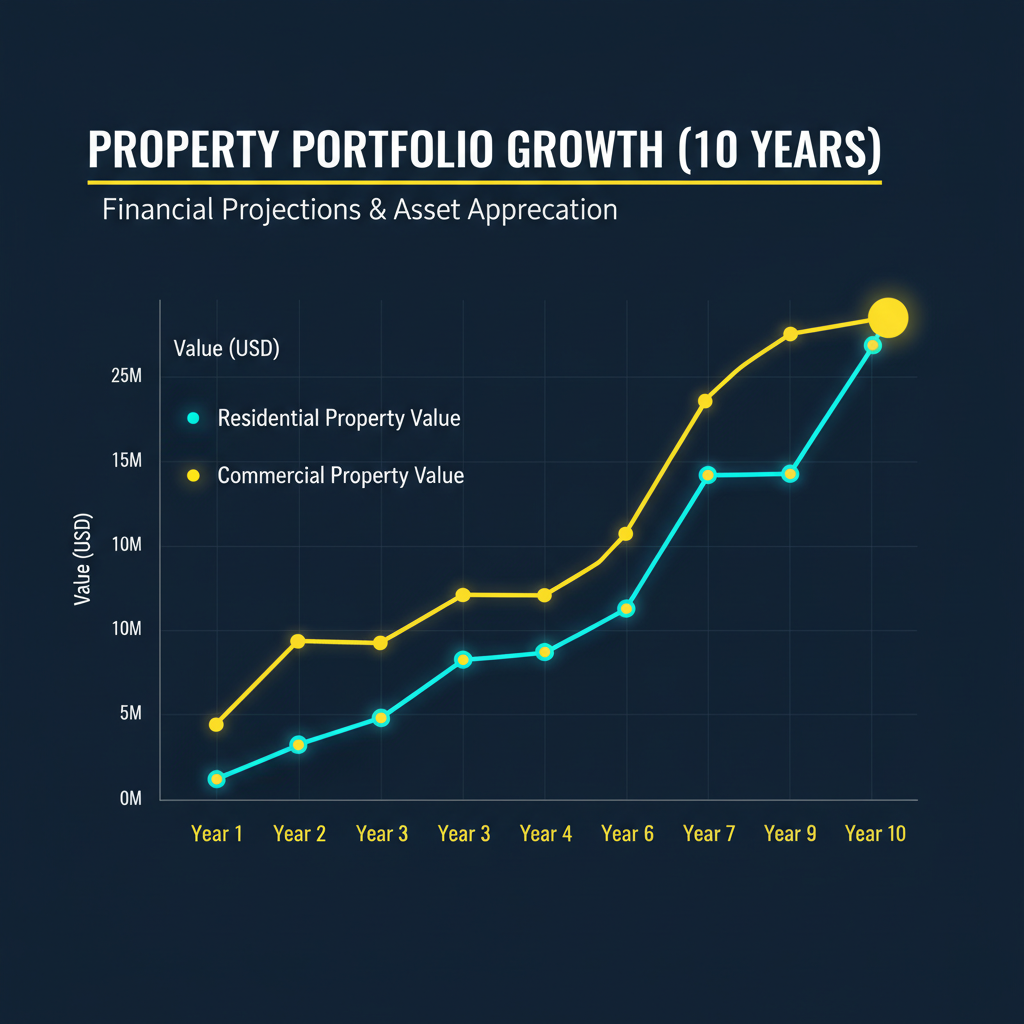
Most buyers agents find you a property. Dragan builds you a strategy.
Every client receives a 10-year portfolio model showing:
- Projected equity growth across multiple properties
- Cash flow analysis under different interest rate scenarios
- Deposit recycling timeline for scaling
- Exit strategies and wealth milestones
This isn't guesswork. It's financial planning backed by 20+ years of experience and real market data.
You can book a free strategy session to see exactly how this works.
Off-Market Access Across Every Australian Capital
Buyers Agency Australia has boots on the ground in Brisbane, Sydney, Melbourne, Perth, Adelaide, and regional growth corridors.
We don't wait for properties to hit the market. We're connected with selling agents, property developers, and private vendors before listings go live.
Most under-market deals happen through relationships, not public listings.
That's our competitive advantage.
Transparent Fixed-Fee Model with No Conflicts
Most buyers agents charge 2-3% of purchase price. That creates a conflict of interest—they make more money when you spend more.
Buyers Agency Australia uses a transparent fixed-fee model. We're paid the same whether you buy a $600,000 property or a $900,000 property. Our incentive is to find you the BEST deal, not the most expensive one.
Frequently Asked Questions
Why do most property investors in Australia fail to build wealth?
Most investors buy emotionally, overpay, and purchase low-yield properties in oversupplied areas. They get stuck with one negatively-geared property and never scale their portfolio.
What is the biggest mistake first-time property investors make?
Buying without a clear strategy. They don't understand cash flow vs capital growth, overpay at auctions, and trust selling agents instead of getting independent buyers advocacy.
How can I buy property under market value in Australia?
Access off-market opportunities, negotiate with motivated sellers, target deceased estates or mortgagee sales, and work with experienced buyers agents who have industry relationships.
What are off-market properties and how do I find them?
Off-market properties are not publicly advertised. They're shared privately among agents and serious buyers. You access them through buyers agents with strong industry connections.
Is negative gearing still a good property investment strategy in 2026?
Negative gearing works only if you can afford the cash flow drain and property values grow significantly. With 65% of investors cash-flow negative, it's risky without buffers.
How do I know if a property investment is actually a good deal?
Analyze rental yield, purchase price vs market value, capital growth history, supply-demand fundamentals, and 10-year cash flow projections under different interest rate scenarios.
What rental yield should I target for investment property?
Target 5-7% gross yield in capital cities, 7-9% in regional growth areas. Anything below 4% requires exceptional capital growth to justify negative cash flow.
Should I use a buyers agent or buy investment property myself?
Buyers agents provide off-market access, negotiation expertise, and strategic guidance. They typically save clients 5-10% on purchase price, which far exceeds their fee.
Final Thoughts: The Hard Truth About Property Wealth
Most Australians will never build wealth through property.
Not because property doesn't work. But because they approach it emotionally, pay retail prices, and lack a clear strategy.
The investors who succeed are the ones who:
- Buy under market value
- Prioritize cash flow and yield
- Access off-market opportunities
- Build portfolios systematically
- Work with experienced buyers agents
If you're serious about building wealth through property in 2026, stop hoping and start strategizing.
Book your free strategy session with Buyers Agency Australia today. Let's build your investment roadmap based on data, experience, and 20+ years of proven results.
The property market rewards preparation, not luck. Let's make sure you're prepared.
 General
Most property investors fail because they buy emotionally, overpay at auctions, chase low-yield areas, and never scale beyond...
The Reserve Bank of Australia raised the cash rate by 25 basis points to 4.1% in March 2026, marking the second consecutive hike in 2026. This reverses cuts made in 2025 and pushes rates to their highest level since April 2025, driven by sticky inflation sitting at 3.8% and Middle East conflict risks.
If you're a property investor or first-home buyer, you've likely felt the whiplash. After three rate cuts through 2025, the RBA's sudden pivot back to tightening has sent shockwaves through the market. The question everyone's asking is the same: is this the trigger that finally crashes Australian property prices?
The truth is more complex than the headlines suggest. While borrowing capacity is shrinking and affordability is hitting breaking point in Sydney and Melbourne, Australia's housing supply shortage, robust migration levels, and investment-grade market fundamentals are creating a split-speed market. Buyers Agency Australia has tracked these cycles for over 20 years, and here's what the data actually says about what's coming next.
What the March 2026 RBA Rate Hike Really Means
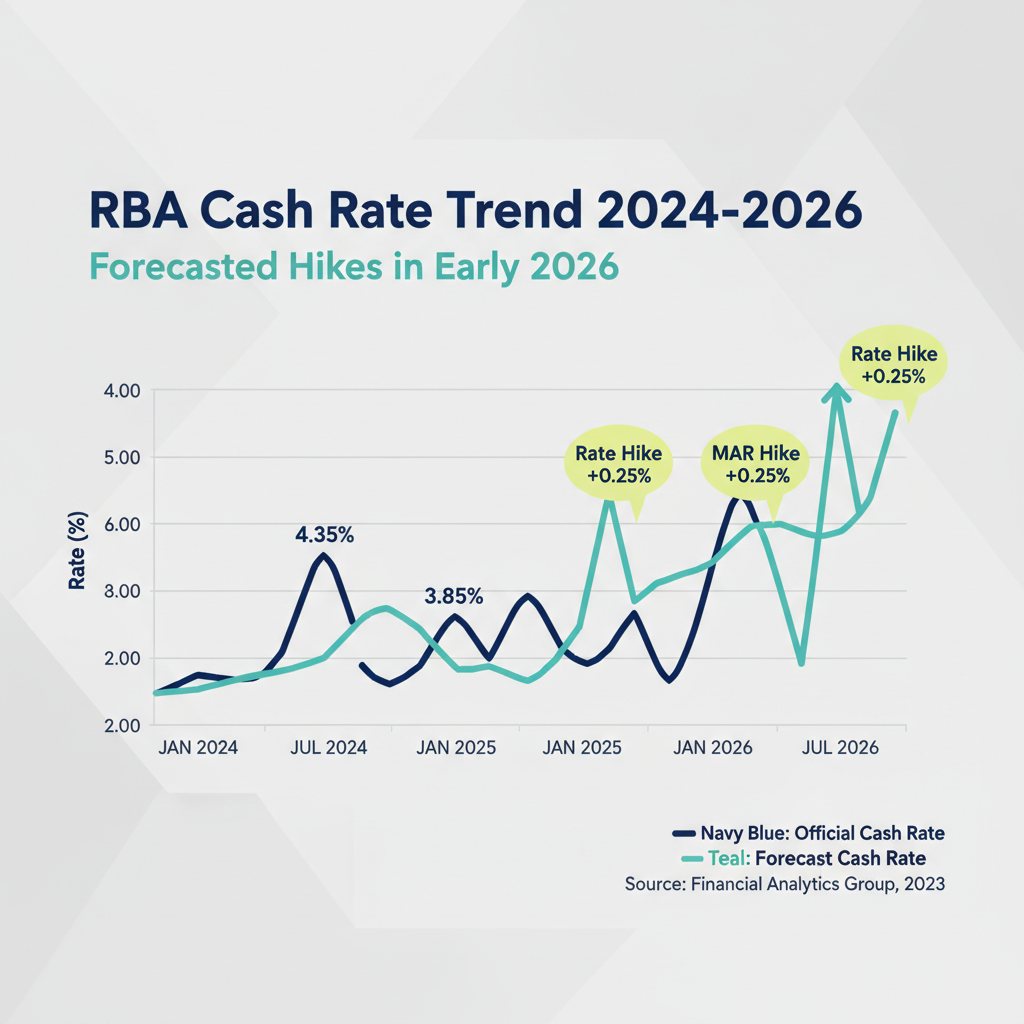
The RBA's March 2026 rate decision was anything but unanimous. The board voted 5-4 to increase the cash rate target to 4.1%, highlighting deep division over whether to act now or wait for more data.
Why the RBA Raised Rates Again
Governor Michele Bullock made it clear in her post-decision press conference: inflation is too high, and the RBA can't afford to lose further control. January 2026 inflation held at 3.8%, well above the RBA's 2-3% target band, with trimmed mean inflation rising to 3.4%.
Domestic demand has been stronger than forecast. Fourth-quarter GDP growth hit 2.6%, exceeding expectations. Unemployment remains low at levels that typically fuel wage growth. The labour market is tighter than anticipated, and capacity pressures are greater than the RBA previously assessed.
But the real wildcard is geopolitical. The war in the Middle East has closed the Strait of Hormuz, sending oil prices from US$70 per barrel to over US$100. Petrol prices in Australia have jumped 15% in weeks, adding direct inflationary pressure. The RBA forecast inflation could peak at 4.2% by mid-2026, with risks tilted to the upside.
How This Compares to Previous Tightening Cycles
This isn't the first time the RBA has reversed course. But the speed of the pivot is unusual. Just months after delivering the third rate cut in August 2025, the bank is now unwinding those gains.
Historically, property markets have proven resilient during tightening cycles when supply remains constrained. The 2022-2023 rate rise cycle saw Sydney and Melbourne prices dip temporarily, but mid-sized capitals like Brisbane, Perth, and Adelaide powered through with double-digit gains. The question isn't whether rates matter. It's whether supply shortages and migration can offset the borrowing capacity hit.
What Borrowers Are Facing Right Now
For a household with a $700,000 mortgage, the March rate hike adds roughly $100 per month to repayments. That's on top of February's increase. For renters, the pain is indirect but real: landlords facing higher servicing costs often pass increases through via rent rises.
Mortgage stress is climbing. CommBank's household spending data showed a February dip, though March rebounded slightly. The key stress point is households with mortgages, where affordability is now worse than at any point in the last two decades.
Will Australian Property Prices Crash in 2026
Let's address the headline question directly: are we heading for a property market crash?
Defining a Property Market Crash vs Correction
A correction typically means price declines of 5-10% over 6-12 months. A crash implies sustained falls of 20%+ that fundamentally reshape the market. Australia hasn't experienced a national crash since the early 1990s recession.
What we're seeing now is divergence, not collapse. Sydney and Melbourne are losing momentum. National home values rose just 0.8% in February 2026, and Sydney prices fell 0.3% over the month. But Perth, Brisbane, Adelaide, and Darwin continue reporting boomtime results, with Perth up 1.8% and Adelaide up 2.0% in February alone.
Historical Context: How Australian Property Has Responded to Rate Rises
Australian property has tripled in value every 20 years since World War II, requiring an average annual growth rate of 6%. That compounding has survived recessions, rate cycles, and crises.
The 2022-2023 rate rise cycle saw Sydney prices fall roughly 10% from peak to trough, but they've since recovered and hit new highs. Melbourne lagged but is forecast to return to pre-pandemic highs and push beyond them in 2026. The reality is that short-term rate shocks matter, but long-term supply-demand fundamentals matter more.
Key Metrics to Watch in 2026

If you're serious about tracking crash risk, watch these indicators:
- Auction clearance rates: Sydney and Melbourne clearance rates cooled from August 2025 highs, but remain above long-term averages.
- Days on market: National median sits at 28 days, a sign demand is still running ahead of supply.
- Rental vacancy rates: National vacancy at 1.7%, well below the 3% level that signals balanced supply.
- Building approvals: Down 6.4% in October 2025, with the Housing Accord 20% behind target after 18 months.
- Credit growth: Investor lending surged 26% since 2021, with more than 205,000 new investor loans in the past year.
None of these metrics suggest a crash. They suggest a two-speed market where affordability constraints slow growth in expensive cities, but supply shortages keep floors under prices.
Key Risks That Could Push Prices Down
While a crash seems unlikely, risks are real. Here's what could tip the balance.
Further Interest Rate Rises
The RBA's next meeting is May 4-5. By then, the board will have Q1 trimmed mean CPI data. If inflation prints at 0.9% quarterly instead of 0.8%, another 25bp hike becomes more likely. Markets are pricing a live risk of rates hitting 4.35% by mid-2026.
If oil prices stay elevated and inflation expectations become unanchored, the RBA could be forced into a more aggressive tightening cycle. That would materially reduce borrowing capacity and demand, particularly in Sydney and Melbourne where affordability is already stretched.
Recession Risk and Unemployment
Governor Bullock acknowledged that the RBA doesn't want to trigger a recession, but if inflation can't be controlled, "we're going to have to deal with that, possibly."
If unemployment rises from current lows to 5% or higher, forced sales could increase. But right now, unemployment remains subdued, wage growth is solid, and household savings rates are above average. The labour market would need to deteriorate significantly to trigger distressed selling.
Borrowing Capacity Squeeze
Every 25bp rate rise reduces borrowing capacity by roughly 2%. Two hikes in two months means first-home buyers and upgraders face a material reduction in what they can borrow.
APRA has also ramped up macroprudential controls, requiring lenders to assess loan serviceability at higher buffer rates. This compounds the rate rise impact, especially for buyers stretching into expensive markets.
Forced Sales and Investor Exits
Investor loans have surged, but if rental yields compress further and capital growth stalls, some leveraged investors may exit. However, rental vacancy rates near record lows and rising rents (up 5.9% on a six-month annualised basis in December 2025) suggest investor fundamentals remain strong.
Forced sales typically require unemployment spikes or credit crunches. Neither is evident right now.
Support Factors That Could Keep Prices Rising
Despite rate rises, several structural forces are propping up the market.
Chronic Housing Supply Shortage
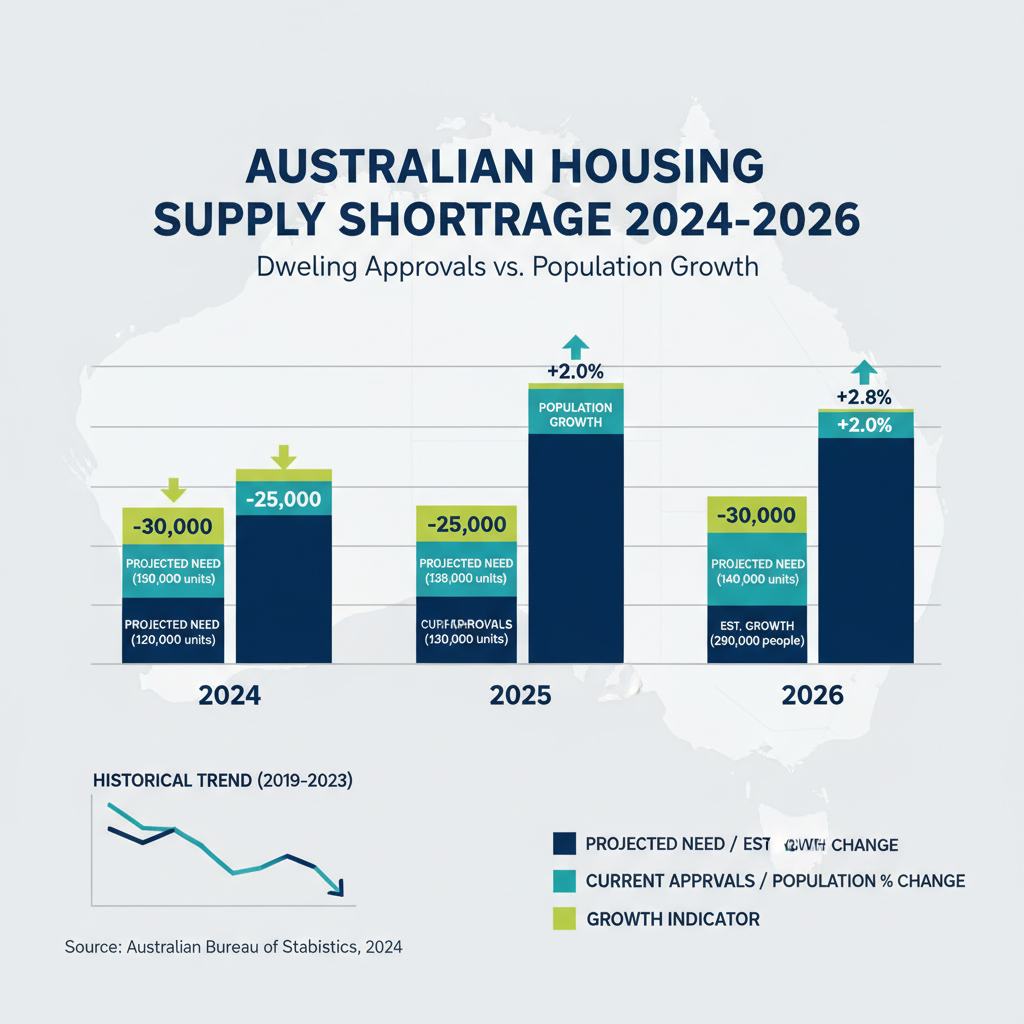
Australia's cumulative housing shortage sits between 200,000 and 300,000 dwellings, according to AMP chief economist Shane Oliver. The National Housing Accord target of 1.2 million new homes by mid-2029 is already 20% behind schedule.
Dwelling approvals in 2025 totaled 195,700, roughly 44,000 fewer than the 240,000 annual run rate required. Construction costs have surged 62-77% in key precincts over four years, labour shortages persist, and planning approvals take months or years in major cities.
This isn't a short-term blip. It's a structural supply crisis that underpins price support for years to come.
Migration and Population Growth
Australia's population is forecast to exceed 30 million by 2030, up from 27.6 million today. That's 3 million additional people requiring housing.
Net overseas migration remains elevated, with permanent and long-term arrivals concentrated in Sydney, Melbourne, Brisbane, and Perth. Migration-driven rental demand is the primary driver of rental market tightness, outweighing interest rates and affordability cycles.
Government Buyer Support Programs
The expanded 5% Deposit Scheme allows first-home buyers to purchase with a 5% deposit and no lenders mortgage insurance. The Help to Buy Scheme, launched in December 2025, allows the federal government to take a 30-40% equity stake in a property purchase.
Both policies bring forward demand and increase how much buyers can pay, particularly in the lower quartile of the market. Domain noted that properties below the expanded deposit guarantee price caps have seen a clear divergence in growth trends, even before the scheme went live.
These demand-side policies don't solve supply shortages, but they do support price floors in entry-level segments.
Rental Market Tightness Driving Investor Demand
Rental vacancy rates sit at 1.6% nationally, near record lows. Advertised rents rose 5.9% on a six-month annualised basis. Median weekly rent in Q4 2025 reached $681 nationwide, up 5.2% year-on-year.
For investors, the combination of strong rental yields, capital growth potential, and structural undersupply creates a compelling case. Investor lending is growing much faster than owner-occupier lending, with more than 205,000 new investor loans written in the past year.
What Strategic Investors Should Do Right Now
If you're an investor navigating this environment, here's the playbook.
Focus on Investment-Grade Properties in Supply-Constrained Markets
Perth, Brisbane, and Adelaide demonstrate the strongest fundamentals. Perth is forecast to lead house-price growth at 12.8% in 2026, followed by Brisbane at 10.9% and Darwin at 10.5%. These markets combine supply constraints, migration inflows, and relative affordability.
Melbourne and Sydney offer value for contrarian buyers. Melbourne's comparatively lower price base and forecast 6.8% growth in 2026 make it an attractive re-entry point for long-term investors. Sydney's status as a major jobs hub supports underlying demand, even as affordability constraints slow short-term momentum.
Avoid Emotional Properties and Speculation Traps
Chasing government stimulus, buying off-the-plan apartments in oversupplied precincts, or stretching finances without cash buffers are the costliest errors in this environment.
Investment-grade properties are owner-occupier desirable, in supply-constrained suburbs, within 10-15km of employment hubs, and demonstrate historical capital growth. Emotional properties are trendy, overpriced, or in fringe locations with no long-term demand drivers.
Maintain Cash Reserves and Borrowing Buffers
Aim for a minimum 20% deposit to avoid lenders mortgage insurance. Maintain an additional six-month cash reserve for vacancy, repairs, and interest rate increases.
If rates rise another 50bp, can you still service the loan comfortably? If not, you're overextended.
Consider Off-Market Opportunities
Off-market properties account for roughly 30% of all sales in Australia. These deals bypass auction competition, reduce emotional bidding, and often deliver better value.
Working with a buyers agency with established agent networks and off-market access can unlock properties that never hit public portals. This is particularly valuable in tight supply markets where quality stock is absorbed before it's advertised.
10-Year Portfolio Modeling Over Short-Term Timing
Strategic timing matters less than strategic selection. Australia's property market has delivered 6% average annual growth for decades. The question isn't whether to buy. It's what to buy, where to buy it, and why.
A 10-year portfolio model accounts for rate cycles, supply dynamics, and migration trends. It positions you to weather short-term volatility and capture long-term compounding.
How Buyers Agency Australia Helps Investors Navigate Rate Volatility
With over 20 years of experience and a $10M+ personal portfolio, Dragan Dimovski and the Buyers Agency Australia team have guided investors through multiple rate cycles.
Data-Driven Investment Strategies
We don't guess. We model. Our 10-year portfolio modeling accounts for supply constraints, migration trends, infrastructure pipelines, and capital growth drivers. We identify suburbs before they boom, not after.
Our transparent, fixed-fee model means we're aligned with your long-term success, not chasing commissions on overpriced stock.
Off-Market Deal Access
Our agent network across all major Australian capitals gives us access to off-market opportunities that never reach public auction. This reduces competition, removes emotional bidding, and delivers better value.
We've secured properties for clients 5-10% below market value by negotiating directly with vendors before listings go live.
End-to-End Advocacy
From initial strategy session through settlement, we handle due diligence, negotiations, building inspections, and contract review. For time-poor professionals, this removes the stress and complexity of property investment.
We're not selling you a property. We're building your wealth strategy.
Book Your Free Strategy Session
If you're serious about investing in 2026, book a free strategy session and let's build your roadmap. Whether you're scaling from one property to five or entering the market for the first time, we'll show you how to position for long-term success.
Frequently Asked Questions
Will Australian property prices crash in 2026?
Unlikely. Supply shortages, migration, and rental market tightness support price floors. Expect divergence, not crash.
How do rising interest rates affect property prices?
Rising rates reduce borrowing capacity and demand, but supply constraints and migration can offset impacts in tight markets.
Should I wait to buy property until rates fall?
Strategic selection matters more than timing. Australia's 200,000-300,000 dwelling shortage supports ongoing price appreciation.
What are the best cities to invest in 2026?
Perth, Brisbane, and Adelaide forecast the strongest growth. Melbourne offers contrarian value for long-term investors.
How much deposit do I need to invest in property in 2026?
Aim for 20% deposit plus six-month cash reserves to avoid mortgage insurance and buffer rate rises.
 General
The RBA hiked rates to 4.1% in March 2026 amid sticky inflation. We break down whether this signals...
Positive cash flow property in Australia is still achievable in 2026, but only when you know where to look and how to structure the deal. Properties yielding 5.5% to 6%+ gross rental returns can deliver positive cash flow after expenses and tax deductions, especially when paired with strategies like co-living conversions, dual income setups, or buying under market value.
If you're searching for positive cash flow property Australia opportunities right now, you've probably been told it's impossible. Interest rates are elevated, property prices are still climbing in many markets, and rental yields in capital cities hover around 3% to 4%.
But here's the truth: positive cash flow property isn't dead. It's just harder to find if you're looking in the wrong places or using outdated strategies. Buyers Agency Australia has helped investors secure positive cash flow assets across Brisbane, Perth, Adelaide, and regional Queensland in 2026 by applying precise location analysis and creative property selection.
This guide will walk you through what positive cash flow property actually means, why most properties are negatively geared, and seven proven strategies that still work in 2026. You'll also see a realistic example with numbers, common mistakes to avoid, and how to position your portfolio for long-term wealth creation.
What Is Positive Cash Flow Property
Positive cash flow property occurs when your rental income exceeds all ownership expenses, including mortgage interest, rates, insurance, maintenance, and property management fees. After paying every bill, you're left with surplus income.
This is different from capital growth properties, which typically lose money weekly but appreciate over time. With positive cash flow, the property pays you to own it.
Gross Yield vs Net Yield
Gross rental yield is your annual rent divided by the property's purchase price. A $500,000 property renting for $500 per week delivers a 5.2% gross yield.
Net yield accounts for all expenses. Subtract rates, insurance, maintenance, vacancies, and management fees from your rental income, then divide by the purchase price. Net yield is always lower than gross yield, typically by 1% to 2%.
For positive cash flow, you need a net yield higher than your loan interest rate after tax benefits. In 2026, that means targeting properties with gross yields above 5.5%.
After-Tax Cash Flow
Australia's negative gearing rules let you offset rental losses against your taxable income. But when a property is positively geared, you pay tax on the surplus income.
The key is structuring your portfolio so the after-tax cash flow remains positive. Depreciation deductions, loan structures, and ownership entities all influence your final position.
CoreLogic's latest rental yield data shows that Darwin houses deliver 5.8% yields and Perth properties reach 5.3%, creating genuine opportunities for positive cash flow when paired with the right loan structure.
Why Most Properties Are Negatively Geared
Negative gearing dominates Australian property investment because capital city prices have grown faster than rents. Sydney's median house price sits above $1.4 million, but median weekly rent is around $780, delivering a gross yield under 3%.
When you borrow 80% of the purchase price at 6.5% interest, your annual interest bill alone exceeds your rental income. Add rates, insurance, and maintenance, and you're losing $15,000 to $20,000 per year before tax offsets.
Investors accept this loss because they expect capital growth to exceed the annual shortfall. Over a 10-year hold, a 7% annual price increase turns a $700,000 property into a $1.38 million asset, offsetting years of negative cash flow.
But this strategy has three risks:
- Cash flow pressure: You need spare income to cover the shortfall every month.
- Portfolio scalability: Banks limit how many negatively geared properties you can hold based on serviceability.
- Market dependency: If prices stagnate, you're bleeding cash with no growth to show for it.
This is why positive cash flow property is so valuable. It removes cash flow pressure, improves your borrowing capacity, and lets you scale faster.
Why Cash Flow Is Still Possible With the Right Strategy
Positive cash flow hasn't disappeared. It's just concentrated in specific property types, locations, and deal structures that most investors overlook.
Rental yields in regional Western Australia, Queensland mining towns, and select Adelaide suburbs currently range from 5.5% to 11%, according to SQM Research. When paired with lower purchase prices and strategic financing, these properties can deliver positive cash flow from day one.
The shift in 2026 is that investors can no longer rely on a single strategy. You need to combine location selection, property type, deal negotiation, and financing structure to engineer positive cash flow.
Buyers Agency Australia specializes in identifying these opportunities using 10-year economic modeling, off-market access, and vendor negotiation to secure properties below market value.
Interest Rates and Yield Compression
Higher interest rates increase your holding costs, making positive cash flow harder to achieve. But they also create opportunities.
When rates rise, some investors exit the market, reducing competition and creating negotiation leverage. Motivated vendors accept lower prices, improving your yield on entry.
A property purchased for $450,000 instead of $500,000 instantly boosts your gross yield by 0.5% to 1%, often the difference between negative and positive cash flow.
Vacancy Rates and Rental Demand
Tight rental markets with vacancy rates below 2% support strong rental growth. SQM Research reports national vacancy rates around 1.2% in early 2026, with regional Queensland and Perth even tighter.
Low vacancy means tenants are competing for properties, allowing landlords to push rents higher without losing occupancy. This rental growth can turn a neutrally geared property into a positive one within 12 to 18 months.
Seven Strategies to Create Positive Cash Flow Property
Co-Living Property Conversions
Co-living properties deliver 10% to 15% rental yields in the right locations by leasing individual rooms instead of the entire dwelling.
Here's how it works: A standard three-bedroom house in regional Victoria rents for $350 to $400 weekly. Convert that property into a purpose-built co-living home with three fully self-contained rooms (each with ensuite, kitchenette, and private access), and you can charge $200 to $250 per room.
Three tenants at $225 weekly equals $675 total weekly rent, a 70% income increase on the same property. The conversion typically costs $80,000 to $120,000 depending on the existing layout.
You need council approval, Class 1B certification in most states, and specialist property managers who understand multi-tenant coordination. But the yield uplift is substantial.
Co-living works best in university towns, regional employment hubs, and areas with strong FIFO worker demand. Buyers Agency Australia has facilitated co-living conversions in Ballarat, Geelong, and Toowoomba, delivering 11% to 14% net yields after expenses.
Dual Income Properties
Dual income properties, also known as dual-key or dual-occupancy homes, feature two separate dwellings on one title. You collect two rents but pay one set of council rates and land tax.
A typical dual-key setup includes a main house (three bedrooms, two bathrooms) and a secondary dwelling (two bedrooms, one bathroom). Total construction costs range from $500,000 to $650,000, with combined weekly rent of $800 to $1,000.
Gross yields on dual income properties in outer Brisbane, Adelaide, and Perth suburbs currently sit between 5.5% and 7%, depending on location and build quality.
The key advantage is lower land cost per dwelling. You're not buying two separate blocks, so your entry price per rental income stream is lower. This structure improves your cash flow and borrowing capacity.
Dual income properties also offer flexibility. You can live in one dwelling and rent the other, creating an owner-occupier loan structure with lower interest rates and higher leverage.
Granny Flats and Secondary Dwellings
Adding a granny flat to an existing property is one of the fastest ways to boost rental yield. A $120,000 granny flat construction cost can add $350 to $450 per week in rental income.
If your existing property rents for $500 weekly with a $600,000 value (4.3% gross yield), adding a $120,000 granny flat and collecting an extra $400 weekly pushes your total rent to $900 weekly on a $720,000 investment (6.5% gross yield).
Granny flats work best in suburbs with strong rental demand, limited supply, and council approval for secondary dwellings. NSW, Queensland, and Victoria all have streamlined approval processes for compliant granny flats.
The downside is construction risk, time delays, and the need for upfront capital. But the yield uplift is significant, and the additional dwelling often adds more value than the construction cost.
Buying Under Market Value
Purchasing property 10% to 20% below market value instantly improves your cash flow position. A $500,000 property purchased for $400,000 delivers a 6.5% gross yield if rent is $500 weekly, compared to 5.2% at full price.
Under-market opportunities come from motivated vendors, off-market deals, distressed sales, and properties requiring cosmetic renovation. Most buyers overlook these properties because they require work or aren't listed on realestate.com.au.
Buyers Agency Australia maintains a network of agents, developers, and private vendors across Brisbane, Perth, Adelaide, and regional Queensland, providing access to off-market deals before they reach public portals.
Negotiating 10% below asking price on a $450,000 property saves $45,000, which can be redirected into renovations, granny flats, or additional deposits for more properties.
High-Yield Regional Markets
Regional Queensland, Western Australia, and South Australia dominate Australia's high-yield markets in 2026. Towns like Geraldton, Port Lincoln, Rockhampton, and Townsville deliver gross yields between 5.5% and 8%.
These markets offer lower entry prices ($400,000 to $600,000), strong rental demand driven by mining, agriculture, and infrastructure projects, and limited new supply.
The risk is economic concentration. Mining towns experience boom-bust cycles, and population decline can create prolonged vacancies. But diversified regional cities with multiple employment drivers provide stable, high-yield opportunities.
Buyers Agency Australia targets regional markets with 10-year infrastructure pipelines, diversified employment bases, and population growth above 1.5% annually. These fundamentals support both yield and capital growth over the long term.
Unit Developments and Townhouses
Units and townhouses deliver higher rental yields than houses in the same location because purchase prices are lower while rents remain comparable. A $400,000 unit renting for $450 weekly delivers a 5.8% gross yield, compared to 4.5% for a $650,000 house renting for $550 weekly.
The trade-off is lower capital growth. Units appreciate slower than houses due to higher supply, body corporate restrictions, and land scarcity. But for cash flow investors, the higher yield compensates for slower growth.
Target units in high-demand precincts near universities, hospitals, and employment hubs. Avoid oversupplied apartment markets and buildings with high body corporate fees.
Renovate to Increase Rent
Cosmetic renovations can increase rental income by 15% to 25% without requiring major capital expenditure. A $20,000 renovation (new kitchen, fresh paint, updated bathroom, landscaping) can add $50 to $100 per week in rent.
If you purchase a $450,000 property renting for $400 weekly (4.6% gross yield), a $20,000 renovation lifting rent to $480 weekly increases your yield to 5.3% on a $470,000 total investment.
Renovations also reduce vacancy periods. Tenants stay longer in well-presented properties, reducing turnover costs and maximizing occupancy.
Real Example With Numbers
Let's walk through a realistic positive cash flow example using 2026 market data.
Property Details
- Location: Rockhampton, Queensland
- Property Type: Three-bedroom house with granny flat
- Purchase Price: $480,000
- Main House Rent: $450 per week
- Granny Flat Rent: $280 per week
- Total Weekly Rent: $730 ($37,960 annually)
- Gross Yield: 7.9%
Financing Structure
- Loan Amount: $384,000 (80% LVR)
- Deposit: $96,000 (including stamp duty and costs)
- Interest Rate: 6.5%
- Annual Interest (IO Loan): $24,960
Annual Expenses
- Council Rates: $2,800
- Insurance: $1,500
- Property Management (7%): $2,657
- Maintenance (1% of property value): $4,800
- Vacancy Allowance (2 weeks): $1,460
- Total Expenses: $13,217
Cash Flow Calculation
- Annual Rent: $37,960
- Less Interest: $24,960
- Less Expenses: $13,217
- Net Cash Flow (before tax): -$217
Tax Position
Total deductions (interest + expenses): $38,177
Taxable income reduction: $38,177 – $37,960 = -$217
For an investor on a 37% marginal tax rate, this small loss delivers an $80 tax refund.
After-Tax Cash Flow
Out-of-pocket loss: $217
Tax refund: $80
Final annual cost: $137, or $2.60 per week.
This property is essentially neutrally geared after tax, requiring minimal cash flow contribution while building equity and benefiting from capital growth.
If interest rates drop to 6% or rents increase by just $20 per week, the property becomes genuinely positive cash flow after tax.
Common Mistakes Investors Make
Many investors chase high yields without analyzing the underlying market. A 10% yield in a declining mining town with 5% vacancy is far riskier than a 6% yield in a diversified regional city with 1% vacancy.
Always assess employment diversity, population trends, infrastructure pipelines, and rental demand before committing.
Ignoring Hidden Costs
Investors often underestimate maintenance, vacancy, and property management costs. A property with a 7% gross yield can deliver just 4.5% net yield after expenses.
Build a conservative budget with 1% to 2% annual maintenance, 2 to 4 weeks vacancy, and realistic management fees. This protects your cash flow from surprises.
Overleveraging
Borrowing 95% to maximize positive cash flow works until interest rates rise or vacancies occur. A 1% rate increase on a $500,000 loan costs an extra $5,000 annually.
Maintain a buffer by borrowing at 80% LVR and stress-testing your cash flow at interest rates 2% higher than current levels.
Neglecting Capital Growth
Positive cash flow is valuable, but long-term wealth comes from capital growth. A property delivering 8% yield with zero growth leaves you treading water.
Target markets with both yield and growth drivers. Buyers Agency Australia uses 10-year economic modeling to identify locations where infrastructure, population growth, and supply constraints support both income and appreciation.
Buying Without Professional Advice
Property selection, financing structure, and tax planning all influence your cash flow outcome. DIY investors often miss opportunities for depreciation, loan optimization, and ownership structures that improve after-tax returns.
Book a free strategy session with Buyers Agency Australia to discuss your specific situation and discover which positive cash flow strategies align with your goals.
How Dragan Dimovski and Buyers Agency Australia Identify High-Yield Deals
Dragan Dimovski has spent over 20 years analyzing property markets across Australia, building a personal portfolio exceeding $10 million, and guiding investors through every market cycle.
Buyers Agency Australia doesn't chase listings on realestate.com.au. The team uses off-market networks, vendor relationships, and data-driven suburb analysis to identify properties before they hit public portals.
Every property is assessed against a 10-year economic model that tracks employment growth, infrastructure investment, population trends, and rental demand. This ensures you're not just buying yield, you're buying yield in a market with long-term growth potential.
The agency specializes in positive cash flow strategies including co-living conversions, dual income properties, granny flat developments, and under-market acquisitions. Each strategy is tailored to your borrowing capacity, risk tolerance, and portfolio goals.
For investors seeking passive income, portfolio scaling, or serviceability improvement, Buyers Agency Australia delivers properties that pay you to own them while building equity.
Explore more insights on the Passive with Property podcast, where Dragan shares case studies, market analysis, and investor interviews.
Final Thoughts
Positive cash flow property in Australia isn't a myth. It's a strategy that requires precision, market knowledge, and creative structuring.
In 2026, the investors who succeed are those who look beyond capital city houses, embrace alternative property types, and leverage off-market opportunities to secure properties below market value.
Whether you're targeting co-living conversions, dual income properties, or high-yield regional markets, the fundamentals remain the same: buy well, structure smart, and focus on markets with both yield and growth.
If you're ready to explore positive cash flow opportunities tailored to your portfolio, contact Buyers Agency Australia or attend the next FastTrack event to learn how to build a property portfolio that pays you.
The properties delivering 6% to 12% yields exist. The question is whether you'll find them before other investors do.
Frequently Asked Questions
What gross yield do I need for positive cash flow?
You typically need 5.5% to 6%+ gross yield to achieve positive cash flow after expenses, interest, and tax in 2026.
Are positive cash flow properties only in risky mining towns?
No. Diversified regional cities like Rockhampton, Geraldton, and Townsville offer 5.5% to 8% yields with stable employment bases beyond mining.
Can I achieve positive cash flow in capital cities?
Rarely. Capital city yields average 3% to 4.5%, making positive cash flow difficult without creative strategies like granny flats or co-living conversions.
How do I calculate after-tax cash flow?
Subtract all expenses and interest from rental income, then apply your marginal tax rate to the net position to determine your after-tax cash flow.
Should I prioritize cash flow or capital growth?
Both. Target properties in markets with economic growth drivers that support rental demand and price appreciation, delivering yield and capital gains.
 General
Discover whether positive cash flow property still exists in Australia in 2026, with proven strategies including co-living, dual...