Building $200,000 in annual passive income through property investment requires owning 4-7 strategically selected properties that balance high rental yields (5-6%) with capital growth, combined with smart leverage and equity recycling over 10-15 years. Most successful Australian investors achieve this by focusing on dual-income properties, regional high-yield markets, and systematic portfolio expansion rather than speculative timing.
If you're searching for a genuine path to financial freedom, property remains one of the most reliable vehicles for building passive income in Australia. With rental yields averaging 4.7% nationally in 2026 and strategic markets offering 5-6%+ returns, the math becomes compelling when you understand how to scale correctly.
The key isn't chasing quick wins or betting on the next boom suburb. It's about building a diversified portfolio across proven markets, using the equity you create in each property to fund the next purchase, and holding long enough for compounding to do the heavy lifting. This article breaks down exactly how investors structure portfolios to reach six-figure passive income, with realistic numbers, property types, and timelines you can model for your own journey.
Understanding Passive Income Through Property Investment
What Qualifies as Passive Income from Property
Passive income from property refers to rental earnings that continue flowing regardless of your active work schedule. Unlike wages that stop when you stop working, rental income keeps arriving monthly once the tenant agreements are in place and the property is managed.
According to Statista research, approximately 47% of Australians earn some form of passive income in 2022. For property investors, this means weekly rent payments minus holding costs (mortgage interest, rates, insurance, management fees, and maintenance).
The critical distinction is between gross rental income and net passive income. A property generating $600 per week in rent might only deliver $150-200 weekly in true passive profit after all expenses. Smart investors focus on the net figure when calculating how many properties they need.
How Many Properties Do You Need for $200K Annually
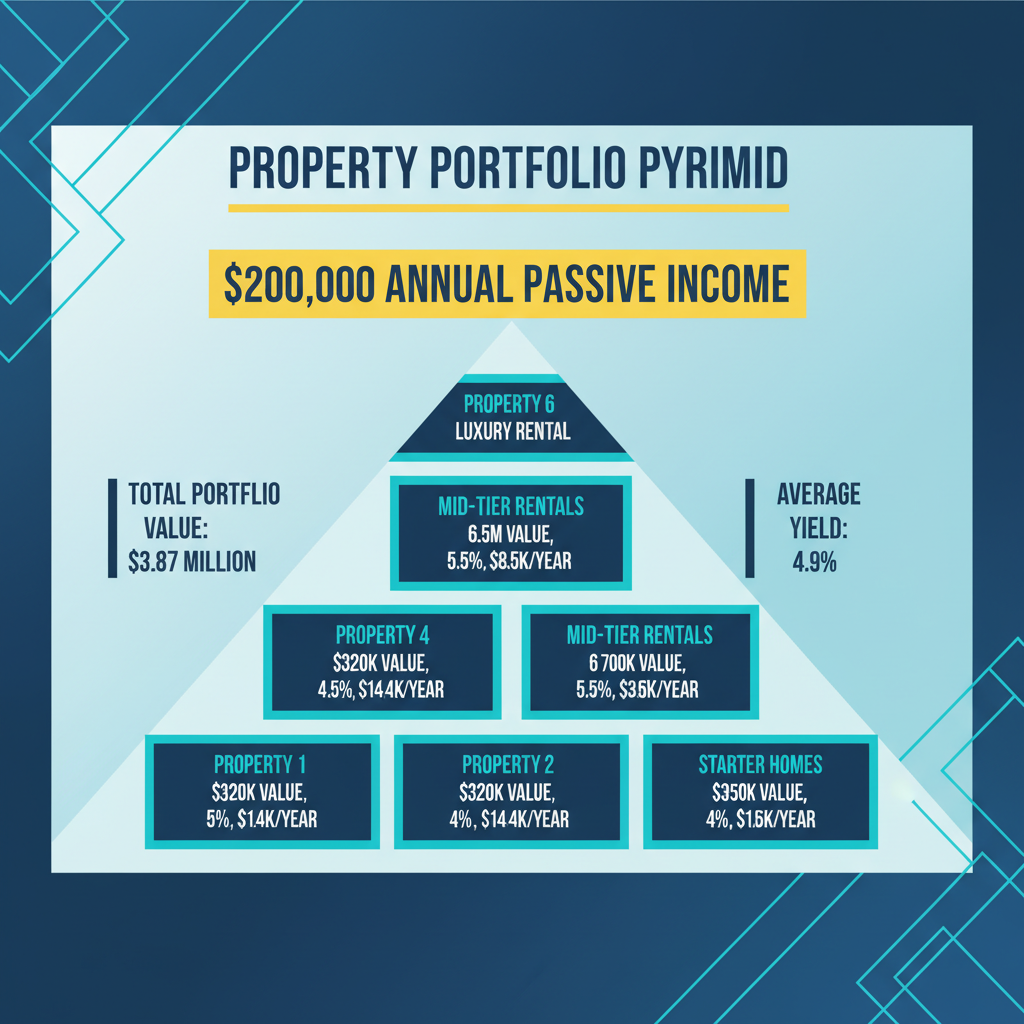
To generate $200,000 in passive income annually, you need approximately $3,846 per week before tax. The exact number of properties required depends entirely on your strategy and the markets you target.
A single person starting in their late 20s can build a portfolio generating $130,000 per year (around $2,500 weekly) with just 3 investment properties plus their primary residence over a 30-year timeframe.
For $200K annual income, most investors need 5-7 strategically selected properties depending on rental yields. Properties generating net yields of 4-5% on a $600,000 value deliver approximately $24,000-30,000 annually each. Seven properties at $28,000 average annual net income reach $196,000 total.
The Math Behind Property Portfolio Income
The mathematics of passive property income relies on three key variables: property value, rental yield, and net holding costs. Here's how it works in practice.
A property purchased for $650,000 with a 5% gross rental yield generates $32,500 annually in rent. With typical holding costs consuming 30-40% of rental income (interest, rates, insurance, management, maintenance), the net passive income sits around $19,500-22,750 per year.
According to SQM Research, national rental vacancy rates hover around 1-2% in early 2026, creating strong rental demand. This tight market supports consistent rental returns and reduces vacancy risk across most markets.
The key insight is that reaching $200K requires either more properties at moderate yields or fewer properties at exceptional yields (6%+). Most investors find the sweet spot combining 5-7 properties across different price points and yield profiles.
Rental Yield vs Capital Growth Strategy
High-Yield Markets vs Growth Markets
The fundamental choice every investor faces is whether to prioritize immediate cash flow (high rental yield) or long-term wealth building (capital growth). Smart investors understand these aren't mutually exclusive but require different strategies.
According to Savings.com.au data, Darwin offers the highest rental yields among capital cities at 6.6% for houses and 7.8% for units in 2026. Regional Western Australia dominates the top yield markets, with some suburbs exceeding 12% gross yields.
However, high-yield properties often sacrifice capital growth potential. As CoreLogic research notes, Perth properties offering 5% yields delivered 13% capital growth in 2025, while Brisbane balanced 4.5% yields with 12% growth.
The strategic approach involves building a balanced portfolio with both property types. Your first 2-3 properties might target capital growth in Brisbane or Perth to build equity quickly. Properties 4-6 focus on regional high-yield markets to boost cash flow.
Calculating Your Target Rental Yield
Understanding rental yield calculations is essential for evaluating whether a property moves you closer to your $200K income goal. Gross yield is calculated as: (Annual Rent ÷ Property Value) × 100.
For example, a $500,000 property generating $480 weekly rent ($24,960 annually) delivers a 4.99% gross yield. But gross yields are misleading because they ignore holding costs.
Sydney averages 3% gross yield, Melbourne 3.5%, Brisbane 4.5%, Perth 5.3%, and Adelaide 4.8% in 2026. Regional areas frequently achieve 5-7%+ yields.
Net yield is the figure that matters for passive income planning. After deducting mortgage interest, council rates, strata fees, insurance, management (7-8% of rent), and maintenance (typically 1% of property value annually), your net yield might be 1-3% lower than gross.
A property with 5% gross yield and $400,000 loan at 6% interest will see most rental income consumed by interest alone. This is why investors targeting passive income focus on paying down debt strategically or selecting properties where rent substantially exceeds interest costs.
Balancing Cash Flow and Long-Term Wealth
The most successful investors don't choose between yield and growth. They sequence their purchases to balance immediate cash flow needs with long-term equity building.
Starting with growth-focused properties in appreciating markets lets you build equity quickly. Adelaide, Brisbane, and Perth are expected to deliver 6%+ capital growth in 2026, with Perth potentially reaching 10%+.
Once you've built $150,000-200,000 in usable equity across 2-3 properties over 5-7 years, you can access that equity to purchase higher-yield properties in regional markets. These boost your cash flow while your earlier purchases continue appreciating.
Buyers Agency Australia helps investors identify markets offering optimal yield-growth combinations. With Dragan Dimovski's expertise in portfolio modeling, you can structure purchases that compound both income and equity systematically.
A balanced portfolio might include: Brisbane growth property ($650K, 4.5% yield, 8% growth), Adelaide growth property ($580K, 4.8% yield, 7% growth), Regional QLD high-yield ($420K, 6.2% yield, 4% growth), and Regional WA high-yield ($380K, 6.8% yield, 5% growth). This combination delivers strong total returns.
Using Leverage to Scale Your Property Portfolio
How Property Leverage Multiplies Returns
Leverage is the single most powerful tool for building wealth through property investment. It allows you to control assets worth substantially more than your initial capital, amplifying both rental income and capital growth.
With a $100,000 deposit and 80% LVR (loan-to-value ratio), you can purchase a $500,000 property. If that property grows 10% annually, you've gained $50,000 on a $100,000 investment, a 50% return on your capital.
Australian investors typically use 80% LVR to avoid Lenders Mortgage Insurance (LMI). This means every $100,000 in savings controls $500,000 in property assets.
The leverage effect applies to rental income as well. Your $500,000 property generating $25,000 annual rent represents a 25% return on your $100,000 deposit (ignoring expenses for this calculation). Even after mortgage costs, your return on invested capital far exceeds what the property's total yield suggests.
Understanding this mathematical advantage explains why property investors can build substantial passive income portfolios faster than those saving cash alone. The bank essentially funds 80% of your income-producing asset.
Accessing Equity to Buy Your Next Property
Equity recycling is how investors scale from one property to a portfolio generating $200K+ passive income. As your properties appreciate, you can borrow against the increased value to fund additional purchases without selling.
Here's how it works in practice. You purchase a property for $600,000 with a $120,000 deposit and $480,000 loan at 80% LVR. Five years later, the property appreciates to $780,000 through 5.4% annual growth.
Your usable equity is now: ($780,000 × 80%) – $450,000 (remaining loan) = $174,000. According to Real Estate Business analysis, investors in 2026 are refinancing more conservatively at 70-75% LVR to maintain buffers.
At 75% LVR, your usable equity from that $780,000 property is approximately $135,000, sufficient to purchase your next $600,000 property with $120,000 deposit plus $15,000 for stamp duty and costs.
Buyers Agency Australia structures equity access strategies that maintain healthy buffers while maximizing growth velocity. Dragan's portfolio modeling identifies optimal timing for equity pulls based on market conditions and your serviceability position.
The key constraint is serviceability. Lenders assess whether your income can service all loans even if interest rates rise 3%. This typically limits most investors to 5-8 properties depending on income, existing debt, and rental returns.
Managing Debt Strategically for Maximum Income
Debt isn't inherently good or bad. It's a tool that requires strategic management to build passive income systematically. The goal is using debt to acquire income-producing assets while maintaining comfortable serviceability buffers.
Smart debt management means keeping loan structures flexible with offset accounts and splits. This lets you redirect income strategically as your portfolio matures.
According to API Magazine research, investors in 2026 are focusing on cash flow resilience over speculative growth. Many use fixed-rate tranches to protect against rate volatility while maintaining variable portions for flexibility.
A typical strategy involves paying interest-only on investment loans to maximize cash flow during accumulation phase (years 1-15), then switching to principal-and-interest once your portfolio is complete. This lets you direct surplus cash flow toward debt reduction systematically.
For a $200K passive income goal, most investors maintain 4-6 properties with mortgages while paying off 1-2 completely. The debt-free properties provide secure base income ($40,000-60,000 annually) while mortgaged properties deliver smaller net returns but greater total income.
The transition to genuine passive income happens as loans are progressively reduced. A portfolio generating $280,000 gross rent with $80,000 in interest costs and $30,000 other expenses delivers $170,000 net. As you pay down $200,000 in debt, you free up approximately $12,000 annually in interest costs.
Property Types That Generate Highest Returns
Dual-Income and Dual-Key Properties
Dual-income properties offer one of the fastest paths to building substantial passive income because they generate two separate rental streams from a single asset. These properties significantly boost cash flow compared to standard single dwellings.
A dual-income property features two self-contained living spaces within a single building structure or on one title. This might be a main house with a self-contained granny flat, a dual-key apartment with two separate entrances, or a duplex on a single title.
Dual-income properties can deliver rental yields of 6%+ in high-growth NSW, QLD, VIC, and WA markets. The combined rent from two dwellings typically exceeds what a single larger home generates.
For example, a $580,000 dual-income property in regional Queensland might generate $380 weekly from the main dwelling and $280 weekly from the secondary dwelling, totaling $660 weekly or $34,320 annually. This delivers a 5.9% gross yield compared to 4.5% for a standard home at the same price point.
The advantage compounds when building a portfolio. Instead of needing 7 standard properties to reach $200K income, you might achieve the same with 5 well-selected dual-income properties.
Buyers Agency Australia specializes in identifying dual-income opportunities in growth corridors. Book a free strategy session to discover how these properties can accelerate your passive income timeline.
Regional High-Yield vs Metro Properties
The choice between regional high-yield properties and metropolitan assets fundamentally shapes your passive income timeline. Regional markets offer superior cash flow, while metros provide greater capital growth and stability.
According to Duo Tax analysis, Western Australia leads rental yields with several regional suburbs exceeding 12% gross returns. Queensland regional centers and South Australian regional markets consistently deliver 6-8% yields.
A $400,000 regional property generating 7% gross yield ($28,000 annually) might deliver $18,000-20,000 net passive income after expenses. That same $400,000 in Sydney or Melbourne generates 3.5-4% gross yield ($14,000-16,000), with net income potentially neutral or negative after mortgage costs.
The tradeoff is capital growth and liquidity. According to Cotality data, Perth houses grew 13% and Brisbane 9% in 2025, substantially outperforming regional averages. Metro properties also sell faster with deeper buyer pools.
The optimal strategy combines both property types. Your first 2-3 purchases might target Brisbane, Adelaide, or Perth outer suburbs offering 4.5-5.5% yields with 7-10% growth potential. These build equity quickly.
Once you've established $300,000+ usable equity, purchase 2-3 regional high-yield properties in markets like Toowoomba QLD, Geraldton WA, or Port Augusta SA. These boost cash flow immediately while your metro holdings continue appreciating.
Dragan Dimovski's 20+ years of market analysis helps investors identify regional markets with sustainable rental demand beyond mining booms. His due diligence filters out high-risk cyclical markets while finding genuine cash flow opportunities.
Townhouses vs Houses vs Units for Investors
Property type selection significantly impacts both rental yields and capital growth trajectories. Each asset class serves different purposes within a passive income portfolio.
Houses on land consistently deliver the strongest long-term capital growth but often lower initial rental yields. Houses appreciate substantially more than units over 20-year periods, with the gap widening over time.
A typical house in a growth suburb might deliver 4.2% gross yield but 7-9% annual capital growth. A unit in the same area offers 5.0% yield but only 4-6% growth. Over 10 years, the house builds far more usable equity for portfolio expansion.
Townhouses occupy the middle ground with yields typically 0.5-1.0% higher than houses but lower strata costs than units. They appeal to families seeking low-maintenance living, supporting stable tenancy and good capital growth.
Units deliver the highest immediate rental yields, especially in capital cities. A unit in Perth averages 5.7% yield compared to 4.3% for houses. However, units face higher vacancy risk, body corporate fees (reducing net yield), and slower capital growth.
For a $200K passive income strategy, the optimal mix might include 3 houses in growth suburbs for equity building, 2 townhouses for balanced returns, and 2 dual-income properties or regional houses for high cash flow.
Contact Buyers Agency Australia to discuss which property types align with your passive income timeline and risk tolerance. Their market analysis identifies the specific suburbs where each property type delivers optimal returns.
Building Your Portfolio Systematically
The 5-Year Plan to Your First Three Properties
Building substantial passive income requires a systematic approach rather than opportunistic purchases. Most investors reach their first three properties within 5-7 years with disciplined execution.
Year 1: Purchase your first investment property using saved deposit ($80,000-120,000) or equity from your primary residence. Target a growth market property in Brisbane, Adelaide, or Perth outer suburbs. Focus on serviceability and rental coverage.
Years 2-3: Let your first property appreciate while you save additional funds and improve serviceability. A property purchased at $600,000 growing 7% annually reaches $686,000 after 3 years, creating approximately $109,000 usable equity at 80% LVR (minus remaining loan).
Year 4: Purchase your second property using the equity from property one plus any additional savings. Target a similar growth-focused property or consider a higher-yield regional option if cash flow is limiting serviceability.
Years 4-5: Both properties appreciate while generating rental income. The combined equity growth from two properties appreciating 7% annually builds substantial borrowing capacity.
Year 5: Purchase your third property using accumulated equity from properties 1-2. At this stage, many investors shift toward higher-yield properties to improve cash flow and serviceability for future purchases.
Investors who buy 3-4 properties over 10-15 years and hold can generate $130,000+ passive income by retirement through appreciation and debt reduction.
How to Use Equity Recycling to Scale Faster
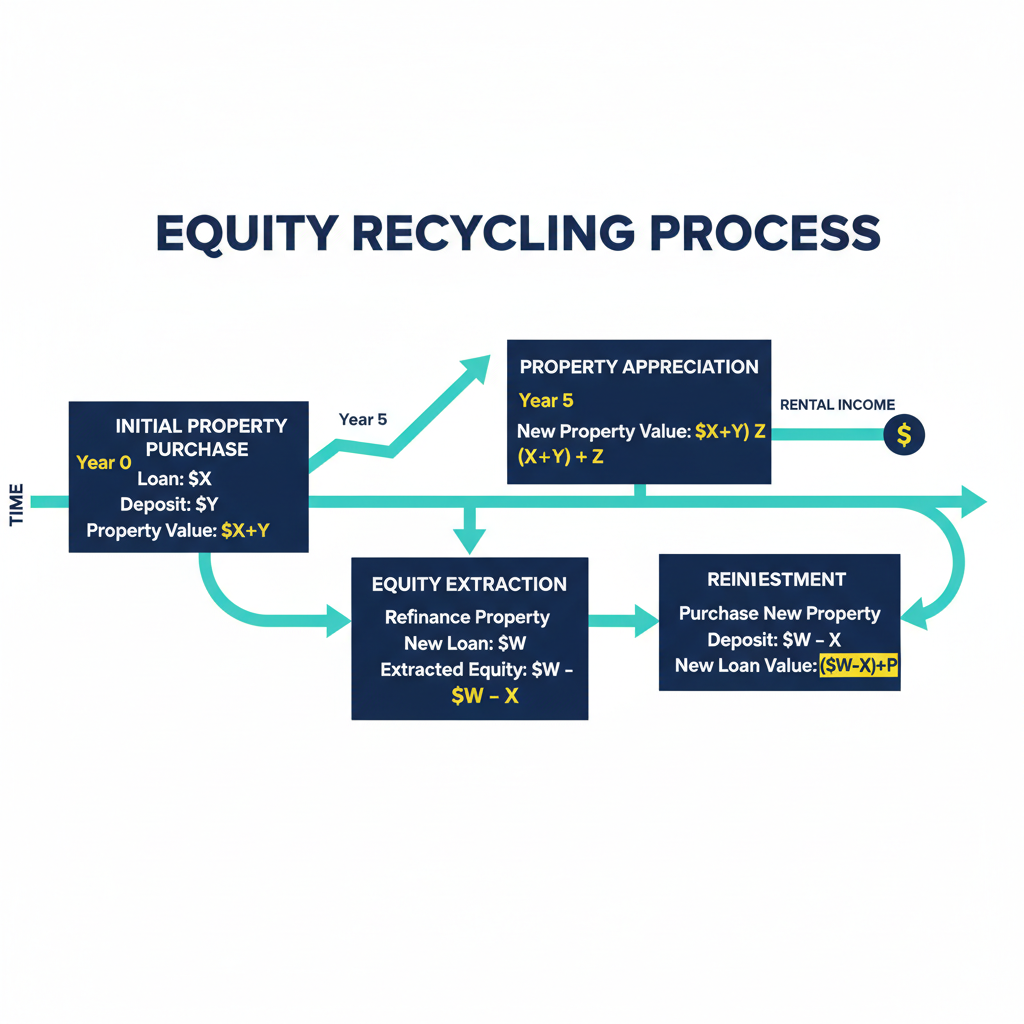
Equity recycling is the technique that separates investors who build one or two properties from those who construct portfolios generating $200,000+ passive income. It requires understanding both the mechanics and optimal timing.
The equity recycling cycle works like this: Buy property with 80% LVR, Hold 3-5 years while property appreciates, Refinance to access equity growth, Use equity as deposit for next purchase, Repeat while maintaining serviceability.
lenders typically allow you to borrow up to 80% of current property value. If your property worth $800,000 has a $550,000 loan, you have approximately $90,000 usable equity ($640,000 x 80% minus $550,000).
The critical factor is timing your equity pulls to align with market conditions and your income growth. Pulling equity during soft markets means getting lower valuations and less borrowing capacity.
Dragan Dimovski's portfolio modeling at Buyers Agency Australia helps investors plan optimal purchase sequences. His FastTrack program maps your specific path from current position to $200K passive income, identifying when to access equity and which markets to target.
The typical equity recycling timeline sees investors purchase every 2-3 years during accumulation phase. Property 1 at year 0, Property 2 at year 3, Property 3 at year 5, Property 4 at year 7, Properties 5-6 at years 9-12. By year 15, you're managing 5-6 properties with substantial equity positions.
Serviceability eventually limits further purchases. Most investors hit their borrowing ceiling at 5-8 properties depending on income and rental returns. At that point, the strategy shifts to debt reduction and cash flow optimization rather than portfolio expansion.
When to Stop Buying and Start Debt Reduction
The transition from acquisition mode to consolidation mode is critical for converting portfolio equity into actual passive income. Many investors miss this shift and either overbuy or stop too early.
You should consider stopping portfolio expansion when you've reached serviceability limits (banks won't lend more), Your portfolio generates sufficient gross rent to hit $200K net after debt paydown, or Market conditions shift to favor debt reduction over new purchases.
Smart investors are buying below long-term borrowing ceilings and focusing on manufacturing equity through renovations rather than continued acquisition.
A portfolio of 6 properties with total value $3.5 million and $2.2 million debt generates approximately $175,000 gross rent at 5% average yield. After $132,000 in interest costs (6% rate) and $35,000 other expenses, net income is just $8,000 annually.
However, if you stop buying and redirect all cash flow toward debt reduction, you might pay off $400,000 over 5-7 years. This eliminates $24,000 in annual interest costs, converting to additional passive income. Your net jumps from $8,000 to $32,000 annually.
The optimal strategy often involves paying off 1-2 properties completely while maintaining mortgages on higher-value properties. Debt-free properties generate $30,000-45,000 each in passive income while mortgaged properties contribute smaller amounts that grow as debt reduces.
Dragan Dimovski's portfolio modeling includes debt paydown simulations showing your passive income trajectory under different scenarios. This helps you make informed decisions about when to shift from growth mode to consolidation mode.
Advanced Strategies for Accelerating Income
Co-Living and Rooming House Opportunities
Co-living properties represent an advanced strategy for investors seeking to maximize rental income per square meter. These properties generate substantially higher yields than traditional rentals but require more active management.
A co-living property involves renting individual rooms within a house to separate tenants who share common areas. A 4-bedroom house renting for $550 weekly as a whole might generate $180-220 per room when rented individually, totaling $720-880 weekly.
Co-living arrangements in Brisbane can generate $900+ weekly from properties worth $600,000-700,000, delivering gross yields exceeding 7%.
The risks include higher tenant turnover, increased wear and tear, more complex management, and regulatory requirements in some states. Many councils restrict rooming houses or require special permits.
For investors willing to accept higher management intensity, 1-2 co-living properties within a portfolio can significantly boost overall cash flow. A $650,000 co-living property generating $42,000 annually ($808 weekly) might deliver $28,000-30,000 net passive income.
This strategy works best for investors who've already established 3-4 traditional properties and understand property management fundamentals. Adding co-living properties at the portfolio's tail end can push you over the $200K threshold faster.
Value-Add Renovations That Boost Rent
Strategic renovations offer one of the fastest ways to increase passive income without buying additional properties. The key is targeting improvements that tenants will pay extra rent for relative to renovation costs.
High-return renovations include fresh paint (interior and exterior), updated kitchen with modern appliances, renovated bathrooms, new flooring (hybrid timber or quality carpet), improved outdoor areas and landscaping, and energy-efficient additions (solar panels, insulation).
A $30,000-40,000 renovation on a property currently renting for $450 weekly might justify a $50-70 weekly rent increase. That additional $60 weekly equals $3,120 annually, representing a 7.8% return on your $40,000 investment plus boosted cash flow permanently.
According to API Magazine analysis, investors in 2026 are increasingly using value-add renovations to manufacture equity and boost rental returns in a market where capital growth is moderating.
The renovation strategy particularly suits investors who've reached borrowing limits. Instead of buying property 7, you might invest $150,000 renovating properties 1-5, increasing total rent by $250-350 weekly. This additional $13,000-18,000 annual income requires no additional debt.
Buyers Agency Australia's due diligence process identifies properties with value-add potential during initial purchase. Dragan's renovation network includes trusted trades who execute improvements cost-effectively, maximizing your return on renovation investment.
The key is renovating to the suburb's rental market standard, not overcapitalizing. A property in a $500 weekly rental market doesn't justify $80,000 in luxury finishes. Target renovations that lift your property to the suburb's top 25% rental band.
Tax Strategies to Maximize After-Tax Income
Tax planning significantly impacts your actual passive income because all rental earnings face tax at your marginal rate. Strategic structuring and deduction maximization can save $15,000-30,000 annually on a substantial portfolio.
Key tax strategies include claiming depreciation on building structure (2.5% annually for 40 years on post-1985 construction) and plant/equipment assets, deducting all interest on investment loans, claiming council rates, insurance, property management fees, maintenance, and repairs, and utilizing negative gearing to reduce taxable income during accumulation phase.
According to ATO guidelines, Australian investors can claim $8,000-15,000 annually in depreciation on newer properties, providing tax-free cash flow improvement.
A quantity surveyor depreciation schedule costs $600-800 but typically identifies $40,000-100,000 in claimable depreciation over the property's life. For an investor in the 37% tax bracket, this saves $14,800-37,000 in tax over time.
Ownership structure matters significantly once portfolios exceed 3-4 properties. Many investors start in personal names to benefit from negative gearing against personal income, then consider trust structures for asset protection and tax distribution as portfolios grow.
Buyers Agency Australia's podcast features interviews with tax specialists who explain optimal structuring for different investor situations. Dragan's network includes trusted accountants specializing in property investment tax planning.
The transition to positive cash flow changes your tax position substantially. Investors generating $200K passive income face tax liabilities of $60,000-70,000 annually depending on other income and deductions. Planning for this tax obligation is essential to maintaining your desired lifestyle.
How Dragan Dimovski Helps Investors Reach $200K Income Goals

Portfolio Modeling and 10-Year Projections
Reaching $200,000 in passive income isn't about buying random properties and hoping for the best. It requires detailed modeling of purchase sequences, market selection, equity growth, and cash flow trajectories over 10-15 year horizons.
Buyers Agency Australia provides comprehensive portfolio modeling that maps your specific path from current position to your income goal. Dragan Dimovski's modeling incorporates your current equity, income, expenses, and serviceability to determine realistic purchase timing and property selection.
The modeling process identifies how many properties you need, which markets to target in which sequence, when to access equity for each purchase, projected rental income and capital growth for each property, debt paydown schedules, and your passive income trajectory year by year.
This evidence-based approach removes guesswork and emotional decision-making. You can see exactly how long it takes to reach $200K passive income under different scenarios (conservative 5% growth vs moderate 7% growth vs strong 9% growth).
Many investors discover they need fewer properties than expected when targeting the right markets. A portfolio of 5 well-selected properties in high-yield markets with strong growth can outperform 8 randomly chosen properties.
Book a free strategy session to receive your personalized portfolio roadmap. Dragan's team analyzes your situation and provides a detailed acquisition timeline showing your path to $200K passive income.
Identifying High-Yield Markets Before They Peak
Timing your market entry significantly impacts both rental yields and capital growth. Buying into markets early in their growth cycle maximizes total returns, while entering at peak means accepting lower yields and potential short-term stagnation.
Dragan Dimovski's 20+ years of market analysis has developed a systematic process for identifying markets offering optimal yield-growth combinations before mainstream investors flood in. This early identification creates the best opportunities for building passive income portfolios.
The analysis examines economic indicators (employment growth, business investment, infrastructure spending), supply-demand dynamics (dwelling approvals vs population growth, vacancy rates, days on market), affordability metrics (price-to-income ratios, rental yields compared to historical averages), and migration patterns (interstate and overseas migration trends).
Adelaide, Brisbane, and Perth offer the strongest fundamentals in 2026 with anticipated 6%+ capital growth. Regional markets in Queensland and Western Australia provide superior cash flow opportunities.
Buyers Agency Australia's research process filters through Australia's 400+ markets to identify the 20-30 suburbs offering optimal risk-adjusted returns for passive income investors. This focused approach ensures you're buying in markets with sustainable rental demand and growth catalysts.
Dragan's $10M+ personal portfolio demonstrates his ability to identify markets early. His investments consistently outperform because they're grounded in fundamental analysis rather than speculation or media hype.
End-to-End Buyer Advocacy and Negotiation
Identifying the right markets and properties is only half the equation. Successful passive income building requires securing properties at or below market value to maximize equity position and rental returns from day one.
Buyers Agency Australia provides comprehensive buyer advocacy services including property search aligned with your portfolio strategy, detailed due diligence (building inspections, pest reports, rental appraisals, title searches), market value assessments using comparable sales analysis, expert negotiation to secure below-market purchases, and auction bidding when required.
Dragan Dimovski's negotiation expertise consistently saves clients $20,000-50,000 per purchase. Over a 6-property portfolio, this represents $120,000-300,000 in additional equity created through purchasing power alone.
For time-poor professionals, the end-to-end service is particularly valuable. You don't need to spend weekends attending inspections or researching comparable sales. Buyers Agency Australia handles all research, due diligence, and negotiation while keeping you informed at each decision point.
The fixed-fee model provides transparency without conflicts of interest. Unlike commission-based agents who benefit from higher prices, Buyers Agency Australia's incentive aligns with yours—securing the best properties at the best prices to maximize your passive income potential.
Contact Buyers Agency Australia to discuss how their buyer advocacy services can accelerate your path to $200,000 passive income. With offices serving all major Australian capital cities, they provide boots-on-the-ground expertise regardless of where you're targeting investment.
Frequently Asked Questions
How long does it take to build $200K passive income?
Most investors require 10-15 years to build $200K passive income, acquiring 5-7 properties with equity recycling and allowing time for capital appreciation and partial debt paydown.
What deposit do I need to start building a portfolio?
You need $80,000-120,000 deposit for your first investment property, or sufficient equity in your home. Subsequent properties use equity from earlier purchases as deposits.
Can I reach $200K income with negatively geared properties?
Yes, negative gearing during accumulation phase builds equity through growth. As debt reduces over 10-15 years, properties transition to positive cash flow, generating passive income.
What rental yield do I need for $200K income?
Target average 5-5.5% net yields across 6-7 properties worth $600,000 each, generating $30,000-33,000 annually per property after debt paydown, totaling $200K+ income.
How does Buyers Agency Australia charge for services?
Buyers Agency Australia uses a transparent fixed-fee model. Contact them for a detailed fee schedule based on your purchase locations and portfolio strategy.
 General
Learn the proven strategies Australian investors use to generate $200,000 in passive rental income through strategic portfolio building,...
Dual-income properties—duplexes, granny flats, and dual-key homes—are generating 6-8% rental yields in 2026, often doubling the income of traditional single-tenancy investments while offering protection against interest-rate pressure and vacancy risk.
Interest rates remain elevated in early 2026, and single-dwelling rental yields are struggling to cover holding costs for most investors. The national vacancy rate sits at just 1.2%, but landlords with only one income stream face mortgage stress when rates climb or tenants leave.
That's why search volume for "dual-income property" has jumped 140% year-on-year. Investors are pivoting to configurations that deliver two rental streams from one asset: granny flats behind existing homes, side-by-side duplexes, or dual-key layouts with lockable internal doors.
Buyers Agency Australia helps clients identify these high-yield opportunities across Brisbane, Melbourne, Sydney, and Perth, where zoning reforms have opened thousands of previously restricted blocks to dual-occupancy development.
The Yield Gap: Single-Tenancy vs Dual-Income in 2026
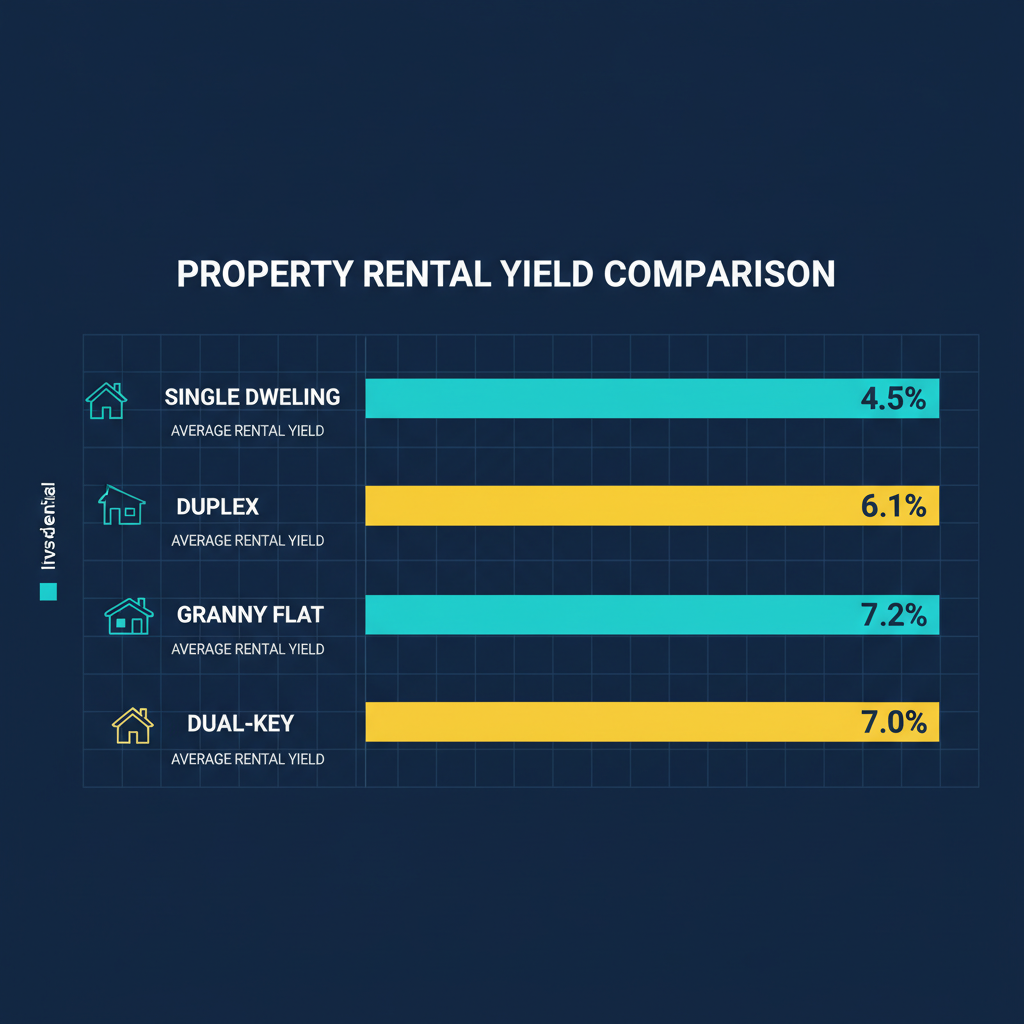
The numbers tell the story. A $700,000 house renting for $600/week delivers a 4.5% gross yield. A $850,000 dual-occupancy property renting for $1,000/week combined delivers 6.1%—and eliminates total vacancy risk.
Rental yields across Australia average 5-6% nationally, according to Elders Real Estate. But dual-income configurations consistently outperform:
- Granny flats: 6.5-8% yields in growth corridors
- Duplexes: 6-7% yields with lower per-unit build costs
- Dual-key homes: 7% yields in high-demand metro areas
A single property renting for $650/week generates $33,800 annually. Two well-designed units on the same land can bring in $1,100-$1,300 combined—that's $57,200 to $67,600 per year, often with shorter vacancy periods.
Why Single-Tenancy Yields Are Under Pressure
Holding costs have climbed. Even with rental growth of 3.9% for houses in 2025, mortgage repayments on investment loans have risen faster. Property taxes, insurance, and maintenance eat into cash flow.
When your sole tenant vacates, income stops completely. With dual-income properties, one unit can remain occupied while the other turns over, maintaining cash flow continuity.
Rental demand is strong—vacancy rates remain tight—but single-dwelling investors can't access the same income diversification that dual configurations provide.
The Dual-Income Advantage: Two Streams, One Title
Dual-income properties sit on a single land title, which means:
- One set of council rates
- One property insurance policy
- No body corporate fees (unlike strata duplexes)
- Simplified financing compared to two separate purchases
You're effectively creating two income-producing assets without doubling your land cost. In Brisbane's outer suburbs, a $700,000 block with a house and granny flat can generate $1,050/week combined—$54,600 annually—while a single $700,000 house might rent for $600/week ($31,200 annually).
That's a $23,400 annual income difference, or 75% more cash flow from the same land value.
Top 3 Dual-Income Configurations for 2026
Not all dual-income properties are created equal. Here's how the three main configurations stack up for yield, cost, and investor suitability.
Duplexes: Side-by-Side or Attached Units
A duplex features two separate dwellings on one block, typically sharing a common wall (attached) or built side-by-side (detached). Each unit has its own entrance, kitchen, bathroom, and living areas.
Yield Profile
Duplexes deliver 6-7% gross yields across Melbourne suburbs, according to recent market data. A $1.2 million duplex development (two 3-bedroom units) can generate $1,200-$1,400/week combined.
Construction Costs
Building a duplex costs $700,000 to $1.2 million in Melbourne, or $2,000-$3,800 per m². Total investment including land often exceeds $1.5-$2 million in established suburbs.
Attached configurations reduce costs by 10-15% compared to detached layouts. Detached duplexes offer better tenant privacy and easier future strata subdivision.
Best For
Investors with larger capital bases ($300,000+ deposit) seeking capital growth plus income. Duplexes attract families and long-term tenants, reducing turnover.
You can live in one unit while renting the other, or rent both for maximum cash flow. Future subdivision allows separate sale of each unit if market conditions favour it.
Granny Flats: Secondary Dwellings Behind the Main House
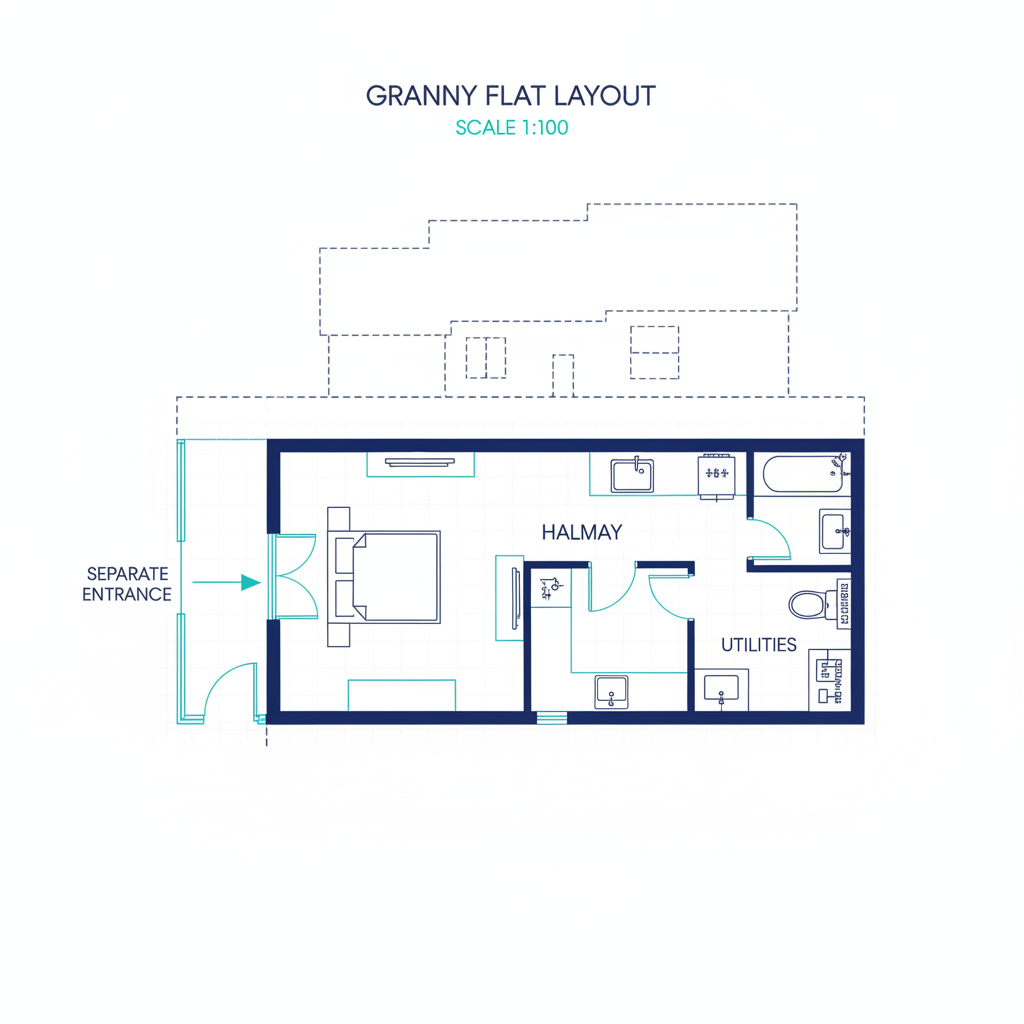
A granny flat is a self-contained secondary dwelling built on the same lot as an existing primary residence. It must remain subordinate to the main house and cannot be sold separately.
Yield Profile
Granny flats deliver 6.5-8% yields, with some setups generating $400-$550/week in high-demand areas. A 60m² granny flat costing $180,000 to build can generate $20,000-$28,000 annually.
Building a granny flat can boost overall property value by 20-30%, according to CoreLogic 2019 data still cited as relevant in 2026 markets.
Construction Costs
A quality granny flat costs $150,000-$200,000 for a compact one-bedroom design. Two-bedroom or custom layouts range $180,000-$250,000 depending on site conditions and finishes.
Fast-track approvals in NSW (Complying Development Certificate pathway) mean 8-12 week approval times versus 4-6 months for traditional Development Applications.
Victoria's December 2023 reforms allow granny flats under 60m² on properties over 300m² with streamlined approvals, no longer requiring full council consent.
Best For
Investors with existing properties on suitable blocks (typically 450m²+) who want to add income without selling. You can retain your primary residence CGT exemption on the main house while claiming depreciation on the granny flat.
Granny flats payback within 10-15 years from rental income alone, faster when factoring property value uplift.
Dual-Key Homes: Shared Entry, Separate Lockable Units
A dual-key property is a single building divided into two self-contained units, typically with one shared front entrance or foyer leading to separate lockable doors. Think of it as a house with an attached granny flat under one roof.
Yield Profile
Dual-key properties deliver around 7% yields, with higher returns in metro areas facing housing affordability pressure. A $750,000 dual-key home can rent for $580/week (main unit) + $400/week (secondary unit) = $980/week combined ($51,000 annually).
Construction Costs
Dual-key homes cost more per square metre than single dwellings because you're duplicating kitchens, bathrooms, and plumbing. Expect $350,000-$500,000 build costs depending on size and finishes.
However, you're building two income streams under one roof, which is more cost-efficient than purchasing two separate properties.
Best For
First-time investors seeking strong cash flow without massive capital outlays. Owner-occupiers can live in the larger unit while renting the smaller one, using tenant income to cover 40-60% of mortgage repayments.
Dual-key homes appeal to multi-generational families, young professionals, and downsizers, creating broad tenant appeal.
Resale Considerations
Dual-key properties have a narrower resale market than traditional homes. Owner-occupiers (67% of Australian buyers) typically prefer standard houses with full backyards. However, in high-density growth corridors, dual-key homes are gaining traction as affordable housing solutions.
Some investors convert dual-key properties back to single dwellings before resale to broaden buyer appeal and maximise capital growth.
Council Secrets: Relaxed Zoning Laws Opening Dual-Income Opportunities
Zoning reforms across Australia have unlocked thousands of previously restricted blocks for dual-occupancy development. Understanding these changes is critical to identifying viable investment opportunities.
NSW: R2 Zone Dual-Occupancy Reforms (July 2024)
The State Environmental Planning Policy (Housing) Amendment 2024 now permits dual occupancies and semi-detached dwellings with development consent in R2 Low Density Residential zones across NSW.
This applies to Greater Sydney, Central Coast, Illawarra, and Hunter regions—but excludes Bathurst, Hawkesbury, Blue Mountains, and Wollondilly councils.
Key Requirements
- Minimum lot size: 400m² or council-specified minimum
- Minimum lot width: 12 metres
- Each dwelling must face a public road (except corner blocks)
- One off-street parking spot per dwelling
- Compliance with Low Rise Housing Diversity Design Guide
Thousands of R2 properties previously locked out of dual-occupancy development are now viable. However, dual occupancies permitted under this SEPP are not eligible for Complying Development (fast-track approval)—you'll need a full Development Application.
Victoria: Secondary Dwelling Reforms (December 2023)
Victoria's planning reforms allow granny flats under 60m² on residential lots over 300m² without full council approval, provided they meet state design standards.
This fast-tracks approval timelines from 4-6 months to 6-8 weeks, reducing holding costs and accelerating rental income commencement.
Queensland: Ancillary Dwellings and Dual Occupancy
Queensland allows dual-occupancy developments in residential zones, provided minimum lot sizes and planning guidelines are met. In some cases, secondary dwellings (granny flats) can be built without full development approval.
However, rental restrictions vary by council—some areas require family connections between main house and granny flat tenants, limiting investment utility. Always verify local regulations before purchasing.
Western Australia: Ancillary Accommodation Flexibility
WA councils are increasingly allowing flexible ancillary dwelling designs under R-Codes. Perth's 2025 reforms expanded dual-occupancy eligibility across suburban zones, with some councils eliminating planning approval requirements for compliant designs.
Ancillary dwellings must be associated with a single house and remain on the same lot, but can be rented independently in most council areas.
How to Verify Your Block's Dual-Income Eligibility
Before purchasing any property for dual-income conversion:
- Check the property's zoning on your council's planning portal
- Request a copy of the Development Approval (DA) or Planning Permit if the property already has a secondary dwelling
- Verify minimum lot size, width, and setback requirements
- Confirm rental permissibility—some granny flats cannot be rented to non-family members
- Factor in approval timelines: 8-12 weeks for CDC pathways, 4-6 months for DAs
Buyers Agency Australia conducts full zoning and feasibility assessments as part of our property search service, identifying blocks with hidden dual-income potential.
The ROI Blueprint: Modeling Dual-Income Returns
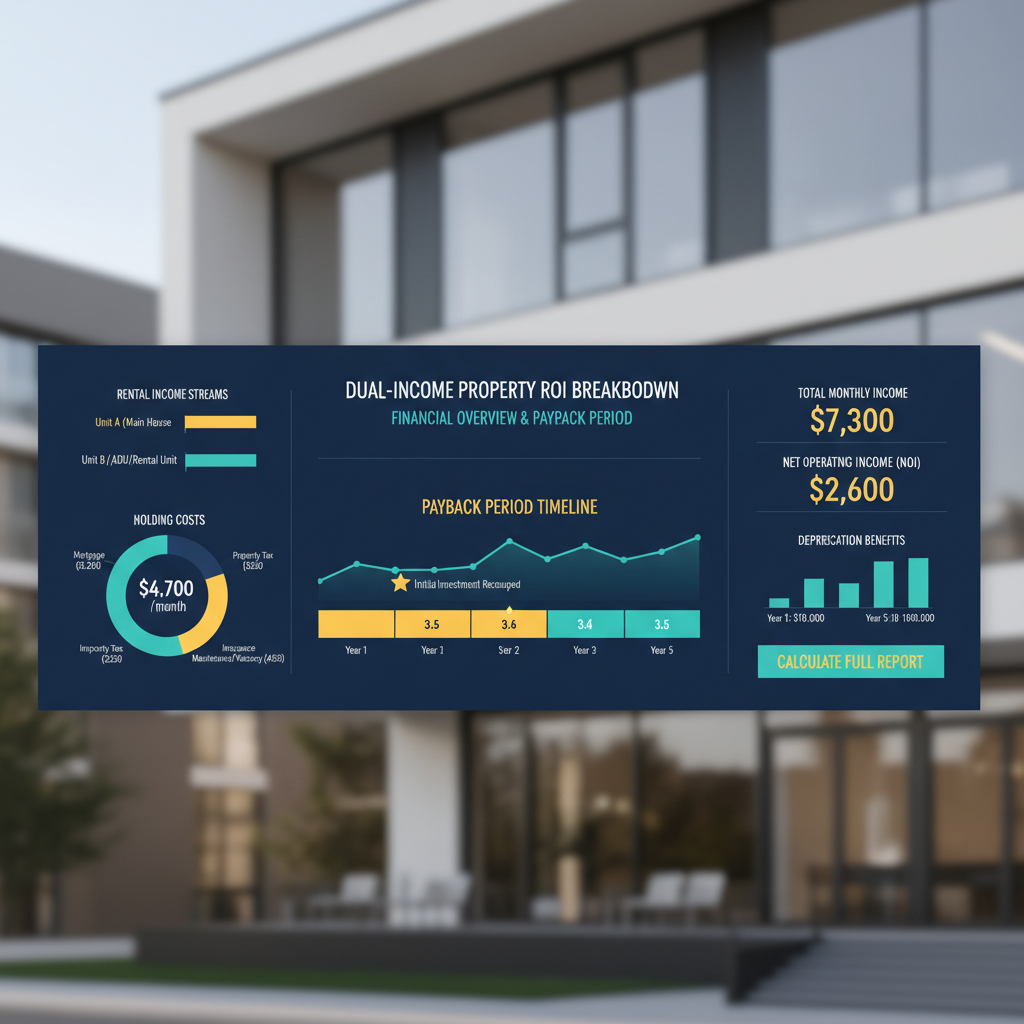
Running the numbers before purchase is non-negotiable. Here's how to model dual-income property returns accurately.
Gross Rental Yield Calculation
Gross rental yield = (Annual Rent / Property Cost) × 100
Example: Granny Flat Addition
- Existing property value: $650,000
- Granny flat build cost: $180,000
- Total investment: $830,000
- Main house rent: $550/week ($28,600/year)
- Granny flat rent: $400/week ($20,800/year)
- Combined annual rent: $49,400
- Gross yield: ($49,400 / $830,000) × 100 = 5.95%
A single $830,000 house might rent for $650/week ($33,800/year) = 4.07% yield. The dual-income configuration delivers 46% more cash flow.
Net Yield: Factoring in Holding Costs
Net rental yield accounts for expenses:
- Council rates: $2,200/year
- Insurance: $1,800/year
- Maintenance: $4,000/year (both dwellings)
- Property management: 8% of rent ($3,952/year)
- Total expenses: $11,952/year
Net yield = ($49,400 – $11,952) / $830,000 × 100 = 4.5%
Still significantly higher than single-dwelling alternatives in the same price range.
Payback Period Analysis
How long until the granny flat build cost is recovered?
Granny flat generates $20,800/year in rent. Build cost: $180,000.
Payback period = $180,000 / $20,800 = 8.7 years
Factor in depreciation deductions (approx. $8,000/year for first 5 years), and the effective payback drops to 6-7 years.
After payback, that $20,800 becomes pure cash flow, plus the property's capital value has increased by 20-30% due to the granny flat addition.
Depreciation Boost: Maximising Tax Deductions
New granny flats and dual-key homes qualify for depreciation deductions on:
- Building structure (Division 43): 2.5% per year for 40 years
- Plant and equipment (Division 40): Appliances, fixtures, fittings depreciate faster (higher deductions in early years)
A $180,000 granny flat can generate $16,000 annually in depreciation for the first several years, reducing taxable income and improving after-tax returns.
A qualified quantity surveyor prepares a depreciation schedule, maximising claimable amounts. This is one of the biggest tax deductions available to property investors after loan interest.
Capital Growth Comparison: Dual-Income vs Single Dwelling
Dual-income properties often experience stronger capital growth than single dwellings due to:
- Higher rental yields attracting investor demand
- Increased property utility (two dwellings vs one)
- Scarcity—dual-income configurations remain relatively rare
Properties with granny flats sell for around 30% more than comparable homes without secondary dwellings, according to CoreLogic data.
A $650,000 property adding a $180,000 granny flat (total $830,000) can see market value jump to $900,000-$950,000 immediately due to dual-income potential—that's instant equity of $70,000-$120,000.
How Buyers Agency Australia Identifies High-Yield Dual-Income Deals
Dragan Dimovski and the Buyers Agency Australia team specialise in uncovering dual-income opportunities that most investors miss. With 20+ years of experience and a $10M+ personal portfolio, Dragan applies a systematic approach to property selection.
The 3-Filter Dual-Income Assessment
Filter 1: Zoning and Feasibility
We analyse council zoning overlays, minimum lot sizes, and planning policies to confirm dual-occupancy eligibility. Many properties marketed as "granny flat potential" fail basic zoning tests—we eliminate these before you waste time on inspections.
Filter 2: Yield Modeling
We run full ROI calculations including build costs, rental income projections, depreciation schedules, and holding costs. If the numbers don't deliver 6%+ net yields, we move on.
Filter 3: Capital Growth Indicators
Dual-income properties must also offer long-term capital appreciation. We assess:
- Suburb infrastructure pipelines (transport, schools, retail)
- Median house price growth trends (5-10 year view)
- Rental demand indicators (vacancy rates, population growth)
- Development activity levels
This ensures you're buying in areas where both yield and growth converge.
Off-Market Dual-Income Opportunities
Many of our best dual-income acquisitions never hit the open market. We access off-market listings through our agent network across Brisbane, Melbourne, Sydney, and Perth.
Off-market properties avoid bidding wars, deliver better negotiation outcomes, and often come with existing DAs or completed granny flats—accelerating your path to rental income.
End-to-End Dual-Income Project Management
For clients adding granny flats to existing properties, we coordinate:
- Zoning feasibility reports
- Architect and builder selection
- Council approval navigation (CDC or DA pathways)
- Quantity surveyor engagement for depreciation schedules
- Property management setup
You get a turnkey dual-income asset without project management headaches.
Book a free strategy session to discuss your dual-income investment goals and see how we can accelerate your portfolio growth.
Dual-Income Financing: Structuring Loans for Maximum Serviceability
Banks assess dual-income properties differently than single dwellings. Understanding financing nuances ensures you secure optimal loan terms.
Rental Income Shading
Lenders typically shade (discount) rental income by 20% when calculating serviceability. If your dual-income property generates $1,000/week combined, banks use $800/week in serviceability tests.
However, having two income streams reduces vacancy risk perception, which can improve lending appetite.
Construction Lending for Granny Flats
If you're building a granny flat on an existing property, you'll need a construction loan. Banks lend 80-95% of the property's value (including the main house), but only 65-70% if you demolish the house first.
Retaining the existing house maintains higher borrowing capacity and serviceability.
Lenders Who Prefer Dual-Income Properties
Some lenders view dual-income configurations favourably due to enhanced cash flow and risk diversification. Working with a mortgage broker experienced in dual-income financing ensures you access the best rates and terms.
Interest-Only Loans for Dual-Income Investors
Many dual-income investors use interest-only loans to maximise cash flow during the early years. This allows rental income to cover more of the mortgage, improving after-tax returns.
After 5-7 years, the property's capital growth and rent increases typically support a switch to principal-and-interest repayments without cash flow strain.
Case Study: Brisbane Duplex Delivering 6.4% Yield
Let's walk through a real-world example of how dual-income properties outperform single-dwelling alternatives.
Property: Knockdown-rebuild duplex in Brisbane's Northside
Land cost: $550,000 (existing house demolished)
Build cost: $700,000 (two 3-bedroom units)
Total investment: $1,250,000
Rental income:
- Unit 1: $600/week ($31,200/year)
- Unit 2: $600/week ($31,200/year)
- Combined: $1,200/week ($62,400/year)
Gross yield: ($62,400 / $1,250,000) × 100 = 5.0%
Holding costs:
- Council rates: $2,800/year
- Insurance: $2,200/year
- Maintenance: $5,000/year
- Property management: 8% of rent ($4,992/year)
- Total: $14,992/year
Net yield: ($62,400 – $14,992) / $1,250,000 × 100 = 3.8%
Depreciation deductions: $18,000/year (first 5 years)
Capital growth: Brisbane median house prices grew 12.6% in regional areas in 2025. Applying conservative 8% annual growth:
- Year 1 value: $1,350,000 (10% uplift due to new dual-income build)
- Year 5 value: $1,980,000 (8% compound growth)
- Equity gained: $730,000
Compare to Single Dwelling
A $1,250,000 single house in the same suburb might rent for $750/week ($39,000/year) = 3.1% gross yield. After expenses, net yield drops to ~1.9%.
The duplex delivers 61% more annual cash flow ($62,400 vs $39,000) and stronger capital growth due to higher investor demand for dual-income assets.
Common Dual-Income Mistakes That Kill ROI
Even high-yield dual-income properties can fail if you make these critical errors.
Mistake 1: Ignoring Rental Permissibility Rules
In some Queensland and Victorian council areas, secondary dwellings (granny flats) cannot be rented to non-family members. This restriction eliminates investment utility.
Always verify rental eligibility before purchasing. Properties marketed as "dual occupancy" may actually be primary + secondary dwellings with rental restrictions.
Mistake 2: Underestimating Build Costs
Budget granny flats advertised at $120,000-$150,000 typically exclude permits, site preparation, and quality fixtures. Actual completed costs often match honest builders' all-inclusive pricing ($180,000-$200,000).
Get fixed-price contracts covering all works, permits, and site costs. Factor in 10-15% contingency for unforeseen issues.
Mistake 3: Choosing Yield Over Growth
Dual-income properties in mining towns or remote areas may deliver 10%+ yields, but offer zero capital growth and high vacancy volatility when industry cycles turn.
Focus on dual-income opportunities in established growth corridors with infrastructure pipelines, population growth, and diversified employment bases.
Mistake 4: Poor Tenant Privacy Design
Granny flats or dual-key homes with inadequate privacy (shared driveways, overlooking windows, poor soundproofing) struggle to attract quality tenants and command lower rents.
Invest in thoughtful design: separate entrances, strategic fencing, landscaping buffers, and soundproofing. Well-designed dual-income properties rent faster and retain tenants longer.
Mistake 5: Skipping Depreciation Schedules
New dual-income properties generate substantial depreciation deductions ($16,000-$18,000 annually), but you need a quantity surveyor's depreciation schedule to claim them.
This costs $600-$800 but saves thousands in tax annually. Skipping this step leaves money on the table.
Your 2026 Dual-Income Action Plan
Ready to pivot from single-tenancy to dual-income investing? Here's your step-by-step roadmap.
Step 1: Define Your Dual-Income Strategy
Are you:
- Adding a granny flat to an existing property?
- Buying a block to build a duplex?
- Purchasing a completed dual-key home?
- Acquiring off-market properties with dual-income potential?
Your strategy determines budget, timeline, and property search criteria.
Step 2: Run the Numbers
Model gross yield, net yield, depreciation benefits, and capital growth projections for your target configuration. Use conservative rental income estimates and factor in 10-15% build cost contingencies.
A good dual-income property should deliver 6%+ net yield and sit in a suburb with 5-year compound annual capital growth above 6%.
Step 3: Verify Zoning and Approvals
Check council zoning, minimum lot sizes, and rental permissibility for every potential property. Properties in R2 zones (NSW), residential zones with secondary dwelling allowances (VIC, QLD, WA), or areas with recent planning reforms offer the best opportunities.
If buying an existing granny flat or dual-key property, request the Development Approval or Planning Permit to confirm legal compliance.
Step 4: Engage the Right Buyer's Agent
Buyers Agency Australia specialises in dual-income property acquisitions across Brisbane, Melbourne, Sydney, and Perth. We identify off-market opportunities, conduct full feasibility assessments, and negotiate purchase terms that protect your downside.
Our fixed-fee structure means no percentage-based commissions—you get transparent pricing and aligned incentives.
Step 5: Secure Pre-Approval for Dual-Income Financing
Work with a mortgage broker experienced in dual-income lending. Banks assess these properties differently, and you'll need lenders who recognise the income diversification benefits.
If building a granny flat, ensure your lender offers construction loan products with favourable LVR ratios.
Step 6: Execute and Track Performance
Once you've acquired or built your dual-income property, track actual vs projected performance:
- Rental income (compare to initial projections)
- Vacancy periods (should be shorter with two units)
- Holding costs (watch for cost creep)
- Depreciation claimed (ensure quantity surveyor schedule is maximised)
- Capital growth (annual valuations)
Use property management software or financial dashboards to monitor cash flow and ROI in real-time.
FAQs: Dual-Income Property Investing in 2026
Can I rent a granny flat to non-family members in all states?
No. Some QLD and VIC councils restrict granny flat rentals to family members only. Always verify local regulations before purchase.
Do dual-income properties qualify for first home buyer grants?
Yes, if you intend to live in the primary dwelling. Grants typically apply to the main house value, not the secondary dwelling.
What's the minimum lot size for a dual-income property?
It varies by council. NSW R2 zones require 400m² minimum. VIC granny flats need 300m²+ blocks. Always check local planning schemes.
Are dual-income properties harder to sell than single dwellings?
Dual-key homes face narrower buyer markets, but duplexes and granny flat properties often sell faster to investors seeking high yields. Location matters most.
Can I claim negative gearing on both dwellings?
Yes. Both rental incomes and expenses (including depreciation) are claimable on your tax return if both units are investment properties.
Final Word: The Dual-Income Shift Is Here
The 2026 property market rewards investors who think beyond single-tenancy configurations. Dual-income properties—granny flats, duplexes, and dual-key homes—deliver superior cash flow, downside protection, and capital growth in an environment where holding costs are squeezing traditional landlords.
Zoning reforms across NSW, VIC, QLD, and WA have unlocked thousands of previously restricted blocks. Rental demand remains strong, vacancy rates tight, and investor appetite for high-yield assets is accelerating.
If you're still relying on single-tenancy rentals to build wealth, you're leaving 40-75% of potential income on the table.
Book a free strategy session with Buyers Agency Australia to identify dual-income opportunities in your target market and start doubling your rental yield in 2026.
 General
Discover why dual-income properties are dominating 2026 searches. Learn how granny flats, duplexes, and dual-key homes deliver 6-8%...
Property investment due diligence is the systematic process of verifying every legal, physical, and financial aspect of a property before purchase to identify risks, hidden costs, and genuine investment potential. Strong due diligence begins with the suburb, not the property, analysing vacancy rates, infrastructure pipelines, population growth, and local employment drivers before moving to property-specific checks.
You've found a property that looks perfect on paper. Great rental yield. Decent photos. The agent tells you three other buyers are circling. But here's the thing: most investors lose money not because they bought the wrong property type, but because they skipped proper due diligence.
With national home values up 10.2% year-on-year as of January 2026 and median dwelling prices sitting at $957,300 across capital cities, the stakes have never been higher. Every shortcut in your property investment due diligence can cost tens of thousands in repairs, legal disputes, or lost rental income. This checklist walks you through every critical check Australian investors must complete before signing a contract.
Why Property Due Diligence Separates Winning Investors from Expensive Lessons
Property investment due diligence Australia standards require more than a quick drive-by and a bank valuation. It's your financial armour against buying a property lemon, overpaying in a hot market, or discovering structural defects after settlement.
The Buyers Agency Australia team has reviewed thousands of properties over 20 years, and we see the same pattern: investors who commit to thorough due diligence build wealth, while those who rush in carry expensive lessons on their balance sheet.
What Due Diligence Actually Protects You From
Proper due diligence isn't bureaucracy. It protects you from:
- Hidden structural issues: Termite damage, cracked foundations, and non-compliant renovations can cost $50,000+ to fix
- Legal complications: Encumbrances, easements, and zoning restrictions that limit your property use
- Poor investment returns: Buying in suburbs with rising vacancy rates or stagnant rental demand
- Overpaying: Properties marketed as "hot" but actually priced 10-15% above comparable sales
With variable mortgage rates sitting between 6.2% and 6.7% as of early 2026, and investment loans averaging 6.02%, every dollar you save through due diligence compounds over your ownership period.
The Real Cost of Skipping Checks
According to the CSIRO, around 1 in 3 Australian homes are affected by termites at some point, responsible for more than 80% of structural damage. A building and pest inspection costs $400-800. Termite repairs? Often $30,000-$100,000.
That's the mathematics of due diligence. Small upfront investment, massive downside protection.
Start With Suburb Research Before the Property
Strong property investment due diligence always begins with location analysis. You can renovate a tired bathroom, but you can't change a suburb's fundamentals.
Infrastructure and Employment Drivers
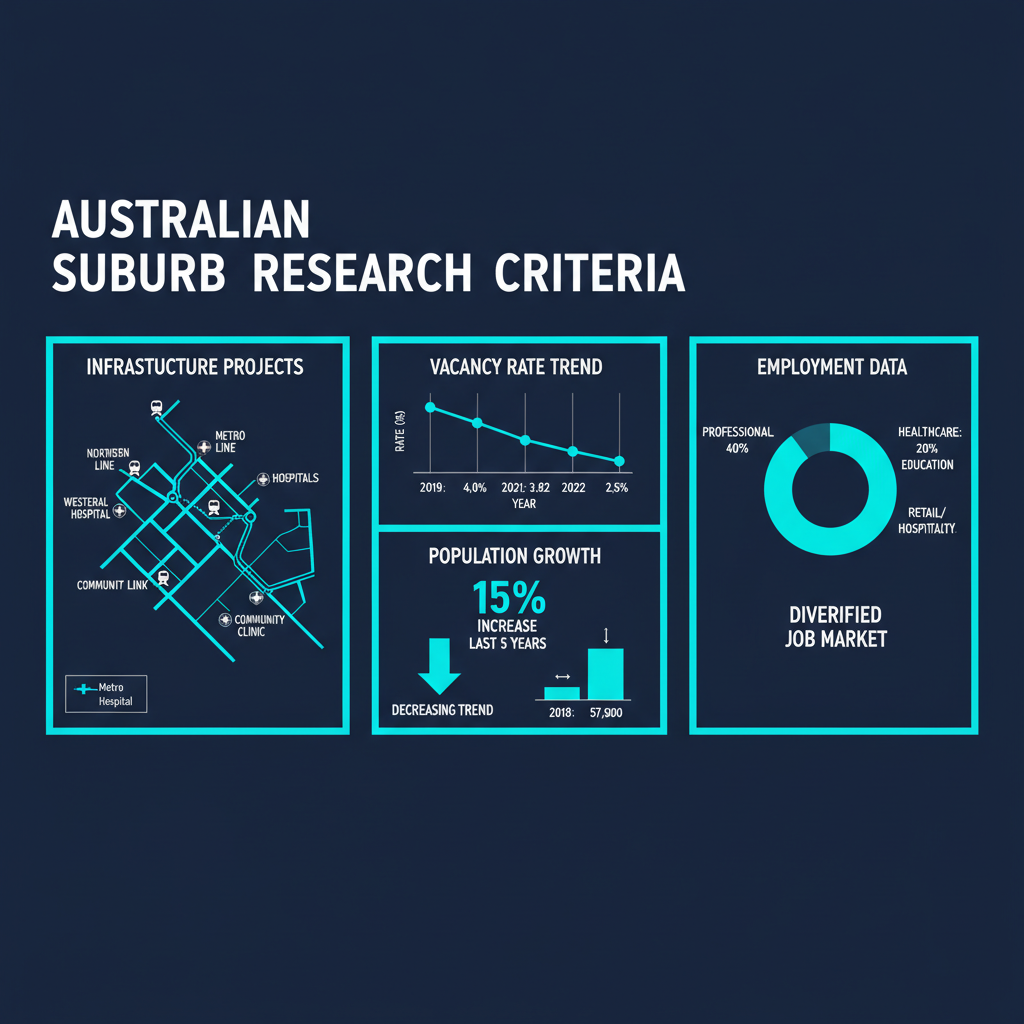
Check Infrastructure Australia's published pipeline and state planning portals for major projects within 5-10km. A new motorway, hospital precinct, or metro station can shift a suburb's growth trajectory dramatically.
Research by the University of Sydney found homes within 800m of Sydney Metro Northwest stations experienced up to 15% higher price growth than the broader market. Properties within 400m of ferry wharves commanded premiums of 10-15% over comparable properties further inland.
Key infrastructure indicators to check:
- Transport projects: New rail lines, highway upgrades, airport expansions
- Health infrastructure: Hospital developments, medical precincts
- Education: New schools, university campuses
- Commercial hubs: Business parks, retail centres, employment nodes
Vacancy Rates and Days on Market
Australia's national residential vacancy rate fell to 1.2% in January 2026, down from 1.4% in December 2025. But national averages hide crucial suburb-level differences.
Brisbane, Perth, and Darwin are sitting below 1% vacancy, indicating tight rental markets. Melbourne and Sydney show more variation across different postcodes. Use SQM Research to check suburb-specific vacancy trends over 12-24 months.
In 2026, capital city homes are selling with a median of just 26 days on market, five days faster than a year ago. If properties in your target suburb are sitting for 60+ days, that's a red flag about demand.
Population Growth and Demographic Trends
Access ABS census data and state government population projections. Look for:
- Population growth: Annual growth rate of 1.5%+ indicates healthy demand
- Age demographics: Areas attracting young families signal long-term stability
- Income levels: Median household income above $80,000 supports rental demand
- Employment participation: Areas above 65% participation typically show stronger markets
Cross-reference population data with building approvals. If supply is growing faster than population, rental yields may compress.
Legal and Title Checks Every Investor Must Complete
Before you inspect the property, verify the legal foundation. These checks cost $200-400 but protect you from title defects worth tens of thousands.
Title Search and Ownership Verification
Order a title search through your state's land titles office (PEXA, NSW Land Registry Services, Land Services SA). The search confirms:
- Registered owner: Ensures the seller actually owns the property
- Encumbrances: Mortgages, caveats, or restrictions that could affect your ownership
- Easements: Rights of way, utility access, or drainage rights that limit property use
- Covenants: Restrictions on renovations, building height, or land use
Pay special attention to easements. A drainage easement through your backyard can prevent extensions or pools. A utility easement might restrict fence heights or landscaping.
Zoning and Planning Restrictions
Check your local council's zoning maps and planning controls. Zoning determines:
- What you can build or renovate
- Whether you can subdivide or add a granny flat
- Height restrictions and setback requirements
- Future development potential
If you're buying near a commercial or mixed-use zone, check council development applications. A proposed high-rise next door can impact sunlight, privacy, and resale value.
Outstanding Rates and Levies
Request a certificate from council showing:
- Outstanding council rates: Unpaid rates transfer to the new owner
- Water usage charges: Verify the seller has paid current bills
- Special levies: Infrastructure charges or council improvements
For strata properties, request the last three years of body corporate financial statements. A depleted sinking fund in a building with ageing infrastructure is a red flag that has caught many investors off guard.
Building and Pest Inspections Are Non-Negotiable
Building and pest inspections following Australian Standards AS 4349.1-2007 and AS 4349.3-2010 are your primary defence against buying a structurally compromised property.
What Building Inspectors Check
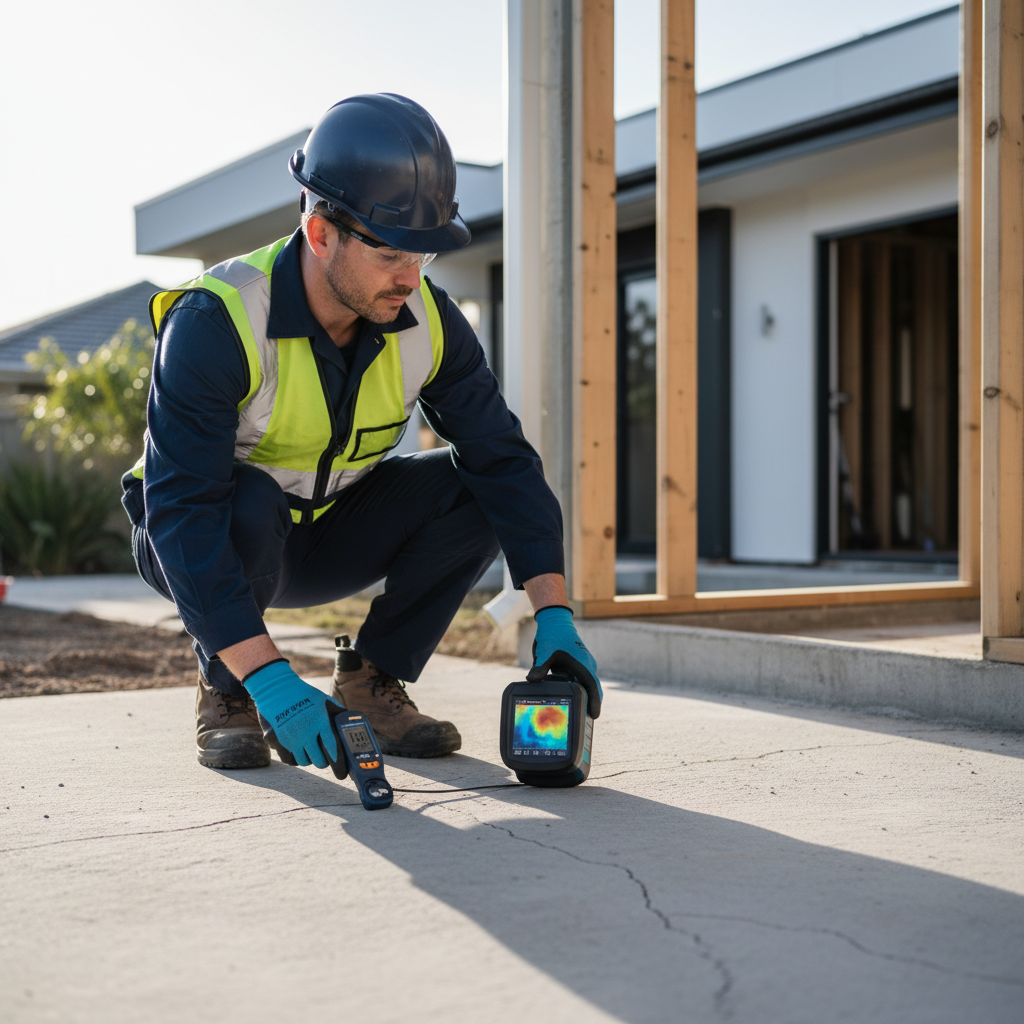
A qualified building inspector examines:
- Structural integrity: Foundation cracks, wall movement, roof condition
- Electrical and plumbing: Safety compliance, visible wiring issues
- Water damage: Dampness, mould, poor drainage
- Non-compliant work: Renovations done without permits or not to code
Building inspections typically take 2-3 hours and cost $400-600. The inspector provides a written report within 24-48 hours detailing defects, safety hazards, and recommended repairs.
Crucial: Building inspectors in most Australian states (except Queensland) don't require registration. Verify your inspector has:
- Relevant qualifications: Diploma of Building, construction qualifications
- Professional indemnity insurance: Minimum $1-2 million coverage
- Industry membership: Housing Industry Association or similar bodies
Pest Inspections for Termites and Timber Pests
Termite inspections follow AS 4349.3-2010 and check for:
- Active termite infestations: Current termite activity
- Previous termite damage: Evidence of past attacks and repairs
- Conducive conditions: Moisture, timber-ground contact, poor ventilation
- Other timber pests: Borers, fungal decay
In Queensland, sellers must provide buyers with a completed Property Inspection Report disclosing structural issues and termite infestations before signing. In other states, buyers organise their own inspections.
Termite inspections cost $250-400 when combined with building inspections. Given termites are responsible for more than 80% of structural damage to Australian homes, this is money well spent.
When to Walk Away Based on Inspection Results
Some defects are fixable. Others should end negotiations immediately:
Red flags that justify walking away:
- Active termite infestation with major structural damage
- Foundation cracks indicating significant movement
- Asbestos throughout the property requiring full removal
- Non-compliant electrical work creating fire hazards
- Major plumbing failures requiring complete re-piping
If the inspection reveals $20,000+ in essential repairs, either negotiate a price reduction equal to 1.5x the repair cost (to account for your time and risk), or move to the next property.
Financial Analysis and Comparable Sales Research
Even if the property passes physical inspections, you need to verify you're paying fair market value and the numbers actually work for investment.
Independent Valuation vs Bank Valuation
Never rely solely on the agent's appraisal or the bank's valuation. Order an independent valuation from an Australian Property Institute certified valuer for $400-600.
Independent valuers analyse:
- Recent comparable sales: Properties sold within 1km in the past 90 days
- Market conditions: Whether the suburb is rising, flat, or declining
- Property-specific features: Land size, condition, location within the suburb
- Income approach: For investment properties, valuation based on rental income
A 2026 bank valuation might come in at $800,000, but an independent valuer accounting for recent comparable sales might value it at $750,000. That $50,000 gap protects you from overpaying.
Rental Yield Calculation and Cash Flow Analysis
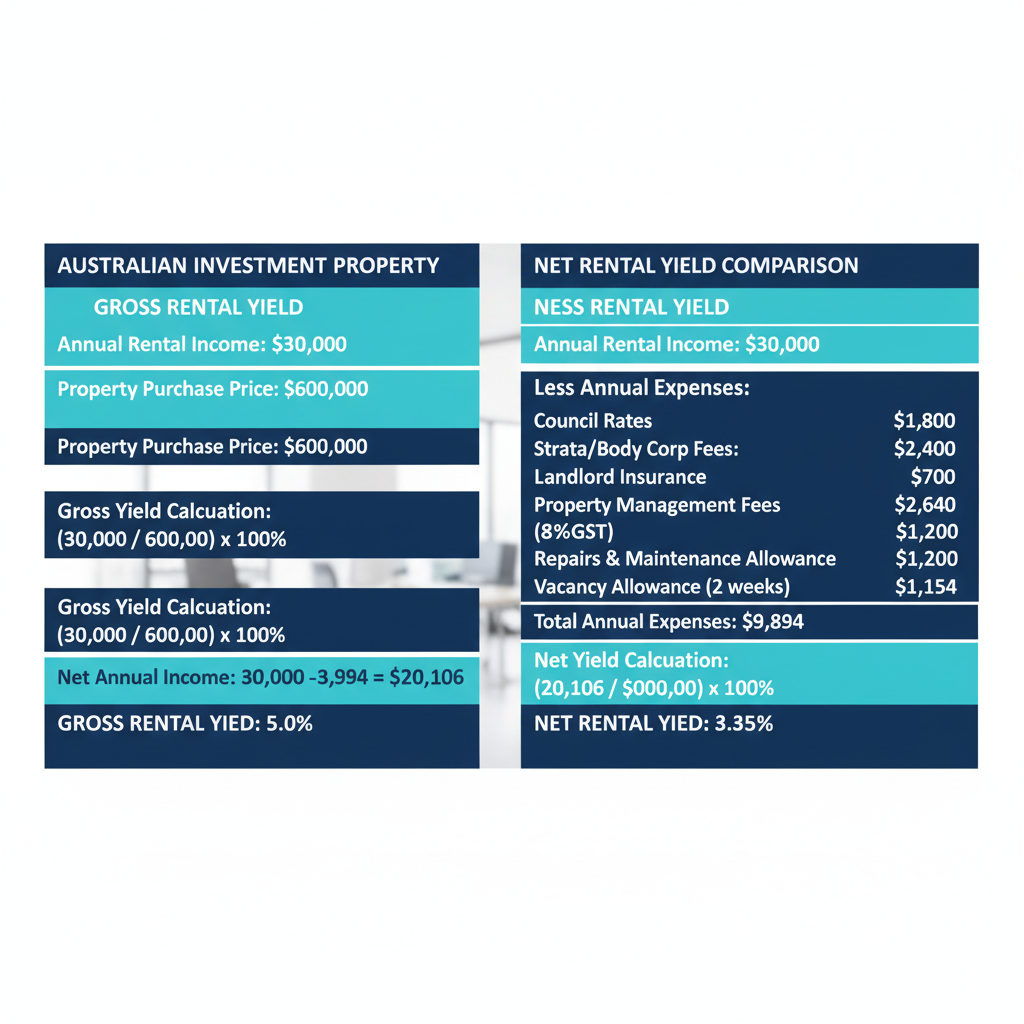
In 2026, national rents have risen 43.9% over five years. But vacancy rates in some markets are beginning to stabilise. Calculate both gross and net yield:
Gross rental yield = (Annual rent / Purchase price) × 100
Net rental yield = (Annual rent – All expenses) / Purchase price × 100
A 5% gross yield can quickly become 3.2% net in a high-cost market once you deduct:
- Council rates: $1,200-3,000 annually
- Water charges: $800-1,500 annually
- Strata fees: $3,000-8,000+ for units
- Insurance: $1,200-2,500 annually
- Property management: 7-10% of rent
- Maintenance: Budget 1% of property value annually
Rental yields of 3-6% for residential properties are considered good net yields. Regional Western Australia and Northern Territory average higher yields (6-8%), while capital city blue-chip suburbs often sit below 3%.
Verify the rental estimate by checking recent leases on Domain and realestate.com.au. If the agent quotes $600/week but similar properties lease for $520/week, adjust your cash flow projections accordingly.
Comparable Sales Analysis
Analyse at least 5-10 comparable sales within 1km sold in the past 90 days. Focus on properties with:
- Similar land size (within 50sqm)
- Similar dwelling size (within 20sqm)
- Similar condition and age
- Similar street appeal and aspect
If your target property is listed at $850,000 but three comparable properties sold for $780,000-$810,000, you have strong negotiation leverage.
Access sold price data through CoreLogic, RP Data, or your buyers agent. In some states (SA, WA), sold prices are publicly available through land titles offices.
Flood Risk, Environmental Hazards and Insurance Checks
Climate risks are increasingly pricing into property markets. Thorough environmental due diligence protects you from uninsurable properties and unexpected damage.
Flood Zone Verification
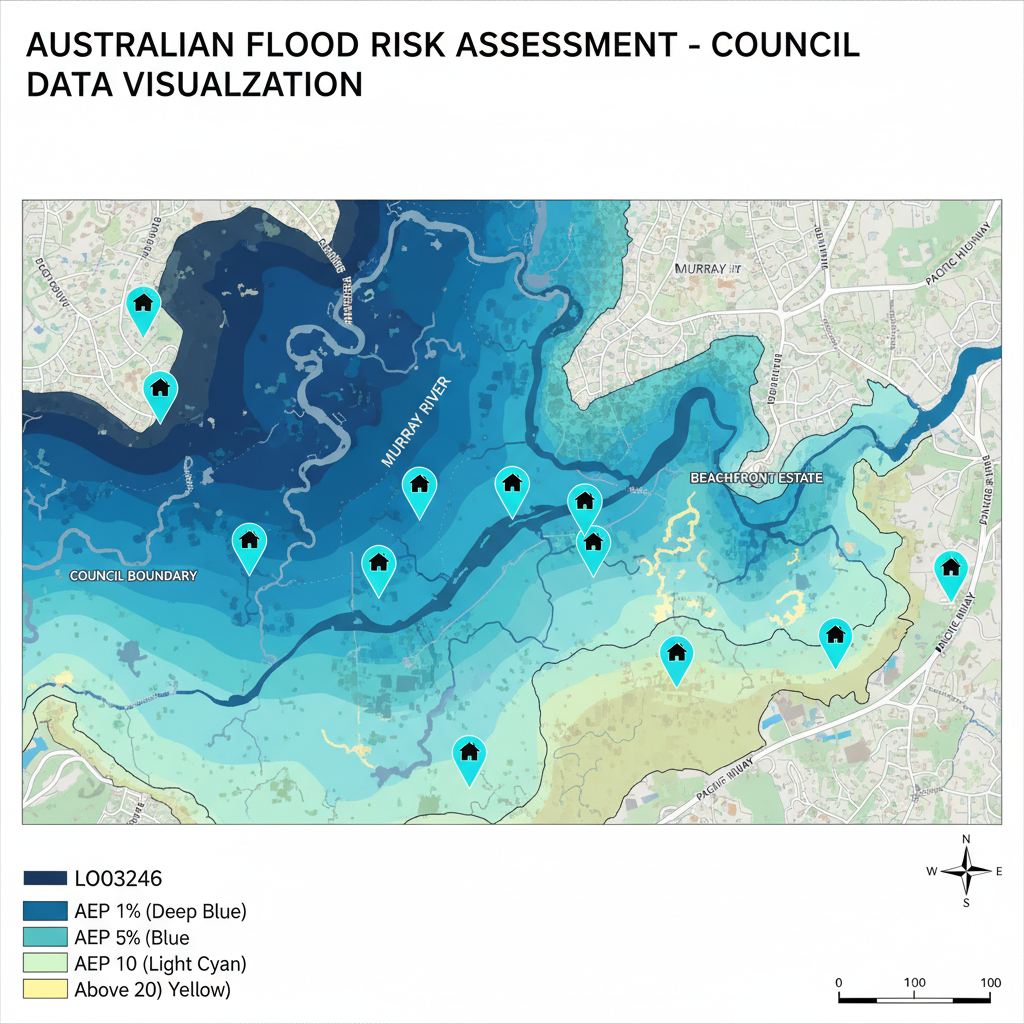
More than 1 million Australian properties (around 1 in 10 private homes) are impacted by floods annually. According to a Climate Council and PropTrack report, at least 70% of the 2 million flood-prone houses across the country have seen their value decrease.
Check flood zones through:
- Local council flood maps: Most councils publish historical flood data and risk modelling
- State planning portals: NSW Planning Portal, VicPlan, Queensland Globe
- Landchecker: Digitised flood zone data by address
Properties are typically classified by Annual Exceedance Probability (AEP):
- 1% AEP (1-in-100 year): Moderate flood risk, most banks will lend with insurance
- 2% AEP (1-in-50 year): Higher risk, some lenders hesitant
- 5% AEP (1-in-20 year): High risk, difficult to finance and insure
Even if financing is available, flood-prone properties command 4-11% discounts and require substantially higher insurance premiums. Factor these ongoing costs into your investment analysis.
Contaminated Land and Bushfire Zones
Check your state's contaminated land register. Properties on or near former industrial sites, petrol stations, or landfills may have soil contamination requiring expensive remediation.
For bushfire-prone areas, check the Bushfire Attack Level (BAL) rating. Properties in BAL-FZ (Flame Zone) or BAL-40 zones require expensive construction standards and face higher insurance costs.
Insurance Availability and Costs
Before making an offer, get insurance quotes from at least three insurers. Verify:
- Building insurance: Cost to insure the structure
- Landlord insurance: Coverage for rental-specific risks
- Flood coverage: Whether flood damage is included or excluded
Some high-risk properties are becoming uninsurable. According to a Climate Council report, one in 25 Australian homes will be uninsurable by 2030. If you can't insure the property, you can't get financing, and you shouldn't proceed with the purchase.
Strata Reports and Body Corporate Due Diligence
If you're buying a unit, townhouse, or apartment, strata due diligence is just as critical as building inspections.
What to Check in Strata Records
Request from the seller or strata manager:
- Last three years of meeting minutes: Check for disputes, special levies, or upcoming major works
- Sinking fund balance: Verify adequate reserves for future maintenance
- Outstanding debts: Ensure the body corporate isn't carrying unpaid contractor invoices
- Insurance coverage: Confirm building insurance is current and adequate
- By-laws: Understand restrictions on renovations, pets, parking, short-term rentals
A depleted sinking fund in a building with ageing infrastructure (lifts, roofs, plumbing) signals major special levies ahead. If the sinking fund is below $200 per unit, expect a special levy within 12-24 months.
Red Flags in Body Corporate Records
Walk away from strata properties showing:
- Ongoing legal disputes: Litigation with builders, contractors, or unit owners
- Unpaid levies by multiple owners: Indicates financial stress in the building
- Deferred maintenance: Major items like roof repairs pushed back repeatedly
- High owner-occupier vs investor ratio: Buildings with 70%+ investors often have maintenance issues
Strata Levies and Future Cost Estimates
Strata levies in Australian capital cities range from $3,000-$12,000 annually depending on building age, amenities, and management quality. Verify the levy covers:
- Building insurance
- Common area maintenance (lifts, pools, gardens)
- Sinking fund contributions
- Management fees
Buildings with pools, gyms, and concierge services carry higher levies. Older buildings (20+ years) with original lifts and plumbing often face special levies for replacement works.
How Buyers Agency Australia Eliminates Due Diligence Risks
Dragan Dimovski and the Buyers Agency Australia team have spent over 20 years perfecting property investment due diligence for clients building portfolios across Sydney, Melbourne, Brisbane, and Perth.
Our due diligence process includes:
Location analysis first: We analyse suburb fundamentals including infrastructure pipelines, vacancy trends, population growth, and employment drivers before shortlisting any property.
Expert network coordination: We coordinate building inspectors, pest inspectors, valuers, and conveyancers, ensuring every check meets Australian Standards and protects your interests.
Financial modelling: Our 10-year portfolio modelling shows you the true investment returns including all costs, tax implications, and realistic growth scenarios.
Negotiation leverage: Our comparable sales analysis and market intelligence give you precise negotiation leverage to avoid overpaying.
Transparent fixed-fee structure: You know exactly what due diligence costs upfront, with no percentage-based commissions inflating your purchase price.
We've helped clients avoid properties with $80,000+ in hidden termite damage, negotiate $50,000-$100,000 off asking prices based on comparable sales analysis, and identify suburbs 18-24 months before major value growth.
Book your free strategy session to access our due diligence framework and data-driven property analysis.
Property Investment Due Diligence Checklist Summary
Here's your complete investment property checklist to print and reference:
Suburb Research:
- ✓ Infrastructure projects within 5-10km
- ✓ Vacancy rates over 12-24 months
- ✓ Days on market compared to city median
- ✓ Population growth and demographic trends
- ✓ Median household income and employment participation
Legal Checks:
- ✓ Title search confirming ownership and encumbrances
- ✓ Zoning and planning restrictions
- ✓ Outstanding council rates and water charges
- ✓ Easements, covenants, and caveats
- ✓ Development applications for neighbouring properties
Physical Inspections:
- ✓ Building inspection by qualified inspector (AS 4349.1)
- ✓ Pest inspection for termites and timber pests (AS 4349.3)
- ✓ Independent valuation from API-certified valuer
- ✓ Verification of building permits for renovations
Financial Analysis:
- ✓ Comparable sales within 1km, past 90 days
- ✓ Gross and net rental yield calculations
- ✓ Cash flow analysis including all expenses
- ✓ Rental market research for realistic income projections
Environmental Risks:
- ✓ Flood zone verification through council and state portals
- ✓ Bushfire zone and BAL rating
- ✓ Contaminated land register check
- ✓ Insurance quotes from multiple providers
Strata Properties:
- ✓ Last three years of body corporate meeting minutes
- ✓ Sinking fund balance and financial statements
- ✓ By-laws affecting renovations, pets, rentals
- ✓ Upcoming special levies or major works
Frequently Asked Questions
What is property investment due diligence?
Property investment due diligence is the systematic verification of legal, physical, and financial aspects of a property before purchase to identify risks and investment potential.
How much does property due diligence cost in Australia?
Comprehensive due diligence costs $1,500-$3,000 including building inspection ($400-600), pest inspection ($250-400), valuation ($400-600), title search ($200), and legal review ($300-800).
When should I complete due diligence checks?
Complete due diligence during the cooling-off period (2-5 business days in most states) or before making an unconditional offer at auction.
Can I skip building inspections to save money?
No. Building and pest inspections protect you from $30,000-$100,000+ in structural repairs. The $600-800 cost provides massive downside protection.
What are the biggest due diligence mistakes investors make?
Skipping independent valuations, ignoring suburb vacancy trends, failing to verify rental income estimates, and not checking flood zones or environmental risks.
 General
Complete property investment due diligence checklist for Australian buyers covering legal checks, inspections, suburb research, and financial analysis...
Property investment in 2026 remains fundamentally sound despite rate uncertainty and affordability concerns. Australia's housing shortage of 200,000 to 300,000 dwellings, combined with population growth exceeding 30 million by 2030, creates structural demand that supports long-term capital appreciation. Strategic buyers who understand market fundamentals will outperform those chasing headlines.
We've all been there. You're watching property prices climb month after month, hearing warnings about interest rate hikes, and reading headlines predicting a market correction. You're wondering if now is the right time to invest, or if you've already missed the boat.
Here's the honest answer: 2026 isn't about perfect timing. It's about understanding what drives property values over decades, not months. While national prices are forecast to rise 5% to 7.7% this year according to CoreLogic and KPMG, the real question isn't whether property is "worth it." It's whether you're buying the right property for the right reasons.
Let's cut through the noise and examine what actually matters for property investment Australia 2026.
Why Everyone's Asking This Question Right Now
The property conversation in 2026 feels different. Interest rates rose to 3.85% in February after three cuts in 2025, creating what economists call a "higher for longer" environment. First-home buyer stimulus has injected unprecedented demand into the sub-$800,000 price bracket. Migration patterns continue driving population growth, yet housing construction remains 20% behind government targets.
This creates confusion. Prices are rising, but affordability is stretched. Supply is low, but sentiment is cautious. Investors hear conflicting messages from every direction.
The Fear vs. Reality Gap
Media headlines focus on crash predictions and rate hikes. The data tells a different story. AMP estimates Australia's accumulated housing shortage sits between 200,000 and 300,000 dwellings. The National Housing Supply and Affordability Council projects the deficit will worsen by 79,000 homes through 2029.
When demand structurally exceeds supply for extended periods, prices don't collapse. They moderate, adjust, and continue climbing in fundamentally strong locations. This is basic economics, not speculation.
What Changed Since 2024
The easy money period of 2020-2023 is definitively over. Borrowing capacity has shrunk by $50,000 to $100,000 across millions of buyers due to APRA's 3% serviceability buffer. Government stimulus is now concentrated at the affordable end of the market.
For sophisticated investors, this creates opportunity. Competition has reduced in investment-grade properties above $850,000. Emotional buyers are chasing entry-level stock. Strategic buyers are securing quality assets while others hesitate.
The Supply Crisis No One's Talking About Enough
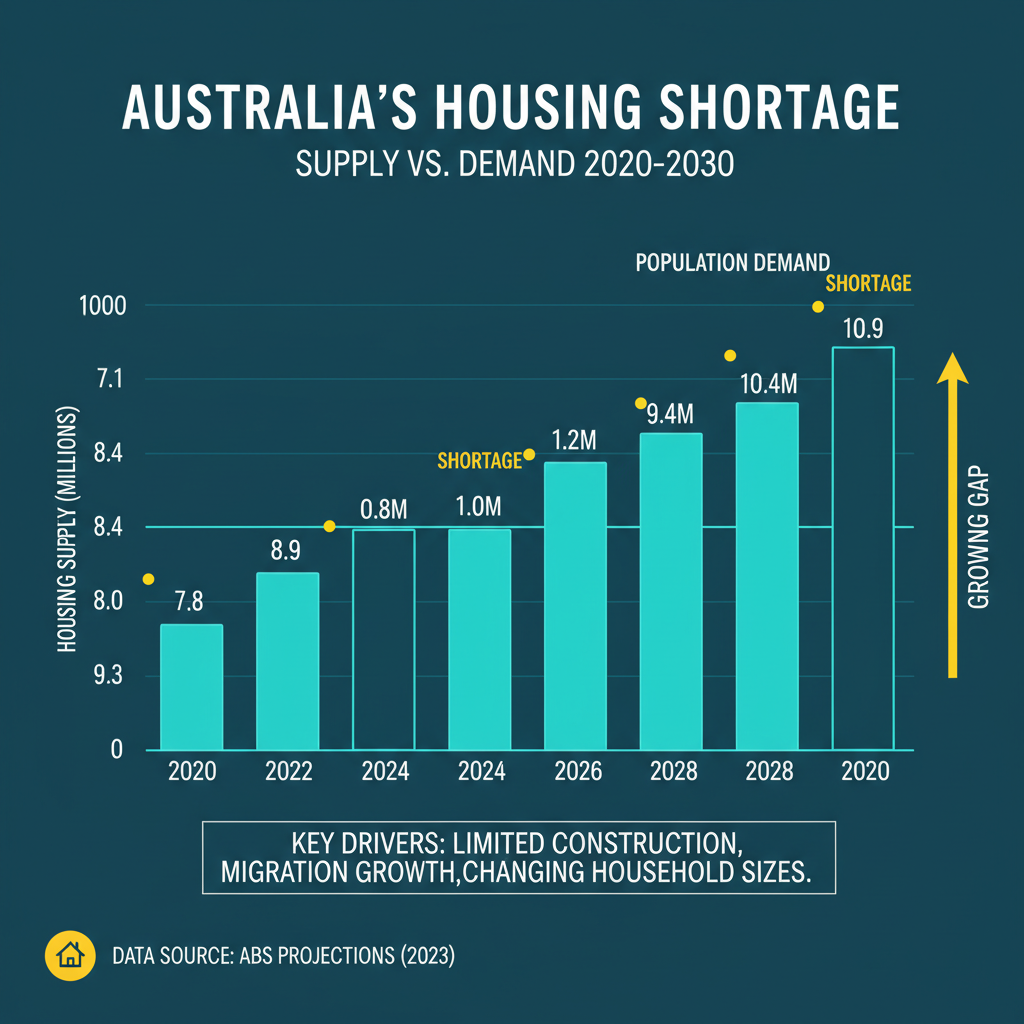
Supply isn't just "tight." It's structurally broken. Housing approvals fell 6.4% in October 2025. After 18 months of the federal Housing Accord targeting 1.2 million new homes by mid-2029, progress sits more than 20% behind schedule.
This isn't a short-term blip. Construction costs have surged 62% to 77% in key precincts over four years according to CBRE's 2026 Pacific Market Outlook. Labour shortages persist. Planning approvals take months or years in major cities.
The Math That Matters
Australia's population is forecast to exceed 30 million by 2030, up from 27.6 million today. That's 3 million additional people requiring housing. Even if construction reaches targeted levels, which it won't, supply won't catch demand for years.
Vacancy rates hover near record lows at 1.6% nationally. Perth tracks at 40% below the five-year average for advertised stock. Brisbane sits 29% below. These aren't statistics. They're structural imbalances that take decades to resolve.
Rental yields remain strong across gateway cities and growth corridors. Median apartment rents are forecast to grow 24% between 2025 and 2030 across capital cities, according to CBRE. This isn't speculation. It's the inevitable result of too many people chasing too few properties.
Why This Supports Long-Term Values
Property investment rewards patient capital. When you examine rolling 20-year periods since World War II, standard Australian houses have tripled in value or better in every cycle. This requires 6% average annual growth, a threshold five of eight capital cities achieved in 2025 alone.
Compounding is the silent wealth builder. A $750,000 property growing at 6% annually doubles in 12 years and triples in 19 years. This isn't get-rich-quick territory. It's methodical wealth accumulation backed by fundamental demand.
The Mistakes That Cost Investors Hundreds of Thousands
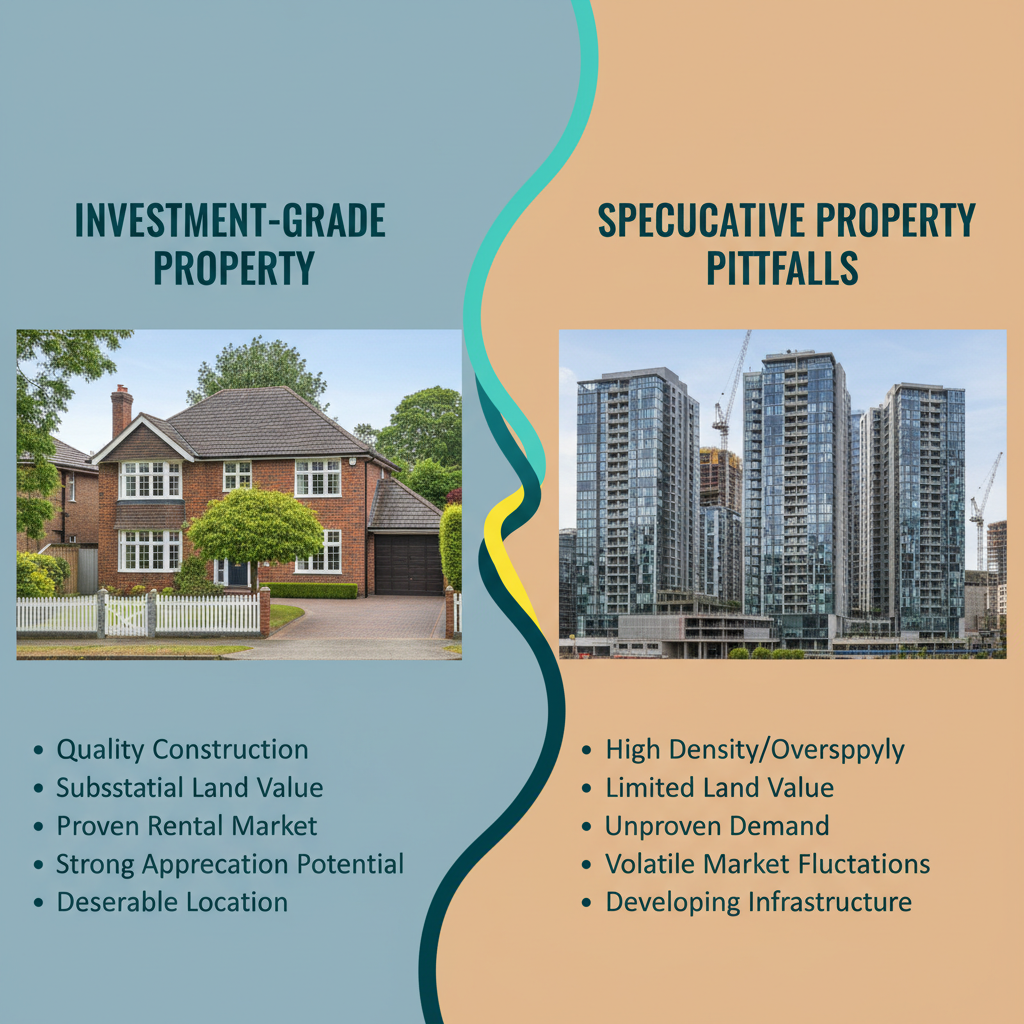
Here's where good intentions meet bad outcomes. Most investors don't fail because markets turn. They fail because they make avoidable errors that compound over time.
Mistake 1: Buying Emotion Over Fundamentals
Investing isn't about finding suburbs with great cafes or properties you'd live in yourself. It's about identifying locations where employment growth, infrastructure investment, and supply constraints converge.
Less than 5% of properties on the market qualify as investment-grade. The rest are owner-occupier stock that will always underperform. Investors who don't understand this difference pay premium prices for average returns.
Buyers Agency Australia builds 10-year portfolio models before clients purchase a single property. We're not chasing hotspots. We're identifying markets where fundamentals support sustained growth regardless of short-term sentiment.
Mistake 2: Chasing Government Stimulus
The expanded First Home Guarantee scheme is injecting 20,000 additional buyers into the market in 2026. Research estimates this inflates prices by 3.5% to 9.9% in lower-priced areas, creating artificial demand.
Smart investors avoid these price brackets. When government props disappear, which they always do, values correct. You don't want to be holding a $650,000 property that's really worth $580,000 in three years.
Focus on locations with genuine employment drivers, not subsidy-dependent outer suburbs with 70% investor ownership and no underlying demand.
Mistake 3: Ignoring Transaction Costs
Stamp duty, conveyancing, building inspections, and selling costs consume 7% to 12% of your purchase price. In a 5% growth market, these costs eliminate most of your gain if you hold for less than five years.
Too many investors treat property like shares, buying and selling based on short-term movements. Property rewards decade-long holds. If you're not prepared to wait through at least one full property cycle, you're speculating, not investing.
Mistake 4: Stretching Finances Too Thin
Property is illiquid. You can't sell the bathroom when interest rates rise or tenants leave. Investors who deploy every dollar of capital leave no buffer for vacancy, repairs, or opportunity.
Maintain minimum six-month cash reserves. Structure finance to survive rate increases of 2% to 3% above current levels. Buy properties you can comfortably hold even if growth stalls for 18 months. Wealth isn't built by those who own the most properties. It's built by those who hold quality assets safely through market volatility.
Strategic Buying in 2026: Where Opportunity Actually Exists
So what does smart money do right now? It avoids the herd, focuses on fundamentals, and positions for long-term compounding.
Target Investment-Grade Stock
Investment-grade properties share common characteristics: established suburbs within 10km of employment hubs, owner-occupier appeal, land-to-asset ratios above 30%, and proven capital growth history exceeding 6% over rolling 10-year periods.
These properties cost more upfront but deliver superior risk-adjusted returns. A $900,000 house in an established inner-ring suburb will outperform a $650,000 house-and-land package on the city fringe over every meaningful timeframe.
Focus on Supply-Constrained Markets
Perth, Brisbane, and Adelaide demonstrate structural undersupply with forecast growth between 8% and 16% in 2026 depending on scenarios. But this doesn't mean buy anywhere in these cities.
Within each market, specific suburbs with limited developable land, strong infrastructure investment, and proximity to employment centres will capture disproportionate gains. This requires on-the-ground knowledge, not Google searches.
Value-Add Opportunities
Markets where momentum has slowed create renovation and subdivision opportunities. Melbourne's median grew 4.8% in 2025, below national averages, but specific pockets with development potential offer manufactured equity.
Buying a tired property in a strong location, adding value through strategic renovation or subdivision, and holding through the next growth phase compounds returns in ways standard "buy and hold" never achieves.
Regional Growth Corridors
Regional markets outperformed capitals in 2025, with combined regional dwelling values rising 9.7% versus 8.2% in capital cities. This isn't a short-term trend. Remote work, lifestyle migration, and relative affordability are driving sustained population shifts.
Target regional centres within two hours of major cities, with diversified employment bases beyond mining or tourism. Towns with university campuses, regional hospitals, and government infrastructure investment demonstrate resilience through economic cycles.
How Dragan Dimovski Separates Signal From Noise
Dragan Dimovski, founder of Buyers Agency Australia, has navigated property markets for over 20 years, building a personal portfolio exceeding $10 million. His approach differs from typical buyer's agents because it starts with financial modelling, not property searching.
The 10-Year Portfolio Model
Every client engagement begins with projecting where they want to be financially in 10 years. How much passive income do they need? What capital base supports their retirement? What tax structures optimise their position?
Only after answering these questions does property selection begin. Most investors work backwards, finding properties first and hoping they achieve goals. This is expensive trial and error.
Data Over Gut Feel
Buyers Agency Australia analyses employment data, infrastructure pipelines, zoning changes, and demographic trends across every Australian capital and 66 regional townships. This research identifies markets 12 to 24 months before mainstream investors notice.
By the time property spruikers are hosting seminars about a "hot suburb," we've already secured assets for clients and moved to the next opportunity.
Fixed-Fee Transparency
The traditional percentage-based buyer's agent model creates perverse incentives. Agents earn more when clients pay more, discouraging negotiation and encouraging overpriced purchases.
Buyers Agency Australia operates on fixed fees regardless of purchase price. This aligns our interests with yours: secure the best possible property at the lowest defensible price.
Clients save an average of 8% below comparable sales through strategic negotiation and access to off-market opportunities. On a $750,000 purchase, that's $60,000 preserved capital available for your next investment.
What 2026 Actually Demands From Investors
Property investment isn't about predicting market turns or timing perfection. It's about understanding what drives values over decades and positioning accordingly.
Australia's housing shortage isn't resolving in 2026, 2027, or even 2028. Population growth continues. Construction can't keep pace. Rental markets remain tight. These fundamentals support ongoing price appreciation in well-selected markets.
But this doesn't mean buy anything, anywhere. Quality matters more than ever. Transaction costs punish short-term speculation. Government stimulus creates artificial hotspots that will correct. Borrowing capacity constraints limit how much prices can rise in expensive markets.
Smart investors focus on:
- Investment-grade properties in supply-constrained locations
- Markets with genuine employment and infrastructure drivers
- Properties offering value-add opportunities to manufacture equity
- Conservative financing that survives rate increases and vacancy
- 10-year hold periods that allow compounding to work
Those who follow this approach will look back at 2026 as the year they positioned themselves for significant long-term wealth. Those who chase headlines, follow stimulus money, or overcomplicate simple fundamentals will wonder why their portfolio underperformed.
Your Next Move: Turn Analysis Into Action
Every month of delay adds thousands to your target property's price. Sydney's median is forecast to reach $1.92 million by year-end, up $154,000 from current levels. Brisbane and Perth are tracking double-digit growth in many submarkets.
But this isn't about rushing into bad decisions. It's about making informed, strategic choices with expert guidance.
Buyers Agency Australia offers complimentary strategy sessions where we analyse your financial position, model your 10-year investment goals, and identify specific markets and property types aligned with your objectives. No obligation, no sales pressure, just honest advice from professionals who've built wealth through multiple property cycles.
We work with property investors seeking long-term wealth, first-home buyers looking for expert guidance, and time-poor professionals requiring end-to-end property search and negotiation. Our clients don't have time to attend 200 open homes, chase agents, or second-guess their decisions. They want certainty, strategy, and execution.
Dragan Dimovski and the Buyers Agency Australia team have helped hundreds of clients secure investment-grade properties across every Australian capital. We don't sell you property. We build investment strategies that deliver financial freedom.
If you're serious about is now a good time to buy property Australia, the answer is: it depends on what you buy, where you buy it, and why you're buying it. Get those three elements right, and 2026 will be the year you look back on with satisfaction.
Get them wrong, and you'll spend the next decade regretting an expensive mistake.
Book your free strategy session today and let's build your investment roadmap for 2026 and beyond.
Frequently Asked Questions
Is property investment still worth it with interest rates rising in 2026?
Yes, property remains fundamentally sound due to structural supply shortages and long-term population growth. Focus on investment-grade properties in supply-constrained markets.
What are the biggest property investment mistakes in 2026?
Buying emotional properties over investment-grade stock, chasing government stimulus, ignoring transaction costs, and stretching finances without cash buffers are the most costly errors.
Which Australian cities offer the best property investment opportunities in 2026?
Perth, Brisbane, and Adelaide demonstrate strong fundamentals with supply constraints and forecast growth between 8% and 16%. Regional centres within two hours of capitals also offer value.
How much deposit do I need to invest in property in 2026?
Aim for minimum 20% deposit to avoid lenders mortgage insurance. Maintain additional six-month cash reserves for vacancy, repairs, and interest rate increases.
Should I wait for property prices to drop before investing in 2026?
Australia's 200,000 to 300,000 dwelling shortage and population growth to 30 million by 2030 support ongoing price appreciation. Strategic timing matters less than strategic selection.
 General
Wondering if property investment is still worth it in 2026? Despite rate uncertainty and affordability concerns, housing supply...
Property hotspots Australia are suburbs experiencing or about to experience above-average capital growth driven by infrastructure investment, population growth, and limited housing supply. Identifying these areas early, before prices spike, requires analyzing leading indicators including new transport projects, supply-demand ratios, rental vacancy rates, and demographic shifts.
If you're searching for Buyers Agency Australia's services, you already know the stress of trying to pick the right suburb at the right time. Missing a boom by 12 months can cost tens of thousands in lost equity.
The truth is, most investors only recognize property hotspots after median prices have already jumped. By then, entry points are expensive and rental yields have compressed. Smart investors track infrastructure announcements, days on market, and auction clearance rates well before the crowd arrives.
This guide reveals the practical, data-backed methods professional buyers agents use to uncover high growth suburbs Australia before capital growth accelerates.
What Is a Property Hotspot
Defining a Hotspot vs General Market Growth
A property hotspot is a suburb or region delivering price growth significantly above the national or state average. While Australian dwelling values rose 8.6% nationally in 2025 according to CoreLogic, genuine hotspots posted double-digit gains.
Perth led all capitals with 13% annual house price growth, while Brisbane achieved 9%. These aren't random spikes. They reflect concentrated demand meeting constrained supply.
Hotspots differ from general market movements. National trends lift most areas slowly. Hotspots surge due to localized catalysts: a new rail line, rezoning, or sudden population inflows.
Short-Term Hotspots vs Sustainable Growth Areas
Some hotspots flame out quickly. Regional towns that boomed during COVID-19 saw prices flatten by late 2025 as workers returned to cities.
Sustainable property investment hotspots combine multiple growth drivers. Western Sydney suburbs near the new airport, for example, benefit from transport upgrades, employment hubs, and ongoing rezoning. That layered demand supports multi-year growth cycles.
Short-term hotspots rely on one trigger, often speculative. Sustainable areas stack infrastructure, jobs, and population growth over 5 to 10 years.
Why Timing Matters for Investors
Buying before a boom multiplies returns. Leppington in Sydney's southwest posted a 17.67% 10-year average annual growth rate, rewarding early entrants who purchased before the Western Sydney Airport announcement.
Once a suburb hits the "Hot 100" lists, competition intensifies. Auction clearance rates climb, vendor discounting shrinks, and days on market fall. Late arrivals pay premium prices for compressed yields.
Timing also impacts borrowing capacity. Entering early lets you secure finance at lower valuations, then refinance against equity gains to fund the next purchase.
Core Characteristics of Australian Hotspots
Hotspots share recurring traits. They sit in growth corridors with confirmed infrastructure spending. Ripley, Plainland, and Logan Central in Queensland's southeast all benefit from transport links between Brisbane, Ipswich, and the Gold Coast.
Affordability relative to neighboring suburbs drives spillover demand. Ashbury in Sydney's inner west offers period homes at $2.23 million, well below adjacent Dulwich Hill, attracting buyers priced out of premium pockets.
Tight rental markets signal strong tenant demand. Suburbs with vacancy rates below 1.5% and rising rents indicate undersupply, a precursor to capital growth. Darwin's rental vacancy sat at 0.76% in late 2025, fueling 18% house price growth that year.
Signs a Suburb Is About to Boom
Rising Buyer Enquiry and Auction Activity
Increased buyer competition appears before price spikes. Track auction clearance rates in your target suburbs. Rates above 70% suggest demand outstrips supply.
Adelaide's clearance rate hit 81% in late 2025, the highest among capitals. That intensity preceded 8% annual house price growth. When clearance rates climb consistently over three months, momentum is building.
Days on market also reveal urgency. Perth properties averaged 31 days on market in December 2025, down from 40+ days a year earlier. Faster sales indicate buyers fear missing out.
Vendor Discounting Trends
Vendor discounting measures the gap between listing price and final sale price. Low discounts mean buyers are meeting or exceeding asking prices.
Nationally, capital city vendors discounted 2.9% in late 2025. In hotspots, discounting often falls below 2% or disappears entirely. Adelaide vendors barely discounted in 2025 as buyer demand stayed strong.
Rising asking prices alongside shrinking discounts confirm seller confidence. Monitor this across 10 to 20 recent sales in your suburb to spot the trend early.
Media Coverage and Developer Interest
Developers and institutional investors move before retail buyers. Large land purchases, rezoning applications, and new project launches signal professional confidence.
Austral in Sydney's southwest saw master-planned communities expand rapidly, anticipating 55,000 future residents. Developer activity preceded the suburb's price surge.
Media attention follows, not leads. By the time national outlets feature a suburb, early gains are gone. Use developer announcements and Infrastructure Australia project lists to front-run the headlines.
Changes in Rental Demand and Yields
Rising rents indicate tenant competition. National rents jumped 5.4% annually to January 2026, but hotspots exceeded 7%.
Gross rental yields above 5% in capital cities or 6% regionally attract investors. Maddington in Perth offered 5.2% yields for houses and 6.28% for units in 2025, drawing cash-flow focused buyers.
Watch rental vacancy rates monthly. A drop from 2% to 1% signals tightening supply. Cairns held below 1.5% vacancy for five years, supporting both rent and price growth.
Infrastructure and Population Growth
How Transport Projects Drive Demand
Transport infrastructure reshapes property values. Sydney Metro West, connecting Parramatta to the CBD, boosted interest in Westmead and Strathfield well before completion.
Melbourne's Suburban Rail Loop and Metro Tunnel, opening late 2025, increased demand in Box Hill and West Melbourne. Properties near new stations see price premiums of 10% to 20% once projects are confirmed.
Road upgrades matter too. The M12 Motorway linking Western Sydney Airport to the motorway network supports growth in Oran Park and Leppington. Monitor state infrastructure pipelines for upcoming projects.
Employment Hubs and Economic Zones
Jobs drive housing demand. Western Sydney's Bradfield City Centre, a 60-hectare commercial precinct near the new airport, will create thousands of jobs and pull workers westward.
Regional hubs with diversified economies outperform single-industry towns. Townsville, Cairns, and Mackay combine defense, education, health, and tourism, creating resilient demand.
Proximity to universities also supports rental demand. Charles Darwin University in Millner and Rapid Creek underpins Darwin's tight rental market and strong yields.
Population Growth and Migration Patterns
Queensland recorded the highest net interstate migration, gaining 24,015 people in the year to March 2025. Suburbs absorbing these inflows, like Griffin and Petrie in Greater Brisbane, experience sustained demand.
Overseas migration also concentrates in capitals. NSW gained 96,761 net overseas migrants in the year to March 2025, the highest nationally. This influx supports rental and purchase demand in Sydney's affordable outer suburbs.
Australia's population grew 1.6% annually in 2025, adding 423,400 people. Western Australia's 2.3% growth rate, fastest among states, fueled Perth's property boom.
Schools, Hospitals, and Lifestyle Amenities
Families prioritize school catchments. Suburbs with highly rated public and private schools command premiums. Griffith and Red Hill in Canberra fall within top-tier catchments, supporting consistent demand.
Hospital expansions signal government investment. The Liverpool Hospital redevelopment, completing in 2027, improves amenity in Sydney's southwest and attracts healthcare workers.
Lifestyle amenities, parks, retail precincts, and cultural hubs, improve liveability. Urban renewal projects like Brisbane's Queens Wharf and Adelaide's Lot Fourteen reshape entire suburbs, driving gentrification and price growth.
Supply vs Demand
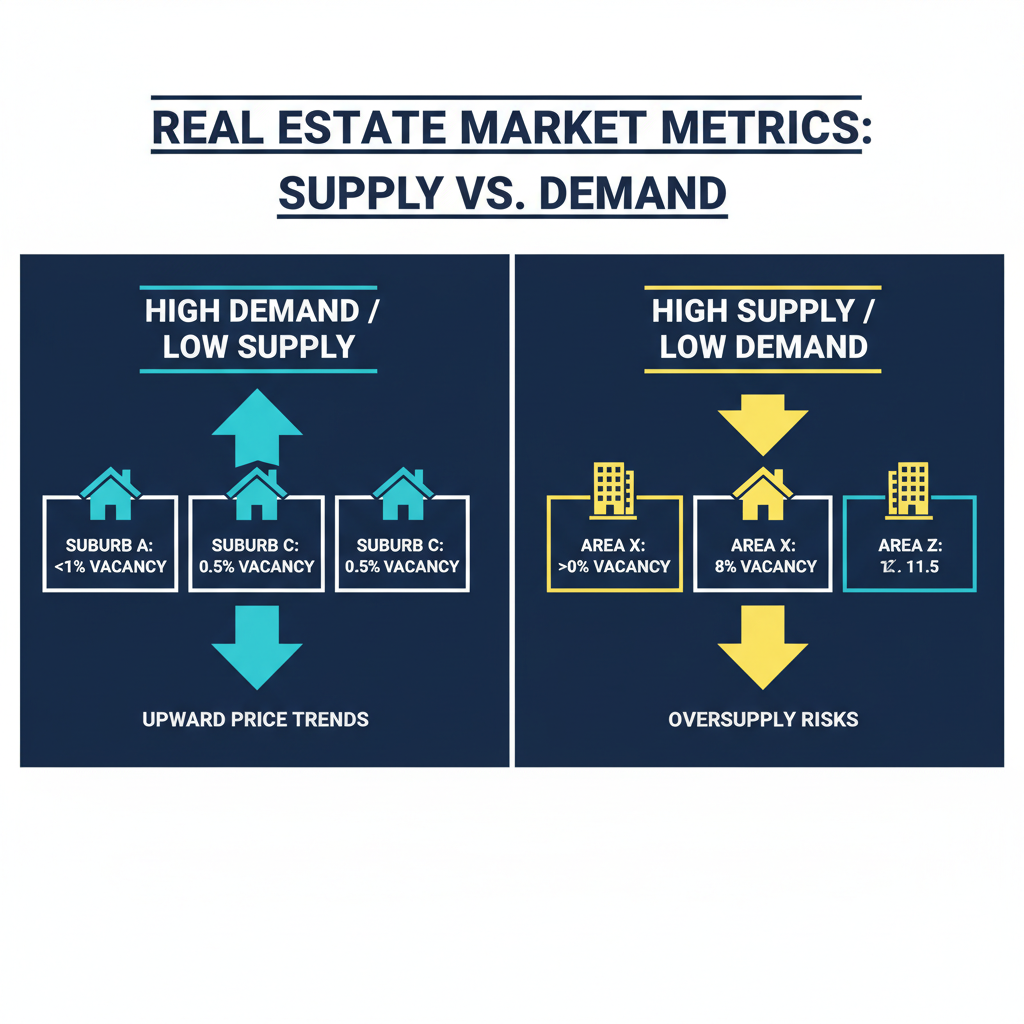
Reading Vacancy Rates and Stock Levels
Rental vacancy rates below 2% indicate tight supply. National vacancy eased to 1.7% in January 2026, but hotspots often sit below 1%.
Perth's vacancy rate remained under 1% through 2025, supporting 13% annual price growth. Brisbane's 0.76% vacancy drove both rent and price increases.
Stock on market (SOM) measures properties for sale as a percentage of total dwellings. SOM below 0.3% signals low supply. Adelaide's 0.20% SOM in late 2025 meant buyers faced limited choice, intensifying competition.
Days on Market as a Demand Signal
Properties selling quickly indicate strong buyer interest. Adelaide's median 23 days on market in 2025 reflected high demand.
Compare current days on market to the 12-month average. A drop from 40 to 25 days over two quarters signals accelerating demand. Combine this with rising clearance rates for confirmation.
Slow-selling properties, over 60 days, suggest weak demand or oversupply. Avoid suburbs where days on market are trending upward unless prices have corrected significantly.
New Dwelling Approvals vs Population Growth
Building approvals reveal future supply. NSW dwelling approvals fell 18.8% in June 2024, worsening the supply-demand imbalance. Fewer approvals today mean tighter stock in 18 to 24 months.
Compare annual approvals to population growth. If a suburb adds 5,000 people annually but approves only 500 dwellings, undersupply intensifies.
Monitor completion rates too. Approved projects don't always finish. Construction cost inflation and labor shortages have delayed many developments, keeping actual supply below forecasts.
Identifying Oversupply Risks
Oversupply kills capital growth. Suburbs with heavy apartment approvals relative to demand face prolonged price stagnation.
Melbourne's inner-city apartment market suffered oversupply post-COVID, with values rising only 2% in 2025 versus 8% for Adelaide houses. Check rental yields and vacancy. If yields fall and vacancy rises simultaneously, oversupply is likely.
Regional towns with single major employers face oversupply risk if that employer downsizes. Diversified economies buffer this risk.
Common Investor Mistakes
Chasing Last Year's Hotspot
Buying after a suburb has already boomed locks in peak prices. Melonba in Sydney's northwest posted 192.9% growth over five years, but median prices hit $1.26 million by 2025. Late entrants face lower yields and slower future growth.
Hotspots rotate. Perth and Darwin led in 2025, but Sydney and Melbourne may rebound in 2026 as affordability improves. Focus on emerging areas, not yesterday's winners.
Ignoring Rental Yield and Cash Flow
Capital growth alone doesn't sustain portfolios. Negative cash flow strains budgets, especially if interest rates rise.
Target suburbs offering both growth and yield. Maddington in Perth delivered 8.96% annual price growth and 5.2% rental yield in 2025. That balance supports long-term holding.
Calculate after-tax cash flow before buying. Factor in rates, insurance, property management, and loan costs.
Overlooking Local Market Cycles
National trends don't dictate local performance. Sydney's median grew 6.4% annually to January 2026, but individual LGAs ranged from -4% to +13%.
Research the specific suburb and LGA. Markets within markets mean neighboring postcodes can diverge significantly. Use CoreLogic or PropTrack data for granular suburb-level insights.
Buying Based on Emotion, Not Data
Personal preferences distort investment decisions. A beachside lifestyle suburb might suit you, but if supply is high and employment limited, growth will lag.
Successful investors separate lifestyle from strategy. Use data: vacancy rates, infrastructure timelines, population forecasts, and employment trends. Let the numbers guide the decision, then visit the top three candidates.
How Buyers Agents Identify Property Hotspots Early
Dragan Dimovski's Data-Driven Approach to Suburb Selection
Buyers Agency Australia, led by Dragan Dimovski, combines 20+ years of market experience with a disciplined, data-first methodology. Dragan's approach filters out hype and focuses on measurable growth drivers.
Every suburb undergoes a multi-layer analysis: infrastructure pipeline, demographic trends, employment growth, and historical price cycles. This framework identifies suburbs 12 to 24 months before mainstream recognition.
Dragan's $10M+ personal portfolio proves the model works. He applies the same rigor to client searches, ensuring investors enter markets early with strong fundamentals.
Proprietary Research and Off-Market Networks
Buyers agents access data retail investors miss. Dragan monitors government infrastructure budgets, rezoning applications, and developer pre-sales.
Off-market networks provide early access to properties before public listing. In tight markets like Adelaide and Perth, off-market deals often transact at slight discounts, preserving equity from day one.
Proprietary databases track sales, rents, and yields suburb by suburb, updated weekly. This real-time intelligence lets buyers agents spot inflection points, rising rents, falling days on market, and increasing clearance rates, before the broader market reacts.
Case Study: Identifying Western Sydney Airport Beneficiaries
When the Western Sydney Airport was announced, Dragan and his team immediately mapped the infrastructure corridor. They identified Austral, Leppington, and Oran Park as primary beneficiaries.
By analyzing transport links, rezoning plans, and population projections, Buyers Agency Australia helped clients secure properties in these suburbs before median prices surged. Leppington's 17.67% 10-year growth rate validated the early call.
This case demonstrates the value of forward-looking analysis. Waiting for media confirmation cost later buyers tens of thousands in lost equity.
Why Independent Advice Beats Sales-Driven Recommendations
Real estate agents represent vendors. Their incentive is to sell the listed property, not necessarily to find you the best deal.
Buyers agents represent you. They're paid a fixed fee or percentage by the buyer, aligning interests. Dragan's fixed-fee model removes conflicts, ensuring recommendations are based solely on investment merit.
This independence matters most in emerging hotspots. A sales agent may push a suburb where they have listings. A buyers agent searches nationally, recommending the highest-value opportunity regardless of location.
Using Market Data and Tools

CoreLogic, SQM Research, and PropTrack Insights
CoreLogic provides the Home Value Index, tracking monthly price movements across all Australian regions. Their hedonic methodology adjusts for property attributes, giving accurate growth readings.
SQM Research publishes rental vacancy data and asking rents, updated monthly. This reveals tightening or loosening rental markets before prices react.
PropTrack, owned by REA Group, offers property reports, price estimates, and demand heatmaps. Use these tools to shortlist suburbs, then verify with on-ground research.
Government Infrastructure Announcements
Monitor Infrastructure Australia's Major Public Infrastructure Pipeline. The $242 billion pipeline for 2024-25 to 2028-29 includes transport, utilities, and social infrastructure.
State government budgets detail upcoming projects. The Queensland Government forecasts 500,000 additional people in Brisbane by 2046, driving sustained demand.
Subscribe to infrastructure newsletters and set Google Alerts for "infrastructure investment Australia" and your target states. Early awareness creates a 12 to 18-month advantage.
Rental Yield Calculators and Cash Flow Models
Calculate gross rental yield by dividing annual rent by purchase price. Yields above 5% in capitals or 6% regionally indicate strong cash flow potential.
Build a detailed cash flow model including loan repayments (principal and interest), property management (7-8% of rent), rates, insurance, and maintenance (1% of property value annually).
Use conservative rent assumptions. If the market rent is $600 per week, model at $580 to account for vacancy and rent-free periods. Stress-test against interest rate rises of 1% to 2%.
Suburb Comparison Dashboards
Create a comparison spreadsheet tracking 5 to 10 suburbs. Columns should include median price, annual growth, rental yield, vacancy rate, days on market, clearance rate, population growth, and upcoming infrastructure.
Rank each suburb on a score of 1 to 10 for each metric. Average the scores to identify top performers. Update quarterly as new data arrives.
This dashboard forces objective comparison and prevents emotional attachment to a single suburb.
Comparing Capital Cities and Regional Markets
Perth's 13% Growth vs Sydney's 6.4%
Perth led capitals with 13% annual house price growth in 2025, driven by population growth (2.3% annually), tight supply, and a recovering mining sector.
Sydney's 6.4% growth reflected affordability constraints and slower interstate migration. Median prices at $1.29 million limited buyer pools.
For investors, Perth offered higher growth and better yields (4-5% gross) in 2025. Sydney's appeal lies in long-term stability and larger tenant pools.
Brisbane's Olympic Infrastructure Boom
Brisbane's 2032 Olympics triggered a $6.3 billion infrastructure pipeline including Cross River Rail and Brisbane Metro. Suburbs like Coorparoo and Herston benefit directly.
Brisbane's 0.76% rental vacancy and 9% annual price growth in 2025 attracted interstate investors. Affordability relative to Sydney and Melbourne remains a key draw.
The "Golden Arc" from Sunshine Coast to Gold Coast offers diversified opportunities, from lifestyle coastal suburbs to inland growth corridors.
Adelaide and Darwin's Turnaround Stories
Adelaide posted 8% annual house price growth in 2025 after years of underperformance. Undersupply, interstate migration, and infrastructure investment drove the rebound.
Darwin recorded 18% growth in 2025, the highest among capitals. Rental vacancy below 1%, defense sector growth, and infrastructure upgrades supported the surge.
Both cities prove that patient investors who buy in undervalued markets before the inflection point can capture outsized gains.
Regional Hubs: Cairns, Townsville, Geelong
Regional cities with diversified economies outperform one-industry towns. Cairns combines tourism, health, and education. Its rental vacancy stayed below 1.5% for five years.
Townsville benefits from defense, logistics, and university employment. Median house prices around $500,000 offer affordability and yields above 5%.
Geelong, undergoing infrastructure upgrades to support a projected 500,000 population, offers proximity to Melbourne and lifestyle appeal. Target regional hubs with hospitals, universities, and transport links.
Building Your Hotspot Checklist
Minimum Criteria for Investment-Grade Suburbs
Establish non-negotiable criteria. Population growth above state average, rental vacancy below 2%, median days on market under 30, and confirmed infrastructure within 5km.
Target suburbs with owner-occupier majorities (over 60%). High renter proportions can signal oversupply or investor-dominated markets prone to volatility.
Seek employment diversity. Suburbs reliant on one employer or industry face higher risk. Look for health, education, government, and private sector jobs.
Weighting Growth Drivers: Infrastructure, Jobs, Demographics
Not all drivers weigh equally. Major transport infrastructure (new rail, airport) typically has the strongest price impact, 15-20% premiums.
Employment hubs rank second. New business parks or hospital expansions create sustained demand. Demographics (aging population, young families) influence property type demand more than total price growth.
Assign weights in your scoring model: infrastructure 40%, employment 30%, demographics 20%, affordability 10%. Adjust based on your strategy (growth vs yield).
Setting Realistic Timeframes for Capital Growth
Property cycles run 7 to 10 years from trough to peak. Expecting 20% annual growth every year is unrealistic.
Plan for 6-8% average annual growth over a full cycle in well-selected suburbs. Some years will deliver 12-15%, others 2-3%. The compound effect builds wealth.
Hold for at least 7 to 10 years to ride through downturns and capture the next upswing. Short-term flips incur transaction costs (stamp duty, agent fees) that erode returns.
Avoiding Analysis Paralysis
Data overload stalls decisions. Set a research deadline, typically 4 to 6 weeks for suburb selection.
Once three suburbs score above 8/10 on your checklist, move to property inspections. Perfect data never exists. Reasonable confidence is enough.
Remember, delaying 6 months in a rising market can cost more than a 5% purchase price mistake. Buyers Agency Australia can compress your timeline by providing expert shortlists and negotiating on your behalf.
Next Steps: Working with Buyers Agency Australia
What to Expect from a Free Strategy Session
A free strategy session with Buyers Agency Australia begins with understanding your goals: capital growth, cash flow, portfolio size, and risk tolerance.
Dragan and his team review your current position, borrowing capacity, and investment timeline. They'll outline a tailored search strategy, including target cities, suburb criteria, and property types.
The session is no-obligation. You'll leave with a clear roadmap and actionable next steps, whether you engage immediately or continue researching independently.
How the Search and Negotiation Process Works
Once engaged, Buyers Agency Australia conducts the suburb analysis, shortlisting 3 to 5 high-conviction areas based on your criteria.
They search on-market and off-market listings, inspecting properties on your behalf. You receive detailed reports with photos, price analysis, rental estimates, and risk assessments.
When you approve a property, Dragan negotiates directly with the vendor or agent. His 20+ years of experience and market knowledge often secure prices below asking, preserving your equity from day one.
Understanding Fixed-Fee vs Commission Models
Buyers Agency Australia operates on a transparent fixed-fee model. You know the cost upfront, regardless of purchase price.
Commission models (percentage of purchase price) can create conflicts. Higher prices mean higher fees, potentially misaligning interests.
Fixed fees ensure the focus stays on finding the right property at the right price, not inflating the purchase to boost commission.
Client Success Stories and Portfolio Growth
Clients of Buyers Agency Australia have built portfolios across Perth, Brisbane, and Adelaide, capitalizing on the 2023-2025 growth cycles.
One investor secured a property in Leppington before the Western Sydney Airport announcement, achieving 17% average annual growth over 10 years.
Another client purchased in Maddington, Perth, enjoying 8.96% annual capital growth and 5.2% rental yield, combining cash flow with equity growth.
These results stem from disciplined suburb selection, off-market access, and expert negotiation, core pillars of Dragan's methodology.
Frequently Asked Questions
What defines a property hotspot in Australia?
A property hotspot is a suburb experiencing above-average price growth driven by infrastructure, population growth, and limited supply, typically delivering double-digit annual gains.
How far in advance can you predict a hotspot?
With infrastructure announcements and demographic data, professional buyers agents can identify emerging hotspots 12 to 24 months before mainstream recognition and price acceleration.
Are regional hotspots as reliable as capital city ones?
Regional hotspots can deliver strong growth but carry higher risk. Choose diversified regional hubs with hospitals, universities, and multiple employers rather than single-industry towns.
What's the biggest mistake first-time investors make?
Chasing last year's hotspot is the most common error. By the time media coverage peaks, early gains are gone and entry prices are inflated.
How do buyers agents add value in hotspot identification?
Buyers agents access proprietary data, off-market networks, and infrastructure pipelines, identifying suburbs 12-24 months early and negotiating below-market prices, preserving equity from day one.
Key Takeaways
Identifying property hotspots Australia before prices boom requires systematic analysis of infrastructure, population growth, and supply-demand metrics. Early identification, 12 to 24 months ahead, multiplies equity gains.
Monitor leading indicators: auction clearance rates, days on market, rental vacancy, and vendor discounting. Combine these with government infrastructure announcements and population forecasts.
Avoid common mistakes: chasing last year's hotspot, ignoring cash flow, and making emotional decisions. Use data-driven checklists and score suburbs objectively.
Working with an independent buyers agent like Buyers Agency Australia provides access to proprietary research, off-market properties, and expert negotiation, compressing your research timeline and securing better prices.
Start your journey today with a free strategy session to discover high-growth opportunities tailored to your investment goals. Whether you're targeting Perth's momentum, Brisbane's Olympic boom, or Adelaide's turnaround, expert guidance turns data into actionable strategy and long-term wealth.
 General
Learn how to identify Australian property hotspots early by analyzing infrastructure, population growth, and supply-demand indicators before capital...
Buying an investment property in Australia involves securing pre-approval finance, researching high-growth markets, conducting thorough due diligence including building and pest inspections, negotiating the purchase price, and completing settlement within 30 to 90 days. Each stage requires careful planning to avoid costly mistakes and build long-term wealth.
If you're serious about property investment, understanding the complete process is critical. Over 87% of real estate professionals expect property values to rise in 2026, with Perth, Brisbane, and Adelaide leading growth at 6 to 20 percent annually. Yet many investors rush in without a clear roadmap, only to overpay, buy in the wrong location, or encounter unexpected repair bills.
This guide walks you through every step of the investment property journey, from securing finance through to settlement day. We'll cover the practical tasks, timelines, costs, and common traps, drawing on current 2026 market data and the expertise of Buyers Agency Australia, a national firm specialising in data-driven investment strategies and transparent fixed-fee advocacy.
Why Buy an Investment Property in 2026
Strong Market Fundamentals Support Long-Term Growth
Australia's property market continues to defy predictions of decline. National capital city dwelling prices rose 9.5% over the 12 months to February 2026, driven by chronic housing undersupply, population growth, and tight rental markets.
Perth led the charge with 13% annual growth in 2025, followed by Brisbane at 12% and Adelaide at 9%. Regional markets across Western Australia and Queensland also delivered above-average returns, with some areas posting 16% annual gains.
Rental Yields and Tax Benefits Remain Attractive
Rental vacancy rates sit near historic lows across most capital cities. Combined with rental growth averaging 5% per year, investors are seeing strong cash flow support.
Australia's negative gearing framework allows investors to offset rental losses against salary income, reducing taxable income. When combined with depreciation deductions and the 50% capital gains tax discount (for assets held over 12 months), property remains one of the most tax-effective wealth-building strategies available.
The Two-Speed Market Creates Opportunity
Not all markets are equal. Sydney and Melbourne have experienced slower growth due to affordability constraints, while Perth, Adelaide, and Brisbane continue to outperform.
This two-speed dynamic rewards investors who conduct rigorous research and select properties based on fundamentals rather than headlines. That's where having a structured process becomes essential.
Step 1: Get Your Finance Pre-Approved
Understand Your Borrowing Capacity
Before you start browsing listings, speak to a mortgage broker or lender to understand how much you can borrow. Investment loans differ from owner-occupier loans. Lenders assess rental income at 80% of market rent and apply higher interest rate buffers (typically 3%).
APRA's new debt-to-income (DTI) cap, effective February 2026, limits lenders to issuing no more than 20% of new loans at a DTI ratio of six times income or higher. This means borrowing capacity is now more constrained for investors with existing debt or lower incomes.
Secure Pre-Approval Early
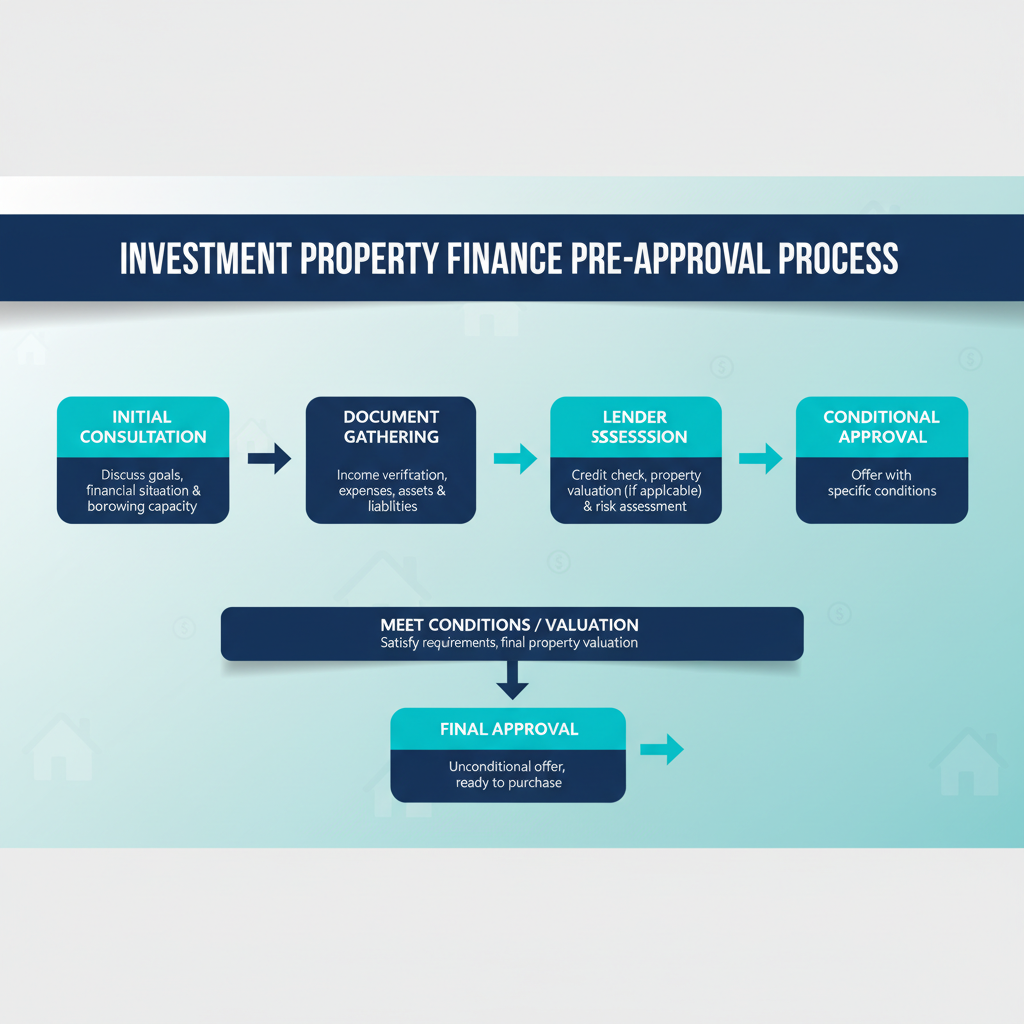
Pre-approval gives you certainty on your budget and strengthens your negotiating position. Most lenders issue pre-approval valid for 90 days.
You'll need to provide payslips, tax returns, bank statements, and details of existing debts. If you own property already, lenders will assess your equity position and may allow you to use this as a deposit for your next purchase.
Factor in Deposit and Upfront Costs
Most lenders require a 20% deposit for investment properties. If you borrow more than 80% of the property value, you'll pay Lenders Mortgage Insurance (LMI), which can cost $15,000 to $30,000 depending on the loan size.
In addition to your deposit, budget for:
- Stamp duty (varies by state, typically 4 to 5% of purchase price)
- Building and pest inspections ($500 to $900)
- Conveyancing fees ($1,200 to $2,500)
- Loan establishment fees ($600 to $1,000)
For a $650,000 property in Queensland, expect total upfront costs of around $40,000 to $50,000 (excluding deposit).
Step 2: Research and Identify Target Markets
Focus on Fundamentals, Not Hype
Successful property investment starts with rigorous market research. Avoid buying based on emotional attachment or media headlines. Instead, focus on suburbs with strong fundamentals:
- Population growth and migration trends
- Employment diversity and major infrastructure projects
- Median days on market and sales volume trends
- Rental vacancy rates below 2%
- Historical capital growth over 10+ year cycles
Buyers Agency Australia uses 10-year portfolio modeling to identify markets with sustainable growth, not just short-term price spikes.
Understand the 2026 Property Market Landscape
Perth, Adelaide, and Brisbane are forecast to deliver 6 to 8% growth in 2026. Darwin may exceed 20% due to strong local demand.
Melbourne and Canberra are expected to grow more modestly (4 to 5%) as affordability pressures and slower population growth weigh on buyer sentiment.
Regional markets in Western Australia and Queensland continue to outperform, offering lower entry prices and higher rental yields.
Define Your Investment Strategy
Are you targeting capital growth or rental yield? High-growth metro suburbs typically deliver lower initial yields (3 to 4%) but stronger long-term appreciation. Regional markets often offer higher yields (5 to 7%) but slower capital growth.
Most successful investors balance both, selecting properties in growth corridors with solid tenant demand.
Step 3: Conduct Thorough Due Diligence
Building and Pest Inspections Are Non-Negotiable
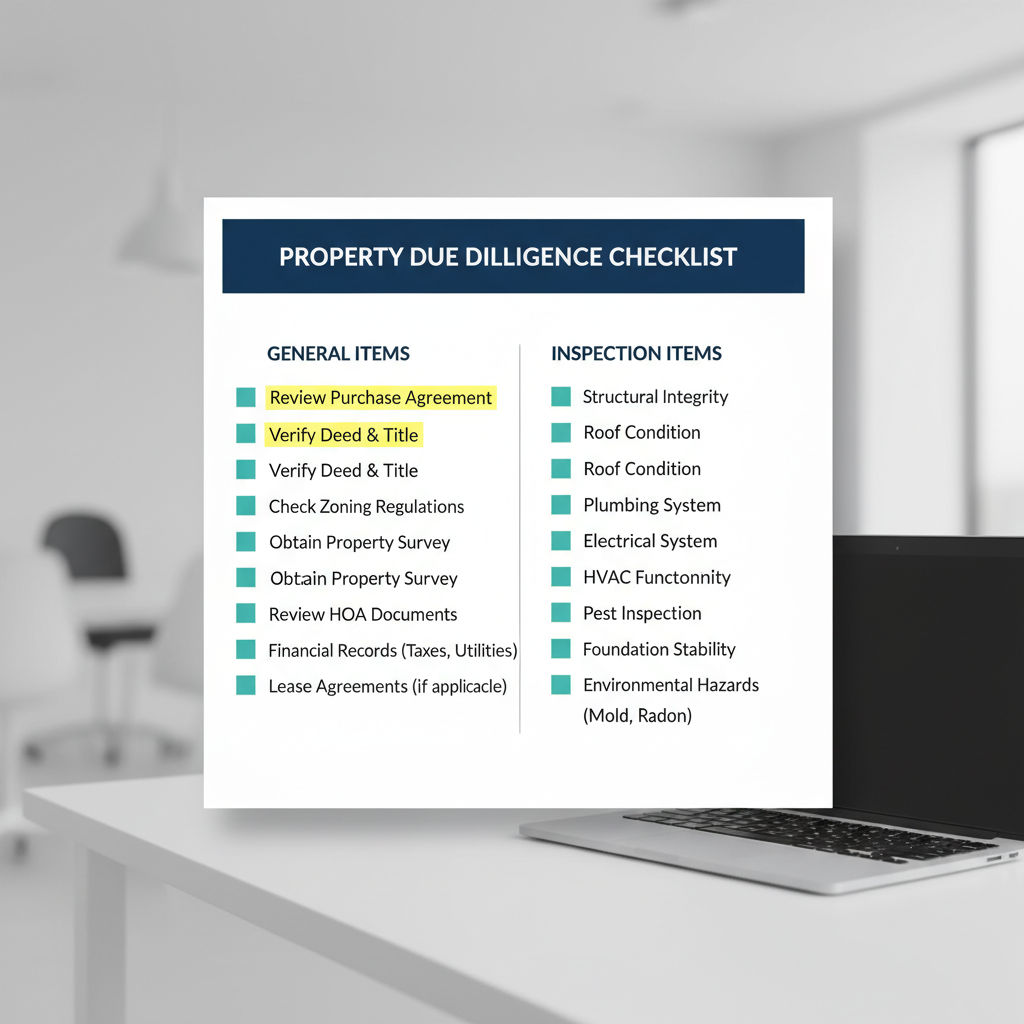
Never skip the building and pest inspection. Pre-purchase inspections cost $500 to $900 but can save you tens of thousands in unexpected repairs.
Building inspections cover structural integrity, roof condition, plumbing, electrical systems, and signs of damp or subsidence. Pest inspections identify termite activity, wood rot, and borer damage.
In 2026, the average cost of rectifying a major building defect exceeds $10,000. Termite damage alone costs Australian homeowners an estimated $1.5 billion annually.
Review Strata Reports and Body Corporate Records
If you're buying an apartment or townhouse, request the strata inspection report. This document reveals upcoming major works, sinking fund balances, disputes, and body corporate fee increases.
High body corporate fees (over $4,000 per year) can erode your cash flow. Look for buildings with healthy sinking funds and no history of special levies.
Check Title, Zoning, and Planning Overlays
Your conveyancer will conduct title searches to confirm ownership and identify easements, covenants, or caveats on the property.
Check local council planning schemes to understand zoning, potential future developments, and any planning overlays that could affect property value (e.g., flood zones, heritage listings).
Run the Numbers on Cash Flow and Returns
Before committing, calculate your expected cash flow using conservative assumptions:
- Rental income at current market rates (not aspirational)
- Interest repayments at your actual loan rate plus 1% buffer
- Ongoing costs: rates, insurance, maintenance (1% of property value per year), property management fees (7 to 9% of rent)
Most investment properties in 2026 are negatively geared, meaning expenses exceed rental income. Ensure you have sufficient cash flow from salary or other sources to cover the shortfall.
Step 4: Negotiate the Purchase Price
Understand Market Conditions and Comparable Sales
Successful negotiation starts with data. Research recent sales of comparable properties in the same suburb. Look at days on market, auction clearance rates, and vendor motivation.
In slower markets, you may achieve 5 to 10% below asking price. In hot markets like Perth or Brisbane, competition is fierce and properties often sell at or above listing price.
Use Your Buyers Agent to Strengthen Your Position
Buyers Agency Australia negotiates on behalf of investors daily. Their fixed-fee model aligns their interests with yours (no commission bias), and their market knowledge gives you a strategic edge.
Buyer's agents can assess vendor motivation, structure offers to appeal to sellers, and negotiate terms such as longer settlement periods or inclusion of chattels.
Make an Offer Subject to Finance and Inspections
Always include finance and building inspection clauses in your contract. These clauses protect you if your loan is declined or the inspection reveals major defects.
Most contracts in NSW allow 14 days for finance approval and 7 days for building inspections. In Queensland, the cooling-off period is 5 business days.
Step 5: Exchange Contracts and Prepare for Settlement
Engage a Conveyancer or Solicitor
Your conveyancer handles the legal transfer of ownership. They review the contract of sale, conduct title searches, liaise with the seller's solicitor, and prepare settlement documents.
Conveyancing fees range from $1,200 to $2,500 depending on the complexity of the transaction.
Finalise Your Loan and Transfer Deposit
Once your offer is accepted, provide your lender with the signed contract. They'll conduct a property valuation to confirm the property's market value.
If the valuation comes in below the purchase price, the lender may reduce the loan amount, requiring you to increase your deposit.
You'll typically pay a 10% deposit within 2 to 7 days of signing the contract. This deposit is held in trust by the seller's agent or solicitor until settlement.
Complete Final Inspection Before Settlement
Most contracts allow a final inspection 48 hours before settlement. This is your last chance to ensure the property is in the same condition as when you made the offer and that any agreed repairs have been completed.
Check that appliances, fittings, and fixtures listed in the contract are still present and working.
Settlement Day
Settlement typically occurs 30 to 90 days after contract exchange. The standard period in NSW is 42 days.
On settlement day, your conveyancer meets with the seller's representative (usually electronically via PEXA). Your lender transfers the loan funds, your conveyancer pays the seller, and ownership is registered in your name.
You're responsible for building insurance from settlement day (earlier in some states). Arrange landlord insurance to cover tenant damage, loss of rent, and liability.
Common Mistakes to Avoid When Buying Investment Property
Buying in the Wrong Location
Location determines 80% of your investment's success. Avoid buying in markets with declining employment, high vacancy rates, or oversupply of new stock.
Many investors buy interstate without visiting the property or understanding local market dynamics. This often leads to poor tenant quality, longer vacancy periods, and lower capital growth.
Overpaying Due to Emotional Attachment
Investment property is a numbers game. Don't fall in love with the property. Stick to your budget and walk away if the numbers don't stack up.
Skipping Due Diligence
Skipping building inspections or failing to review strata reports can cost you tens of thousands. Always invest in professional inspections and take time to review all documentation.
Underestimating Ongoing Costs
Many first-time investors focus on mortgage repayments and forget about rates, insurance, maintenance, and vacancy periods. Budget for 1 to 2% of the property value per year in maintenance and repairs.
Buying Off-the-Plan Without Independent Advice
Off-the-plan apartments carry significant risks, including construction delays, defects, and valuation shortfalls at completion. If you're considering off-the-plan, seek independent advice from a buyer's agent and always include a sunset clause.
How Buyers Agency Australia Simplifies the Investment Property Journey
Navigating the investment property process alone is time-consuming and risky. Buyers Agency Australia removes the guesswork by providing end-to-end support tailored to your investment goals.
Led by Dragan Dimovski, a property advocate with over 20 years of experience and a personal portfolio exceeding $10 million, the firm specialises in data-driven market analysis, off-market property access, and transparent fixed-fee pricing.
Unlike commission-based agents, Buyers Agency Australia works exclusively for you. Their 10-year portfolio modeling ensures you're buying in markets with sustainable growth, not just chasing short-term hype.
Whether you're a first-time investor or scaling your portfolio, their national coverage across Sydney, Melbourne, Brisbane, Perth, and Adelaide means you can invest in the right market, not just your local area.
Book a free strategy session to discuss your investment goals and receive a tailored property plan.
Frequently Asked Questions
How much deposit do I need to buy an investment property in Australia?
Most lenders require a 20% deposit for investment properties. Borrowing above 80% LVR triggers Lenders Mortgage Insurance, adding $15,000 to $30,000 to upfront costs.
How long does the settlement process take in Australia?
Settlement typically takes 30 to 90 days after contract exchange. The standard period in NSW is 42 days, though parties can negotiate shorter or longer timeframes.
Can I use equity from my home to buy an investment property?
Yes. If you own property, you can access up to 80% of its value minus your outstanding loan. This usable equity can fund your deposit without needing cash savings.
Is negative gearing still worth it in 2026?
Yes. Negative gearing allows you to offset rental losses against salary income, reducing your taxable income. Combined with capital growth and depreciation deductions, it remains a tax-effective strategy.
Do I need a buyer's agent to buy an investment property?
No, but a buyer's agent saves time, reduces risk, and often negotiates better prices. They provide market insights, access off-market listings, and handle due diligence, negotiation, and settlement coordination.
Buying an investment property in Australia doesn't have to be overwhelming. By following a structured process, securing finance early, researching markets thoroughly, and conducting rigorous due diligence, you can build a portfolio that generates passive income and long-term wealth.
Ready to take the next step? Contact Buyers Agency Australia today to discuss your investment goals and receive expert guidance tailored to your financial situation.
 General
Master the complete investment property buying process with our practical guide covering finance, research, due diligence, negotiation, and...
Australia's housing shortage has reached a critical point, with estimates placing the deficit between 200,000 and 300,000 homes for the existing population alone. In the year to September 2025, only 174,200 dwellings were completed, falling 65,800 short of the 240,000 homes needed annually to meet the government's Housing Accord target.
If you're watching property prices climb while trying to break into the market, you're not imagining things. The gap between housing supply and demand has never been wider in modern Australian history.
This isn't just affecting renters and first-home buyers. Investors, downsizers, and even established homeowners are navigating a market shaped by structural undersupply, record-low vacancy rates, and policy settings that can't keep pace with population growth.
The Numbers Behind Australia's Housing Shortage
Current Supply vs Demand Gap
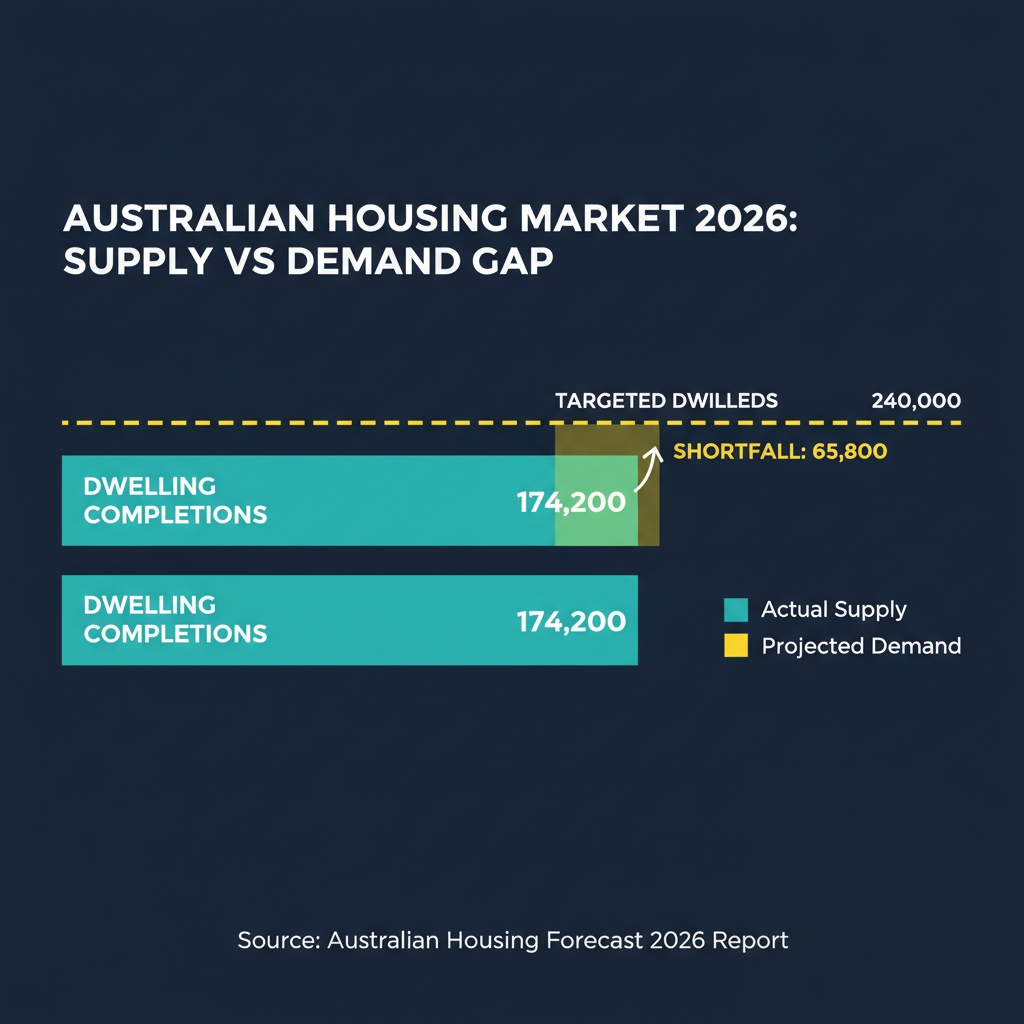
The housing crisis isn't new, but the scale has intensified. According to AMP's Chief Economist Shane Oliver, Australia's cumulative housing shortage sits between 200,000 and 300,000 dwellings, depending on assumptions around household size.
Meanwhile, dwelling approvals tell a worrying story. In 2025, 195,700 dwellings were approved, roughly 44,000 fewer than the 240,000 run rate required to meet government targets.
But approvals don't guarantee completions. Over the last decade, approvals have outpaced completions by 5%, meaning even fewer homes actually get built.
Dwelling Completions Falling Short
Completion data from the Australian Bureau of Statistics shows that in the year to September 2025, just 174,200 dwellings were finished. That's 27% below what's needed.
To meet the National Housing Accord's goal of 1.2 million homes by mid-2029, Australia would need to deliver 240,000 completions annually. Current forecasts from the National Housing Supply and Affordability Council project only 938,000 new dwellings over the Accord period—a shortfall of 262,000 homes.
After accounting for demolitions, net new supply is projected at 825,000 homes, which is 79,000 fewer than expected underlying demand.
Why Supply Can't Keep Up
Several structural issues are choking off new housing:
Construction costs have soared by more than 40% since the start of the COVID-19 pandemic. Residential lot values have jumped 33% over the same period.
Labour shortages remain severe. BuildSkills Australia estimates the industry needs an additional 90,000 residential construction workers just to attempt current targets.
Interest rate impacts have made financing more expensive for developers. Many apartment projects now run on profit margins below 5%, leaving little buffer for cost overruns or delays.
Approval delays compound the problem. In Victoria, planning approvals average 140 days, or over 300 if objections are lodged. The time from approval to completion has increased by more than 50% over the past decade.
What the Housing Shortage Means for Property Prices
Price Growth Forecast for 2026
The supply crunch is directly feeding into price growth. National property values rose 8.2% in 2025, lifting the national median dwelling value to around $900,000.
For 2026, forecasts vary by institution but all point upward:
- KPMG predicts national growth of 7.7%, with houses up 8.2% and units rising 7.1%
- AMP expects 5–7% growth nationally
- ANZ has downgraded its forecast to 4.8% growth following the February rate hike
Perth, Brisbane, and Adelaide are forecast to outperform. KPMG expects Perth house prices to rise almost 13% in 2026, while Brisbane could see 11% growth. Canstar analysis suggests both cities could see median house price increases exceeding $100,000 in 2026 alone.
Sydney and Melbourne face affordability constraints but are still tipped to record 2–7% gains.
Regional Divergence and Hotspots
Australia's housing market is increasingly two-speed. Mid-sized capitals with severe supply shortages are seeing the strongest momentum.
Perth leads national growth, supported by the fastest population growth in the country, limited supply, and relative affordability compared to Sydney and Melbourne.
Brisbane benefits from ongoing interstate migration and strong infrastructure investment ahead of the 2032 Olympics.
Adelaide has seen affordability issues emerge, which may moderate future gains, but supply remains tight.
Sydney and Melbourne, while still expensive, are facing slower growth due to poor affordability, higher inventory, and weaker consumer sentiment in Victoria.
Rental Market Under Extreme Pressure
Rental vacancy rates remain near record lows at around 1.6% nationally. In the year to January 2026, advertised rents rose 5.4%, outpacing wage growth once again.
Since the end of 2019, national advertised rents have climbed 47%, according to Cotality, adding $11,400 to the annual cost of renting. In Sydney alone, renters are paying around $3,770 more per year than 12 months ago.
Demand for rental accommodation continues to far exceed available supply, which is driving both rental growth and investor interest.
Implications for Property Investors
Why This Creates Opportunity
For investors who understand the fundamentals, supply shortages create long-term tailwinds.
When underlying population-driven demand exceeds supply, prices rise. This dynamic has been in play for 20 years, and it's intensifying.
The key for investors is to focus on markets where:
- Population growth is strong
- Vacancy rates are below 2%
- New supply is limited
- Infrastructure investment is confirmed
- Rental yields remain attractive
These conditions exist right now in Perth, Brisbane, and select regional centres.
Strategic Advice for Investors
Don't chase headlines. FOMO buying leads to overpaying in overheated markets. Strategic investors buy assets with strong fundamentals, not postcodes.
Focus on rental yield. With interest rates remaining elevated, cash flow is critical. Look for properties offering yields above 4.5% in high-growth corridors.
Buy in supply-constrained locations. Markets with low listing volumes and high buyer competition will outperform over the next 3–5 years.
Consider interstate investment. Sydney and Melbourne investors are increasingly looking to Brisbane, Perth, and Adelaide for better yield and growth prospects.
How Buyers Agency Australia Helps Investors Navigate Supply Shortages
At Buyers Agency Australia, we specialise in identifying under-market opportunities in supply-constrained markets. With over 20 years of experience and a $10M+ personal portfolio, our founder Dragan Dimovski has built a reputation for data-driven investment strategies that prioritise long-term wealth creation.
We use 10-year portfolio modelling to ensure every acquisition supports your financial goals, not just short-term market sentiment. Our transparent, fixed-fee model means we're aligned with your success, not commission-based incentives.
Whether you're building a portfolio from scratch or scaling from one property to five, we provide end-to-end support—from suburb research to settlement—so you can invest with confidence in markets shaped by structural undersupply. Book a free strategy session to discuss your investment goals.
What It Means for First-Home Buyers
The Affordability Challenge
First-home buyers face the toughest conditions in a generation. The time required to save for a deposit has blown out to 10.6 years, and households with a new mortgage now spend 50% of their income on housing.
The house price-to-income ratio sits at 8.0, meaning the median home costs eight times the median annual household income. In Sydney and Melbourne, that ratio is even higher.
With property prices rising faster than wages, the gap between aspiration and reality is widening.
Government Support Schemes
The Federal Government has expanded the First Home Guarantee Scheme, allowing eligible buyers to purchase with as little as 5% deposit. This has brought forward demand, with Domain estimating the scheme could pull 20,000 first-home buyers into the market in year one.
The Help to Buy scheme allows the government to take a 30–40% equity stake in a property, reducing upfront costs.
But these demand-side policies add fuel to an already undersupplied market, potentially driving prices higher in the short term.
First-Home Buyer Strategy
If you're a first-home buyer, here's what to focus on:
Get pre-approved early. Knowing your borrowing capacity helps you act quickly in competitive markets.
Consider rentvesting. Buying an investment property in an affordable, high-growth market while continuing to rent where you want to live can be a smarter wealth-building strategy.
Work with a buyer's advocate. Professional representation gives you access to off-market deals, skilled negotiation, and peace of mind that you're not overpaying. Contact Buyers Agency Australia to discuss your first-home purchase.
Look beyond the CBD. Outer suburbs and regional centres with strong infrastructure investment often offer better value and growth potential.
Policy and Structural Issues Driving the Shortage
The 1.2 Million Homes Target Won't Be Met
The Albanese government's Housing Accord aims to deliver 1.2 million new homes by mid-2029. But current trends show this target is unachievable.
Over the first 18 months of the Accord, 287,200 dwellings were approved—20% fewer than the 360,000 target. No state or territory is on track to meet its implied housing target.
Victoria is forecast to achieve 98% of its target, while Western Australia, Queensland, and the ACT will hit around 80%. Other states lag further behind.
Migration and Population Growth
Australia recorded 266,000 net migrants annually between Q4 2019 and Q2 2025, including the COVID-19 border closure. This is the strongest net overseas migration in the nation's history.
The government has pledged not to lower immigration, meaning the housing shortage will worsen unless construction output accelerates dramatically.
If immigration remains strong, KPMG forecasts Australia's housing shortage could double to 400,000 by 2028–29.
Why Construction Can't Scale Fast Enough
Even if government policies improve, the construction industry lacks the capacity to deliver 240,000 homes per year.
Productivity in residential construction has been falling for a decade. Overregulation, slow land release, labour shortages, and material cost increases all constrain supply.
The solution requires long-term reform—planning system overhauls, workforce development, and tax incentives that prioritise housing supply over speculation.
FAQ
How many homes is Australia short?
Between 200,000 and 300,000 dwellings for the existing population, with the gap widening if migration stays high.
Will house prices drop in 2026?
No. All major forecasters predict continued price growth, though at a slower pace than 2025 due to affordability constraints.
Which cities have the worst housing shortage?
Perth, Brisbane, and Adelaide have the lowest vacancy rates and strongest buyer demand relative to supply.
How long will the housing shortage last?
At least another decade. Construction output won't meet demand until 2030 or beyond, assuming major policy reforms.
Should I invest in property during a housing shortage?
Yes, if you buy strategically. Supply shortages support long-term price growth and rental yield, making it a strong investment environment for informed buyers.
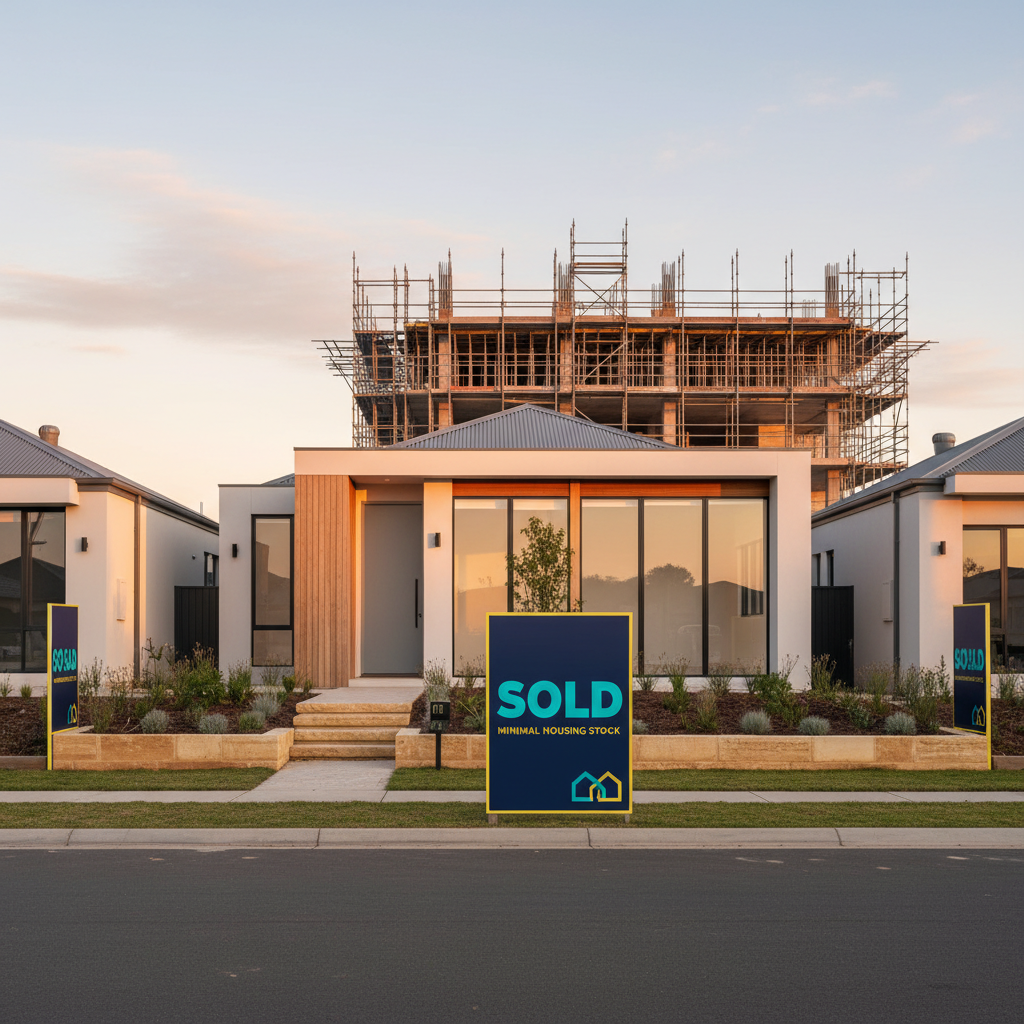 General
Australia's housing deficit now sits between 200,000–300,000 dwellings, with only 174,200 homes completed versus 240,000 needed annually, driving...
Dragan Dimovski is the founder of Buyers Agency Australia, a Qualified Property Investment Adviser with over 20 years of hands-on experience identifying under-market value properties and building strategic investment portfolios. He helps Australian investors secure high-performing properties through data-driven strategies, exclusive off-market access, and expert negotiation that saves clients thousands.
If you're searching for a buyers agent who genuinely understands the Australian property market from the ground up, you'll want to know about Dragan Dimovski. He's not your typical property professional who jumped straight into real estate. His journey started with photography, took him overseas where he learned expensive lessons, and eventually led him to build a multi-million dollar property portfolio and found Buyers Agency Australia.
What sets Dragan apart is his commitment to transparency and results. He's walked in the shoes of investors who've made costly mistakes, overpaid for properties, and felt overwhelmed by the complexity of the market. That lived experience shapes how he and his team serve clients today, whether you're a first-home buyer or scaling a multi-property portfolio.
The Unconventional Path: From Photography Studio to Property Investment
Starting Young in Business
Dragan's entrepreneurial journey began at just 21 years old when he owned a photography studio In Ashfield. Growing up in Sydney's western suburbs, he developed a work ethic early and turned his passion for photography into a thriving business. But it was a conversation with his landlord that changed everything.
The landlord's lifestyle, nice cars, and financial freedom sparked a question that many young Australians ask: "How do people actually afford these things?" The answer was property investment, and Dragan immediately booked himself into a property seminar to learn more.
Learning the Hard Way
Like many first-time investors, Dragan made mistakes early on. He bought a two-bedroom apartment in Pymble, northern Sydney, for $440,000 after hearing a seminar presenter recommend renovation properties. After spending $20,000 on renovations, $20,000 on stamp duty, and accounting for other fees, he barely broke even.
That experience taught him a crucial lesson: due diligence matters more than guru advice. According to API Magazine, Dragan admits "the due diligence wasn't there" on that first purchase. But instead of giving up, he doubled down on learning.
He also invested overseas, which nearly broke him financially. That gut-wrenching experience of losing savings became the foundation for his risk-management philosophy today.
Finding His Mentor
A turning point came when Dragan reconnected with an uncle who was quietly building his own property portfolio. Having a close mentor made all the difference. Someone in the family who could provide guidance on what to do (and what not to do) helped Dragan refine his approach during those critical early years.
Building a Personal Portfolio Worth Millions
The Strategy That Works
Over 20 years, Dragan developed a portfolio strategy that differs from typical buy-and-hold advice. He focuses on purchasing older houses on large blocks (1,000 to 2,000 square metres), primarily on the north coast of NSW and in Brisbane, with subdivision potential.
His approach involves riding growth for 5 to 10 years, then subdividing the block to sell and pay off debt. This accelerated wealth-building strategy has worked consistently for him across multiple property cycles.
From Investor to Adviser
Dragan's personal success led him to obtain his Qualified Property Investment Adviser (QPIA) certification and establish Buyers Agency Australia. He also holds a Class 1 Real Estate License, ensuring he operates with full regulatory compliance.
His hands-on experience, combined with formal training from esteemed buyers agents, positions him as someone who doesn't just teach theory. He applies strategies he's personally tested in the market.
What Makes Buyers Agency Australia Different
A Data-Driven, Client-First Approach
When you work with Buyers Agency Australia, you're not getting cookie-cutter advice. Dragan and his team use a data-driven methodology that analyzes vacancy rates, days on market, stock levels, and capital growth indicators to identify suburbs before they boom.
The firm operates nationally across Sydney, Melbourne, Brisbane, Perth, and regional markets. They've helped clients from Australia, the Middle East, UK, the US, and China secure properties that align with their financial goals.
Transparent Fixed-Fee Model
Unlike traditional commission-based agents who may push higher-priced properties, Buyers Agency Australia operates on a transparent fixed-fee structure. This removes conflicts of interest and ensures recommendations are based purely on what's best for your investment strategy.
Clients consistently report saving twice the cost of the agency's fees through expert negotiation and avoiding overpriced properties.
Access to Off-Market Properties
One of the biggest advantages Dragan offers is access to off-market properties. Through his extensive network of agents and industry contacts built over two decades, he finds properties before they hit public listings.
This gives clients less competition, more negotiation leverage, and often instant equity. According to Real Estate Buyer's Agents Association of Australia (REBAA), off-market deals can save investors 5-15% compared to on-market purchases.
How Dragan and His Team Help Different Types of Buyers
For Property Investors Building Wealth
If you're a serious investor looking to build a portfolio, Dragan specializes in identifying positively geared properties that deliver cash flow from day one. His strategy focuses on:
- Capital growth potential in high-demand suburbs
- Rental yield that covers mortgage costs and generates income
- 10-year portfolio modeling to map your path to financial freedom
- Subdivision and value-add opportunities for accelerated wealth building
He's particularly skilled at helping rentvestors (those priced out of Sydney and Melbourne) buy high-yield properties in Brisbane, Perth, and regional areas where they can afford to scale their portfolios.
For First-Home Buyers Overwhelmed by Auctions
Buying your first home is stressful, especially when you're competing at auctions against experienced investors. Dragan and his team provide:
- End-to-end guidance through the entire purchase process
- Auction bidding strategies to help you win without overpaying
- Property due diligence to avoid buying a lemon
- Negotiation expertise that saves you thousands
Multiple client testimonials highlight how Dragan "took away the hesitation" that stopped them from purchasing property for years.
For Time-Poor Professionals Who Need Help
High-net-worth professionals (doctors, IT specialists, business owners) don't have weekends to attend open homes or skills to evaluate properties. Buyers Agency Australia handles:
- Property search and shortlisting based on your criteria
- Building and pest inspections coordinated on your behalf
- Contract review with legal and financial experts
- Settlement coordination to ensure smooth handover
Clients report that working with Dragan feels like having an expert property partner who does all the heavy lifting while keeping you informed at every step.
The Buyers Agency Australia 5-Step Process
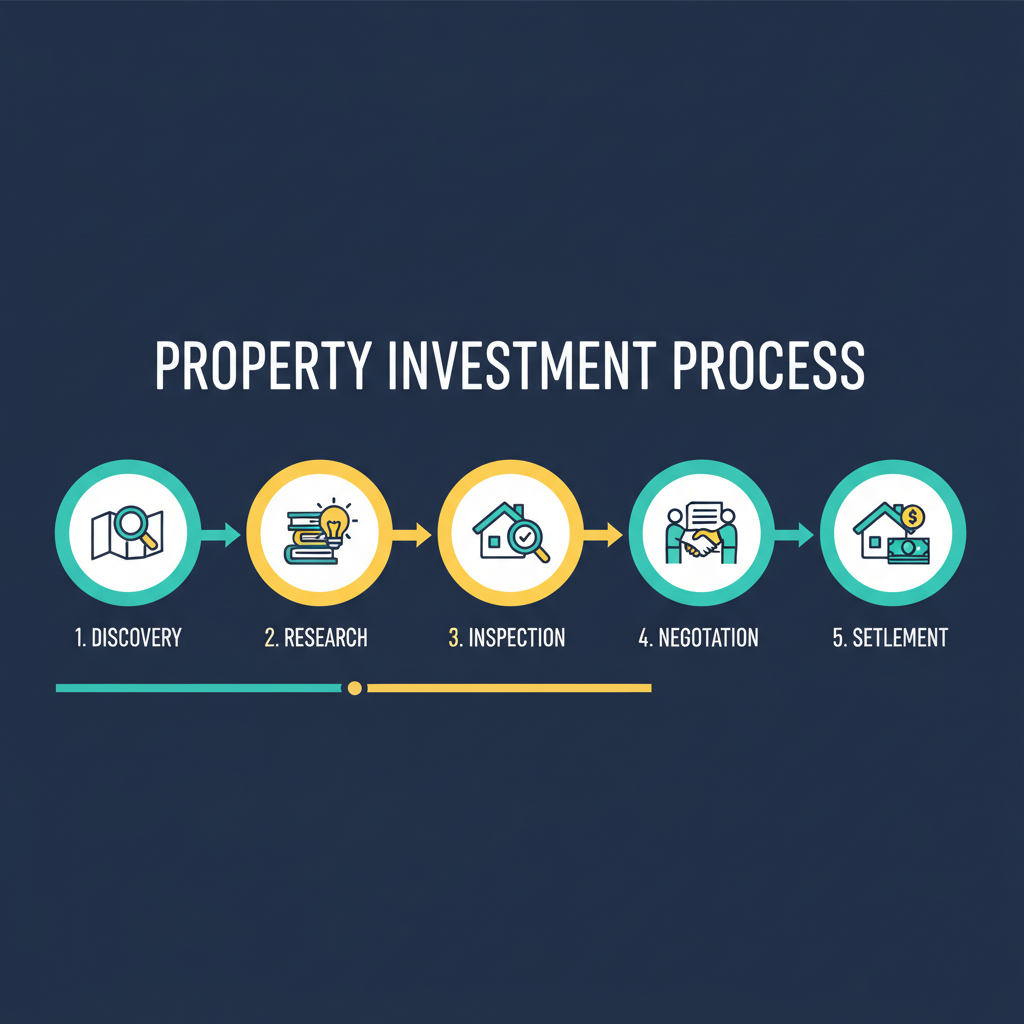
Step 1: Discovery and Strategy Session
The journey starts with a free strategy session where Dragan and his team listen to your goals, financial situation, and investment timeline. They don't push products or rush decisions. Instead, they build a personalized investment strategy that fits your unique circumstances.
Step 2: Property Research and Market Analysis
Using proprietary data analysis tools and on-the-ground market intelligence, the team identifies suburbs and properties that match your criteria. They consider factors like:
- Median property prices and growth trends
- Rental vacancy rates and tenant demand
- Infrastructure projects and employment hubs
- School zones and lifestyle amenities
- Building quality and land size
This research phase typically uncovers opportunities that DIY investors miss because they lack access to the same data sources.
Step 3: Property Shortlisting and Inspection
Dragan and his buyers agents inspect properties on your behalf, evaluating everything from structural condition to rental potential. They present only properties that meet strict investment criteria, saving you from wasting time on unsuitable options.
For interstate or overseas buyers, they provide detailed reports with photos, videos, and honest assessments so you can make informed decisions remotely.
Step 4: Negotiation and Acquisition
This is where Dragan's experience truly shines. He's skilled at negotiating discounts well below asking prices, especially in softening markets. His approach involves:
- Understanding seller motivation and urgency
- Presenting strong but realistic offers
- Using comparable sales data to justify pricing
- Managing auction bidding strategies
- Negotiating favorable contract terms
Clients consistently report that Dragan negotiated deals they never could have secured on their own.
Step 5: Settlement and Tenant Placement
Once contracts are exchanged, the team coordinates settlement, arranges property management, and ensures tenants are placed quickly. For investment properties, they target positive cash flow from day one, so you're earning income immediately.
Dragan's Philosophy: No-Fluff, Results-Oriented Advice
Why He Wrote "Property = Wealth"
Dragan recently authored a book titled "Property = Wealth," published by Wiley. Drawing on more than 20 years' experience, the book reveals strategies, mindset, and team-building principles for lasting wealth creation.
Unlike many property books filled with sales pitches, Dragan's approach is refreshingly honest. He discusses mistakes to avoid, risks to manage, and realistic timelines for building wealth through property.
The "Passive with Property" Podcast
Dragan hosts the "Passive with Property" podcast, where he interviews mortgage brokers, developers, successful investors, and industry experts. The podcast cuts through hype to deliver practical advice on:
- Suburb analysis and market trends
- Finance strategies and serviceability
- Tax planning and depreciation benefits
- Portfolio scaling and risk management
With over 40 episodes, it's become a go-to resource for Australian property investors who want no-fluff insights from someone who's actually doing the work.
Speaking Engagements and Media Appearances
Dragan is a regular contributor to property industry events and media. He's been featured on:
- Australian Property Investor Magazine podcasts
- Yahoo Finance property commentary
- Sydney Property Expo
- Various property investment seminars and workshops
His media presence reflects his standing as a trusted authority in the Australian buyers agency space. You can explore more about his media appearances on the Buyers Agency Australia podcast page.
Real Client Success Stories
Gordon: From Blind First Purchase to High-Performing Portfolio
Gordon, a client featured on the Passive with Property podcast, shared how his first property purchase was essentially "blind." After connecting with Dragan and the Buyers Agency Australia team, he learned proper due diligence processes and built a portfolio of high-performing properties.
Gordon's story highlights the difference between DIY investing and working with an expert who can show you what to look for.
Rentvesting Couple: Gaining a Foothold in the Market
A young couple priced out of Sydney decided to rentvest with Dragan's guidance. They now own a reliable investment property in a regional town with low vacancy rates, strong rental income, and promising growth potential. The wife said, "We may have made serious errors on our own as novice investors. Instead, we're thrilled with what we've achieved."
Multi-Property Investor: Three Properties, Massive Savings
Another client purchased three properties through Buyers Agency Australia and reported saving "a great deal of money with each one." They highlighted the team's sector expertise and highly recommend their services to other investors.
First-Time Investor: Overcoming 10 Years of Hesitation
One testimonial stands out: "For over 10 years I was very hesitant in property investing. After using your service and seeing how the process works, I wish I did it sooner!" This sentiment is common among clients who delayed investing due to fear or overwhelm.
Why Dragan's Experience Matters in Today's Market
Navigating Market Cycles
Dragan has invested through multiple property cycles, including boom periods, corrections, and the COVID-19 disruption. This experience allows him to adapt strategies based on current conditions rather than following outdated formulas.
He understands when to buy aggressively, when to wait, and how to spot early indicators of suburb gentrification before prices spike.
Avoiding Common Pitfalls
His early mistakes (buying off-the-plan disasters, overpaying in hot markets, investing overseas without proper due diligence) inform the risk-management protocols he applies for clients today.
Dragan teaches investors to avoid:
- Emotional buying in competitive markets
- Overextending financially without cash reserves
- Ignoring building and pest issues that cost tens of thousands
- Following market hype instead of fundamentals
- Poor property selection that leads to low rental demand
Building the Right Team
Dragan emphasizes that successful property investment requires a trusted team: mortgage brokers, accountants, solicitors, property managers, and buyers agents. He's built relationships with top professionals across these disciplines and connects clients with the right experts.
This team-based approach, detailed in his book "Property = Wealth," ensures all aspects of your investment are handled by specialists who work in your best interests.
How Dragan Dimovski Secures Off-Market Deals for Clients
The Power of Industry Relationships
After 20 years in the industry, Dragan has cultivated relationships with selling agents, developers, accountants, and solicitors who contact him first when clients need to sell quietly. These relationships are the foundation of his off-market access.
Sellers often prefer off-market sales to avoid public marketing costs, reduce time on market, and maintain privacy. This creates win-win scenarios where buyers get better prices and sellers get quick, certain transactions.
Instant Equity Opportunities
Many off-market properties are purchased 10-30% below market value, creating instant equity. This equity can be used to purchase additional properties faster, accelerating portfolio growth.
For investors building wealth, this compounding effect is powerful. Instead of waiting 5-7 years for equity to grow, you start with a significant buffer that can be accessed within 12-18 months.
The Financial Reality: Is Working with a Buyers Agent Worth It?
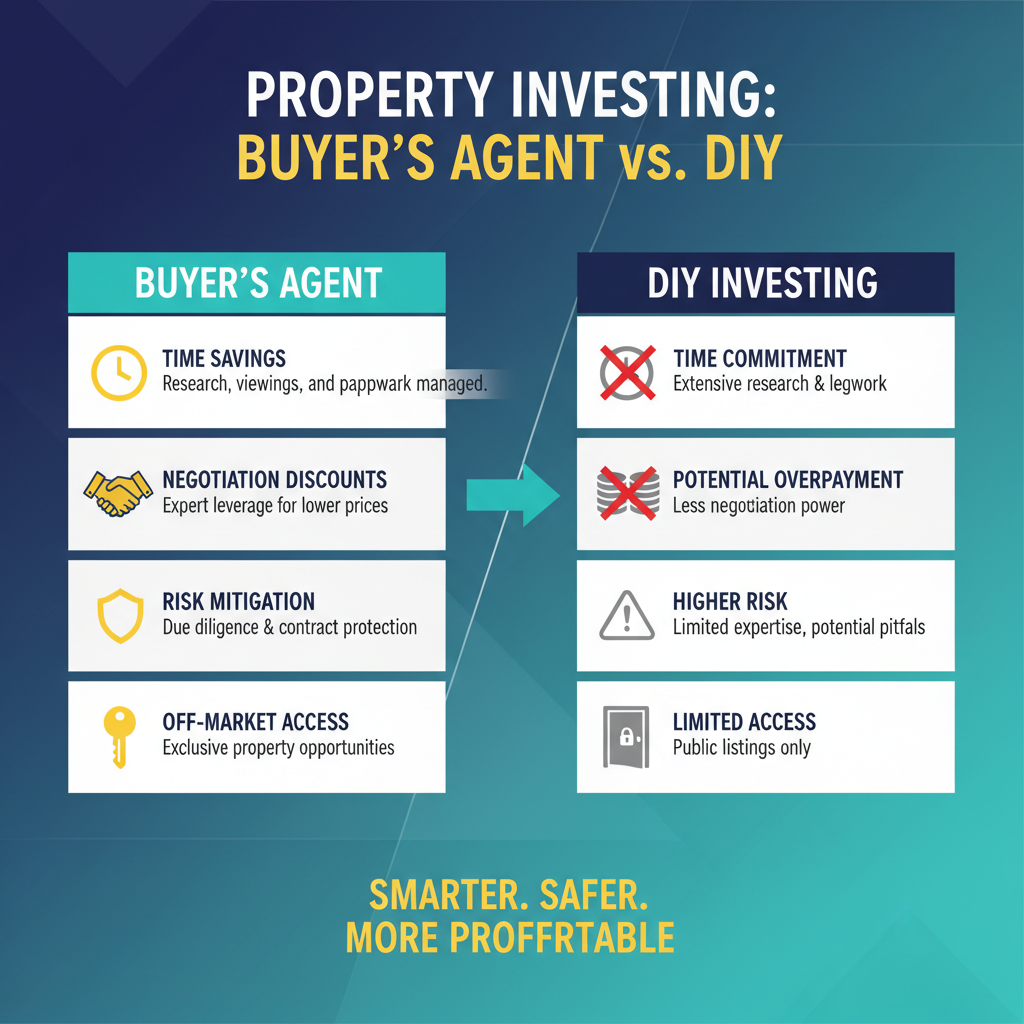
Breaking Down the Costs
Buyers agent fees typically range from $8,000 to $15,000 depending on the service level and property price. For some investors, this feels like a significant upfront cost. But Dragan's clients consistently report saving twice the fee amount through negotiation alone.
For example, if you're buying a $600,000 property and Dragan negotiates a 5% discount ($30,000), you've saved double the typical fee while avoiding the risk of overpaying.
Time Savings and Opportunity Cost
Beyond money, consider the time you save. How many weekends would you spend attending open homes, researching suburbs, and coordinating inspections? For high-income professionals, that time has value.
Moreover, delaying your property purchase by 6-12 months while you learn the market could cost you $50,000+ in growth and rental income.
Risk Mitigation
The biggest value Dragan provides is risk mitigation. Buying the wrong property in the wrong suburb at the wrong price can set you back years financially. One client mentioned how Dragan's due diligence checklist helped them spot major foundation issues a seller was hiding, saving them from a "money pit."
That single avoided mistake paid for the buyers agent fee many times over.
How Dragan Dimovski Helps You Build a Property Portfolio Strategy
10-Year Portfolio Modeling
Dragan doesn't just help you buy one property. He maps out a 10-year strategy showing how to scale from your first investment to a portfolio of 3-5+ properties that generate passive income and long-term wealth.
This modeling considers:
- Your current income and borrowing capacity
- Equity release timelines
- Cash flow requirements
- Capital growth projections
- Tax planning and depreciation benefits
- Exit strategies and refinancing options
Balancing Cash Flow and Capital Growth
One of the biggest mistakes investors make is chasing either pure cash flow or pure capital growth. Dragan teaches a balanced approach:
- Early properties should be positively geared or neutral to build confidence and cash reserves
- Middle properties can focus more on capital growth once you have cash flow stability
- Advanced strategies involve value-add opportunities like subdivision or renovation
This balanced portfolio design, tailored to your risk tolerance and goals, ensures sustainable growth without overextending financially.
Scaling Safely
Dragan emphasizes safe scaling practices:
- Maintain 6-12 months of cash reserves for emergencies
- Don't buy all properties in one suburb or city (diversification)
- Regularly review and adjust your strategy based on market conditions
- Work with mortgage brokers who understand investment lending
- Structure ownership correctly from the start (trusts, companies, personal names)
These principles, learned through his own mistakes and successes, protect clients from the common traps that derail property investors.
Why Investors Choose Dragan Dimovski and Buyers Agency Australia
Proven Track Record Across Market Cycles
With over 20 years of personal investment experience and a multi-million dollar portfolio, Dragan has proven he can identify opportunities and execute strategies that work. He's helped hundreds of families build wealth through property, with many clients returning for their second, third, and fourth purchases.
Boots-on-the-Ground Market Intelligence
Dragan and his team actively inspect properties, meet with agents, and monitor markets daily. This boots-on-the-ground intelligence beats desktop research every time. They know which suburbs have tight rental markets, which agents are motivated to sell, and which properties offer the best value.
A Team That Actually Cares
Client testimonials consistently mention how Dragan and his team "held my hand," "took away hesitation," and "made the process simple." This empathetic, client-first approach reflects Dragan's understanding that property investment can feel overwhelming and stressful.
His team includes Amanda Calabria (Property Educator), Rocco Marrapodi (Head Strategist), and other buyers agents who share his commitment to transparent, results-oriented service.
National Coverage with Local Expertise
Whether you want to invest in Sydney, Melbourne, Brisbane, Perth, or regional markets, Buyers Agency Australia has local expertise. They've helped clients from overseas and interstate buy with confidence, managing the entire process remotely when needed.
This national reach, combined with deep local knowledge, gives you access to the best opportunities across Australia rather than being limited to one market.
Getting Started with Dragan Dimovski and Buyers Agency Australia
Book a Free Strategy Session
The best first step is booking a free strategy session where you'll discuss your goals, finances, and investment timeline. There's no pressure or obligation. Dragan and his team simply want to understand your situation and share how they can help.
During this session, you'll learn:
- Whether property investment makes sense for you right now
- Which markets and strategies align with your goals
- Realistic timelines for building wealth
- How Buyers Agency Australia's process works
- Transparent fee structure based on your needs
Attend the FastTrack Event
Buyers Agency Australia hosts the FastTrack event, where Dragan reveals insider strategies for buying ultra-discounted off-market real estate deals. You'll learn his "Crystal Ball" strategy, due diligence checklists, and negotiation tactics.
This free event is perfect for investors who want to understand Dragan's approach before committing to a full buyers agent service.
Explore Educational Resources
If you're not ready to work with a buyers agent yet, start with Dragan's free resources:
These resources help you build knowledge and confidence before making investment decisions.
What Sets Dragan Apart in a Crowded Buyers Agency Market
Transparency Over Sales Pitches
Dragan's philosophy is simple: provide honest guidance without hidden agendas. He's not affiliated with developers pushing new builds or financial planners selling managed funds. His only focus is helping you buy the right property at the right price.
This transparency extends to fee structures, property recommendations, and realistic expectations about returns and timelines.
A Personal Investment Portfolio That Speaks Volumes
Unlike some buyers agents who don't invest themselves, Dragan has built a substantial personal portfolio using the exact strategies he teaches clients. This skin-in-the-game credibility matters. He's not recommending strategies from textbooks; he's sharing what's worked in his own wealth-building journey.
Continuous Learning and Adaptation
Dragan holds a Qualified Property Investment Adviser (QPIA) certification, has completed training with esteemed buyers agents, and maintains his real estate license with ongoing professional development. He regularly attends industry conferences, studies market data, and interviews experts on his podcast to stay ahead of trends.
This commitment to continuous learning ensures his strategies remain relevant in changing markets.
Common Questions About Working with Dragan Dimovski
How Does Dragan Find Off-Market Properties?
Through 20 years of building relationships with selling agents, developers, accountants, and solicitors who contact him first when clients need to sell. He also monitors pre-market listings, private sales networks, and distressed property opportunities that never reach public portals.
Can Dragan Help First-Home Buyers or Just Investors?
While Buyers Agency Australia specializes in investment properties, they also help first-home buyers overwhelmed by auctions or struggling to find suitable homes in competitive markets. The same negotiation skills and market knowledge apply whether you're buying to live in or invest.
What Markets Does Dragan Cover?
Buyers Agency Australia operates nationally across Sydney, Melbourne, Brisbane, Perth, Adelaide, and high-growth regional markets. Dragan and his team have boots-on-the-ground contacts in all major Australian cities and can coordinate purchases for interstate or overseas clients.
How Much Can You Really Save Working with Dragan?
Clients typically save 5-15% below market value on off-market properties, which often equals $30,000-$90,000 on a $600,000 property. Even after accounting for buyers agent fees, most clients save twice the fee amount while gaining instant equity and avoiding costly mistakes.
Is Dragan's Service Only for High-Net-Worth Investors?
No. Buyers Agency Australia works with first-time investors, young couples rentvesting, and retirees looking for cash flow properties. While they do serve high-net-worth professionals, their service is accessible to anyone serious about building wealth through property.
Frequently Asked Questions
Who is Dragan Dimovski and what experience does he have?
Dragan Dimovski is a Qualified Property Investment Adviser with 20+ years of experience, founding Buyers Agency Australia to help investors secure high-performing properties.
What services does Buyers Agency Australia provide?
They offer property search, market analysis, negotiation, off-market access, portfolio strategy, and end-to-end purchase support for investors and first-home buyers.
How does Dragan help investors access off-market properties?
Through 20 years of industry relationships with agents, developers, and professionals who contact him first when properties become available privately.
What is Dragan's property investment strategy?
He focuses on buying properties with capital growth potential, positive cash flow, and value-add opportunities like subdivision on large blocks.
Can Buyers Agency Australia help interstate or overseas buyers?
Yes, they provide full service for remote buyers, coordinating inspections, reports, and settlements across Sydney, Melbourne, Brisbane, Perth, and regional markets.
 General
Discover how Dragan Dimovski, founder of Buyers Agency Australia, uses 20+ years of experience to help investors secure...
The Australian property market is forecast to deliver solid growth through 2026, driven by chronic housing shortages, strong migration demand and limited supply. Despite the RBA increasing rates to 3.85% in February 2026, property prices are tipped to rise between 4.8% and 7.7% nationally, with Perth, Brisbane and Adelaide leading the charge.
If you’re watching the 2026 Australian property market wondering whether now is the time to buy, you’re not alone.
Recent headlines have been pulling in two directions. One week it’s rate hikes and affordability warnings. The next, it’s record auction clearance rates and analysts calling another growth year.
So what’s actually happening? Is the market about to boom again, or are we heading for a slowdown? The truth is more nuanced than either narrative suggests. Buyers Agency Australia has been tracking every indicator, every forecast and every regional variation to help investors make smarter, more confident decisions in what’s shaping up to be one of the most complex property cycles in recent memory.
What’s Driving the 2026 Property Market Outlook
The 2026 Australian property market isn’t being shaped by one factor. It’s the collision of multiple structural forces that don’t always move in the same direction.
Let’s break them down.
Interest Rates: The February Shock and What’s Next
At its February 2026 meeting, the Reserve Bank of Australia raised the cash rate by 25 basis points to 3.85%, marking the first increase since November 2023.
The decision came after inflation picked up materially in the second half of 2025. Headline inflation rose to 3.8% in the year to December 2025, up from 3.4% in November. Underlying trimmed mean inflation increased 0.9% over the quarter and 3.4% over the year.
The RBA stated that “inflation is likely to remain above target for some time” and flagged that financial conditions eased over 2025, making it uncertain whether policy remains restrictive.
Market watchers now expect another rate hike in May 2026. Commonwealth Bank economists revised their outlook, stating the RBA will likely take the cash rate to 4.10% if inflation stays elevated.
What does this mean for buyers? Each 0.25% rate rise reduces borrowing capacity by approximately $12,000 for an average income earner. That’s a meaningful constraint, especially at the $1 million+ price points now common in Sydney, Brisbane and Melbourne.
But here’s the thing: rate movements aren’t the only driver of property prices. In fact, structural supply and demand forces often matter more.
Housing Supply Shortage: The 200,000-Home Deficit
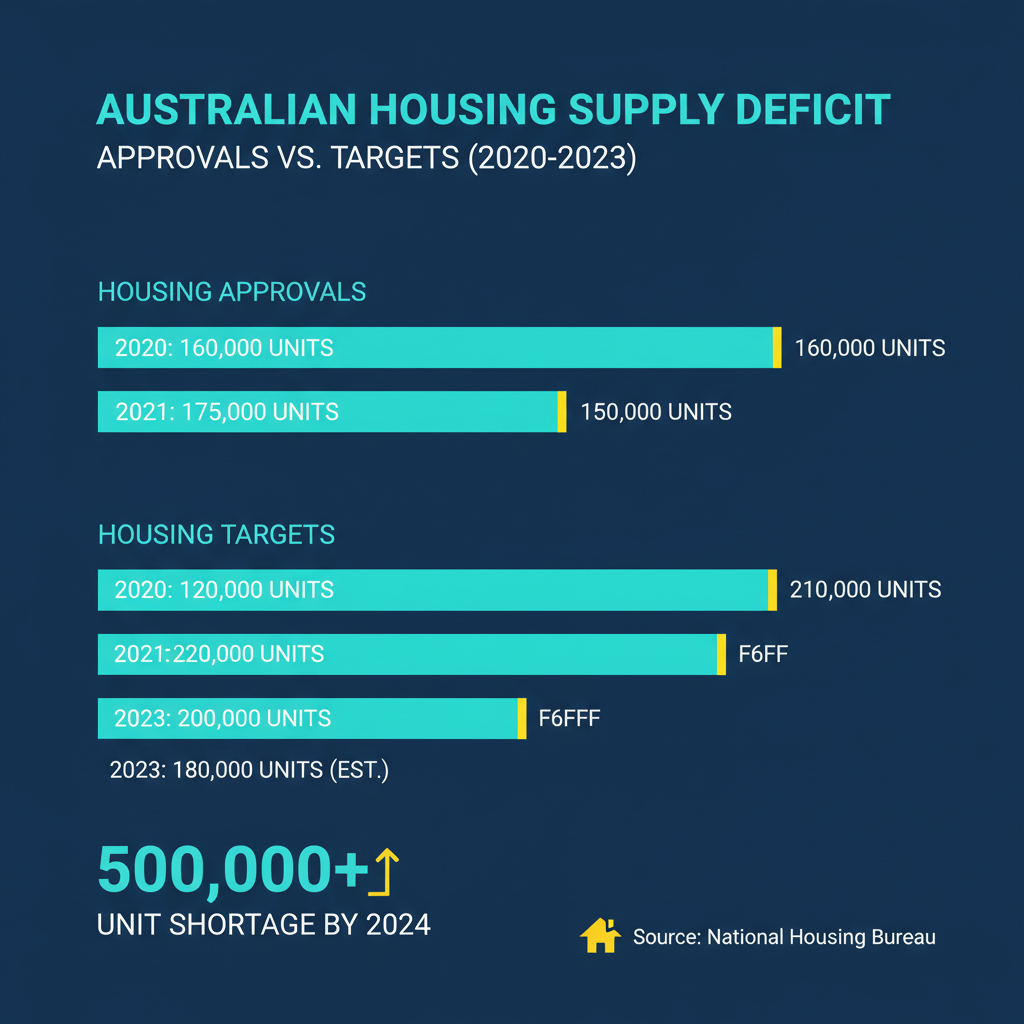
Australia’s housing crisis isn’t easing.
According to AMP Chief Economist Shane Oliver, Australia faces a cumulative housing shortage of between 200,000 and 300,000 homes.
The federal government’s Housing Accord target is to build 1.2 million homes over five years. But approvals are tracking well below the 240,000 annual run rate needed. In 2025, just 195,700 dwellings were approved, a shortfall of 44,000.
Over the first 18 months of the Housing Accord (to December 2025), 287,200 dwellings were approved. That’s 72,800 (20%) fewer than the 360,000 target.
The National Housing Supply and Affordability Council forecasts 938,000 new dwellings will be built by June 2029, implying a shortfall of 262,000 against the Housing Accord target. After accounting for demolitions, net new supply will be 825,000, which is 79,000 dwellings fewer than expected demand.
Why isn’t supply catching up? Labour shortages, high material costs, elevated interest rates, restrictive planning systems and rising construction timelines are all contributing.
For property investors, this supply crunch is a tailwind. When demand consistently outpaces supply, prices rise.
Migration and Population Demand
Australia’s net overseas migration remains a major demand driver.
In the year ending 30 June 2024, overseas migration contributed a net gain of 446,000 people. While that’s down from the record 536,000 the previous year, it’s still well above the long-run average.
Treasury forecasts suggest net migration will stabilise around 260,000 to 335,000 annually. But actual monthly data is tracking closer to 500,000 annualised, according to AMP analysis.
New arrivals typically enter the rental market first, tightening vacancy rates and pushing up rents. This creates demand for both rental properties and starter homes once these households transition to ownership.
Interstate migration is also reshaping regional property markets. Perth, Brisbane and Adelaide have all seen strong population inflows, driven by affordability and lifestyle factors. Melbourne’s return to positive interstate migration is a major signal for its housing market recovery.
The bottom line: population growth creates housing demand. And right now, that demand is running well ahead of supply.
Rental Market Tightness and Investor Activity
Australia’s rental vacancy rate sits near historic lows at around 1.6% nationally, according to NAB’s Housing Monitor.
Advertised rents rose 5.9% on a six-month annualised basis in December 2025. In some capital cities, median rents are forecast to grow 24% between 2025 and 2030.
Tight rental markets are driving investor activity. The share of new mortgage finance secured for investment property purchases hit 42% of overall housing loans in late 2025, a historically high level. The last time investment lending reached these levels, APRA intervened with macroprudential controls.
For property investors, this environment offers opportunity. High rental yields, low vacancy and capital growth expectations make investment-grade property an attractive asset class, especially in supply-constrained markets.
Dragan Dimovski, founder of Buyers Agency Australia, has spent over 20 years identifying these high-yield opportunities. His approach focuses on 10-year portfolio modeling to ensure long-term wealth creation, not short-term speculation.
Property Price Forecasts for 2026: What the Experts Say
Forecasters are broadly aligned: the Australian property market will deliver another year of growth in 2026, though the pace will be more moderate than 2025.
Here’s what major institutions are predicting.
ANZ: 4.8% National Growth
ANZ forecasts national home prices will rise 4.8% in 2026, down from 7.3% in 2025.
ANZ expects Brisbane, Perth, Darwin and Adelaide to lead with growth above 6%. Darwin is forecast at 13.7%, Perth at 10.9%, Brisbane at 9.5% and Adelaide at 6.1%.
Sydney and Melbourne are expected to see more modest growth as affordability constraints weigh on demand. ANZ notes that uncertainty around interest rates is likely to “take some heat out of the market.”
KPMG: 7.7% National Growth
KPMG forecasts house prices across Australia will increase 7.7% in 2026.
KPMG’s Chief Economist Dr Brendan Rynne says “momentum in the property market is expected to continue in 2026, despite ongoing speculation about where rates are heading.”
Brisbane is tipped for almost 11% house price growth and nearly 8% for units. Melbourne houses are forecast to rise 6.8%, Sydney 5.8%, Adelaide 8.2%.
KPMG notes that first-home buyer incentives and housing supply shortages will sustain demand.
Domain: Two-Speed Market in 2026
Domain forecasts a two-phase cycle for 2026.
The first half will see strong momentum as rate cuts from 2025, rising incomes and policy support flow through. The second half will see a natural slowdown as affordability limits re-emerge, particularly in Brisbane, Adelaide and Perth.
Domain expects combined capital city house prices to rise 6% and units 5% in 2026.
Sydney is forecast to deliver the strongest house price growth, reaching a median of around $1.92 million by year-end. Melbourne will stage a full recovery to $1.17 million.
Domain highlights the expanded First Home Guarantee Scheme as the single most influential demand driver in 2026, potentially lifting prices by 3.5% to 6.6% in the first year.
SQM Research: 6-10% National Growth
SQM Research forecasts dwelling values will rise between 6% and 10% nationally in 2026.
Brisbane, Perth, Adelaide and Darwin could see values rise by up to 16% under SQM’s base case.
SQM expects the momentum from late 2025, driven by strong migration, earlier rate cuts and changes to the First Home Buyer Deposit Scheme, to carry into 2026.
What This Means for Investors
While forecasts vary, the consensus is clear: 2026 will deliver positive price growth, but the market will be fragmented.
A-grade assets in supply-constrained, high-demand locations will outperform dramatically. B- and C-grade properties risk underperformance as the market moderates.
This is not a cycle that rewards FOMO buying or chasing hotspots. It rewards strategic, evidence-based decisions.
That’s where Buyers Agency Australia adds value. Dragan Dimovski’s team uses transparent, fixed-fee structures and data-driven investment strategies to help clients identify investment-grade properties before the crowd catches on.
Is Now a Good Time to Buy Investment Property
The question every investor is asking: should I buy now, or wait?
Here’s the honest answer: there’s never a “perfect” time to buy. Every market phase has trade-offs.
But let’s look at the factors that make 2026 compelling for investors who are finance-ready and strategically focused.
Why 2026 Offers Opportunity
1. Supply shortage won’t be solved quickly
Even with government incentives, construction approvals are running 20% below target. It will take years to close the 200,000-300,000 home deficit. That means upward price pressure will persist.
2. Migration demand remains strong
Net overseas migration is still running above pre-COVID levels. New arrivals need somewhere to live, and rental vacancy rates are near historic lows.
3. Interest rate peaks are likely priced in
While the RBA may hike again in May 2026, most economists believe we’re near the top of the rate cycle. Once inflation moderates, rates will stabilise or ease, which will support property prices.
4. First-home buyer stimulus is pulling demand forward
The expanded First Home Guarantee Scheme allows purchases with just 5% deposit and no lenders mortgage insurance. Domain estimates this will bring up to 20,000 first-home buyers into the market in the first year, equivalent to 125 basis points worth of rate cuts.
5. Investors can still find positive cash flow opportunities
In select markets, Brisbane, Perth and regional Queensland, investors can secure properties with rental yields above 5%, offering both cash flow and capital growth potential.
The Risks to Consider
No investment is risk-free. Here’s what could go wrong.
Affordability constraints may slow demand
With median home prices at $900,000 nationally and mortgage serviceability stretched, many buyers are priced out. If incomes don’t keep pace with price growth, demand will soften.
APRA may introduce macroprudential controls
Investor lending is at historically high levels. If regulators become concerned about financial stability, they could introduce lending caps or tighten serviceability buffers, which would reduce borrowing capacity.
Interest rates could stay higher for longer
If inflation remains above target, the RBA may hold rates at restrictive levels for an extended period, dampening buyer sentiment.
Global economic uncertainty
Geopolitical risks, trade tensions and recession fears in major economies could flow through to Australia, affecting confidence and demand.
The Strategic Approach: Quality Over Timing
Instead of trying to time the market, focus on buying the right asset.
Here’s what that looks like:
- Location: Target suburbs with strong infrastructure, employment hubs, population growth and limited supply.
- Property type: Favour detached houses or townhouses in family-friendly suburbs over high-density apartments.
- Rental demand: Look for areas with low vacancy rates, strong rental yield and tenant stability.
- Capital growth drivers: Identify suburbs in the early stages of gentrification or benefiting from major infrastructure projects.
- Affordability relative to income: Ensure the property remains accessible to a broad pool of future buyers.
This is exactly the framework Buyers Agency Australia applies when shortlisting properties for clients. Dragan’s 20+ years of experience and $10M+ personal portfolio give him a boots-on-the-ground understanding of what separates investment-grade assets from speculative punts.
If you’re serious about building wealth through property in 2026, book a free strategy session to see how a data-driven approach can stack the odds in your favour.
Capital City Breakdown: Where to Invest in 2026

Not all markets are created equal. Here’s how the major capital cities are shaping up for 2026.
Sydney: Modest Growth, High Barriers
Sydney is forecast to record house price growth of 5-6% in 2026, pushing the median to around $1.92 million by year-end.
Sydney’s market has always led the cycle in response to interest rate changes. But affordability is now a major constraint. Even with strong income growth and ongoing migration, fewer buyers can afford entry.
Opportunities exist in outer-suburban areas with strong transport links and in suburbs benefiting from infrastructure upgrades like the Sydney Metro.
For investors, Sydney offers stability and long-term capital growth but lower rental yields than other capitals.
Melbourne: Recovery Mode
Melbourne is forecast to see house prices rise 6-7% in 2026, finally surpassing pre-pandemic highs and reaching a median of around $1.17 million.
Melbourne’s return to positive interstate migration is a major signal. The city’s comparatively lower price base compared to Sydney provides room for growth.
However, Victoria’s land tax regime continues to weigh on investor activity. Rental yields are lower than Brisbane or Perth, making cash flow harder to achieve.
Melbourne offers medium-term capital growth for patient investors, but it’s not the strongest cash flow market.
Brisbane: The Goldilocks Market
Brisbane is forecast to deliver house price growth of 9-11% in 2026, with units rising 8%.
Brisbane has seen strong population inflows, driven by affordability and lifestyle migration from Sydney and Melbourne. The 2032 Olympics is driving infrastructure investment, and supply remains tight.
Brisbane offers a rare combination: positive cash flow (rental yields above 4.5%), strong capital growth and relative affordability.
For investors building a portfolio, Brisbane is one of the best risk-adjusted opportunities in 2026.
Perth: The Breakout Star
Perth is forecast to see house price growth of 10-11% in 2026, extending a multi-year run of outperformance.
Perth has the tightest supply conditions in Australia. Homes are selling in 7-8 days, and listings are more than 50% below normal.
Perth also has the strongest income growth, driven by the mining and resources sector, and the highest population growth rate of any state.
Rental yields in Perth are above 5% in many suburbs, making it highly attractive for investors seeking cash flow and capital growth.
Perth is no longer “underestimated.” It’s one of the most compelling investment markets in the country.
Adelaide: Moderating But Still Strong
Adelaide is forecast to see house price growth of 6-8% in 2026, moderating from recent highs but still solid.
Affordability issues are starting to emerge, which may temper demand. However, supply has also picked up, which will keep growth at a more moderate pace.
Adelaide offers good value compared to the east coast, and rental yields remain attractive.
Regional Markets: The Hidden Gems
Regional markets like Geelong, Ballarat, Sunshine Coast, Gold Coast and Cairns are offering more affordable options with strong growth potential.
These markets are benefiting from lifestyle migration, infrastructure investment and relative affordability.
For investors willing to look beyond the major capitals, regional markets can deliver strong rental yields and capital growth.
How Buyers Agency Australia Helps Investors Navigate 2026
The 2026 property market isn’t straightforward. It’s fragmented, complex and requires a disciplined, data-driven approach.
That’s where Buyers Agency Australia makes the difference.
Dragan Dimovski founded Buyers Agency Australia to bridge the gap between expensive corporate agencies and impersonal data firms. His approach is transparent, results-oriented and built on 20+ years of real-world investing experience.
Here’s how Buyers Agency Australia helps investors succeed in 2026:
10-Year Portfolio Modeling
Instead of chasing short-term gains, Buyers Agency Australia focuses on long-term wealth creation. Every property is assessed using 10-year portfolio modeling to ensure it meets cash flow, capital growth and risk-adjusted return targets.
Transparent, Fixed-Fee Pricing
No commissions. No hidden costs. Buyers Agency Australia operates on a transparent, fixed-fee model, so your interests are always aligned.
Nationwide Coverage, Local Expertise
With boots-on-the-ground presence across all major Australian capital cities, Buyers Agency Australia can identify opportunities in Brisbane, Perth, Adelaide, Sydney and Melbourne, as well as high-growth regional markets.
Access to Off-Market Deals
Many of the best investment-grade properties never hit the public market. Buyers Agency Australia’s network provides access to off-market opportunities before the competition even knows they exist.
End-to-End Property Search and Negotiation
From suburb selection to settlement, Buyers Agency Australia handles every step of the buying process. For time-poor professionals and interstate investors, this removes the stress and uncertainty of DIY property buying.
Data-Driven, No-Fluff Advice
Dragan’s philosophy is simple: specificity over hype, evidence over emotion. If a property doesn’t meet the investment criteria, he’ll tell you. If a market is overheated, he’ll steer you away.
That honesty has built a reputation for integrity and results.
If you’re ready to make 2026 the year you build serious property wealth, book a free strategy session with Buyers Agency Australia. You’ll walk away with a clear, actionable plan tailored to your financial goals.
Frequently Asked Questions
Will Australian property prices crash in 2026?
No major forecaster predicts a crash. Structural housing shortages, strong migration and limited supply will support prices despite interest rate rises.
Should first-home buyers wait for prices to drop?
Waiting may cost more. Supply won’t catch up quickly, and prices are expected to rise 5-10% in 2026. Use the expanded First Home Guarantee Scheme.
What is the best city to invest in 2026?
Brisbane and Perth offer the best combination of cash flow and capital growth. Sydney and Melbourne offer stability but lower yields.
How much will interest rates rise in 2026?
The RBA increased rates to 3.85% in February 2026. Most economists expect one more rise to 4.10% if inflation stays elevated.
Are buyers agents worth the cost?
Yes. Buyers agents save investors time, negotiate better prices and identify off-market opportunities. The ROI often exceeds the fee in the first year.
Final Thoughts: 2026 Rewards Strategic Investors
The Australian property market in 2026 isn’t about boom or bust.
It’s about strategy, discipline and evidence-based decision-making.
Property prices will continue rising, but not uniformly. A-grade assets in supply-constrained, high-demand locations will outperform. B- and C-grade properties will lag.
Interest rates may rise slightly, but the structural forces driving property prices, supply shortages, migration demand and rental market tightness, are more powerful.
For investors who are finance-ready, who understand market fundamentals and who are willing to take a long-term view, 2026 offers genuine opportunity.
But it’s not a market for speculation, FOMO or guesswork.
If you want to make 2026 the year you build long-term property wealth, work with experts who’ve been through multiple market cycles and who put your interests first.
Book a free strategy session with Buyers Agency Australia today. Dragan Dimovski and his team will show you exactly how to navigate the 2026 market with confidence, clarity and a clear path to results.
You can also explore Dragan’s insights on the Passive with Property podcast or get in touch via the contact page.
The 2026 property market is moving. The question is: will you move with it?
 General
Australian property market outlook for 2026: interest rates, supply shortage, migration trends and what it means for investors...
Australia's property investment landscape in 2026 is driven by supply-constrained markets, infrastructure investment, and interstate migration, with Brisbane recording 15.7% annual growth, Perth house prices exceeding $1 million, and regional Queensland delivering yields above 5%. Investors who prioritise data-driven suburb selection and off-market opportunities are capturing both capital growth and rental returns ahead of the market.
The question keeping most investors awake isn't whether property is a good investment. It's where.
With Sydney's median house price sitting at $1.76 million, Melbourne recovering from years of stagnation, and Brisbane's median now above $1.15 million, location has never been more critical. The difference between buying in the right suburb versus the wrong one can mean $200,000+ in equity over five years, or worse, negative cash flow and stagnant values.
This isn't about chasing headlines or "hot tips" from social media. It's about understanding which Australian markets have the fundamentals to deliver consistent, long-term returns through 2026 and beyond. Buyers Agency Australia works with investors every day to identify these pockets of opportunity, often securing properties before they hit the open market.
Understanding Australia's Property Market Conditions in 2026
Current Interest Rate Environment and Affordability Pressures
February 2026 marked a turning point when the RBA raised the cash rate to 3.85%, the first increase in over two years. While economists had anticipated rate cuts throughout 2025, inflation remained stubbornly above the 2-3% target band, with trimmed mean inflation at 3.3% according to the RBA's latest data.
Here's what this means for property investors right now.
Borrowing capacity has contracted. The typical investor can service roughly 10-12% less debt than they could 12 months ago. APRA's debt-to-income (DTI) ratio restrictions, implemented in February 2026, now limit loans to 6 times annual income for most borrowers. A household earning $150,000 can generally borrow up to $900,000, down from approximately $1 million previously.
Affordability constraints are reshaping demand. Sydney's mortgage-to-income ratio sits at the 96th percentile of its historical range, meaning nearly a full annual wage is required to service an 80% LVR mortgage on the median dwelling. This explains why middle-ring and outer suburbs are outperforming premium markets across Sydney and Melbourne.
Supply shortages continue to support prices. According to KPMG's latest residential property outlook, national house prices are forecast to rise 7.7% in 2026, with Brisbane and Perth leading at 11% and 13% respectively.
Population Growth and Interstate Migration Trends
Australia's population reached 27.54 million in March 2025, up 1.6% year-on-year, driven by 315,900 net overseas migrants. Queensland is the clear winner, attracting over 25,000 net interstate migrants annually, with Western Australia also recording strong inflows.
The numbers tell the story:
- Brisbane gained 44,000 new residents in 2025-26, pushing vacancy rates below 1% across most suburbs
- Perth recorded population growth of 2.3% per annum, the fastest of any capital city
- Melbourne lost 31,678 residents to interstate migration but gained 184,619 from overseas
- Sydney remains a net loser to Brisbane and Perth but continues to attract international arrivals
Where people move, property demand follows. But not all growth corridors are equal.
Supply Constraints: Why New Housing Can't Keep Up
The construction sector is in crisis. New dwelling commencements in Western Australia totalled just 16,900 in 2025, well below the pre-COVID average of 25,000. Builder insolvencies, material cost inflation, and labour shortages have created a structural undersupply that won't resolve quickly.
Brisbane's housing supply is running at approximately 40% of equilibrium levels, with only 5,000 active listings when a balanced market should have 12,000-13,000. This supply-demand mismatch is the single biggest driver of capital growth across Queensland and Western Australia right now.
What this means for investors: Properties in established, supply-constrained suburbs with infrastructure connectivity will continue to outperform new estates on the urban fringe. Dragan Dimovski from Buyers Agency Australia has been warning clients about this dynamic for over 12 months.
Key Factors to Consider When Choosing Property Investment Locations
Capital Growth vs Rental Yield: Finding the Right Balance
Most investors fall into one of two camps: growth chasers or yield hunters. Smart investors understand you need both.
Capital growth is how you build wealth. A property purchased at $600,000 that grows 8% annually will be worth $1.03 million in seven years. That's $430,000 in equity you didn't have to save.
Rental yield is how you hold the property through market cycles. A positively geared investment cash flows from day one, reducing financial stress and giving you capacity to expand your portfolio.
Here's a framework that works:
- High growth, moderate yield (4-5%): Brisbane middle-ring suburbs, Perth middle-ring coastal corridors
- Moderate growth, high yield (5.5-7%): Regional Queensland centres (Townsville, Mackay, Cairns)
- Balanced growth + yield (4.5-5.5%): Adelaide growth corridors, Newcastle, Ipswich
Buyers Agency Australia specialises in identifying properties that deliver both metrics, often through off-market acquisitions where vendor motivation creates below-market entry points.
Infrastructure Investment and Economic Drivers
Infrastructure doesn't just improve lifestyle—it creates measurable property value uplift. The data proves it.
Brisbane's infrastructure boom is unprecedented outside of Olympic host cities:
- Cross River Rail ($6.8 billion) opens mid-2026, connecting 10 stations and cutting CBD commute times
- Brisbane Metro ($1.5 billion) launched in December 2025, linking eight employment hubs
- 2032 Olympic venues ($7.1 billion) including Victoria Park stadium will transform transport corridors
Suburbs within 2km of new Cross River Rail stations have already outperformed Brisbane's median by 3-5% annually since construction began.
Perth's economic diversification is often overlooked. While mining remains important, renewable energy, construction, and logistics sectors are driving employment growth. The state's unemployment rate of 3.6% is below the national average, supporting rental demand and wage growth.
Western Sydney Airport (opening 2026) has reshaped growth corridors around Leppington, Austral, and Marsden Park. Properties within the airport precinct have recorded gains exceeding 26% annually according to recent CoreLogic data.
Rental Demand and Vacancy Rates
Vacancy rates are the canary in the coal mine for rental markets. Below 2% signals strong landlord conditions; above 3% means tenant choice and rental stagnation.
Here are February 2026 vacancy rates across key investment markets:
- Brisbane: 0.9% (critically tight)
- Perth: 0.8% (record low)
- Adelaide: 0.4% (tightest in the country)
- Sydney: 1.6% (moderate pressure)
- Melbourne: 1.8% (easing from pandemic lows)
These numbers explain why Brisbane rents rose 8.33% annually while wages grew just 3-4%. Tight rental markets give landlords pricing power, protecting cash flow even when interest rates rise.
Regional Queensland consistently delivers rental yields above 5%, often 5.5-6% in centres like Townsville and Mackay. These markets attract FIFO workers, defence personnel, and healthcare professionals—tenant demographics that value stability over short-term mobility.
Economic Stability and Employment Growth
Property follows jobs. Always has, always will.
Queensland's economy is diversifying beyond tourism and mining. Healthcare employment in Brisbane grew 8% in 2025, education sector roles increased 6%, and professional services continue expanding. The state's population growth of 1.5% annually is creating structural demand for housing that supply simply can't meet.
Western Australia's mining sector remains robust, but it's the infrastructure spending ($4.2 billion annually) and population growth (2.3% per annum) that's driving Perth's property market. Unlike the boom-bust cycles of the 2010s, this growth appears more sustainable.
Melbourne and Sydney remain employment powerhouses, but high entry prices and slower growth rates make them challenging for new investors. First-home buyers are increasingly looking at growth corridors 40-50km from the CBD, where affordability and infrastructure convergence create long-term value.
Top States and Regions for Investment Property in 2026
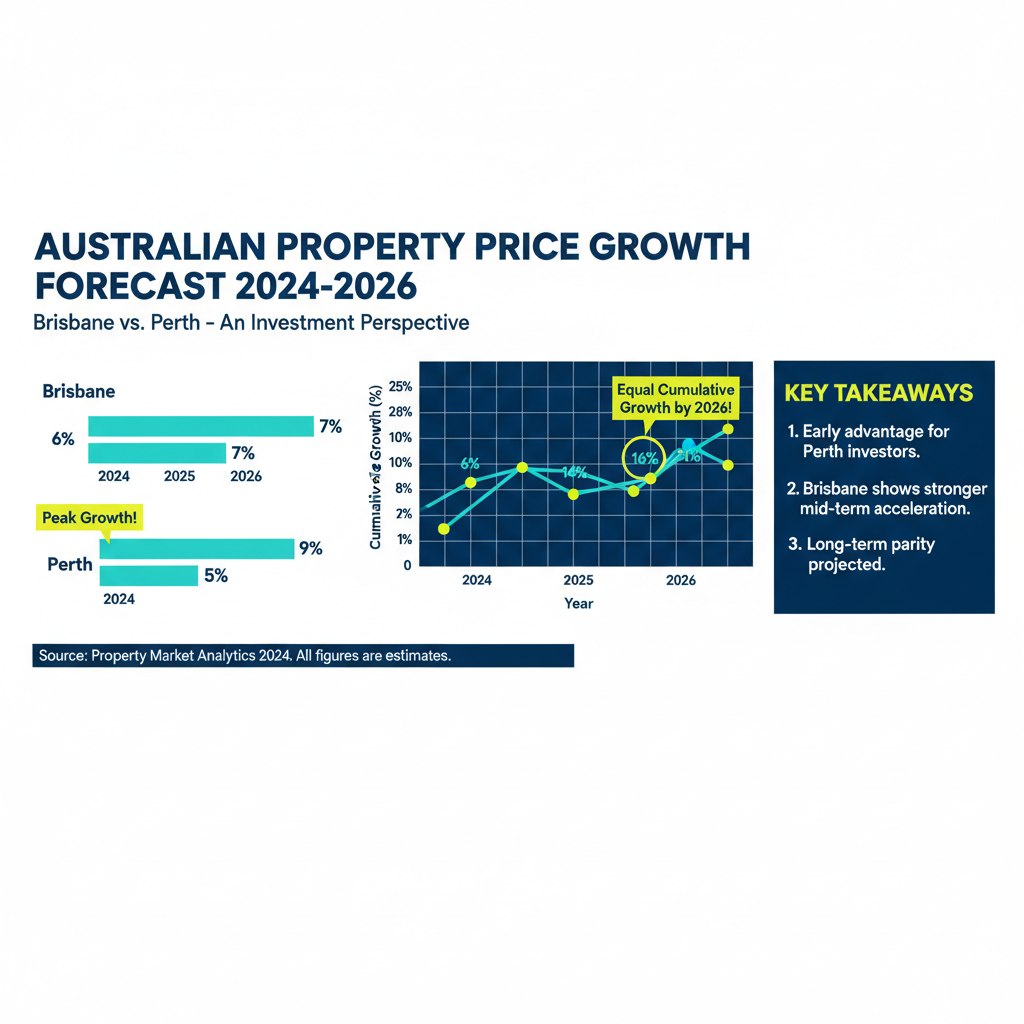
Queensland: Leading the Nation in Growth and Opportunity
Queensland has recorded the strongest property price growth of any Australian state over the past year, with dwelling values up 9.59% according to the latest data. This isn't speculation—it's supply and demand economics playing out in real time.
Brisbane's median dwelling value hit $1,054,555 in February 2026, with house values rising 15.1% annually and unit values outpacing at 18.3%. The city is forecast to see continued growth of 10-11% through 2026 according to KPMG's residential outlook.
Here's why Queensland dominates right now:
Interstate migration is accelerating. Over 25,000 people moved from NSW and Victoria to Queensland in 2024-25, most seeking affordability and lifestyle. This creates sustained rental demand and supports capital growth.
Olympic infrastructure is reshaping connectivity. The 2032 Olympics aren't just about sporting venues. They're driving $7+ billion in transport, stadium, and precinct upgrades that will benefit property owners for decades.
Rental yields remain strong. While Brisbane houses deliver 3.5% yields, regional centres like Cairns (5.5%+), Townsville (5%+), and Mackay (5.8%+) offer genuine cash flow opportunities.
Supply constraints are severe. Brisbane has only 5,000 active listings when equilibrium sits at 12,000-13,000. Until construction ramps up significantly, upward price pressure will persist.
Properties in middle-ring Brisbane suburbs (8-15km from CBD) are particularly attractive right now. Suburbs like Coorparoo, Nundah, and Woolloongabba combine transport connectivity, established amenity, and vacancy rates below 1%.
Western Australia: Perth's Structural Scarcity Cycle
Perth crossed a psychological threshold in January 2026 when the median house price exceeded $1 million for the first time. Unit values aren't far behind at $699,814, up 20.1% annually.
This isn't a speculative bubble. It's a structural scarcity cycle driven by:
Chronic undersupply: Perth has approximately 5,000 active listings when a balanced market needs 12,000-13,000. That's 40% of equilibrium, creating intense competition for available stock.
Affordability advantage: Even at $1 million, Perth remains 30-45% cheaper than Sydney and Melbourne, attracting interstate buyers and investors priced out of eastern markets.
Population growth: WA recorded net migration of over 80,000 in 2025, driven by mining sector employment, renewable energy investment, and lifestyle appeal.
Economic diversification: Perth's economy is no longer dependent on mining cycles. Renewable energy, infrastructure investment, and professional services are creating employment stability.
REIWA forecasts Perth house prices to rise 10%+ in 2026, with units potentially outperforming at 15-20% due to affordability pressures pushing buyers into medium-density options.
Middle-ring suburbs like Maddington (yields 5.2% for houses, 6.28% for units), Baldivis, and Ellenbrook are delivering the rare combination of capital growth and strong rental returns.
Adelaide: Yields and Affordability Combined
Adelaide consistently flies under the radar, but the numbers don't lie. The city recorded 8.2% house price growth in 2025 and maintains some of the tightest rental conditions in Australia with vacancy rates at 0.4%.
Key Adelaide investment characteristics:
- Strong rental yields: Suburbs like Eyre deliver 5%+ yields with median house prices around $600,000
- Relative affordability: Adelaide's median remains accessible for investors building multi-property portfolios
- Employment growth: Defence sector expansion, healthcare, and renewable energy projects are supporting job creation
- Interstate migration: Adelaide is attracting buyers from Melbourne and Sydney seeking lifestyle and value
Growth suburbs like Davoren Park recorded 28% annual growth in 2024, though investors should conduct thorough due diligence on any suburb posting extreme short-term gains.
Regional Queensland: High-Yield Cash Flow Opportunities
If you're building a portfolio and need cash flow to service debt, regional Queensland deserves serious attention.
Townsville combines defence employment (Lavarack Barracks), healthcare (Townsville Hospital), and education (James Cook University) to create diversified rental demand. Gross yields sit around 5-6%, with properties available well below $500,000.
Mackay serves the Bowen Basin coal mining region and offers yields exceeding 5.5%. The suburb of Mount Pleasant delivered 26.3% annual growth with a median house price of $660,000.
Cairns benefits from healthcare expansion, tourism recovery, and southern migration. Rental yields consistently exceed 5%, supported by tight vacancy rates and limited new supply.
Gladstone is seeing renewed interest due to LNG sector employment and hydrogen industry investment. Boyne Island recorded 24.7% annual growth with yields around 5.7%.
Regional markets carry different risk profiles than capital cities. They're more dependent on local economic drivers and can be more volatile during downturns. However, for investors who understand these dynamics and select carefully, the cash flow benefits can be substantial.
Specific Suburb Examples and Investment Opportunities
Brisbane Inner and Middle-Ring Suburbs
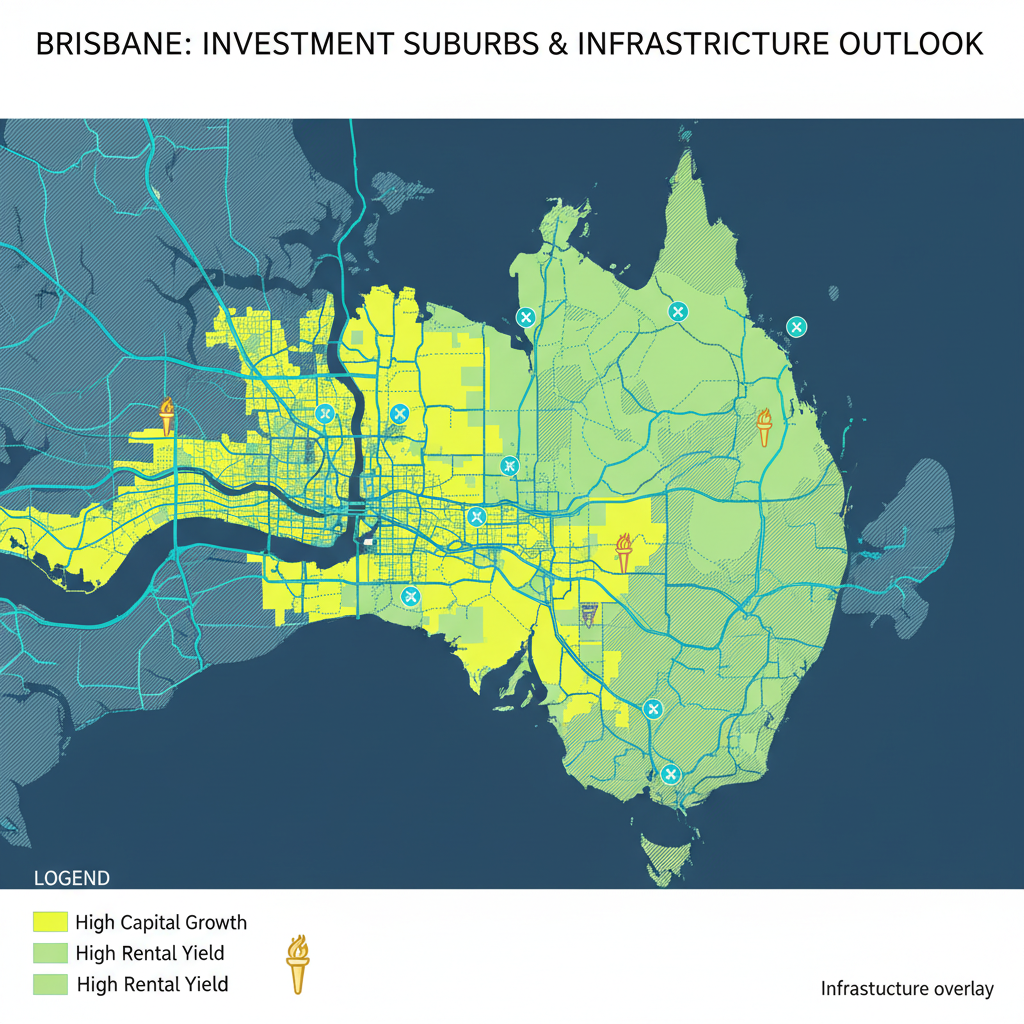
Brisbane's sweet spot for investors sits in the 8-20km radius from the CBD. These suburbs offer established infrastructure, transport connectivity, and the lifestyle amenity that owner-occupiers (your future buyers) seek.
Coorparoo delivers a village atmosphere just 5km from the CBD with a median house price of $1.8 million and units at $725,000. Direct motorway access and the upcoming Buranda Cross River Rail station make this suburb a long-term hold.
Nundah combines character homes, aviation heritage, and the Airport Link tunnel for seamless CBD access. Properties here are tightly held, with vacancy rates below 1% supporting rental growth.
Woolloongabba is being transformed by Cross River Rail and the Gabba redevelopment. Investors who secure property here now will benefit from infrastructure uplift through the next decade.
Chermside offers both houses and units at more accessible price points than inner suburbs, with Westfield shopping centre, excellent schools, and strong public transport.
Perth Growth Corridors and Coastal Suburbs
Perth's property market has shifted from outer-fringe dominance to middle-ring momentum over the past 12 months.
Alkimos remains one of Perth's most consistently mentioned growth suburbs, combining coastal proximity with new estates and improving infrastructure. It's popular with first-home buyers and young families.
Ellenbrook benefits from improved transport links and established community infrastructure. Prices remain below Perth's median, offering entry points for investors building portfolios.
Maddington (20km southeast of CBD) delivers exceptional yields at 5.2% for houses and 6.28% for units, with median house prices around $620,000. Annual growth of 8.96% makes this a balanced opportunity.
Applecross and Carlisle represent middle-ring established suburbs with coastal lifestyle appeal and limited new supply. These areas attract long-term owner-occupiers, supporting stable capital growth.
Regional Growth Centres Worth Watching
Newcastle, NSW is attracting Sydney buyers priced out of coastal markets. The city offers lifestyle, beaches, and infrastructure at a fraction of Sydney's cost.
Geelong, VIC benefits from Melbourne's growth pressure and local employment in manufacturing, healthcare, and education. The Suburban Rail Loop (when complete) will further improve connectivity.
Toowoomba, QLD serves as Queensland's inland capital, with diversified employment, education institutions, and consistent rental demand. Mount Lofty recorded 24.4% annual growth with a median of $960,000.
Wagga Wagga, NSW offers stability through RAAF Base, Charles Sturt University, and healthcare employment. Yields are solid and tenant demographics are stable.
Investment Risks to Avoid in 2026
Oversupply Risks in High-Density Precincts
Not all growth suburbs are created equal. High-rise apartment precincts with 500+ units under construction simultaneously carry serious oversupply risk.
When multiple towers settle within 6-12 months, rental markets flood with competing properties. Vacancy rates spike, rents fall, and capital growth stagnates. Melbourne's Docklands and Brisbane's inner-city apartment market have experienced this dynamic repeatedly.
Red flags to watch for:
- Multiple construction cranes visible within 500m radius
- High proportion of investor-owned units (above 60%)
- Limited owner-occupier appeal or lifestyle amenity
- Homogenous apartment stock with minimal differentiation
- Weak employment or transport connectivity
Buyers Agency Australia's due diligence process includes construction pipeline analysis to identify suburbs at risk of oversupply before clients commit.
Buying in Declining or Volatile Markets
Some Australian property markets remain structurally challenged:
Mining towns dependent on single industries can deliver spectacular yields during boom periods but crash when commodity cycles turn. Towns like Moranbah, Dysart, and Newman offer 9-12% yields but have experienced 30-50% value declines during mining downturns.
Remote regional centres with population decline struggle to maintain property values over time. Always check ABS population trends over 5-10 years before investing in regional locations.
Suburbs with concentrated public housing or declining amenity often underperform over long timeframes, despite appearing affordable on price-per-square-meter metrics.
Ignoring Property Condition and Maintenance Costs
A cheap property isn't a good deal if it costs $80,000 to make it rentable.
Older homes with:
- Asbestos cladding requiring remediation
- Outdated electrical systems needing full rewiring
- Structural issues (stumps, foundations, roofing)
- Plumbing that doesn't meet current codes
All of these issues eat into cash flow and delay rental income. Buyers Agency Australia conducts building and pest inspections on every property before recommending purchase, protecting clients from costly surprises.
Overleveraging Without Cash Flow Buffer
The February 2026 interest rate rise caught some investors off guard. Those holding negatively geared properties with minimal cash reserves suddenly faced monthly shortfalls of $500-1,000+ per property.
Smart investors maintain:
- 3-6 months of holding costs in liquid cash reserves
- Rental income covering at least 80% of mortgage costs
- Borrowing capacity below maximum limits to allow for rate rises
- Diversified income sources beyond rental returns
Property investment is a long-term wealth-building strategy, not a get-rich-quick scheme. Conservative structuring protects your portfolio through market cycles.
How Dragan Dimovski and Buyers Agency Australia Identify High-Yield, High-Growth Properties
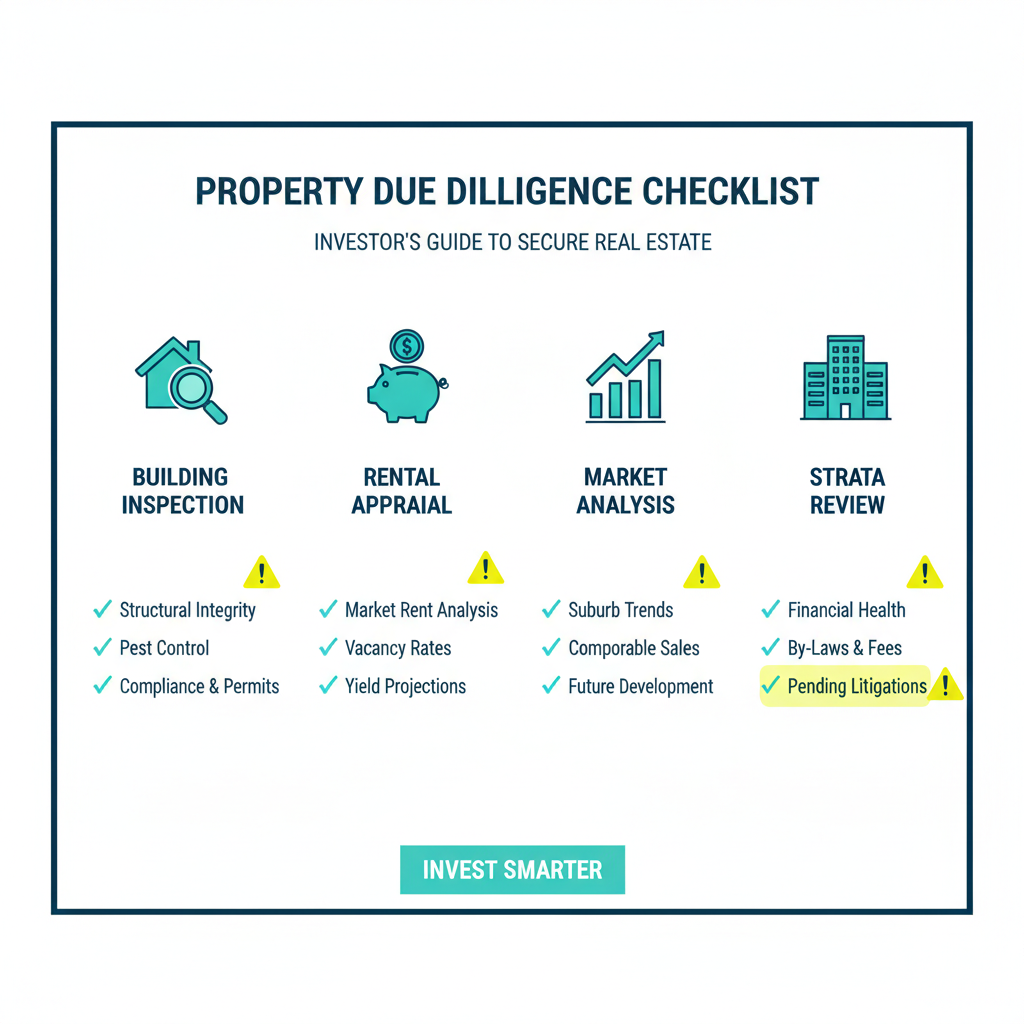
Data-Driven Suburb Selection Process
Dragan Dimovski has over 20 years of experience in property investment and buyer advocacy. His methodology isn't based on gut feel—it's built on rigorous data analysis across multiple indicators:
Supply-demand analysis: Tracking active listings, days on market, clearance rates, and construction pipeline data to identify undersupplied markets
Economic fundamentals: Employment growth, population trends, infrastructure investment, and industry diversification across target regions
Rental market metrics: Vacancy rates, rental yield trends, tenant demographics, and rental growth trajectories
Capital growth history: 5, 10, and 20-year growth patterns adjusted for market cycles and economic conditions
Risk assessment: Oversupply risk, economic concentration, natural disaster exposure, and market volatility indicators
This multi-factor analysis helps Buyers Agency Australia consistently identify suburbs 12-24 months before they hit mainstream investor attention.
Access to Off-Market Properties and Pre-Market Opportunities
Here's a truth most investors don't realise: the best properties rarely hit major listing portals.
Why? Because agents call their buyer's agent network first. Properties that meet investment criteria—good land-to-asset ratio, strong rental demand, motivated vendors—get snapped up before public marketing begins.
Buyers Agency Australia maintains relationships with over 300 selling agents across Brisbane, Perth, Sydney, Melbourne, and regional centres. When a quality property comes to market, Dragan's team often gets first call.
Off-market advantages include:
- Less competition from emotional owner-occupier buyers
- Vendor motivation often creates below-market opportunities
- Faster due diligence and settlement timelines
- Ability to negotiate terms beyond just price
Clients working with Buyers Agency Australia gain access to this hidden market, often securing properties 5-10% below comparable sales simply through early access and strategic negotiation.
Negotiation Strategies That Secure Below-Market Prices
Most buyers leave money on the table during negotiations. They either:
- Offer asking price to "secure" the property
- Make emotional decisions under auction pressure
- Fail to identify vendor motivation points
- Don't understand recent comparable sales data
Dragan's negotiation approach is built on information asymmetry and strategic positioning:
Pre-negotiation research identifies every comparable sale in the past 6 months, vendor purchase price and hold period, days on market trends, and agent sales history.
Structured offers lead with evidence-based pricing, not emotion. If comparable sales support $680,000, that's the opening position—regardless of asking price.
Contingency management uses building and pest clauses, finance conditions, and settlement flexibility as negotiation levers beyond price.
Walking away is always an option. When vendors aren't realistic, Buyers Agency Australia moves to the next opportunity. There's always another deal.
This disciplined approach has saved clients hundreds of thousands of dollars across their portfolios.
End-to-End Support from Search to Settlement
Buying investment property shouldn't feel like a second job. For time-poor professionals, managing property search, inspections, due diligence, negotiations, and settlement while running a business or working full-time is overwhelming.
Buyers Agency Australia provides complete project management:
- Strategy session: Define investment goals, risk tolerance, and target returns
- Market identification: Shortlist 3-5 suburbs matching your criteria
- Property search: Access off-market and pre-market opportunities
- Due diligence: Building and pest inspections, strata review, rental appraisals
- Negotiation: Evidence-based offers and strategic positioning
- Settlement coordination: Liaison with conveyancers, lenders, and agents
- Post-settlement: Property management connections and portfolio review
Clients receive regular updates throughout the process and have direct access to Dragan's team for questions and guidance.
Book a free strategy session to discuss your investment goals and discover how Buyers Agency Australia can help you build long-term wealth through property.
Frequently Asked Questions
Which Australian city is best for property investment in 2026?
Brisbane and Perth lead for capital growth potential, with Brisbane forecast at 10-11% and Perth at 10-13% growth in 2026. Regional Queensland offers superior rental yields above 5%.
What rental yield should I target for investment property?
Aim for minimum 4-4.5% gross yield in capital cities and 5-6% in regional centres. Balance yield with capital growth potential rather than chasing extreme yields in volatile markets.
Are regional properties better investments than capital cities?
Regional properties typically deliver higher rental yields but slower capital growth and higher tenant turnover. They suit experienced investors building cash flow portfolios, while capital cities offer long-term wealth creation.
How much deposit do I need for investment property in 2026?
Most lenders require 20% deposit for investment loans to avoid LMI. With APRA's DTI restrictions, having 25-30% deposit improves borrowing capacity and interest rate negotiation.
Should I use a buyer's agent for investment property?
Buyer's agents provide market knowledge, off-market access, and negotiation expertise that typically save 3-7% on purchase price, easily covering their fees while reducing emotional decision-making risks.
 General
Explore Australia's top property investment locations for 2026, including Brisbane, Perth, and high-yield Queensland suburbs, with expert buyer's...